
TL;DR:
- Strategic app consultation aligns development with business goals, reducing costs and speeding market entry. It involves early planning, market validation, and clear feature prioritization before coding begins. This approach saves up to 40% on costs and halves time-to-market by preventing unnecessary features and technical debt.
Strategic app consultation is the expert process of aligning mobile app development with core business objectives to achieve market fit, cost efficiency, and timely delivery. For business leaders, the role of strategic app consultation goes far beyond choosing a technology stack. It determines whether your app solves a real problem, reaches the right audience, and generates revenue without burning through your budget. The industry term for this discipline is "mobile app development consulting," and it covers everything from product discovery and feasibility studies to MVP definition and go-to-market planning. Getting this right before a single line of code is written is the single most consequential decision in any app project.
How does strategic app consultation reduce costs and accelerate time-to-market?
Strategic app consultation saves companies 30–40% in development costs by cutting unnecessary features, choosing the right technology, and preventing mid-project pivots. That figure translates directly into avoided waste: failed features alone can cost between £24,000 and £80,000, and technical debt can run to £40,000 or more if left unchecked. Consultants identify these risks before they become expensive problems.

Speed is the other major gain. Consultants reduce time-to-market by 50% or more, enabling launches within 3–4 months rather than the typical 8–12 months. Earlier launches mean earlier revenue, which frequently exceeds the cost of the consultation itself. A £12,000 consulting engagement that saves £40,000 in avoidable development costs is not an overhead. It is a return.
The mechanism behind these savings is straightforward. Consultants conduct structured pre-development work: they map your business model, identify which features drive revenue, and eliminate everything else from the initial build. This prevents the single most common cause of budget overruns, which is building features nobody uses. The app project discovery phase is where this discipline pays off most visibly.
- Avoided failed features: £24,000–£80,000 saved per project
- Avoided technical debt: £40,000+ saved through early architecture decisions
- Reduced wasted development time: 20–30% of budget recovered
- Faster launch: 3–4 months versus 8–12 months without consultation
Pro Tip: Before signing any development contract, ask your consultant to produce a written feature priority matrix. If they cannot produce one, they are not doing strategic consultation. They are doing project management.
What best practices define effective strategic app consultation?
Effective consultation begins well before any development work starts. Consultation should happen early, focusing on product discovery, feasibility studies, and user interviews to validate market demand and prevent failure. Consultants who skip this phase and move straight to wireframes are solving the wrong problem.
The table below outlines the key phases of a well-run consultation engagement and what each one achieves.
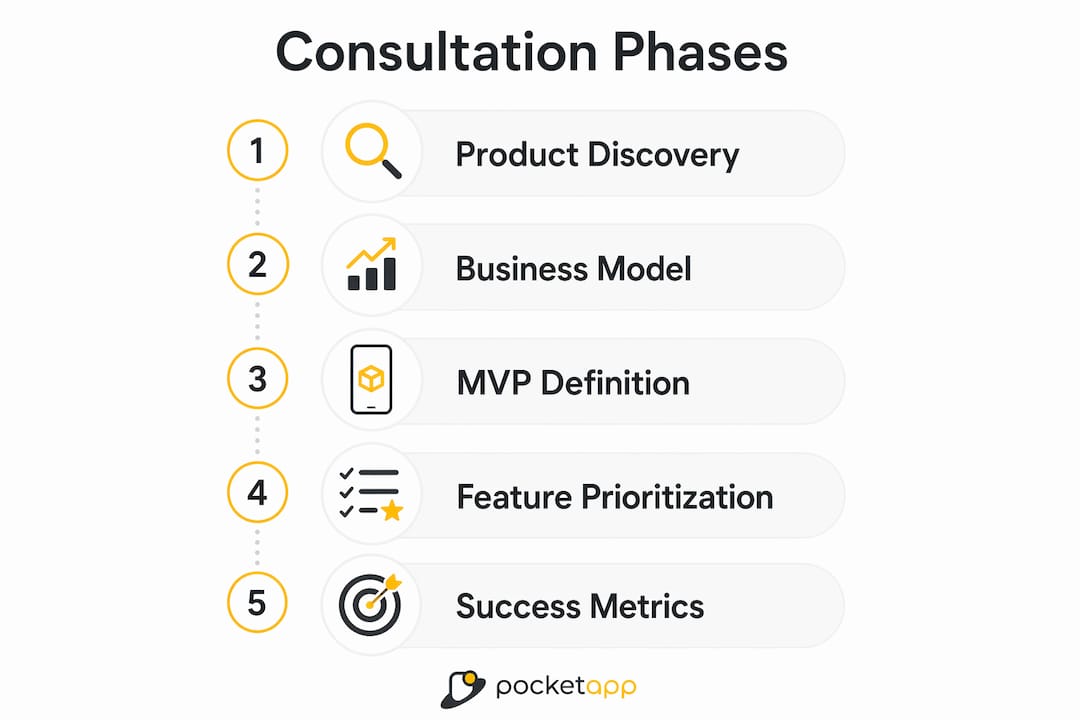
| Phase | Purpose |
|---|---|
| Product discovery | Validate the core problem and confirm there is a market willing to pay for a solution |
| Feasibility study | Assess technical, financial, and operational viability before committing budget |
| User interviews | Gather direct evidence of user needs to inform feature decisions |
| MVP definition | Identify the minimum set of features that prove the revenue model |
| Tech stack selection | Choose technology based on business requirements, not trends |
| Go-to-market planning | Align launch timing, channels, and pricing with business goals |
Most app consultants prioritise business model and revenue generation before technology and features. This is the correct order of operations. Choosing a technology stack before validating your business model is like designing a shop interior before confirming there are customers for your product.
MVP definition deserves particular attention. Detailed feature prioritisation defines the minimum viable product, avoiding cost overruns and feature bloating. The MVP is not a stripped-down version of your dream app. It is the smallest product that can prove your revenue model works. Consultants who understand this distinction save clients months of unnecessary work. The essential steps for mobile app discovery cover this process in detail.
Pro Tip: Insist that your consultant defines success metrics before the MVP is built, not after. If you cannot measure whether the MVP has proved your business model, you have not defined the MVP correctly.
Which roles and expertise do strategic app consultants bring to projects?
Strategic app consultants are not developers who also attend meetings. They are specialists in translating business objectives into technical decisions. Consultants provide expertise in user experience design, technology selection, and market positioning, ensuring apps remain adaptable after launch. That post-launch dimension is frequently overlooked by leaders who treat consultation as a pre-build formality.
The specific competencies a strong consultant brings include:
- Business modelling: Mapping how the app generates revenue and where the commercial risks sit
- Market research: Validating demand through competitor analysis, user research, and market sizing
- UX strategy: Defining user flows and interaction patterns before design begins
- Technology evaluation: Selecting the right architecture, platform, and third-party integrations for the business case
- Risk identification: Spotting regulatory, technical, and commercial risks early
- Feature prioritisation: Ranking features by revenue impact, not by stakeholder preference
Consultants conduct app audits in 2–3 weeks to identify business model and user experience issues rather than just technical faults. This is a meaningful distinction. A technical audit tells you whether the code is clean. A business model audit tells you whether the app can make money. Leaders need the second type far more than the first.
Strategic consultation also reduces costly redesigns and feature creep by aligning business and development teams from the outset. When both sides share the same definition of success, the number of mid-project direction changes drops sharply. A UX optimisation guide can help teams understand how this alignment translates into better user engagement after launch.
How can business leaders select the right app consultant?
Choosing the right consultant is a business decision, not a procurement exercise. The criteria that matter most are not the size of the agency's portfolio or the number of platforms they support. They are the quality of the questions the consultant asks you in the first meeting.
A consultant who leads with "What technology do you want to use?" is the wrong choice. A consultant who leads with "What problem does this app solve, and who will pay for that solution?" is asking the right questions. That distinction separates a technology vendor from a genuine strategic technology adviser.
Use these questions to evaluate any consultant before engaging them:
- Can you show me an example where you advised a client not to build a feature they wanted? What was the outcome?
- How do you define the MVP for a new product, and what criteria do you use to include or exclude features?
- What does your product discovery process look like, and what deliverables does it produce?
- How do you measure the success of a consultation engagement?
- Have you worked in our sector before, and what were the specific commercial constraints you had to navigate?
Avoid consultants who cannot answer questions one and two with specific examples. Vague answers signal that their process is not repeatable. Also avoid purely technical service providers who position consultation as a sales step before development. Genuine consultation produces written outputs, including feasibility reports, feature priority matrices, and business model canvases, before any development contract is signed.
The business leader's guide to mobile app development covers additional evaluation criteria for leaders assessing development partners in 2026.
Key takeaways
Strategic app consultation is the most cost-effective investment a business leader can make before committing to mobile app development, reducing costs by 30–40% and cutting time-to-market by half.
| Point | Details |
|---|---|
| Consult before you build | Engage a consultant during product discovery, before any development budget is committed. |
| MVP focus saves money | Define the minimum viable product by revenue impact, not feature count, to avoid costly bloat. |
| Business model first | Choose consultants who prioritise your revenue model over technology trends. |
| Audit for commercial viability | A 2–3 week app audit reveals business model and UX issues, not just technical faults. |
| Ask the hard questions | Evaluate consultants by their ability to advise against features, not just build them. |
Why I think most businesses engage consultants too late
The pattern I see repeatedly is this: a business leader commissions development, spends six months and a significant budget, then brings in a consultant to fix what is not working. That is the most expensive way to use strategic expertise. Consultation at that stage is triage, not strategy.
The leaders who get the best outcomes engage consultants before they have a clear brief. They use the consultation to create the brief. That sounds counterintuitive, but it is the correct sequence. A consultant's job is to pressure-test your assumptions about the market, the user, and the revenue model before those assumptions are baked into code.
The other misunderstanding I encounter is treating consultation as a one-off event. The value of ongoing strategic involvement, particularly around post-launch feature decisions and market response, is consistently underestimated. Apps that grow well after launch almost always have a consultant or internal strategist who continues to prioritise features against commercial outcomes. The ones that stagnate are usually left to the development team to decide what to build next.
My advice is direct: if you are planning an app and you have not yet had a structured conversation about your business model, your target user, and your revenue assumptions, you are not ready to commission development. Spend the time and budget on consultation first. The savings are not marginal. They are structural.
— Paul
Pocketapp's approach to strategic app consultation
Pocketapp has delivered over 300 mobile app projects for clients including WWF, Dechra, and Crocus, with strategic consultation built into every engagement from day one.
The process starts with business model alignment and MVP definition, not wireframes. Pocketapp's mobile app development service covers the full journey from product discovery and feasibility through to cross-platform deployment, with each phase grounded in commercial outcomes rather than technical preferences. If you are at the stage of evaluating whether to build, or what to build, the app consulting service is the right starting point. Contact Pocketapp to arrange a structured consultation before your next development decision.
FAQ
What is strategic app consultation?
Strategic app consultation is the process of aligning mobile app development with business objectives through product discovery, feasibility studies, MVP definition, and technology selection before development begins.
How much can strategic consultation save on app development costs?
Strategic consultation saves 30–40% in development costs by eliminating unnecessary features and preventing technical debt, with a typical £12,000 engagement saving over £40,000 in avoidable costs.
When should a business engage a strategic app consultant?
Consultation should begin before any development budget is committed, ideally during the product discovery phase when market demand and business model assumptions can still be validated cheaply.
What is the difference between a strategic consultant and a development agency?
A strategic consultant produces written outputs such as feasibility reports and feature priority matrices before development starts. A development agency without strategic capability moves directly to building, which increases the risk of costly mid-project pivots.
How do I know if a consultant is genuinely strategic?
Ask them to describe a situation where they advised a client not to build a requested feature. A genuine strategic consultant can answer this with a specific example and a measurable outcome.