
TL;DR:
- An app strategy is a comprehensive plan that aligns goals, target audience, UX, retention, monetization, and measurement.
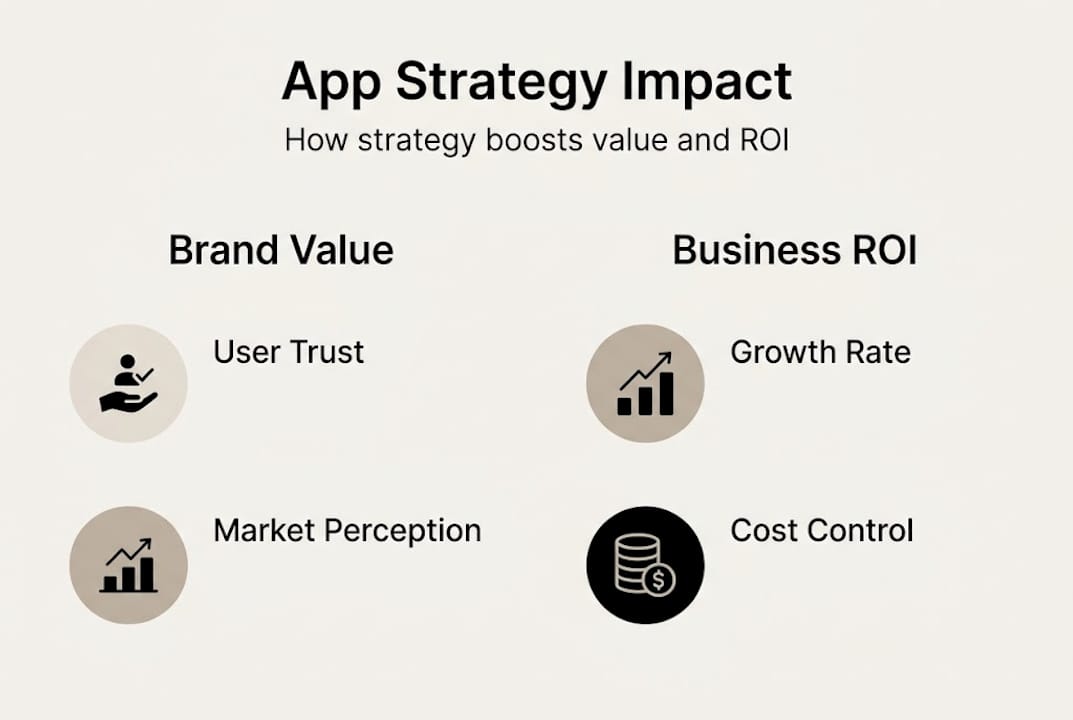
- Investing in strategy improves ROI by reducing redesigns, optimizing spending, and boosting user retention.
- Most app failures stem from poor discipline and lack of continuous improvement, not technical issues.
Launching a mobile app is not the same as having a mobile app strategy. Many businesses pour budget into development, hit publish, and wait for results that never arrive. 77% of app users abandon an app within three days when no coherent strategy supports their experience. For marketing managers and business leaders, this gap between launch and lasting impact is where real money is lost. This article unpacks exactly what app strategy involves, why it drives measurable ROI, and how you can use it to build genuine brand engagement and operational efficiency across your organisation.
Table of Contents
- What is an app strategy and why does it matter?
- The ROI of investing in app strategy
- Retention, engagement, and iterative improvement
- Choosing the right app strategy for your business model
- Why most apps fail: a strategic perspective
- How to take the next step with app strategy
- Frequently asked questions
Key Takeaways
| Point | Details |
|---|---|
| Strategy maximises ROI | Investing in an app strategy transforms app investments into measurable long-term value. |
| Retention beats installs | Focusing on retention means greater engagement and profitability than aiming for sheer download counts. |
| Choose the right approach | Select between custom or off-the-shelf app solutions based on your unique business model and growth goals. |
| Continuous improvement is vital | App success relies on cycles of feedback, testing, and optimisation, not just the launch. |
What is an app strategy and why does it matter?
An app strategy is the holistic planning framework that governs everything your mobile app is supposed to achieve. It goes far beyond wireframes and feature lists. Think of it as the business case, user experience blueprint, and performance governance plan all rolled into one living document. Without it, you are essentially building a shop window with no clear idea of who walks past, what they want, or whether they will ever return.
At its core, a robust app strategy addresses several interconnected elements:
- Business goals: What specific outcomes must the app deliver, and over what timeframe?
- Target audience: Who are your users, and what problems are you solving for them?
- UX and design standards: How will the interface keep users engaged beyond the first session?
- Retention mechanisms: What features, notifications, or content loops bring users back?
- Monetisation model: How does the app generate value, whether through transactions, subscriptions, or operational savings?
- Measurement framework: Which metrics confirm whether the strategy is working?
That last point matters enormously. Active user metrics are a direct indicator of whether your investment is producing returns or quietly draining your budget. Tracking active users, session duration, and launch frequency gives leadership teams the visibility they need to make informed decisions rather than guessing.
When strategy is absent, businesses typically over-invest in features nobody uses and under-invest in the onboarding and retention flows that actually determine success. Understanding the key app benefits for UK businesses is a solid starting point, and the business app development benefits extend well beyond customer-facing engagement into genuine operational gains.
Pro Tip: Before a single line of code is written, define three to five measurable KPIs that your app must influence. Revenue per user, support ticket reduction, and weekly active users are far more useful than download counts.
The ROI of investing in app strategy
With the basics established, it is time to examine exactly how app strategy investment drives tangible business returns. The clearest argument is cost avoidance. Businesses that launch without strategy tend to fund repeated redesigns, emergency fixes, and costly re-engagement campaigns that could have been prevented. Mobile apps reduce overinvestment when teams use retention and optimisation metrics to guide decisions rather than instinct.
The numbers support this firmly. Lumos increased ROI by 20% by shifting focus from raw install volumes to lifetime value (LTV) predictions, which allowed them to allocate marketing spend far more precisely. LTV, or the total revenue a single user generates over their relationship with your app, is the metric that separates sustainable app businesses from those constantly chasing new downloads to replace churned users.
| Metric | Without strategy | With strategy |
|---|---|---|
| Day-3 user retention | Below 23% | 40% or higher |
| LTV per user | Low, unpredictable | Measurable and growing |
| Capital allocation | Reactive and inefficient | Planned and optimised |
| App redesign frequency | Every 12 to 18 months | Iterative, continuous |
| Marketing cost per active user | High | Significantly reduced |
"Focusing on retention rather than installs is what transforms an app from a cost centre into a revenue-generating asset."
For business leaders reviewing their business leader's app guide, the takeaway is consistent: strategy is not a luxury phase you skip to save time. It is the mechanism through which operational excellence with apps becomes achievable rather than aspirational.
Consider two retailers launching apps simultaneously. One focuses purely on features and promotion. The other invests in an onboarding flow, personalisation triggers, and a feedback loop. Within six months, the second business sees measurably lower customer service costs and higher average order values from app users. Same market, same product category, different outcomes entirely.
Retention, engagement, and iterative improvement
Beyond headline metrics, successful strategies focus on sustaining user connections and continual refinement. Downloads are vanity. Retention is the metric that keeps a board happy and a finance director confident.

The reason retention outperforms raw install counts is straightforward. Acquiring a new user costs significantly more than retaining an existing one. Every churned user represents not just lost revenue but wasted acquisition spend. Retention can be boosted through a combination of App Store Optimisation (ASO), structured A/B testing, and genuine responsiveness to user feedback.
Here are three core tactics your team should implement:
- ASO (App Store Optimisation): Ensure your app listing uses the right keywords, compelling visuals, and clear value propositions so the right users download it in the first place. Quality installs retain far better than broad, untargeted ones. Explore the principles of app store optimisation to understand how listing quality affects long-term performance.
- A/B testing on onboarding and features: Small changes to your first-run experience can produce dramatic shifts in day-7 retention. Test permission request timing, tutorial length, and initial content personalisation. The data will always tell you more than intuition.
- Structured user feedback loops: In-app surveys, ratings prompts, and support ticket analysis reveal what your users actually struggle with. Acting on this feedback is what makes users feel heard, and feeling heard is what keeps them returning. Use a step-by-step retention guide to build this practice into your product cycles.
Pro Tip: Schedule a quarterly retention review. Pull your cohort data, identify where users drop off, and assign a specific test to address the biggest leak. Treat your app like a living product, not a finished project.
Hybrid monetisation models, which blend free access with premium features or in-app purchases, also help by lowering the barrier to entry whilst still generating revenue from your most engaged segment. The goal is always sustainable engagement, not a one-time transaction.
Choosing the right app strategy for your business model
With a method for improvement in mind, the next step is picking the right approach for your industry and goals. Not every business needs a fully bespoke application. But not every business can afford to be constrained by an off-the-shelf solution either.
Custom apps deliver a competitive edge but carry higher upfront investment compared to standard solutions. The decision depends on how differentiated your user experience needs to be and how much of your operational value lives inside the app itself.
| Factor | Off-the-shelf solution | Custom development |
|---|---|---|
| Upfront cost | Low | Higher |
| Time to launch | Fast (weeks) | Longer (months) |
| Scalability | Limited | Built to your needs |
| Unique features | Restricted | Fully tailored |
| Long-term ROI | Lower ceiling | Higher ceiling |
| Competitive advantage | Minimal | Significant |
When evaluating your options, consider the following factors:
- Budget and timeline: Off-the-shelf suits quick pilots; custom suits long-term differentiation
- Growth plans: Will your needs outgrow a standard platform within two years?
- Competitive landscape: Is your sector already served by similar apps, requiring you to stand out?
- Operational integration: Does the app need to connect deeply with internal systems, CRMs, or data platforms?
For organisations in retail, healthcare, or charity sectors, custom app development for UK businesses often delivers returns that standard tools simply cannot replicate. There are also clear reasons to build a business app beyond the customer experience, including internal workflow automation and staff communication. The key warning here is this: whatever route you choose, the investment must align directly with your core business goals, not just technical curiosity.
Why most apps fail: a strategic perspective
Having covered all major routes and tactics, it is worth being honest about something the industry does not say loudly enough. Most apps do not fail because of poor development. They fail because of poor discipline.
Businesses launch with excitement and then treat the app as finished. KPIs are vague, feedback is ignored, and the moment downloads plateau, budget is reallocated elsewhere. This "set and forget" mentality is the single biggest predictor of app failure, and it has nothing to do with technology.
The businesses we see succeed long-term treat their app as a continuously evolving product. They build cultures of testing, own their retention data, and make iterative decisions monthly rather than annually. They also align their app monetisation strategies with real user behaviour rather than theoretical revenue models drawn up before launch.
The uncomfortable truth is that strategic discipline is harder than technical execution. Any competent agency can build an app. Far fewer organisations have the internal commitment to keep improving it until it genuinely performs.
How to take the next step with app strategy
If reading this has confirmed that your organisation needs a more rigorous approach to mobile, you are not alone. Most businesses we work with arrive having already launched something that underperformed expectations.
At Pocket App, we guide business leaders through strategic discovery before a single screen is designed. Our mobile app development services are built around measurable outcomes, not feature lists, and our bespoke app design process ensures your users stay engaged long after launch. With over 300 projects delivered across retail, healthcare, charity, and consumer sectors, we know what separates an app that performs from one that quietly stalls. Reach out to explore how strategic app investment can deliver real returns for your business.
Frequently asked questions
What are the core elements of a mobile app strategy?
The core elements include business goals, user experience design, retention tactics, app store optimisation, and continuous measurement of success. High drop-off rates confirm that without these foundations, even well-built apps lose users rapidly.
How does app strategy affect ROI?
A targeted app strategy reduces wasted spend and focuses resources on what actually drives value. App strategies mitigate inefficient corporate investments by grounding decisions in user retention and performance data.
Is custom app development worth the higher cost?
For unique business models requiring differentiated experiences, custom development offers a competitive advantage that justifies the investment. Custom apps provide a measurable edge over generic solutions in competitive markets.
What's the biggest mistake businesses make with apps?
Neglecting retention and ongoing optimisation is the most common and costly error. Retention outperforms raw download figures as the true indicator of long-term app value and business return.