
Building a brilliant app is only half the battle. The harder challenge is getting it found. With 65% of downloads originating from app store search, organic discovery is the single most powerful lever available to business leaders, yet most organisations treat it as an afterthought. The result is a graveyard of well-engineered apps that never reach their intended audience. This article walks you through the evidence-backed steps to maximise your app's visibility, attract the right users, and build sustainable engagement from day one.
Table of Contents
- Understanding the mobile app discovery landscape
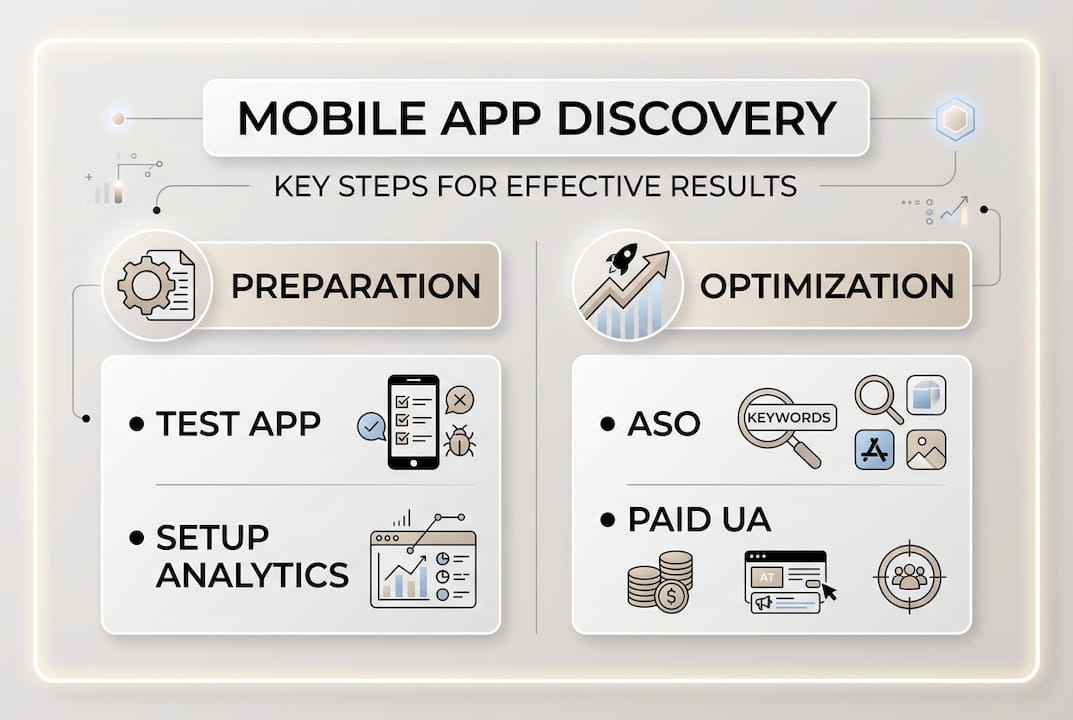
- Preparation: What you need before starting app discovery
- Step-by-step guide to optimising app store presence (ASO))
- Amplifying discovery with paid user acquisition (UA))
- Iterate, test, and adapt: Sustaining long-term discovery
- Planning for the future: Trends in app discovery
- Accelerate your app's discovery with expert support
- Frequently asked questions
Key Takeaways
| Point | Details |
|---|---|
| Discovery starts with ASO | Optimised keywords and compelling visuals drive most organic installs. |
| Hybrid approach is key | Paid user acquisition boosts both organic ranking and download volume. |
| Constant iteration pays off | Regular testing and adaptation sustain long-term app discovery and growth. |
| Retention matters more than volume | Quality installs and user retention influence app store algorithms and ranking. |
Understanding the mobile app discovery landscape
App discovery is the process by which users find, evaluate, and decide to install your app. It sounds simple, but the commercial stakes are enormous. Get it right and you unlock a scalable growth engine. Get it wrong and even a technically excellent product stagnates.
The market is brutally competitive. 1.4 million new apps launched in 2025 alone, yet only 10% gained meaningful traction. Worse still, 70 to 80% of apps are uninstalled within 30 days of download. Discovery is not just about installs. It is about attracting users who stay.
"The vast majority of apps never find their audience, not because they lack quality, but because they lack a structured discovery strategy."
There are two primary discovery channels every business leader should understand:
| Channel | Speed | Cost | Sustainability |
|---|---|---|---|
| Organic (ASO) | Slow to build | Low ongoing cost | High, compounds over time |
| Paid UA | Immediate | High and ongoing | Low without organic base |
The most common pitfalls business leaders face include:
- Launching without keyword research or store optimisation
- Relying solely on paid spend without an organic foundation
- Ignoring post-install retention signals that affect store rankings
- Failing to localise assets for target markets
The winning approach combines improving app store visibility through strong ASO with targeted paid user acquisition. Understanding the evolution of ASO also helps you anticipate algorithm changes before they hurt your rankings.
Preparation: What you need before starting app discovery
Before you touch a keyword tool or launch a paid campaign, your foundations must be solid. ASO is the foundation for sustainable discovery, and a shaky foundation means wasted budget regardless of how clever your strategy is.
On the technical side, your app must be crash-free, fast, and instrumented with clear analytics. If you cannot measure installs, sessions, and retention, you cannot improve them. On the market side, you need a clear picture of your target audience segments and a thorough competitor audit.

| Prerequisite | ASO focus | Paid UA focus |
|---|---|---|
| App quality | Ratings and reviews impact | Ad creative performance |
| Analytics setup | Keyword and conversion tracking | Install attribution and ROAS |
| Audience research | Keyword intent mapping | Targeting parameters |
| Competitor audit | Keyword gap analysis | Bid strategy benchmarking |
The core store assets you need ready before any discovery work begins:
- A distinctive, high-contrast app icon that reads clearly at small sizes
- Screenshots that tell a story rather than just show features
- A short, benefit-led description with primary keywords in the first two lines
- A proactive ratings strategy to encourage satisfied users to review
- Localised metadata for each priority market
Pro Tip: Set up a monthly competitor monitoring routine using tools such as AppFollow or Sensor Tower. Competitors frequently reveal high-performing keywords through their own store updates, and spotting these early gives you a meaningful head start. You can also use optimising app store listings guidance alongside a structured pre-launch checklist to ensure nothing critical is missed.
Step-by-step guide to optimising app store presence (ASO)
Once your foundations are set, the next step is hands-on app store optimisation for improved discovery and conversion. Follow these steps in sequence for the strongest results.
- Keyword research. Use dedicated ASO tools to identify high-volume, low-competition terms. Mine competitor listings for gaps your app can fill.
- Optimise your title, subtitle, and keyword fields. Your app title carries the most algorithmic weight. Place your primary keyword here. Use the subtitle and keyword field for secondary terms without repeating words.
- Upgrade visual assets and run A/B tests. Quarterly A/B testing of screenshots and icons increases conversion rates by 20 to 30%. Test one variable at a time for clean data.
- Manage and encourage reviews. Prompt satisfied users at natural moments in the app journey. Respond to negative reviews promptly and professionally. Ratings directly influence store ranking algorithms.
- Localise for key markets. Translated metadata and culturally relevant screenshots dramatically improve conversion in non-English markets. See localising your app store assets for a practical framework.
- Deploy custom product pages. Both Apple and Google now allow tailored store pages for different audience segments or campaign sources. Use these to match messaging to intent.
For a deeper look at optimising your app title and metadata, including field-by-field guidance, the ASO best practices resource from Gummicube is worth bookmarking.
Pro Tip: Refresh your screenshots and promotional copy every quarter, even if your app has not changed. Seasonal relevance and updated visuals signal to store algorithms that your listing is actively maintained, which can positively influence ranking.
Amplifying discovery with paid user acquisition (UA)
While ASO is your foundation, scaling requires paid UA. The key insight most business leaders miss is that paid and organic are not separate strategies. They reinforce each other. Paid downloads boost organic installs by up to 17 times due to the velocity effect, where a surge in installs signals popularity to store algorithms and lifts organic rankings.
The main paid UA channels available in 2026 are Apple Search Ads, Meta Advantage+, Google UAC, and TikTok for Business. Each suits different audience profiles and budget levels.
| Channel | Avg. cost per install | Best for |
|---|---|---|
| Apple Search Ads | $3.50 to $5.00 (iOS) | High-intent keyword targeting |
| Google UAC | $1.00 to $2.50 (Android) | Scale and reach |
| Meta Advantage+ | Variable | Audience-based targeting |
| TikTok for Business | Variable | Younger demographics |
To launch a paid UA campaign effectively:
- Define your target audience segments and match them to the right channel.
- Build at least three creative variants per ad set and test them simultaneously.
- Set up install attribution using a mobile measurement partner such as AppsFlyer or Adjust.
- Monitor key KPIs: lifetime value (LTV), cost per acquisition (CAC), return on ad spend (ROAS), and Day 1 and Day 30 retention rates.
- Kill underperforming creatives quickly. Reallocate budget to winners within the first two weeks.
For a broader view of effective app marketing strategies and guidance on measuring UA ROI, both resources will help you build a business case for ongoing investment.
Iterate, test, and adapt: Sustaining long-term discovery
Mastering UA and ASO is not a one-off task. Store algorithms reward apps with strong retention and penalise those with high uninstall rates. Ongoing A/B testing and post-install signals are vital inputs that algorithms weigh heavily when determining ranking.
The three types of iteration every discovery strategy needs:
- Quarterly A/B tests on store visuals, descriptions, and custom product pages
- Visual refreshes tied to seasonal moments, product updates, or campaign themes
- Onboarding flow reviews to reduce early drop-off and improve Day 1 retention
The post-install analytics signals that matter most are Day 1 retention, Day 30 retention, session frequency, and uninstall rate. A drop in any of these feeds back into your store ranking, so monitoring them is not optional.
Pro Tip: Schedule a quarterly discovery review in your team calendar now. Set up automated alerts in your analytics platform for negative trends in retention or ratings. Catching a problem in week two is far cheaper than recovering from a ranking drop six months later.
Strategies for keeping users engaged and techniques like using gamification for engagement are practical tools for improving the retention signals that directly support your discovery performance.
Planning for the future: Trends in app discovery
Looking beyond today's tactics, larger forces are reshaping how apps get found. The most significant shift is the move towards AI-powered search. AI and large language models are shifting app store search towards semantic and contextual models, meaning keyword stuffing is becoming less effective and genuine relevance is becoming more important.
To prepare your discovery strategy for what is coming:
- Write metadata that answers user intent, not just matches keywords
- Invest in localisation for high-growth markets in Southeast Asia, Latin America, and the Middle East
- Explore emerging discovery surfaces such as App Clips (iOS), Instant Apps (Android), and voice assistant integrations
- Monitor super app ecosystems in markets where WeChat-style platforms dominate discovery
- Build a content and social presence that drives external signals back to your store listing
The shifts in app store optimisation are accelerating. Business leaders who adapt their metadata strategy to reflect user intent rather than raw keyword volume will hold a significant advantage as AI-driven ranking models mature.
Accelerate your app's discovery with expert support
Understanding the mechanics of app discovery is one thing. Executing it consistently across ASO, paid UA, creative testing, and analytics is another challenge entirely, especially when your core team is focused on running the business.
At Pocket App, our mobile app development experts work with business leaders across retail, healthcare, charity, and consumer sectors to build apps that are engineered for discovery from the ground up. From professional app design that converts browsers into loyal users, to business app solutions that integrate seamlessly with your operations, we bring over 300 projects of hands-on experience to every engagement. If you are ready to move from visibility challenges to measurable growth, we would love to talk.
Frequently asked questions
What is the most effective first step in mobile app discovery?
Optimising your app store listing with relevant keywords is the most impactful starting point, given that 65% of downloads begin with a store search. Getting your title and keyword fields right before anything else sets the foundation for all subsequent discovery work.
How does paid user acquisition affect organic discovery?
Paid campaigns increase download velocity, which signals popularity to store algorithms and lifts organic rankings. Paid downloads can boost organic installs by up to 17 times in high-velocity scenarios, making paid and organic a complementary pairing rather than competing choices.
How often should you update app store assets for optimal discovery?
At minimum, review and refresh your store visuals and descriptions every quarter. Quarterly A/B testing of screenshots and icons can lift conversion rates by 20 to 30%, making it one of the highest-return activities in your discovery programme.
What is one key trend impacting app discovery in 2026?
AI-driven semantic search is the most significant shift, rewarding apps whose metadata reflects genuine user intent over keyword density. Adapting your store copy to answer contextual queries rather than simply matching search terms will become increasingly important as AI and LLM models continue to influence ranking logic.