
TL;DR:
- Skipping discovery increases project costs and failure rates significantly.
- Discovery aligns stakeholders, clarifies scope, and validates user needs before development.
- Frameworks like Design Thinking and Design Sprints suit UK custom app projects best.
Most UK businesses assume an app project begins the moment a developer opens their laptop. That assumption is expensive. Skipping discovery leads to 40 to 60% higher costs to fix mistakes and a threefold higher project failure rate. Before a single line of code is written, there is a phase that separates successful apps from abandoned ones: project discovery. This article explains what app project discovery is, how it works in practice, which frameworks suit UK custom app projects, and when it genuinely matters for your business.
Table of Contents
- Defining app project discovery
- Key steps and deliverables in the discovery phase
- Popular frameworks and methodologies
- When and why you should invest in discovery
- Our perspective: why discovery is the best insurance policy for your app project
- Ready to avoid costly mistakes? Let us guide your app discovery
- Frequently asked questions
Key Takeaways
| Point | Details |
|---|---|
| Reduces project risk | Project discovery clarifies requirements and uncovers hidden risks before development starts. |
| Saves time and costs | Investing in discovery prevents costly mistakes, keeping custom apps on time and on budget. |
| Enables smart decision-making | Discovery arms decision-makers with data, user insights, and clear priorities for successful launches. |
| Not for every project | Discovery is essential for complex or custom apps but is less required for basic or template builds. |
Defining app project discovery
App project discovery is a structured, time-limited phase that happens before development begins. Its purpose is to understand user needs, clarify business goals, and assess technical feasibility. Think of it as the architectural survey before you build a house. You would not lay foundations without knowing the ground conditions. Discovery gives you that ground truth.
The phase typically produces three core outcomes. First, it reduces risk by surfacing unknowns early, when they are cheap to address. Second, it clarifies scope, so your development team builds the right thing rather than a plausible guess at it. Third, it validates ideas against real user behaviour and business constraints before significant budget is committed.
It is important to distinguish discovery from delivery. Delivery is the act of building, testing, and launching your app. Discovery precedes it entirely. As Monday.com explains, discovery focuses on validating assumptions rather than simply building quickly. That distinction matters enormously for product managers who are under pressure to show momentum. Speed without direction is not momentum.
"The most expensive line of code is the one written to solve the wrong problem."
Discovery is not universally necessary. A straightforward app built on a proven template with a well-understood audience may not need a formal discovery phase. But for custom builds, minimum viable products (MVPs), regulated industries, or any project where the user journey is genuinely uncertain, skipping it is a false economy. You can explore the essential steps for app discovery in detail to understand what a thorough process looks like.
The common misconception is that discovery slows things down. In reality, it accelerates delivery by removing ambiguity. Teams that skip it often spend the first third of their build cycle re-scoping, re-briefing, and re-estimating. That is not speed. That is churn.
Key goals of app project discovery:
- Align stakeholders on a shared definition of success
- Identify and challenge assumptions before they become architecture
- Define the user problem with precision, not approximation
- Establish a realistic scope and cost baseline
- Reduce the likelihood of costly mid-project pivots
Key steps and deliverables in the discovery phase
Understanding what discovery is only gets you so far. Knowing how it unfolds in practice is what helps you evaluate a development partner or run the process yourself.
Discovery typically moves through five structured stages:
- Stakeholder alignment — Workshops and interviews to surface business objectives, constraints, and success criteria from everyone who has a stake in the outcome.
- User research — Interviews, surveys, and behavioural analysis to understand who your users are, what they need, and where current solutions fail them.
- Ideation and prioritisation — Structured sessions to generate potential solutions and rank them against user value and technical feasibility.
- Prototyping — Low or mid-fidelity wireframes that make abstract ideas tangible and testable without committing to full development costs.
- Validation — Testing prototypes with real users to confirm or challenge the assumptions made in earlier stages.
| Discovery stage | Key activity | Primary deliverable |
|---|---|---|
| Stakeholder alignment | Workshops, interviews | Problem statement, success metrics |
| User research | Surveys, user interviews | User personas, journey maps |
| Ideation | Collaborative workshops | Prioritised feature list |
| Prototyping | Wireframing, mockups | Clickable prototype |
| Validation | Usability testing | Validated requirements, updated estimates |
The 1-10-100 rule is worth knowing here. Fixing a problem during discovery costs roughly £1. Fixing it during development costs £10. Fixing it post-launch costs £100. Skipping discovery leads to 40 to 60% higher project costs and a threefold increase in failure rates. Those numbers are not theoretical. They reflect what happens when teams build on unvalidated assumptions.

Pro Tip: Treat discovery as a continuous activity, not a one-off gate. The most resilient projects revisit user assumptions at each sprint cycle. A step-by-step app development guide can help you see where discovery feeds into each development stage. Before you launch, also review what you need to consider before launching your app to ensure nothing critical has been missed.
Popular frameworks and methodologies
With the steps clear, the next question is which framework should guide your discovery process. The answer depends on your project type, team maturity, and timeline.
Leading product discovery frameworks include Dual-Track Agile, the Opportunity Solution Tree, Design Thinking, Lean Startup, Jobs-to-be-Done, the Double Diamond, and Design Sprints. Each has a different emphasis and suits different contexts.
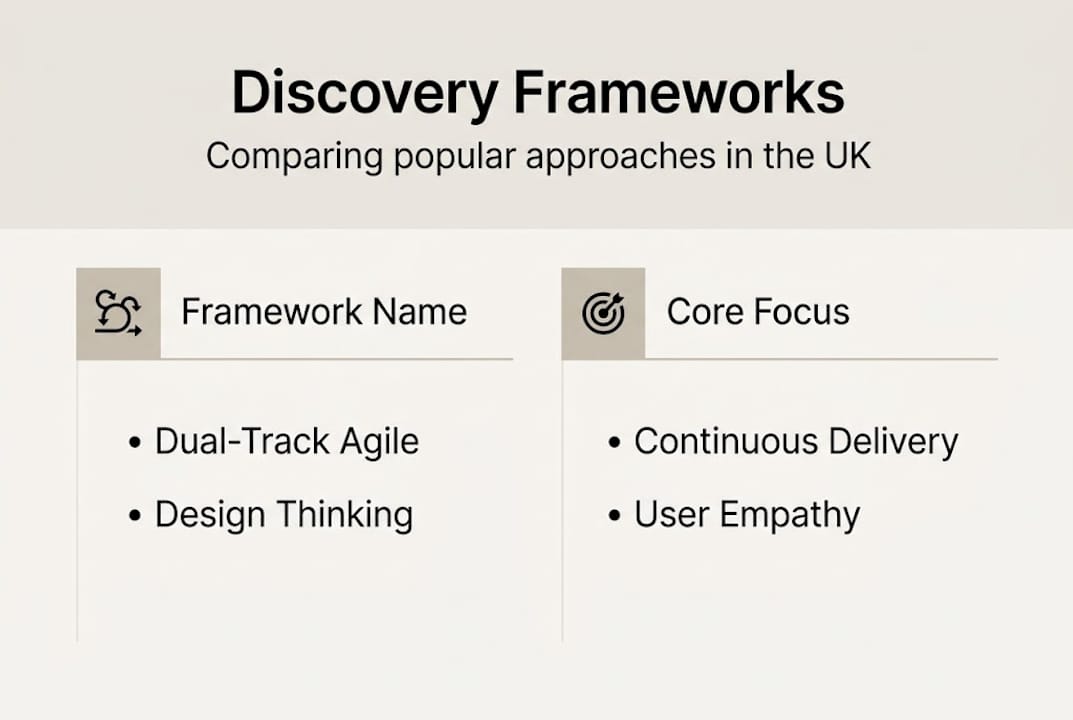
| Framework | Core focus | Best suited for |
|---|---|---|
| Dual-Track Agile | Parallel discovery and delivery | Ongoing product teams |
| Design Thinking | Human-centred problem solving | Complex user problems |
| Lean Startup | Build-measure-learn cycles | Early-stage MVPs |
| Jobs-to-be-Done | User motivation and context | Feature prioritisation |
| Double Diamond | Diverge and converge thinking | UX-led projects |
| Design Sprints | Rapid prototyping in 5 days | Time-constrained validation |
For UK custom app projects, Design Thinking and Design Sprints are particularly practical. They are structured enough to give stakeholders confidence, yet flexible enough to adapt to real-world constraints like compressed timelines or limited user access. Understanding product discovery fundamentals can help you assess which approach fits your context before briefing a development partner.
When selecting a framework, consider these criteria:
- Scalability — Can it grow with the project if scope expands?
- Stakeholder involvement — Does it accommodate non-technical decision-makers?
- Output clarity — Does it produce artefacts your development team can act on directly?
- Time to value — How quickly does it surface actionable insights?
- Compatibility — Does it align with your development methodology, such as Agile or Scrum?
A good development partner will recommend a framework based on your specific situation rather than defaulting to a single house methodology. An iterative app design strategy that incorporates ongoing user feedback is often the most durable approach for complex or evolving products.
When and why you should invest in discovery
Not every app project needs a formal discovery phase. But knowing when it is genuinely essential can save your business from significant financial and reputational damage.
Discovery is critical when:
- Your app is custom-built rather than template-based
- You are entering a market or audience segment you have not served before
- The user journey involves multiple touchpoints or complex workflows
- You are building an MVP and need to validate the core proposition before scaling
- Regulatory or compliance requirements add technical complexity
- Internal stakeholders disagree on what the app should do
The risks of skipping discovery are well-documented. 34% of startups fail due to a lack of product-market fit, a problem that disciplined discovery is specifically designed to prevent. Misaligned goals, unvalidated assumptions, and scope creep are not development problems. They are discovery failures that show up during development.
Scope creep deserves particular attention. When discovery is skipped, teams often discover mid-build that the original brief was incomplete. New requirements emerge, timelines extend, and budgets inflate. This is not bad luck. It is a predictable consequence of building before understanding.
Pro Tip: Every pound invested in discovery typically saves between ten and one hundred pounds in later rework. Frame discovery as risk management, not overhead, when presenting it to financial stakeholders.
Improving your app UX becomes far easier when user needs are validated during discovery rather than assumed during build. Similarly, prototyping is most effective when it emerges from a structured discovery process rather than being used as a substitute for one.
Our perspective: why discovery is the best insurance policy for your app project
After working across more than 300 app projects, the pattern is unmistakable. The projects that ran over budget, missed their launch window, or failed to gain traction almost always had one thing in common: discovery was rushed, abbreviated, or skipped entirely.
The uncomfortable truth is that most costly app mistakes are avoidable. They are not the result of poor development talent or bad technology choices. They are the result of building on assumptions that were never tested. Teams confuse activity with progress, and motion with direction.
What genuinely separates successful projects is not the framework used or the size of the budget. It is the discipline to keep asking hard questions throughout the lifecycle. The projects that treat effective mobile app discovery as a continuous practice rather than a one-off box to tick consistently outperform those that do not. Discovery is not a phase. It is a habit.
Ready to avoid costly mistakes? Let us guide your app discovery
If this article has clarified what discovery can do for your project, the logical next step is working with a team that has made it central to how they build.
At Pocket App, we bring structured discovery to every custom build we undertake. Our mobile app development process is grounded in validating your assumptions before a single line of code is written. From stakeholder alignment to prototype testing, our app design services ensure your project starts with clarity and ends with a product your users actually want. Get in touch to discuss how a discovery-led approach can protect your investment and accelerate your path to launch.
Frequently asked questions
How long does the app project discovery phase typically take?
Discovery phase duration varies with scope and complexity, but most projects complete it within two to six weeks. More complex builds with multiple user groups or regulatory requirements may take longer.
Do I need project discovery for a simple app or template?
For basic or template-based apps, formal discovery is less crucial for simple projects but becomes vital as complexity, customisation, or user diversity increases.
What are the main deliverables after app project discovery?
Discovery deliverables typically include validated user research, detailed requirements, wireframes or interactive prototypes, and a technical feasibility report with updated cost estimates.
Does discovery guarantee my app will succeed?
No process guarantees success, but discovery reduces failure rates substantially by ensuring your product addresses a real, validated user need before significant budget is committed.