
TL;DR:
- Most business leaders mistakenly view apps as products rather than strategic systems essential for successful digital transformation. Proper architecture, including modular, API-first design and AI integration, is vital for scalability, operational efficiency, and long-term value. Leaders must treat app development as an ongoing investment with continuous review and iteration to avoid costly failures and maximize competitive advantage.
Most business leaders think an app is a product. It is not. It is a system, and the difference between those two mental models determines whether your digital transformation effort succeeds or quietly collapses within a year. The role of apps in digital transformation is not about having a mobile presence. It is about building a strategic asset that carries your operations, your data, and your customer relationships forward. Get that wrong, and no amount of marketing spend will save you.
Table of Contents
- Key takeaways
- The role of apps in digital transformation has fundamentally changed
- Architecture: the foundation that most leaders overlook
- How apps drive operational efficiency across the workforce
- AI and data integration: where apps become genuinely intelligent
- What business leaders must get right before they build
- My honest view on where most leaders go wrong
- Build your transformation on solid foundations
- FAQ
Key takeaways
| Point | Details |
|---|---|
| Apps are strategic systems | Treating apps as products rather than core business infrastructure is the most common cause of transformation failure. |
| Architecture determines longevity | Modular, API-first designs outperform legacy monolithic builds when business demands scale or evolve. |
| AI must be embedded, not bolted on | Native AI integration drives measurably better outcomes than retrofitting intelligence into existing apps. |
| Operational efficiency is app-driven | Mobile apps enable real-time data access, workforce flexibility, and process automation across the entire organisation. |
| Treat development as ongoing investment | Apps require continuous capital allocation and iteration, not a one-off build followed by years of neglect. |
The role of apps in digital transformation has fundamentally changed
There was a time when launching a mobile app meant your business was forward-thinking. That time has passed. What once functioned as a marketing channel or a digital brochure is now expected to carry revenue, process transactions, surface real-time data, and integrate with your back-end systems without friction.
The shift in customer expectations has been sharp. Users compare your app not to your competitors but to the best experience they have had on any app, ever. Speed alone is a deciding factor. 53% of mobile users will abandon an app that takes longer than three seconds to load. That is not a user experience problem. It is a business continuity problem.
"Organisations that still view mobile apps as digital marketing tools are not behind by a quarter or two. They are behind by a strategic generation."
The impact of apps on transformation becomes visible when you look at what happens without genuine commitment to the approach. Over 80% of enterprise mobile apps fail to meet user expectations within 90 days of launch, most often because the architecture cannot support the demands placed on it as the business grows. That statistic is not a warning about design quality. It is a warning about strategic intent. Apps built without scalability at the foundation will always fail at scale.
The importance of applications in the digital shift is that they sit at the intersection of your customer, your data, and your operations. When that intersection is designed well, it becomes a competitive advantage. When it is not, it becomes a liability that compounds with every passing quarter.
Architecture: the foundation that most leaders overlook
If the strategic case for apps is clear, the implementation case is where most organisations stumble. The culprit, almost universally, is architecture. Poor architectural decisions made at the start of a project become exponentially more expensive to unwind later.
Legacy monolithic architectures are the most common inherited problem. Apps built on monolithic architecture collapse under demand spikes and cannot scale globally without a full rebuild. That rebuild is not a version update. It is a significant engineering undertaking that typically costs more than building correctly from the outset.

The alternative is a modular approach. Successful enterprises adopt microservices architecture for their mobile apps, enabling independent component scaling without disrupting the rest of the system. Consider what that means in practice: you can update your payments module without touching your user authentication layer, or scale your analytics pipeline independently during a high-traffic campaign.
Key architectural principles worth insisting on before a line of code is written:
- API-first design: apps must operate across CRM, ERP, payment systems, and analytics platforms. Legacy apps lacking API-first architecture create integration bottlenecks that reduce effectiveness across the whole organisation.
- Security by design: apps built without modern security frameworks expose businesses to significant legal and reputational risk. Security cannot be a post-launch addition.
- Compliance readiness: GDPR obligations do not pause for a slow development cycle. Compliance must be designed in, not audited in.
- Scalability: the app you build today must accommodate two to three times your current user volume without a rewrite.
- Identity management: modern IAM systems for apps increasingly rely on token-based stateless architectures such as OIDC and OAuth to enable secure API and mobile access across distributed environments.
Understanding how to define enterprise software requirements before development begins is one of the most underestimated disciplines in business technology. Get this right, and you avoid rebuilding at cost.
Pro Tip: Before signing off on any app development brief, ask your development partner to walk you through how the architecture scales at ten times your current load. If they cannot answer confidently, that is your answer.
How apps drive operational efficiency across the workforce
The internal value of mobile apps is often the last thing business leaders consider and the first thing they wish they had prioritised sooner. Mobile apps enhance workforce adaptability by enabling remote access and flexible workflows through cloud-based, device-agnostic designs. That is not a benefit limited to technology companies. Logistics firms, healthcare providers, retailers, and financial services organisations all depend on this capability.
Here is how apps in digital innovation translate into day-to-day operational gains:
- Process automation: by integrating with ERP and CRM systems via APIs, apps remove manual data entry, reduce human error, and accelerate approvals. A field engineer who can update a job status from a mobile device in real time eliminates a half-day lag in the back-office workflow.
- Real-time decision-making: when data flows from the field into a central dashboard instantly, managers make faster and more informed decisions. This matters in distribution, field services, healthcare, and retail environments where conditions change by the hour.
- Policy and communications: apps provide a reliable channel for disseminating HR updates, compliance documentation, and operational procedures to distributed teams without relying on email chains that get missed.
- Workforce portability: employees equipped with well-designed apps are not tied to a desk or a specific device. That flexibility supports hybrid work models and reduces friction during organisational change.
You can read more about how apps drive operational excellence when integrated properly with existing business systems.
Pro Tip: Map your top five manual processes before you scope an app. The ones that involve the most steps, the most people, and the most paper are your highest-value automation targets.
AI and data integration: where apps become genuinely intelligent
Artificial intelligence is not a feature you add to an app. It is an architectural decision you make before the project begins. The difference between an AI-native app and an AI-retrofitted app is the difference between compound interest and a single windfall payment. One grows. The other stalls.
AI must be embedded natively to support personalisation, predictive analytics, and intelligent automation efficiently. This is now a baseline expectation in leading mobile applications, not a premium addition.
The evidence supports the investment. 71% of organisations embedding AI into workflows realise substantial or moderate value, compared to significantly lower returns when AI is used as a standalone tool disconnected from core processes. The lesson is direct: AI embedded in your app at the data layer delivers results. AI bolted on top of an existing app as a chatbot widget does not.
Practical applications of AI-native apps for business leaders:
- Predictive personalisation: apps that learn from user behaviour surface the right content, product, or action at the right moment, increasing engagement and conversion.
- Intelligent workflow routing: AI can identify bottlenecks in operational processes and reroute tasks automatically based on priority and capacity.
- Auditable automation: AI-driven workflows generate logs and decision trails, which is critical for regulated industries including financial services and healthcare.
- Anomaly detection: apps integrated with operational data can flag deviations from normal patterns before they become incidents.
"The organisations that will lead their sectors in three years are already building AI-native apps today. Those retrofitting AI into legacy builds are spending twice the budget for half the result."
AI remains underutilised when it sits outside integrated workflows. The mobile app is the delivery mechanism that makes AI useful at scale and in practice.
What business leaders must get right before they build
Digital transformation through software is not a project. It is a programme of continuous decisions. The organisations that treat app development as a one-off budget line discover, usually at considerable cost, that architectural changes after launch are significantly more expensive than building with foresight at the outset.
Here is a direct comparison of the two approaches:
| Approach | Short-term cost | Long-term cost | Risk level |
|---|---|---|---|
| One-off build, no iteration plan | Lower upfront | Very high (rebuild required) | High |
| Continuous capital allocation | Higher upfront | Controlled and predictable | Low |
| Patching legacy architecture | Low initial | Compounding, unsustainable | Very high |
| Modular rebuild with phased MVP | Moderate | Manageable with clear ROI | Low to medium |
The table makes the logic plain. The cheapest option today is rarely the cheapest option over a five-year horizon.
Beyond investment strategy, business leaders should consider the following before committing to a development partner or a brief:
- Plan for scale from day one, even if your launch scope is deliberately narrow.
- Require your development partner to document their approach to testing across devices. 80% of users uninstall apps that fail to meet their expectations, and inadequate testing is a primary cause.
- Treat security and compliance as non-negotiable from the first sprint, not as a checklist item before submission to an app store.
- Build governance into your post-launch process. Apps must be governed with the same rigour as core business systems to avoid becoming costly technical debt.
The business leader's guide to app development in 2026 covers the investment and governance frameworks in detail for those looking to structure this thinking formally within their organisation.
Pro Tip: Set a twelve-month post-launch review as part of your project plan before development begins. Apps that have no scheduled review cycle are almost always the ones that accumulate the most technical debt.
My honest view on where most leaders go wrong
I have seen a version of this same situation repeated across sectors and organisation sizes. A business invests in an app, launches it with some fanfare, and then quietly watches engagement decline over the following two quarters. Nobody takes accountability because the app technically works. It loads. It does not crash. But it is not growing the business, and nobody is sure why.
The reason, in almost every case I have observed, is that the app was conceived as a deliverable rather than a system. Once delivered, it was treated as done. The team moved on. The architecture was never revisited. The data it generated was never connected to anything meaningful.
What I have learned is that the organisations who get genuine, compounding value from their apps share one trait: senior leadership that treats the app as a living business asset, not a finished product. They budget for iteration. They build in review cycles. They ask hard questions about architecture before the first screen is ever designed.
The cost of delay here is real. Delaying a mobile app rebuild often exceeds the cost of rebuilding proactively, particularly in competitive markets where your rivals are not waiting. That is not a scare tactic. That is the observable pattern in fast-moving sectors.
Champion your app with the same rigour you would apply to any core business system. The returns are there for the organisations bold enough to treat it that way.
— Paul
Build your transformation on solid foundations
Pocketapp has delivered over 300 mobile app projects for organisations ranging from global charities to enterprise retailers, including WWF, Dechra, and Crocus. The team brings deep expertise in scalable, secure, and AI-ready architectures that are designed to grow with your business rather than constrain it.
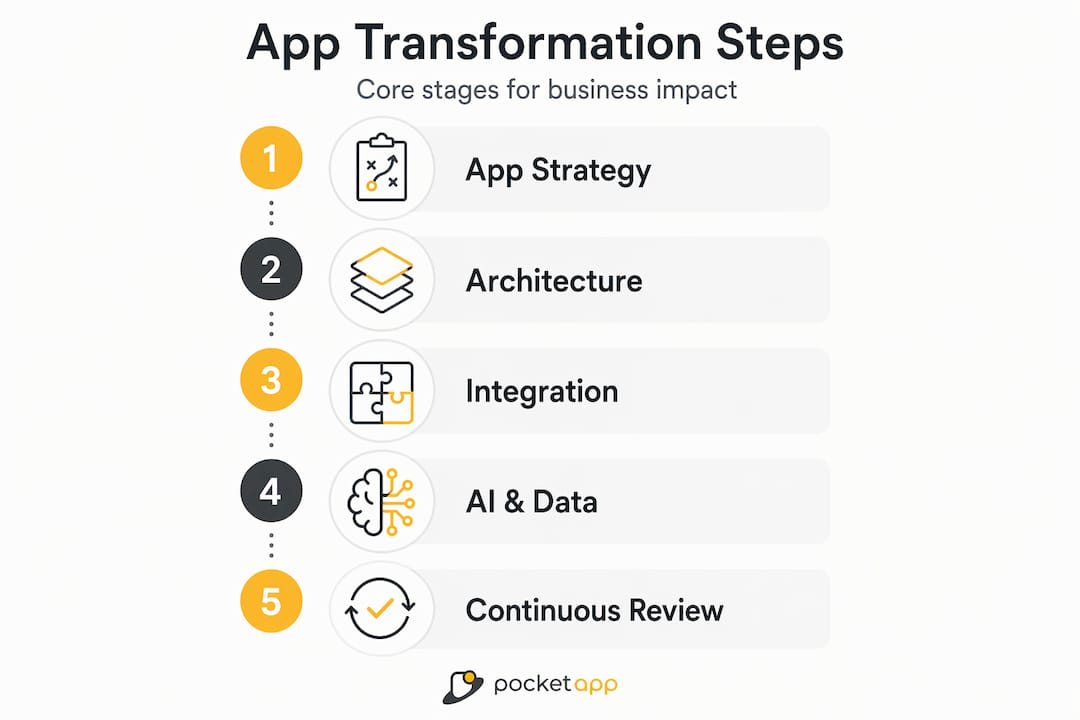
Whether you are starting from scratch, reassessing a legacy app, or planning a phased rebuild, Pocketapp's discovery and development process is built around your specific operational goals. Every project begins with a rigorous scoping phase that prioritises architecture, integration, and long-term flexibility before any design work begins.
Explore Pocketapp's mobile app development services to understand how the team approaches transformation-led builds, or review their expert business application development capabilities for enterprise-grade projects that demand operational rigour from day one. Get in touch to discuss your requirements.
FAQ
What is the role of apps in digital transformation?
Apps serve as the operational and strategic layer through which digital transformation is delivered to employees, customers, and partners. They connect back-end systems, automate processes, and surface data in real time, making them central to any credible transformation effort.
Why do so many enterprise apps fail within the first year?
Over 80% of enterprise mobile apps fail to meet user expectations within 90 days, primarily because their architecture cannot support evolving business demands or the volume of users placed on the system after launch.
How does AI fit into mobile app strategy?
AI should be embedded natively into the app architecture from the outset rather than added after launch. Organisations that integrate AI into workflows see substantially higher value than those treating AI as a standalone tool.
How often should a business review or update its mobile app?
App development should be treated as a continuous investment, not a one-off project. A formal review at twelve months post-launch is a minimum baseline, with iterative updates planned throughout the product lifecycle to address technical debt, user feedback, and business change.
What is the most important decision a business leader makes before building an app?
Choosing the right architecture. A modular, API-first design built for scale determines whether your app can grow with your organisation or require a costly rebuild within three to five years.