
TL;DR:
- Continuously refining apps based on user behavior boosts engagement and operational efficiency.
- Innovative features like personalization and gamification make apps more relevant and habit-forming.
- Clear strategy, user feedback, and small experiments are key to successful app innovation initiatives.
Many organisations treat their mobile app as a finished product. Once it launches, it sits. Updates are rare, features stay the same, and leadership moves on to the next priority. Yet companies with innovative apps see measurably greater customer engagement and operational improvements than those treating their app as a one-off investment. The businesses pulling ahead in retail, healthcare, and the nonprofit sector are not necessarily the ones with the biggest budgets. They are the ones treating their app as a living product, shaped by user behaviour and refined continuously. This article lays out exactly why that distinction matters, and what you can do about it.
Table of Contents
- The changing landscape: why innovation is critical in 2026
- Driving brand engagement through innovative app features
- Operational efficiency: how app innovation transforms workflows
- Common pitfalls: why app innovation initiatives can stall
- A fresh perspective: what most experts miss about app innovation
- How to put app innovation into action
- Frequently asked questions
Key Takeaways
| Point | Details |
|---|---|
| Innovation fuels relevance | Constant app innovation is key to keeping your brand distinct and valuable in fast-changing markets. |
| User engagement drives growth | Innovative features keep users loyal and turn apps into powerful engagement platforms. |
| Efficiency gains cut costs | Up-to-date apps streamline operations, delivering cost and time savings across your business. |
| Small steps, big impact | Continuous minor updates often outperform infrequent large-scale redesigns for long-term success. |
| Avoid common pitfalls | Clarity of goals and user feedback are vital to preventing stalled or wasted innovation efforts. |
The changing landscape: why innovation is critical in 2026
The mobile app market is not the same place it was two or three years ago. User expectations have risen sharply. People now expect the same fluidity and personalisation from a retail loyalty app or a healthcare booking tool that they get from the world's most polished consumer platforms. Sitting still is not a neutral choice. It is a slow retreat.
App development trends in 2026 are reshaping what users expect from every product they touch, and businesses that do not respond find their apps quietly abandoned in favour of competitors who do. The data is consistent: apps with stagnant feature sets see higher churn, lower session times, and declining review scores over time.
So what is actually changing? A few forces are converging simultaneously:
- AI-powered personalisation is now a baseline expectation, not a differentiator
- Cross-platform performance must be seamless across iOS, Android, and web
- Accessibility standards are becoming non-negotiable, particularly in healthcare and public-facing apps
- Real-time data features like live inventory, appointment tracking, and push notifications are standard in leading apps
- Security and privacy requirements are tightening, especially for apps handling personal or financial data
The table below illustrates how user expectations have shifted in just a few years:
| Feature area | 2022 expectation | 2026 expectation |
|---|---|---|
| Personalisation | Nice to have | Essential |
| App load time | Under 5 seconds | Under 2 seconds |
| Offline functionality | Rare | Increasingly expected |
| Accessibility | Optional | Regulatory baseline |
| AI-driven suggestions | Innovative | Standard |
Understanding future app trends early gives you the advantage of planning features before your competitors react.
Pro Tip: Set up a quarterly review process that combines competitor app audits with direct user feedback. The patterns that emerge will tell you where your product is slipping before your engagement metrics do.
Driving brand engagement through innovative app features
Knowing innovation is necessary is one thing. Knowing which features actually move the needle on engagement is another. Not every shiny capability belongs in your product roadmap. The ones worth prioritising are those that change how users feel about your brand, not just what they can do inside your app.
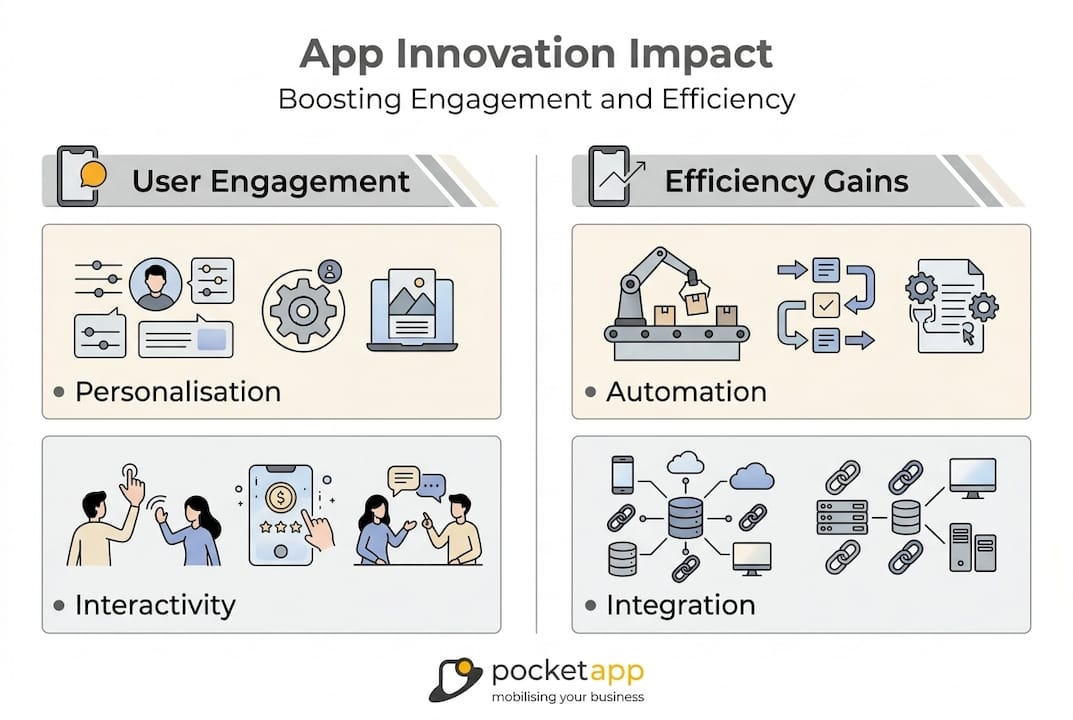
Innovative features like personalisation and interactivity significantly boost engagement by making each user session feel relevant and purposeful rather than generic. When a retail customer opens an app and sees recommendations based on their actual purchase history, they stay longer and return more often. When a healthcare patient receives a proactive reminder calibrated to their care plan, trust in the service deepens.
Here is a comparison of traditional versus innovative app features and their typical impact on engagement:
| Feature type | Traditional approach | Innovative approach | Engagement impact |
|---|---|---|---|
| Product discovery | Static category browse | AI-curated recommendations | Higher session depth |
| Loyalty rewards | Points balance display | Gamified challenges and streaks | Repeat daily usage |
| Notifications | Generic broadcast alerts | Behaviour-triggered personalised push | Higher open rates |
| Onboarding | Static tutorial screens | Interactive, adaptive onboarding flow | Lower drop-off rates |
| Feedback collection | Annual survey email | In-app contextual micro-surveys | Richer, timely insight |
The most effective innovative app features for 2026 that business leaders should prioritise include:
- Adaptive personalisation driven by in-app behaviour and preferences
- Gamification mechanics such as challenges, streaks, and rewards to build habit loops
- Conversational AI for support, guidance, and product discovery
- Social proof integration showing real-time reviews, ratings, and peer activity
- Accessibility-first design to widen your audience and meet evolving standards
Each of these features does something important: it makes the user feel seen. That is not a soft benefit. It is what separates apps with strong retention from those with high uninstall rates.
Operational efficiency: how app innovation transforms workflows
The customer-facing benefits of app innovation attract most of the attention. But the internal gains can be just as transformative, often delivering measurable cost savings and productivity improvements within months of implementation.

App innovation contributes to improved operational workflows and internal communication by replacing fragmented, manual processes with connected, real-time digital tools. A nonprofit coordinating volunteer schedules via email and spreadsheets operates in a very different world to one using a purpose-built app with live updates, task assignment, and reporting dashboards.
Here is how innovative apps enhance workflow across three key sectors:
- Retail: Inventory management apps with real-time stock visibility reduce overstock and shrinkage. Staff communication tools cut down on shift-change confusion and miscommunication at scale.
- Healthcare: Patient-facing apps that integrate with clinical systems reduce no-shows, cut administrative burden, and free clinical staff to focus on care. Remote monitoring features extend support beyond clinic walls.
- Nonprofit: Volunteer management platforms centralise communications, automate onboarding, and generate the impact data needed for grant reporting, saving hundreds of hours per year.
"Organisations that integrate innovative apps into their operations report significant reductions in manual processing time and measurable improvements in team coordination."
The common thread across all three sectors is integration. An app that works in isolation from your existing systems adds complexity. An app that connects to your CRM, your scheduling system, or your data warehouse multiplies its value immediately.
Pro Tip: Before building new features, map your existing systems and identify where manual handoffs slow things down. Prioritising integrations at those friction points delivers efficiency gains faster than almost any other investment.
Common pitfalls: why app innovation initiatives can stall
Understanding the value of innovation is only part of the journey. The next challenge is execution. Many organisations invest in app development with genuine ambition, then find themselves six months later with a product that has not moved the needle. The reasons are usually the same.
Many businesses fail to meet innovation targets due to a lack of clear strategy or poor user feedback loops throughout the development process. Knowing this pattern exists is the first step to breaking it.
The most common pitfalls include:
- Unclear objectives: Teams build features without a defined outcome in mind. Without knowing what success looks like, there is no way to measure it or course-correct.
- Inadequate user involvement: Features are designed based on internal assumptions rather than actual user behaviour. The result is a product that feels logical to its creators but frustrating to the people using it.
- Underestimating ongoing resource needs: App innovation is not a project with an end date. It requires continuous investment in development, design, testing, and iteration. Organisations that treat it as a one-time spend are consistently disappointed.
- Feature overload: Trying to innovate in ten directions at once dilutes focus and delays delivery. The apps that win tend to do fewer things exceptionally well.
- Ignoring performance: A brilliant new feature built on a slow, buggy platform will drive users away rather than pull them in.
Stat to note: Industry research consistently shows that a significant proportion of app projects fail to achieve their stated business objectives, with poor requirement definition and insufficient user testing cited as the leading causes.
The fix is rarely dramatic. Pilot programmes with a small user group, structured feedback sessions, and clear KPIs (key performance indicators) set before development begins will resolve most of these issues before they become expensive. The benefits of app development are fully realisable, but only when the process is as considered as the product itself.
A fresh perspective: what most experts miss about app innovation
Most conversations about app innovation focus on technology. New AI capabilities, emerging frameworks, the latest design trends. And while these matter, they miss something more fundamental.
True innovation is not about the size of the update. It is about the quality of the question you ask before you build anything. The organisations that consistently produce engaging, efficient apps are not those with the biggest development budgets. They are the ones with the clearest understanding of what their users actually struggle with, and the discipline to address that one problem at a time.
The myth that meaningful app innovation requires major, expensive overhauls keeps many leaders from starting at all. In practice, the most impactful improvements often cost relatively little. A better onboarding flow. A smarter notification strategy. A single integration that removes a manual step. These incremental wins, informed by real user insight, compound over time into a product that genuinely stands out.
Leadership's role in this is not to approve the technology roadmap. It is to build a culture where small experiments are encouraged, user feedback is taken seriously, and the team feels safe learning from what does not work. Every strong app in our business leader's app guide shares that trait. The technology follows the thinking, not the other way around.
How to put app innovation into action
The gap between knowing what good looks like and actually building it is where most organisations get stuck. Start by auditing your current app honestly. Where are users dropping off? Which features are rarely used? What feedback appears repeatedly in your reviews?
At Pocket App, we work with leaders in retail, healthcare, and the nonprofit sector to turn those questions into clear, prioritised product strategies. Our mobile app development services are built around your organisation's goals, not a generic template, and our professional app design process puts your users at the centre of every decision. Whether you are starting from scratch or rethinking an existing product, we are ready to help you move from strategy to something your users will genuinely value. Get in touch to arrange a consultation.
Frequently asked questions
What makes app innovation important for my business?
App innovation provides both engagement and efficiency advantages, keeping your brand relevant and your internal operations agile as market conditions shift.
How do innovative app features enhance user engagement?
Personalisation and interactivity are proven engagement drivers that encourage users to return regularly and develop a stronger connection with your brand.
What are common reasons for app innovation failure?
Businesses fail due to unclear goals or feedback gaps, meaning the product ends up solving the wrong problems or missing what users actually need.
Does app innovation require large budgets?
Not always. Small, steady improvements informed by genuine user insight frequently deliver stronger results than infrequent, large-scale overhauls.
Where should I start with app innovation for my sector?
Begin by identifying your users' most persistent pain points, then explore which features would simplify both their experience and your internal processes simultaneously.