
TL;DR:
- Mobile app revenue is projected to reach over $540 billion by 2026, offering vast opportunities for businesses.
- Successful app development involves key phases: discovery, design, development, testing, deployment, and ongoing updates.
- Long-term app success depends on strategic security, user retention, and scalability investments beyond launch.
Mobile apps are no longer the preserve of tech giants. With app revenue projected at over $540 billion in 2026, the opportunity for businesses of every size is enormous. Yet many business leaders still treat mobile apps as an afterthought rather than a core strategic asset. The truth is, a well-executed custom app can transform how you engage customers, streamline operations, and outpace competitors. This guide breaks down everything you need to know, from the fundamentals of app development to the benchmarks, security priorities, and strategic decisions that separate successful apps from forgotten ones.
Table of Contents
- Understanding mobile app development
- Key phases of custom app development
- Benchmarks and real-world app success metrics
- Strategic considerations: Security, retention, and scalability
- Beyond the basics: What most business leaders miss about mobile app development
- Discover tailored mobile app solutions for your business
- Frequently asked questions
Key Takeaways
| Point | Details |
|---|---|
| Clear app development phases | App creation follows ideation, planning, design, development, testing, deployment, and ongoing maintenance for results. |
| Critical business benchmarks | App success is measured by retention, cost, development time, and scalability which drive ROI. |
| Security and retention priorities | Protecting user data and optimising retention rates are vital for brand credibility and long-term app performance. |
| Post-launch scaling matters | Continuous feedback, updates, and iteration maximise app value and market impact after launch. |
Understanding mobile app development
Mobile app development is the process of creating software applications for smartphones, tablets, and other mobile devices. But that definition only scratches the surface. In practice, it covers everything from initial concept and UX design through to coding, testing, deployment, and ongoing maintenance. For business leaders, understanding this scope is essential before committing budget or resources.
The business case for a custom app is compelling. Apps can automate repetitive tasks, reduce reliance on manual processes, and create direct, personalised channels to your customers. They also generate valuable behavioural data that off-the-shelf software simply cannot provide. When you own the app, you own the data and the experience.
There are three main types of mobile apps to consider:
- Native apps are built specifically for one platform, either iOS or Android, using platform-specific languages. They offer the best performance and access to device features.
- Hybrid apps combine web technologies with a native shell, allowing a single codebase to run on multiple platforms. They are faster to build but can have performance trade-offs.
- Cross-platform apps use frameworks like React Native or Flutter to deliver near-native performance across both platforms from one codebase. This is increasingly the preferred choice for businesses balancing cost and quality.
The choice between custom and off-the-shelf software is where many leaders get stuck. Off-the-shelf tools are quicker to deploy and cheaper upfront, but they rarely fit your exact workflows, brand identity, or customer journey. The importance of app design in creating a distinctive, brand-aligned experience is something generic solutions simply cannot replicate.
"A custom app is not just a digital product. It is a strategic business tool that reflects your brand, serves your users, and evolves with your organisation."
For leaders in retail, healthcare, charity, or consumer engagement, the ability to tailor every interaction is a genuine competitive advantage. Custom development is an investment, but it is one that pays dividends in loyalty, efficiency, and differentiation.

Key phases of custom app development
Understanding the process helps you ask better questions, set realistic expectations, and hold your development partner accountable. The development process involves ideation, planning, design, development, testing, deployment, and maintenance. Here is how each phase plays out in practice:
- Discovery and ideation – Define the problem your app solves, identify your target users, and map out core features. This phase prevents costly rework later.
- Planning – Establish timelines, budgets, technology choices, and team roles. A detailed project plan is your roadmap.
- UX/UI design – Create wireframes and prototypes. This is where user journeys are mapped and the visual identity takes shape.
- Development – Engineers build the front end (what users see) and back end (servers, databases, APIs). Sprints keep progress visible.
- Testing and QA – Functional, performance, and security testing catch issues before launch. Do not skip this phase.
- Deployment – Submit to app stores, configure servers, and go live. A staged rollout reduces risk.
- Maintenance and updates – Post-launch iteration is where most value is created or lost.
Pro Tip: Adopt an Agile methodology from day one. Agile breaks development into short sprints with regular reviews, allowing you to adapt to feedback and changing priorities without derailing the entire project.
When choosing your technical approach, the native versus cross-platform decision has real implications:
| Factor | Native | Cross-platform |
|---|---|---|
| Development time | 4 to 8 months | 3 to 5 months |
| Performance | Consistently 60+ FPS | Up to 90 to 120 FPS on modern devices |
| Cost | Higher | More cost-effective |
| Code reuse | Single platform | Both platforms from one codebase |
| Best for | High-performance, platform-specific apps | Broad reach with efficient budget |
For a deeper look at the cross-platform development overview and how it applies to your sector, it is worth reviewing the options before committing to a direction. Equally, investing early in improving app UX will pay off significantly in user retention and satisfaction post-launch.
Benchmarks and real-world app success metrics
Numbers matter when you are making a business case internally. Here are the benchmarks every leader should know before signing off on a development project.
Market context:
- Global app revenue sits between $540 billion and $935 billion across 2025 and 2026
- Annual downloads range from 137 billion to 257 billion globally
- Day 30 retention averages just 5 to 8% across most app categories
- Between 70% and 80% of apps are uninstalled within the first 30 days
- Fewer than 0.1% of apps generate more than $1 million per year
Development cost and timeline benchmarks:
| App type | Average cost | Typical timeline |
|---|---|---|
| Simple app | £30,000 to £60,000 | 2 to 4 months |
| Mid-complexity app | £60,000 to £120,000 | 3 to 6 months |
| Complex business app | £120,000 to £200,000 | 4 to 9 months |
These figures align with industry data showing average development costs of $150,000 to $255,000 for complex apps, with timelines of 4 to 9 months.
The retention figures are sobering, but they point to a clear opportunity. Most apps fail not because of poor technology but because of poor post-launch strategy. The top 1% of apps generate 90% of all app revenue. That concentration is not accidental. It reflects disciplined iteration, user feedback loops, and relentless focus on experience.
Pro Tip: Budget for at least 20% of your initial development cost annually for post-launch maintenance, updates, and feature improvements. Apps that stagnate lose users fast.
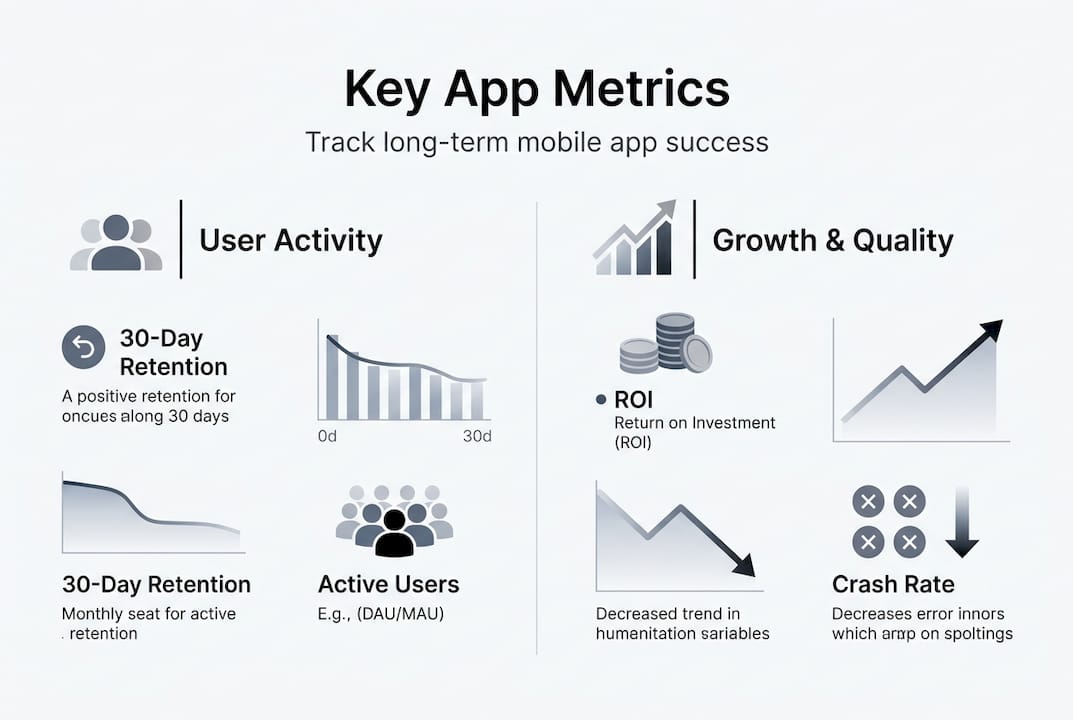
For leaders tracking ROI, the key performance indicators to monitor include Day 30 retention rate, monthly active users, average session length, crash rate, and revenue per user. Understanding where you stand against future app development trends will also help you plan your product roadmap with confidence.
Strategic considerations: Security, retention, and scalability
Once you understand the benchmarks, the next step is building a strategy that protects your investment and maximises long-term impact. Three priorities stand above the rest: security, retention, and scalability.
Security is not optional. 75% of apps fail basic security tests, which is a staggering figure given how much sensitive data modern apps handle. A breach does not just cost money. It destroys trust, and trust is extraordinarily difficult to rebuild. Your development partner should follow OWASP (Open Web Application Security Project) guidelines, conduct penetration testing before launch, and build data encryption into the architecture from the start. Review the essentials of mobile app security and consider the app launch security tips that apply specifically to your sector.
Retention is where most apps struggle. With Day 30 retention averaging just 5 to 8%, exceeding 8% puts you ahead of the majority of apps in the market. The strategies that move the needle include:
- Personalised onboarding that shows value within the first session
- Push notifications used sparingly and contextually, not as spam
- Regular feature updates that give users a reason to return
- In-app feedback mechanisms that make users feel heard
- Loyalty or reward mechanics where appropriate to your sector
Scalability is about building for where you want to be, not just where you are. A well-architected app should handle a tenfold increase in users without requiring a complete rebuild. Cloud-native infrastructure, modular codebases, and API-first design are the foundations of a scalable product.
"The apps that win long-term are not necessarily the most feature-rich at launch. They are the ones built to evolve, secured from day one, and obsessively focused on why users return."
Pro Tip: Establish a regular cadence of user interviews and in-app analytics reviews. Data tells you what users do. Interviews tell you why. Both are essential for making the right product decisions.
Beyond the basics: What most business leaders miss about mobile app development
Here is the uncomfortable reality: most businesses invest heavily in building an app and almost nothing in evolving it. Launch day feels like the finish line, but it is actually the starting pistol. The top 1% of apps that generate 90% of revenue did not get there by shipping once and moving on. They got there through relentless post-launch iteration, data-driven decision-making, and a genuine commitment to user experience.
We see this pattern repeatedly. A business spends months and significant budget on development, launches successfully, and then treats the app as a fixed asset rather than a living product. Within six months, retention drops, reviews decline, and the app becomes a liability rather than an asset.
The leaders who avoid this trap think differently. They treat their app as a product with a roadmap, not a project with a deadline. They use the cross-platform business guide to make smarter platform decisions early, and they invest consistently in UX for retention because they understand that a frictionless experience is the single biggest driver of long-term engagement. The businesses that win with mobile are those that plan for evolution from day one.
Discover tailored mobile app solutions for your business
If this guide has clarified the complexity and opportunity of mobile app development, the logical next step is finding a partner who can translate that understanding into results for your specific business.
At Pocket App, we have delivered over 300 custom mobile projects for brands across retail, healthcare, charity, and consumer engagement. Our approach combines strategic discovery with high-quality UX/UI design and rigorous development. Whether you need bespoke app development tailored to your workflows or want to explore our full range of mobile phone app services, we are ready to help you build something that genuinely moves the needle for your business. Get in touch to start the conversation.
Frequently asked questions
How long does mobile app development typically take?
Mobile app development commonly takes between 4 and 9 months depending on complexity and chosen platform, with cross-platform builds often completing faster than native ones.
What is the average cost to develop a business app?
A complex business app can cost between £120,000 and £200,000 on average, based on industry benchmarks of $150,000 to $255,000, with variations driven by features, integrations, and platform choices.
How can I improve my app's user retention?
Focus on UX optimisation, personalised onboarding, and regular updates, aiming for more than 8% retention on Day 30 to outperform the majority of apps in the market.
What security risks should I know about in app development?
75% of apps fail basic security tests, making robust data protection, encryption, and compliance non-negotiable elements of any serious app development project.
Should I choose native or cross-platform development?
Native offers superior performance and platform-specific customisation, while cross-platform reduces development time to 3 to 5 months versus 4 to 8 months for native; your budget and target audience should guide the final decision.