
Most UK business owners believe mobile app development is a simple technical task, but successful apps require strategic consultancy from concept through to post-launch optimisation. Without expert guidance, businesses risk building apps that fail to engage users or deliver measurable ROI. This guide demystifies mobile app consultancy, explaining the consultancy process, methodologies, and practical benefits. You'll discover how professional consultancy mitigates risks, selects the right technology stack, and maximises return on investment for custom business applications across retail, healthcare, and consumer engagement sectors.
Table of Contents
- What Mobile App Consultancy Involves
- Agile Vs Waterfall Methodologies In Mobile App Consultancy
- Measuring Success And Maximising ROI With Mobile App Consultancy
- Practical Guidance For Choosing A Mobile App Consultancy In The UK
- How Pocket App Supports Your Mobile App Journey
Key takeaways
| Point | Details |
|---|---|
| Lifecycle guidance | Mobile app consultancy covers ideation, research, design, development planning, and post-launch optimisation |
| Methodology matters | Agile suits iterative brand apps whilst Waterfall fits fixed-scope operational systems |
| ROI measurement | Track daily active users, retention rates, and conversion metrics to validate investment |
| Discovery reduces waste | Professional discovery phases cut rework costs by 30-50% through early risk identification |
| Expert selection | Choose consultancies with proven UK case studies and sector-specific experience |
What mobile app consultancy involves
Mobile app consultancy provides expert guidance throughout the app lifecycle including ideation, market research, feasibility studies, design, development planning, auditing, technology selection, budgeting, and post-launch optimisation. Many UK business owners assume consultancy simply means hiring developers, but professional consultancies deliver strategic value far beyond coding. They act as your technical partner, translating business objectives into viable mobile solutions whilst navigating platform constraints, user experience principles, and technology trade-offs.
The initial discovery phase forms the consultancy foundation. During discovery, consultants conduct stakeholder interviews, competitive analysis, and user research to validate your app concept before significant investment. This phase identifies technical risks, defines feature priorities, and establishes realistic timelines. A mobile app consulting company will challenge assumptions, test hypotheses, and ensure your app solves genuine user problems rather than building features nobody uses.
Typical consultancy deliverables include:
- Comprehensive UX/UI audits evaluating design consistency and usability
- Technical architecture reviews assessing scalability and security
- Code quality audits identifying performance bottlenecks
- MVP roadmaps prioritising features for phased launches
- Technology stack recommendations balancing cost and capability
- Budget forecasts with contingency planning
Consultants guide technology strategy selection, helping you choose between native iOS/Android development versus cross-platform frameworks like React Native or Flutter. This decision impacts development cost, maintenance burden, and user experience quality. For businesses requiring app development UK services, consultants evaluate whether your operational efficiency goals demand native performance or whether cross-platform economies suffice.
Post-launch optimisation represents the consultancy's ongoing value. Apps require continuous refinement based on user behaviour data, crash reports, and performance metrics. Consultants establish analytics frameworks, interpret usage patterns, and recommend iterative improvements. They monitor app store ratings, coordinate updates, and ensure your app evolves alongside user expectations and platform changes. This lifecycle approach transforms apps from static products into dynamic business assets that adapt and improve over time.
Agile vs waterfall methodologies in mobile app consultancy
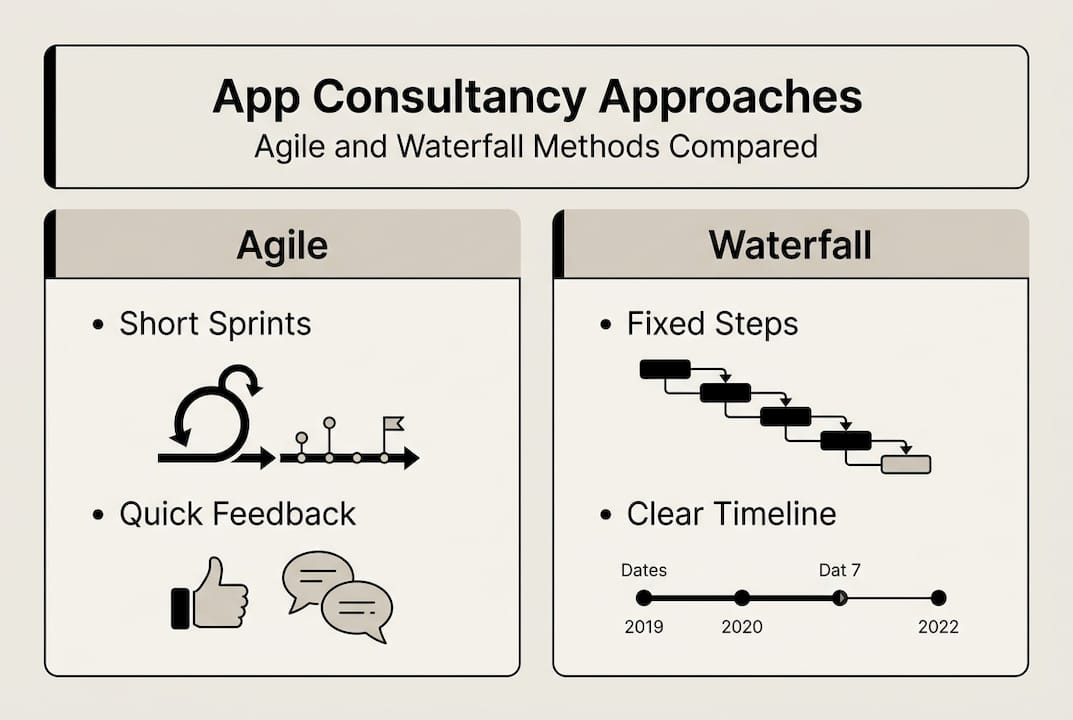
Agile preferred for iterative development with short sprints whilst Waterfall suits fixed requirements and regulatory compliance in UK projects. Understanding these methodologies helps you select the right project management approach for your business app, whether you're building customer engagement platforms or internal operational tools. The methodology choice fundamentally affects timeline predictability, budget flexibility, and stakeholder involvement throughout development.
Agile methodology breaks projects into two-week sprints, delivering working software incrementally. Each sprint produces testable features, allowing you to validate direction and adjust priorities based on real feedback. Agile thrives when requirements evolve, user needs remain unclear, or market conditions shift rapidly. For mobile app development in the UK targeting consumer audiences, Agile enables rapid experimentation and course correction. You'll participate in sprint planning, review demonstrations, and influence the backlog continuously.
Waterfall methodology follows sequential phases: requirements, design, development, testing, deployment. Each phase completes before the next begins, creating clear milestones and predictable timelines. Waterfall excels when requirements are fixed, regulatory compliance demands extensive documentation, or stakeholders need upfront cost certainty. Financial services apps, healthcare systems, and government projects often mandate Waterfall's structured approach. The methodology reduces ambiguity but sacrifices flexibility, making late-stage changes expensive and disruptive.
| Methodology | Best for | Advantages | Disadvantages |
|---|---|---|---|
| Agile | Brand engagement, consumer apps | Flexible priorities, continuous feedback, faster time-to-market | Less predictable costs, requires active client involvement |
| Waterfall | Operational efficiency, compliance apps | Fixed budgets, clear milestones, comprehensive documentation | Inflexible to change, delayed user feedback, higher risk if requirements shift |
Agile suits dynamic brand engagement apps whilst Waterfall suits operational efficiency with fixed scopes. Consider your organisational culture when choosing methodologies. Agile demands regular stakeholder participation, cross-functional collaboration, and comfort with evolving requirements. If your business struggles with rapid decision-making or prefers detailed upfront planning, Waterfall's structure may suit better. Conversely, startups and innovative projects benefit from Agile's adaptability.
Hybrid approaches combine both methodologies, using Waterfall for infrastructure and compliance whilst applying Agile to user-facing features. Many app development companies UK employ hybrid models, balancing predictability with flexibility. Regardless of methodology, ensure post-launch support features in your agreement. Apps require ongoing maintenance, security patches, and platform updates that transcend initial development.
Pro Tip: Align methodology selection with your business goals and risk tolerance. If market validation matters more than fixed costs, choose Agile. If regulatory compliance or budget certainty takes priority, Waterfall provides structure and documentation that auditors and stakeholders appreciate.
Measuring success and maximising ROI with mobile app consultancy
Empirical benchmarks demonstrate consultancy value: 65% daily active user increase, 25% manager app usage growth, £1M+ transactions, and ROI of $100 per $1 invested in UX. These metrics prove that professional consultancy transforms apps from cost centres into revenue drivers. UK business owners must track specific performance indicators to justify investment and guide optimisation decisions. Without measurement frameworks, you cannot distinguish successful features from wasteful ones.

Key performance metrics include daily active users (DAU), retention rates at 7, 30, and 90 days, and conversion rates for target actions. DAU measures how many unique users engage daily, indicating app stickiness and habit formation. Retention rates reveal whether users return after initial download, with 90-day retention predicting long-term viability. Conversion rates track goal completions, whether purchases, bookings, or content engagement. ROI tracking focuses on DAU/MAU, retention, and conversion, with consultancies providing prototypes and audits to validate before full investment.
Consultancies use prototypes and minimum viable products to reduce risk before committing full budgets. Interactive prototypes let stakeholders experience user journeys, test assumptions, and gather feedback cheaply. Technical audits evaluate existing systems, identifying integration challenges and performance constraints early. This validation approach prevents costly mid-project pivots and ensures development effort focuses on proven concepts. For business app development, consultancies often recommend phased launches, releasing core features first and expanding based on usage data.
| Metric | Benchmark | Measurement frequency | Action threshold |
|---|---|---|---|
| Daily active users | 20-30% of installs | Daily | Below 15% investigate onboarding friction |
| 7-day retention | 40-50% | Weekly | Below 35% revise value proposition |
| 30-day retention | 15-25% | Monthly | Below 10% reassess core features |
| Conversion rate | 2-5% depending on action | Weekly | Below 1% optimise user journey |
Top steps to track and improve app ROI:
- Establish baseline metrics before launch using competitor benchmarks and industry standards
- Implement analytics frameworks capturing user behaviour, session duration, and feature adoption
- Set quarterly targets for DAU growth, retention improvement, and conversion optimisation
- Conduct A/B testing on critical user journeys, comparing variations to identify winners
- Review crash reports and performance data weekly, prioritising fixes affecting retention
- Survey users regularly to understand satisfaction drivers and friction points
Mobile application developers UK integrate analytics tools like Firebase, Mixpanel, or Amplitude during development, ensuring data collection starts at launch. Consultancies interpret this data, translating metrics into actionable recommendations. They identify which features drive engagement, which cause abandonment, and where users struggle. This evidence-based approach replaces guesswork with data-driven decisions.
Pro Tip: Align app objectives with measurable business goals from project inception. If your goal is increasing customer lifetime value, track repeat purchase rates and average order values. If operational efficiency matters, measure task completion time and error reduction. Clear objectives enable consultancies to design apps optimised for your specific success criteria rather than generic engagement metrics.
Practical guidance for choosing a mobile app consultancy in the UK
For UK businesses, consultancies reduce rework by 30-50% via discovery phases and recommend cross-platform development for efficiency unless native performance is critical. Selecting the right consultancy partner determines project success more than any other factor. Poor consultancy choices lead to budget overruns, missed deadlines, and apps that fail to meet business objectives. UK business owners must evaluate consultancies systematically, focusing on relevant experience, technical capabilities, and cultural fit.
The discovery phase importance cannot be overstated. Professional consultancies invest 10-15% of project budgets in discovery, conducting user research, technical feasibility studies, and competitive analysis before writing code. This upfront investment identifies risks early, validates assumptions, and establishes realistic scope. Consultancies that skip discovery or rush through it inevitably encounter costly surprises mid-project. Ask potential partners how they structure discovery, what deliverables they produce, and how findings influence development plans.
Choosing between cross-platform and native development depends on your app's performance requirements and budget constraints. Cross-platform frameworks like React Native or Flutter enable simultaneous iOS and Android development, reducing costs by 30-40% compared to separate native apps. However, native development provides superior performance, smoother animations, and better access to device capabilities. For consumer-facing apps where user experience drives differentiation, native development often justifies the premium. For internal operational tools where functionality outweighs polish, cross-platform delivers excellent value.
Criteria for assessing consultancy expertise:
- Portfolio demonstrating similar projects in your sector (retail, healthcare, finance)
- Case studies with quantified outcomes (user growth, revenue impact, efficiency gains)
- Technical certifications and partnerships with Apple, Google, or framework providers
- Client references willing to discuss project experience candidly
- Team composition including strategists, designers, developers, and QA specialists
- Post-launch support offerings covering maintenance, updates, and optimisation
Common pitfalls to avoid include choosing consultancies based solely on price, ignoring cultural fit, or failing to verify technical claims. The cheapest quote often signals inexperienced teams, offshore coordination challenges, or hidden costs emerging later. Cultural misalignment causes communication breakdowns, missed expectations, and frustration. Always request technical interviews with developers who will work on your project, ensuring they understand your business domain and technical requirements.
Mobile app development company London options provide local expertise with face-to-face collaboration benefits. Proximity enables regular sprint reviews, stakeholder workshops, and rapid problem-solving. However, remote consultancies can deliver equal quality if they demonstrate strong communication practices, use collaborative tools effectively, and accommodate your timezone. Evaluate consultancies on capability and cultural fit rather than geography alone.
Pro Tip: Evaluate previous case studies and client references thoroughly before committing. Request permission to speak with past clients about project challenges, communication quality, and post-launch support. Ask specific questions about how the consultancy handled scope changes, technical obstacles, and timeline pressures. References reveal consultancy character better than marketing materials ever can.
How Pocket App supports your mobile app journey
Transforming your app concept into a successful business asset requires expert guidance at every stage. Pocket App delivers comprehensive mobile phone app development and consultancy services tailored for UK businesses seeking competitive advantage through mobile innovation. Our team combines strategic thinking with technical excellence, ensuring your app solves real business problems whilst delighting users.
We specialise in both Agile and Waterfall methodologies, selecting the approach that aligns with your business goals, risk tolerance, and stakeholder preferences. Our discovery process validates concepts before development begins, reducing costly rework and ensuring resources focus on features that drive measurable outcomes. Whether you need consumer engagement platforms or operational efficiency tools, our mobile app consulting company expertise spans retail, healthcare, charity, and B2B sectors with over 300 successful projects delivered.
Our cross platform app development capabilities balance cost efficiency with user experience quality, whilst our native development expertise ensures performance-critical apps meet the highest standards. Post-launch, we provide ongoing optimisation, analytics interpretation, and continuous improvement to maximise your app's ROI over time.
FAQ
What is the role of a mobile app consultancy?
A mobile app consultancy acts as your strategic partner, guiding all project stages from initial concept through post-launch optimisation. Consultants validate ideas through market research, define technical requirements, recommend appropriate technologies, and establish realistic budgets and timelines. They bridge business objectives and technical implementation, ensuring your app delivers measurable value rather than just features.
How do Agile and Waterfall differ in app development?
Agile uses short iterative cycles called sprints, delivering working features every two weeks and adapting to changing requirements continuously. Waterfall follows sequential phases with each stage completing before the next begins, providing predictable timelines and comprehensive documentation. Agile suits evolving projects where flexibility matters, whilst Waterfall fits fixed-scope initiatives requiring regulatory compliance or upfront cost certainty.
What metrics should UK businesses track for app success?
Daily active users (DAU), retention rates at 7, 30, and 90 days, and conversion rates for target actions form the core success metrics. DAU indicates engagement levels, retention reveals long-term viability, and conversion measures goal achievement whether purchases, bookings, or content interactions. Consistent tracking enables data-driven optimisation, justifying investment and guiding feature prioritisation based on actual user behaviour rather than assumptions.
Why is the discovery phase important in app consultancy?
The discovery phase identifies technical risks, validates business assumptions, and defines clear requirements before development begins. Professional discovery reduces costly rework by 30-50% through early problem identification, competitive analysis, and user research. It establishes realistic scope, prevents mid-project surprises, and ensures development effort focuses on features that deliver genuine business value rather than building functionality nobody uses.
Should UK businesses choose cross-platform or native app development?
Cross-platform development suits businesses prioritising cost efficiency and simultaneous iOS/Android launches, reducing development costs by 30-40% compared to separate native apps. Native development provides superior performance, smoother animations, and better device integration, justifying the premium for consumer-facing apps where user experience drives competitive advantage. Consultancies evaluate your specific performance requirements, budget constraints, and business objectives to recommend the optimal approach for your situation.