
TL;DR:
- Proper discovery is essential before app development to prevent costly rework and misaligned features. It ensures clear stakeholder agreement, validated user needs, and a focused scope that enhances adoption and reduces risks. Ongoing user feedback and organizational courage are crucial for creating successful, user-centric apps over time.
Rushing an app project into development without proper discovery is one of the costliest mistakes a UK organisation can make. Features get built that users never asked for, budgets spiral, and timelines collapse under the weight of late-stage rework. Treating discovery as an investment rather than a formality pays dividends throughout every subsequent stage of development. This guide walks you through every critical discovery step, so your team arrives at development with clarity, confidence, and a validated plan.
Table of Contents
- Why app discovery matters for UK organisations
- Preparing for app project discovery: What you need
- Step-by-step app discovery process
- Common mistakes and how to avoid them
- Validating discovery: Measuring success and next actions
- What most guides miss about app project discovery
- Take your app project further with expert support
- Frequently asked questions
Key Takeaways
| Point | Details |
|---|---|
| Discovery saves resources | Investing in app project discovery prevents wasted time and money during development. |
| User-centric methods boost adoption | Validating features and involving users early leads to higher app engagement rates. |
| Structured steps reduce mistakes | Following discovery steps minimises errors and costly design changes. |
| Measure outcomes for success | Monitoring adoption and validated features ensures your discovery phase has real impact. |
Why app discovery matters for UK organisations
Many businesses view the discovery phase as an optional warm-up before the "real work" begins. That thinking is expensive. Discovery is where you identify what your users genuinely need, what your business can realistically deliver, and where the two overlap. Without it, development teams build on assumptions rather than evidence.
The business case is straightforward:
- Reduced scope creep: When requirements are clearly defined upfront, developers have less reason to revisit and renegotiate features mid-build.
- Lower rework costs: Fixing a problem during discovery costs a fraction of what it costs to fix during testing or after launch.
- Higher adoption rates: Apps built around validated user needs perform better. The GOV.UK app beta demonstrated this clearly, with over 80% of users adopting customisation features, validating their user-centric approach from the outset.
- Stronger stakeholder alignment: Discovery forces difficult conversations early, so everyone agrees on priorities before money is spent.
A well-executed app project discovery guide turns vague intentions into a concrete project roadmap. You stop guessing and start building with purpose.
"Discovery is not a phase you rush through. It is the foundation on which every other decision rests. The organisations that invest properly here are the ones that launch apps their users actually return to."
The essential mobile app discovery steps may vary slightly by project, but the underlying logic is consistent: understand before you build.
Preparing for app project discovery: What you need
Before you can begin discovery in earnest, you need to get your house in order. Showing up to a discovery workshop without the right people, clear objectives, or relevant data wastes everyone's time. Preparation is the difference between a two-week sprint and a two-month crawl.
Here is what you need to gather and confirm before starting:
- Core stakeholders: Product owners, department heads, IT leads, and ideally a representative end user or two.
- Business objectives: What problem does this app solve? What does success look like in six months and in two years?
- Existing data: Analytics from current systems, customer feedback, support tickets, and any relevant market research.
- Technical constraints: Existing infrastructure, preferred platforms (iOS, Android, or cross-platform), and any integration requirements.
- Budget and timeline indicators: You do not need a fully costed plan, but having a realistic range prevents proposals that are disconnected from commercial reality.
| Preparation area | Questions to answer | Who is responsible |
|---|---|---|
| Stakeholder alignment | Who has sign-off authority? | Project sponsor |
| User research access | Can we recruit real users for interviews? | Product owner |
| Technical landscape | What APIs or systems must the app connect to? | IT lead |
| Compliance considerations | Are there GDPR or sector-specific regulations? | Legal or compliance |
| Success metrics | What KPIs define a successful launch? | All senior stakeholders |
The app project workflow guide outlines how preparation directly accelerates downstream delivery. Teams that align early consistently report fewer blockers during build.
As evidence of this, treating discovery as an investment for project success is not abstract advice. It is a pattern seen repeatedly across public and private sector app projects in the UK.
Pro Tip: Run a short alignment session with all stakeholders before formal discovery begins. Even a 90-minute meeting to agree on the app's core purpose and primary user group can prevent weeks of disagreement later in the process.
Step-by-step app discovery process
With preparation complete, you can move through discovery methodically. Each step builds on the last, so do not skip ahead or treat any stage as optional.
-
Requirements gathering. Collect everything stakeholders believe the app needs to do. Use workshops, interviews, and questionnaires. At this stage, capture everything without filtering. You will prioritise later.
-
User research and persona development. Speak directly with your intended users. Conduct structured interviews, observe how they use existing tools, and identify the frustrations your app can resolve. Build two or three realistic user personas that represent distinct segments of your audience. These personas guide every subsequent decision.
-
Feature and scope definition. Take the requirements gathered in step one and evaluate each against user needs identified in step two. Define a minimum viable product (MVP) scope that delivers genuine value without overextending development resources.
-
Wireframing. Translate your defined scope into low-fidelity screen layouts. Wireframes map user journeys without the distraction of colour, branding, or polished visuals. They answer the question: does this flow make sense?
-
Prototyping. Build a clickable prototype that simulates the core journeys of your app. This does not require a single line of production code. Tools such as Figma or InVision allow teams to test interactions before committing to development.
-
Validation and feedback. Put the prototype in front of real users. Watch where they hesitate, where they make errors, and where they succeed. User-centric discovery methods consistently improve feature adoption and engagement, which is why this step is non-negotiable.
The step-by-step guide for founders expands on how each of these phases connects to broader project planning and commercial goals.
Lite discovery versus comprehensive discovery
Not every project requires the same depth of discovery. Here is a practical comparison to help you decide which approach fits your situation.
| Factor | Lite discovery | Comprehensive discovery |
|---|---|---|
| Timeline | 1 to 2 weeks | 4 to 8 weeks |
| User research depth | Desk research only | Live interviews plus usability testing |
| Deliverables | Feature list and rough scope | Full persona set, wireframes, validated prototype |
| Best suited for | Simple internal tools or MVP extensions | New consumer apps or complex B2B platforms |
| Risk reduction | Moderate | High |
| Cost | Lower upfront | Higher upfront, significantly lower total project cost |
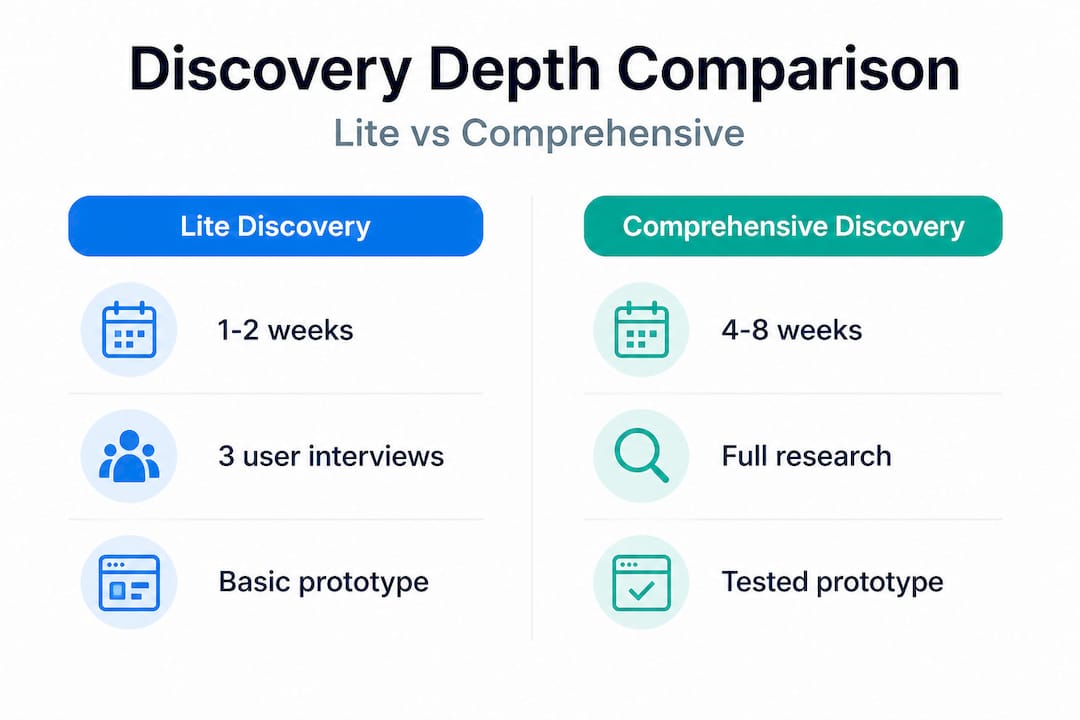
For UK businesses in regulated sectors such as healthcare or financial services, comprehensive discovery is rarely optional. The compliance risks alone justify the investment. For a rapid internal tool, a lighter approach may be perfectly appropriate.
Pro Tip: Even when choosing a lite approach, always include at least three live user interviews. Reading about your users is not the same as listening to them. Twenty minutes of conversation will surface assumptions you did not know you were making.
The app development tips available from Pocket App's blog offer further guidance on calibrating discovery depth to project type.
Common mistakes and how to avoid them
Even well-intentioned teams make avoidable errors during discovery. Knowing what to watch for keeps your project on track.
- Skipping stakeholder buy-in. Discovery workshops without decision-makers present produce outputs that get overruled later. If the people with budget authority are not in the room, your prioritised feature list has no teeth.
- Neglecting user testing. Building a prototype and showing it only to colleagues is not user testing. Your team already understands the product logic. Your users do not. External feedback is what makes prototyping valuable.
- Failing to iterate on prototypes. One round of feedback is rarely enough. Plan for at least two iterations before treating the prototype as finalised.
- Avoiding documentation. Discovery generates a significant amount of decisions, assumptions, and agreements. If these are not documented, they get forgotten or disputed during development. A structured discovery report is not bureaucracy. It is insurance.
- Treating discovery as a one-off event. For larger projects, discovery is ongoing. New information emerges during development, and teams need a lightweight process for handling it without derailing delivery.
"The teams that skip user testing to save a week during discovery inevitably spend three weeks arguing over feature changes during QA. The maths never works in their favour."
User-centric discovery is specifically what prevents these costly missteps from becoming expensive rework. The evidence from public sector projects bears this out repeatedly.
Strong user-centred app design advantages extend well beyond launch. Apps designed with user input from the discovery phase continue to see stronger engagement months after release, because the core experience reflects genuine behaviour rather than internal assumptions.

Understanding how to optimise mobile app engagement also depends on having a solid discovery foundation. You cannot optimise what was never validated.
Validating discovery: Measuring success and next actions
Completing the discovery phase does not automatically mean it was successful. You need clear indicators that your discovery produced reliable, actionable outputs before moving into design and build.
Here are the key indicators of a well-executed discovery phase:
- Stakeholder consensus on scope. Every decision-maker agrees on what is in the MVP and, critically, what is not.
- Validated user personas. Your personas were tested against real user feedback, not invented in a workshop without external input.
- A prioritised feature backlog. Features are ranked by user value and business priority, not by the loudest voice in the room.
- A tested prototype. At least one round of user testing has been completed, and the prototype reflects the resulting changes.
- Documented assumptions and risks. You know what you are assuming, and you have a plan to test those assumptions early in development.
- Agreed success metrics. You have defined what good looks like: user adoption targets, task completion rates, and retention benchmarks.
The GOV.UK app beta demonstrated convincingly that user-centric discovery raises adoption rates, with the programme achieving over 80% customisation uptake. That is not a coincidence. It is the direct result of building features that real users asked for and tested before launch.
Key statistic: Projects that complete a validated discovery phase before development begin report significantly fewer change requests during build, reducing overall project costs and shortening timelines.
Once discovery is validated, the handover to development should include a discovery report, a tested prototype, a prioritised backlog, and defined success metrics. Development teams should not be interpreting or guessing. Everything they need to build confidently should exist in documented form.
What most guides miss about app project discovery
Most discovery guides give you a checklist and call it done. Run workshops, create personas, build a prototype. Tick, tick, tick. What they rarely address is the mindset problem that causes discovery to fail even when the process is followed correctly.
Organisations routinely treat discovery as a formality that legitimises decisions already made in a boardroom. The features are effectively decided before the first user interview takes place. The discovery process then becomes a performance, generating documentation that supports a predetermined conclusion rather than genuinely challenging assumptions.
This is what we call box-ticking discovery, and it produces apps with the same problems as those that skip discovery entirely. The difference is the project team feels more confident, which can actually make the eventual failure harder to diagnose.
True discovery is uncomfortable. It requires decision-makers to hear that their best idea might not resonate with users, and to act on that information even when it means narrowing scope or changing direction. That takes organisational courage, not just a well-facilitated workshop.
The other thing most guides miss is this: discovery is not a separate phase that ends. It is a habit. The teams who launch the most successful apps treat user feedback as a continuous input into every stage of the product lifecycle. The effective discovery steps covered in structured guides are a starting point, not a ceiling.
User-centric discovery is a competitive advantage, particularly in sectors where most apps are still built from internal assumptions. Businesses that genuinely commit to this approach do not just build better apps. They understand their users better than their competitors do, and that knowledge compounds over time.
Take your app project further with expert support
Knowing the steps is one thing. Executing them with rigour, speed, and strategic clarity is another, and that is exactly where the right development partner makes a tangible difference to your project outcomes.
At Pocket App, we run structured discovery workshops designed specifically for UK businesses ready to build something exceptional. With over 300 projects completed across retail, healthcare, charity, and consumer sectors, we know how to move organisations from vague ambitions to validated product plans in weeks, not months. Our mobile app development services and professional app design capability sit directly alongside our discovery expertise, so your project benefits from joined-up thinking from day one. If you are ready to build something your users will genuinely use, we would love to talk.
Frequently asked questions
What is the app discovery phase and why is it important?
The app discovery phase involves researching user needs, defining requirements, and validating features before development begins, and treating it as an investment saves significant time and money whilst increasing user adoption from launch.
How long does app discovery typically take for UK businesses?
App discovery usually takes between two and six weeks depending on project complexity and stakeholder availability, and investing this time upfront consistently reduces delays and surprises during the build phase.
What are the key steps in app project discovery?
Key steps include requirements gathering, user research, feature scoping, wireframing, prototyping, and validating with real users, all of which improve feature adoption and overall engagement post-launch.
How can we measure the success of our app discovery phase?
Success is measured by stakeholder consensus on scope, a tested prototype, a validated feature backlog, and clear adoption targets, with user-centric discovery consistently raising adoption rates as demonstrated by the GOV.UK app programme.
Recommended
- What is app project discovery? A guide for UK decision-makers
- App deployment strategies: effective guide for UK businesses
- Pocket App | Revamping Your App Store Strategy: Tips to Boost Discoverability in 2025
- Innovative app features to boost UK business growth
- Small business accounting: Streamline, save, and scale | Ready Accounting
- Streamline your agency: the essential guide to booking software - LiveDesk CRM