
TL;DR:
- Proper workflow management is crucial to avoid missed deadlines and project derailment.
- Agile, Scrum, and Kanban are preferred for their speed and success rates in app development.
- Sector-specific adaptations and strong team culture significantly influence app project success.
Poor workflow management is one of the most expensive mistakes a business can make when commissioning a mobile app. Missed deadlines, scope creep, and failed launches are rarely caused by bad ideas. They stem from unclear processes, mismatched methodologies, and teams that skip critical planning stages. For organisations in retail, healthcare, and the non-profit sector, the stakes are even higher. Regulatory requirements, tight budgets, and complex user needs mean that a flawed workflow does not just slow you down. It can derail the entire project. This guide walks you through how to build and optimise an app development workflow that delivers speed, compliance, and genuine user value.
Table of Contents
- Understanding core app development workflows
- Step-by-step guide to Agile-based app workflows
- Adapting workflows for specialised sectors: retail, healthcare, and non-profit
- Troubleshooting and optimising your project management workflow
- Why one-size-fits-all project management doesn't work in app development
- Accelerate your app success with expert workflow support
- Frequently asked questions
Key Takeaways
| Point | Details |
|---|---|
| Agile delivers speed | Scrum or Kanban workflows complete projects significantly faster and with greater user focus than traditional methods. |
| Tailor by sector | Adjust workflows to sector-specific needs like compliance in healthcare or budget limits in non-profits for optimal results. |
| Hybrid beats rigid | Combining Agile with selected Waterfall steps boosts success for complex or regulated app projects. |
| Continuous improvement matters | Regular retrospectives and the right tools drive ongoing gains in delivery speed and quality. |
Understanding core app development workflows
Choosing the right methodology is arguably the most consequential decision you will make before a single line of code is written. Agile, Scrum, and Kanban dominate modern app development workflows, but Waterfall and Hybrid models still play important roles depending on the project type.
Agile is an iterative approach that breaks work into short cycles, allowing teams to adapt quickly. Scrum is a specific Agile framework built around fixed-length sprints, typically one to four weeks, with defined roles such as Product Owner and Scrum Master. Kanban focuses on visualising work in progress and limiting tasks at each stage to prevent bottlenecks. Waterfall is a linear, sequential model where each phase must be completed before the next begins. Hybrid blends elements of Agile and Waterfall, often used when a project has both fixed regulatory requirements and areas that benefit from iteration.
Here is a quick comparison to help you choose:
| Methodology | Best for | Key strength | Key weakness |
|---|---|---|---|
| Scrum | Complex, evolving apps | Fast iteration, clear roles | Requires experienced team |
| Kanban | Continuous delivery | Visual flow, flexible | Less structured planning |
| Waterfall | Fixed-scope projects | Predictable timeline | Poor adaptability |
| Hybrid | Compliance-heavy apps | Balances structure and agility | Complex to manage |
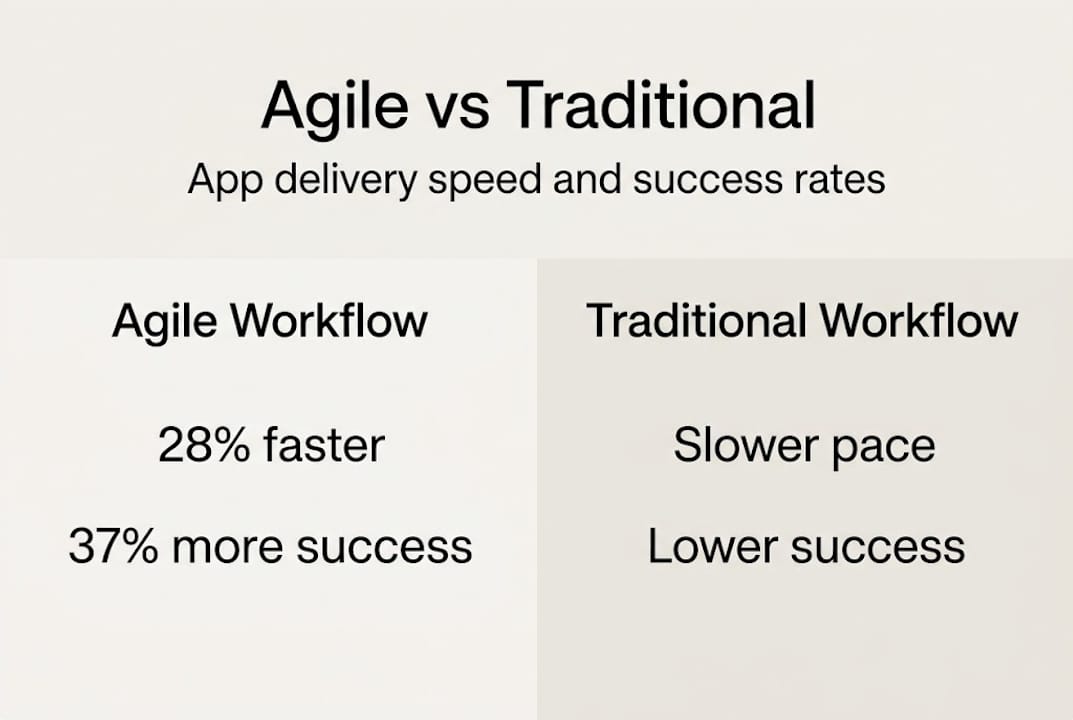
The numbers make a strong case for Agile. Agile projects are 28% more successful and 37% faster than traditional methods. That is a significant competitive advantage for any business trying to get a product to market quickly.
Understanding the full app development process before selecting a methodology helps you match the right framework to your actual delivery needs, rather than defaulting to whatever your development partner prefers.
When evaluating project management methodologies, consider your team's experience, the regulatory environment, and how much your requirements are likely to change during development.
Pro Tip: If your project involves strict compliance requirements, such as patient data handling or financial transactions, a Hybrid model gives you the structured documentation of Waterfall with the adaptability of Agile. Do not let a purist Agile approach leave you exposed to regulatory risk.
Step-by-step guide to Agile-based app workflows
Now that you understand your workflow options, let's get practical with a step-by-step Agile playbook. Before any sprint begins, solid pre-project preparation is essential. This means defining your requirements clearly, setting a Minimum Viable Product (MVP) goal, and outlining any compliance obligations upfront.
Here is how a well-structured Agile workflow unfolds:
- Discovery — Conduct stakeholder interviews, map user journeys, and document technical constraints. This is where you define the problem you are solving.
- Backlog creation — Translate requirements into user stories and prioritise them by business value and technical dependency.
- Sprint planning — Select backlog items for the upcoming sprint, assign tasks, and agree on a sprint goal.
- Development — Build features iteratively. Developers, designers, and QA work in parallel rather than in sequence.
- QA and testing — Test each feature within the sprint. Catching bugs early is far cheaper than fixing them post-release.
- Release — Deploy completed features to a staging or production environment. In retail and healthcare, staged rollouts reduce risk.
- Sprint review and retrospective — Demo completed work to stakeholders, gather feedback, and identify process improvements for the next sprint.
For guidance on managing app projects effectively, the sprint review is often undervalued. It is your earliest opportunity to course-correct before small misalignments become expensive rework.
Here is a typical sprint structure by industry:
| Industry | Sprint length | Key activities | Expected output |
|---|---|---|---|
| Retail | 1 to 2 weeks | UI iteration, payment flows | Shippable feature increment |
| Healthcare | 2 to 3 weeks | Compliance review, clinical testing | Validated, documented feature |
| Non-profit | 2 weeks | Donor UX, accessibility checks | Tested feature with stakeholder sign-off |
The impact of iterative Agile releases is well documented in retail and healthcare, with some teams reporting 50% reductions in task completion time after adopting structured sprint cycles.
For a deeper look at Agile Scrum in app development, the key is consistency. Teams that run disciplined sprints outperform those that treat Agile as an informal suggestion.
Pro Tip: Daily stand-ups should be 15 minutes maximum. Use them to surface blockers, not report status. Pair them with weekly backlog refinement sessions to keep your pipeline clean and your team unblocked.
Adapting workflows for specialised sectors: retail, healthcare, and non-profit
With Agile as the foundation, sector-specific adaptation is what separates average delivery from genuinely effective outcomes. Each industry brings its own compliance demands, user expectations, and risk profile.
Retail apps need fast, frequent releases to respond to seasonal campaigns, inventory changes, and competitor moves. Work-in-progress (WIP) limits on your Kanban board prevent teams from overloading and help maintain a steady release cadence. The priority is speed without sacrificing user experience.
Healthcare apps operate under strict regulatory frameworks, including NHS data standards and GDPR obligations. Healthcare projects require phased workflows covering discovery, design, development, and rigorous testing, often blending Agile and Waterfall to satisfy both iterative development and fixed compliance checkpoints. The project discovery phase is especially critical here. Rushing past it creates compliance gaps that are costly to fix later.
Non-profit organisations typically face tighter budgets and rely heavily on volunteer or part-time teams. Hybrid workflows offer the predictability needed for grant reporting and board oversight, while still allowing iterative improvements to donor-facing features.
Here is a summary of workflow modifications by sector:
- Retail: Short sprints, WIP limits, continuous deployment pipelines, rapid A/B testing
- Healthcare: Phased Hybrid model, compliance sign-off gates, extended QA cycles, detailed audit trails
- Non-profit: Fixed-phase planning for budget control, Agile sprints for UX iteration, accessibility-first testing
For a broader look at healthcare workflow phases, the consensus is clear: no single methodology covers every requirement. Non-profits and retail organisations favour hybrid workflows precisely because they offer predictability alongside flexibility.
"46% of Agile transformations fail not because of the methodology itself, but because of cultural resistance and a lack of leadership commitment to the process."
This is worth taking seriously. Workflow design is only half the battle. The culture around it determines whether it actually works.
Troubleshooting and optimising your project management workflow
Even the best workflows encounter hiccups. The difference between teams that recover quickly and those that spiral into delays is usually how fast they can diagnose and fix the root cause.
Common bottlenecks include:
- Missed or unfocused stand-ups that allow blockers to fester for days
- Vague requirements that force developers to make assumptions, leading to rework
- WIP overload, where too many tasks are in progress simultaneously, slowing everything down
- Inadequate backlog refinement, leaving sprint planning sessions chaotic and unproductive
The right tools make these problems visible before they become critical. 80% of Agile teams use tools like Jira, and implementing WIP limits reduces cycle time by 31%. That is not a marginal gain. It is the difference between hitting your launch date and missing it.

Essential tools for workflow management include Jira for sprint tracking, Trello or Linear for Kanban visualisation, Confluence for documentation, and Figma for design handover. Each tool should serve a specific function. Avoid tool sprawl, where teams use six platforms but master none.
Here are the most common workflow mistakes and their fixes:
- Skipping retrospectives — Fix: make them mandatory and time-boxed. Use a simple format: what went well, what did not, what to change.
- Overloading sprints — Fix: use velocity data from previous sprints to set realistic capacity limits.
- Ignoring technical debt — Fix: allocate 20% of each sprint to refactoring and infrastructure improvements.
- Poor stakeholder communication — Fix: include a non-technical sprint summary in every review meeting.
For practical app success tips, retrospectives are the single most underused tool in most teams' arsenals. They cost 30 minutes and save weeks.
If your team is working across distributed environments, cloud-based development infrastructure can significantly reduce integration friction and improve sprint consistency. Agile statistics consistently show that teams with strong tooling and clear processes outperform those relying on informal coordination.
Pro Tip: Track three metrics every sprint: velocity, bug escape rate, and stakeholder satisfaction score. If any of these trends downward for two consecutive sprints, treat it as an early warning signal and address it in your next retrospective.
Why one-size-fits-all project management doesn't work in app development
Having addressed tactics and troubleshooting, it is worth stepping back to challenge a common assumption. Many organisations adopt Agile because it is fashionable, or stick with Waterfall because it is familiar. Neither instinct produces the best outcomes.
The reality is that rigid adherence to any single methodology introduces blind spots. A healthcare app forced into two-week sprints with no compliance gates is a liability. A retail app managed through a rigid Waterfall process will miss three seasonal windows before it launches.
Hybrid methodologies leverage the strengths of both Agile and Waterfall, reducing risk for compliance-heavy projects while maintaining the speed that modern markets demand. The organisations that consistently deliver successful apps treat methodology as a tool, not a religion.
Culture matters more than process. A team that communicates openly, learns from each sprint, and adapts without ego will outperform a team following a perfect methodology poorly. Build the culture first. The workflow will follow.
Accelerate your app success with expert workflow support
If the workflow challenges outlined above feel familiar, you are not alone. Most organisations discover their process gaps mid-project, when fixing them is expensive and stressful.
At Pocket App, we have spent years refining delivery workflows across retail, healthcare, non-profit, and consumer sectors. Our mobile app development services are built around structured discovery, sector-adapted Agile processes, and seamless handover. From the first sprint to final deployment, we keep your project on track and your users at the centre. Our expert app design team ensures that workflow rigour never comes at the cost of user experience. If you are ready to build something that delivers, let's talk.
Frequently asked questions
What is the best project management workflow for app development?
Agile methods, particularly Scrum or Kanban, are most effective for complex app development. Agile projects are 28% more successful and 37% faster than Waterfall, enabling faster delivery and improved user outcomes.
How do you adapt app workflows for healthcare or non-profit projects?
Tailor workflows to focus on compliance, MVP delivery, and phased discovery, often blending Agile and Waterfall for predictability. Healthcare projects require phased hybrid workflows to meet regulatory and clinical requirements.
What tools are essential for managing app development workflows?
Tools like Jira and visual Kanban boards are crucial for sprint tracking, backlog management, and team collaboration. 80% of Agile teams rely on structured tooling to maintain delivery consistency.
Why do Agile workflows sometimes fail?
Poor cultural fit and weak leadership commitment are the primary causes. 46% of Agile transformations fail not because of the methodology itself, but because organisations underestimate the cultural change required.