
Launching a mobile app without a clear roadmap often leads to missed deadlines, budget overruns, and products that fail to meet user expectations. Business founders frequently struggle to navigate the complex development process, unsure which steps to prioritise or how to manage technical decisions effectively. This comprehensive guide breaks down app development into manageable phases, providing the strategic clarity you need to transform your concept into a successful mobile application whilst avoiding costly missteps and accelerating your route to market.
Table of Contents
- Preparing For App Development: Defining Goals And Requirements
- Choosing The Right Development Approach And Technology Stack
- Designing, Prototyping, And Validating Your App Concept
- Executing Development And Managing The Build Process Effectively
- Verifying, Launching And Iterating Your App For Success
- Get Expert Help With Your Mobile App Development
Key takeaways
| Point | Details |
|---|---|
| Define goals early | Clear business objectives and user requirements establish a solid foundation for all development decisions |
| Choose the right approach | Selecting between native, cross-platform, or hybrid development impacts costs, timelines, and performance significantly |
| Validate before building | Prototyping and user testing reduce development risks and ensure your app meets real user needs |
| Embrace iteration | Launching an MVP and gathering feedback enables continuous improvement and stronger market fit |
Preparing for app development: defining goals and requirements
Successful app development begins long before any code is written. Market research and user feedback are essential for defining your app's purpose, identifying your target audience, and ensuring the product meets genuine user needs. Without this foundational work, you risk building features nobody wants or solving problems that don't exist.
Start by conducting thorough competitor analysis to understand what similar apps offer and where gaps exist in the market. This research reveals opportunities for differentiation and helps you position your app strategically. Define your core business objectives clearly, whether that's increasing customer engagement, streamlining internal operations, or creating a new revenue stream.
Next, draft precise and measurable requirements that specify exactly what your app must accomplish. These requirements should cover:
- Core functionality that delivers your primary value proposition
- Technical specifications including platform compatibility and performance standards
- Security and compliance requirements relevant to your industry
- Integration needs with existing systems or third-party services
- Scalability considerations for future growth
Identify key features that differentiate your app from competitors whilst resisting the temptation to include everything at once. Prioritise features based on user value and business impact, creating a roadmap that starts with essential functionality and builds from there. Choose success metrics early, such as user acquisition rates, engagement levels, or conversion percentages, so you can measure progress objectively.
Involving stakeholders from various departments during this planning phase ensures alignment across your organisation. Product managers, technical leads, marketing teams, and customer service representatives all bring valuable perspectives that strengthen your mobile app development process. Regular stakeholder reviews prevent misunderstandings and keep everyone focused on shared goals.
Pro Tip: Document your requirements in a centralised location accessible to all team members, updating it as your understanding evolves through user research and market validation.
Choosing the right development approach and technology stack
Selecting the appropriate development methodology profoundly influences your project's budget, timeline, and final product quality. Four primary approaches dominate the mobile app landscape, each offering distinct advantages depending on your specific circumstances.

Native app development delivers the best performance and user experience by building separate codebases for iOS and Android using platform-specific languages like Swift or Kotlin. This approach provides full access to device features, optimal speed, and seamless integration with operating system updates. However, maintaining two codebases increases both development costs and ongoing maintenance requirements.
Cross-platform development frameworks like React Native or Flutter enable you to write code once and deploy across multiple platforms. This approach can reduce development costs and time to market by 30 to 50%, making it attractive for businesses with limited budgets or tight deadlines. Modern cross-platform tools have narrowed the performance gap with native apps significantly, though some complex animations or device-specific features may still require native modules.
Hybrid development wraps web technologies within a native container, offering moderate performance and broader compatibility. This approach suits content-focused apps where cutting-edge performance isn't critical. Development costs fall between native and cross-platform options, with reasonable maintenance overhead.
No-code platforms significantly reduce development time and cost for internal tools and MVPs, enabling rapid prototyping without traditional programming skills. These platforms work brilliantly for straightforward apps with standard functionality but struggle with highly customised requirements or complex integrations.
| Approach | Development Cost | Time to Market | Performance | Best For |
|---|---|---|---|---|
| Native | High | Slower | Excellent | Apps requiring maximum performance and device integration |
| Cross-platform | Medium | Faster | Very Good | Most business apps balancing cost and quality |
| Hybrid | Medium | Moderate | Good | Content-heavy apps with simpler interactions |
| No-code | Low | Fastest | Fair | MVPs, internal tools, and simple applications |
Your choice should align with your app's complexity, target audience expectations, and available resources. Consider factors like:
- Required performance levels for your use case
- Budget constraints and funding availability
- Timeline pressures and market windows
- Team expertise and available talent
- Long-term maintenance capabilities
Businesses that align their development approach with product requirements report 15 to 25% improvements in efficiency and stronger user retention. Understanding the web app vs hybrid vs native apps distinction helps you make informed decisions that balance technical requirements with business realities.
Pro Tip: Start with cross-platform development for your MVP, then consider native rebuilds for specific modules if performance bottlenecks emerge through real-world usage data.
Designing, prototyping, and validating your app concept
A well-designed user interface and user experience are critical for app success, directly impacting user retention, engagement, and overall satisfaction. Design validation through prototyping catches usability issues early when they're inexpensive to fix, rather than after costly development is complete.
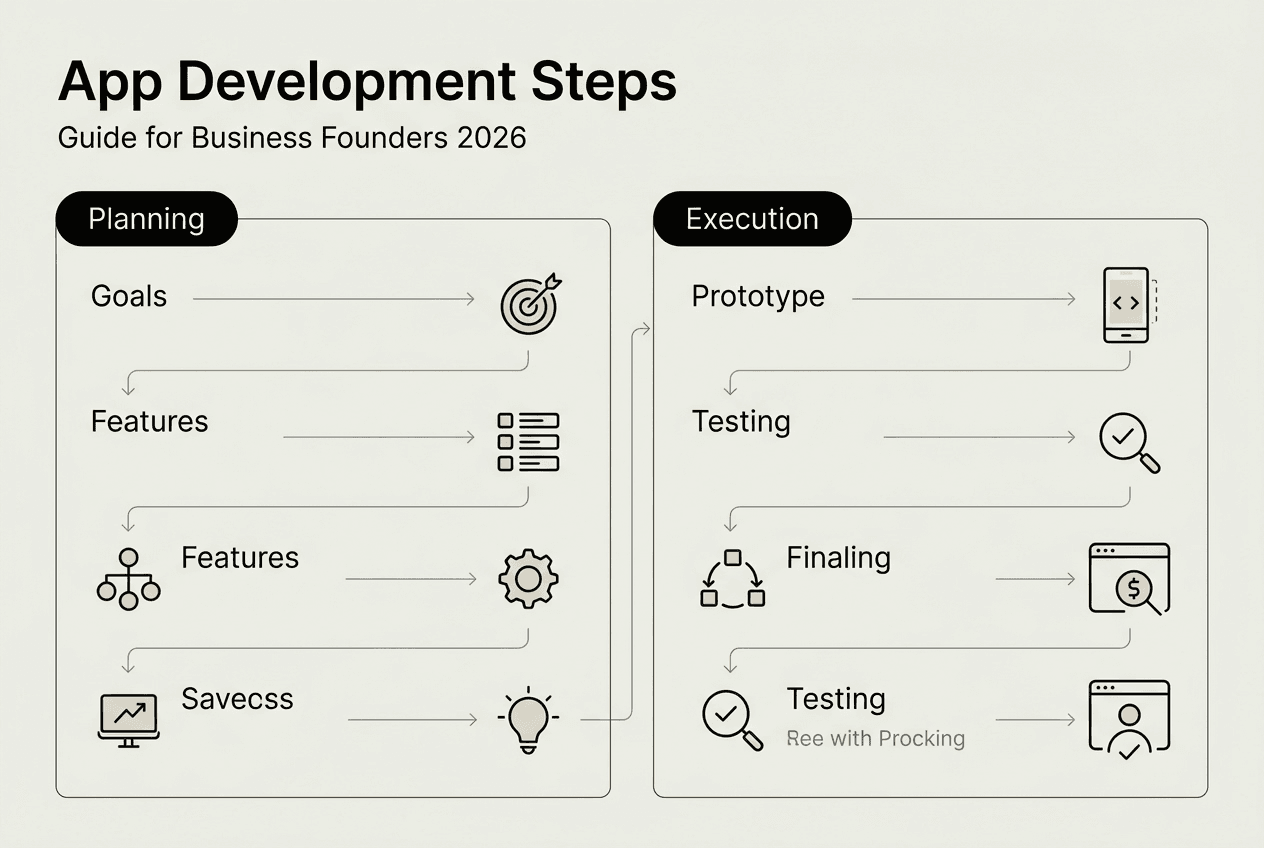
Begin with low-fidelity wireframes that map out user flows without getting distracted by visual details. These simple sketches or digital layouts focus on information architecture, navigation patterns, and core interactions. Wireframes help stakeholders visualise the app structure and provide feedback on functionality before investing in detailed design work.
Once wireframes are approved, develop interactive prototypes that simulate the actual user experience. Modern prototyping tools like Figma, Adobe XD, or Sketch enable you to create clickable mockups that feel remarkably close to finished products. These prototypes serve multiple purposes:
- Validate design decisions with real users before coding begins
- Identify navigation problems and confusing interfaces early
- Test different design approaches quickly and inexpensively
- Communicate design intent clearly to developers
- Secure stakeholder buy-in through tangible demonstrations
Conduct usability testing with representative users from your target audience, observing how they interact with your prototype. Watch for moments of confusion, unexpected behaviours, or features they overlook entirely. Ask participants to complete specific tasks whilst thinking aloud, revealing their thought processes and pain points.
Iterate your design based on testing feedback, refining interfaces until users can navigate intuitively without guidance. This cyclical process of design, test, and refine continues until usability metrics meet your success criteria. Prototyping in successful app development reduces development risks substantially by ensuring user-centred design from the start.
Key prototyping tools worth considering include:
- Figma for collaborative cloud-based design and prototyping
- Sketch for Mac-based interface design with extensive plugin ecosystem
- Adobe XD for integrated design and prototyping workflows
- InVision for advanced interactive prototypes and design handoff
- Marvel for rapid prototyping with minimal learning curve
Pro Tip: Test your prototype with at least five users from each major user segment, as this typically uncovers 85% of usability issues without excessive time investment.
Executing development and managing the build process effectively
Effective development execution requires structured methodologies, disciplined processes, and continuous quality oversight. Adopting agile development practices enables iterative progress through short sprints, typically lasting two weeks, where teams deliver working features incrementally rather than attempting everything simultaneously.
Agile methodologies offer several advantages for app development:
- Flexibility to adjust priorities based on emerging insights
- Regular demonstrations that keep stakeholders informed
- Early detection of technical challenges or scope issues
- Continuous integration of user feedback throughout development
- Reduced risk through incremental delivery and testing
Implement robust version control systems like Git to manage code collaboration across your development team. Version control tracks every change, enables parallel development on different features, and provides safety nets for reverting problematic updates. Establish clear branching strategies and code review processes to maintain code quality and knowledge sharing.
Integrate backend services and APIs securely, following best practices for authentication, data encryption, and access control. Modern apps rarely exist in isolation, typically connecting to cloud databases, payment processors, analytics platforms, and third-party services. Plan these integrations carefully, considering:
- API reliability and service level agreements
- Data privacy regulations and compliance requirements
- Scalability to handle growing user bases
- Fallback mechanisms for service disruptions
- Cost implications of API usage at scale
Perform continuous testing throughout development rather than leaving quality assurance until the end. Automated testing catches regressions quickly, whilst manual testing explores edge cases and user experience nuances. Establish testing protocols covering unit tests, integration tests, and end-to-end user journey validation.
Monitor scope creep vigilantly, as feature additions during development frequently derail timelines and budgets. Maintain a product backlog for future enhancements rather than cramming everything into the initial release. Businesses that align their development approach with product requirements report 15 to 25% improvements in efficiency and stronger user retention.
Regular sprint reviews and retrospectives keep teams aligned and continuously improving their processes. Review completed work against acceptance criteria, gather feedback, and adjust upcoming sprint plans accordingly. Understanding the complete mobile app development process helps you anticipate challenges and maintain momentum through the build phase.
Pro Tip: Allocate 20% of each sprint to technical debt reduction and code refactoring, preventing quality degradation that slows future development.
Verifying, launching and iterating your app for success
Comprehensive quality assurance separates successful launches from problematic releases that damage your brand reputation. Testing must cover functional correctness, performance under load, security vulnerabilities, and compatibility across devices and operating system versions.
Conduct thorough testing across multiple dimensions:
- Functional testing validates that features work as specified
- Performance testing ensures acceptable speed and responsiveness
- Security testing identifies vulnerabilities before malicious actors do
- Compatibility testing confirms proper operation across device types
- Accessibility testing ensures usability for people with disabilities
Beta releases with selected users provide invaluable real-world feedback before your public launch. Beta testers use your app in authentic scenarios, uncovering issues that internal testing missed. Collect crash reports, performance metrics, and user feedback systematically, prioritising fixes based on severity and frequency.
Plan your launch marketing strategy well before release day, building anticipation through social media, email campaigns, and press outreach. Optimise your app store presence with compelling descriptions, high-quality screenshots, and keyword-rich metadata that improves discoverability. First impressions matter enormously in crowded app marketplaces.
Monitor user analytics closely following launch, tracking metrics like:
- Daily and monthly active users
- Session duration and frequency
- Feature adoption rates
- Conversion funnel performance
- Crash rates and error frequencies
Collect user feedback through in-app surveys, app store reviews, and support channels. Prioritise feedback based on frequency, impact on user experience, and alignment with business objectives. Not every feature request deserves implementation, but patterns in user feedback reveal genuine needs worth addressing.
Focusing on a Minimum Viable Product is crucial for validating an app idea and iterating based on real-world feedback. MVPs contain only essential features needed to deliver core value, enabling faster launches and learning cycles. Release updated versions regularly, incorporating improvements and new features based on usage data and user requests.
Establish a sustainable release cadence that balances new feature development with stability and polish. Monthly or quarterly updates keep users engaged whilst providing sufficient time for thorough testing. Communicate your product roadmap transparently, building user confidence that their feedback influences your app's evolution.
Professional mobile phone app development expertise accelerates this entire process, helping you avoid common pitfalls and launch confidently.
Pro Tip: Implement feature flags that enable or disable functionality remotely, allowing you to test new features with subset of users before full rollout.
Get expert help with your mobile app development
Navigating the complexities of app development becomes significantly easier with experienced partners who've successfully delivered hundreds of projects. Professional development teams bring deep expertise across technologies, design best practices, and industry-specific requirements that accelerate your journey from concept to launch.
Working with specialists reduces costly errors and rework whilst ensuring your app leverages the latest technologies and design patterns. Expert teams provide support throughout the entire app lifecycle, from initial strategy and prototyping through development, launch, and ongoing optimisation. This partnership model proves especially valuable for founders seeking reliable guidance through unfamiliar technical territory.
Explore comprehensive mobile phone app development services that align with your business goals. Discover cross platform app development tools that balance cost efficiency with quality, or review professional app design services that create engaging user experiences driving retention and growth.
Frequently asked questions
How long does it typically take to develop a mobile app?
Development timelines vary considerably based on app complexity, chosen development approach, and team size. Simple apps with basic functionality may launch within two to three months, whilst complex applications requiring custom backend infrastructure, advanced features, or extensive integrations often require six to twelve months. Focusing on an MVP significantly reduces initial development time, enabling you to validate your concept and gather user feedback within three to four months before investing in comprehensive feature sets.
What are the cost differences between native and cross-platform development?
Native development typically costs 50 to 100% more than cross-platform approaches because it requires building and maintaining separate codebases for iOS and Android. A native app might cost £50,000 to £150,000 depending on complexity, whilst a comparable cross-platform app could range from £30,000 to £80,000. However, native apps often deliver superior performance and user experience for demanding applications, potentially justifying the additional investment through better user retention and engagement.
How important is user testing before launching an app?
User testing proves absolutely critical for identifying usability issues, confusing navigation, and features that miss user expectations before public launch. Testing with representative users reveals problems that internal teams overlook due to familiarity with the product. Apps that undergo rigorous user testing typically achieve 25 to 40% higher user retention rates because they deliver intuitive experiences aligned with actual user needs and behaviours, rather than developer assumptions.
Can I develop an app without coding skills?
No-code platforms enable app creation without traditional programming knowledge, making them ideal for MVPs, internal business tools, and straightforward consumer apps. These platforms provide visual development interfaces where you configure functionality through drag-and-drop components and settings rather than writing code. Whilst no-code solutions work brilliantly for many use cases, highly customised apps with complex logic or unique features still benefit from traditional development approaches that offer greater flexibility and control.