
User-centred design is often misunderstood as merely polishing interfaces with attractive colours and smooth animations. However, it represents a fundamental approach to building applications that genuinely serve diverse user needs in retail and healthcare sectors. This article explores how authentic user-centred design drives measurable engagement improvements, addresses accessibility challenges, and delivers tangible business outcomes when implemented thoughtfully alongside behavioural science and implementation frameworks.
Table of Contents
- Understanding User-Centred App Design And Its Relevance In Retail And Healthcare
- Challenges And Nuances In Applying User-Centred Design Effectively
- Integrating User-Centred Design With Behavioural Science And Implementation Frameworks
- Practical Applications Of User-Centred Design In Retail And Healthcare Apps
- Discover Expert Mobile App Design And Development Services
Key takeaways
| Point | Details |
|---|---|
| User-centred design increases engagement | Addressing diverse user needs through adaptive interfaces improves app adoption and sustained use |
| Accessibility reduces training time | Features supporting users with disabilities lower onboarding costs and improve efficiency |
| UI focus alone creates risks | Ignoring systemic healthcare challenges leads to failures despite polished interfaces |
| Behavioural science enhances adoption | Integrating user research with behavioural theory delivers measurable ROI improvements |
| Ethical balance is critical | Effective design must consider clinician workload, power dynamics, and patient safety |
Understanding user-centred app design and its relevance in retail and healthcare
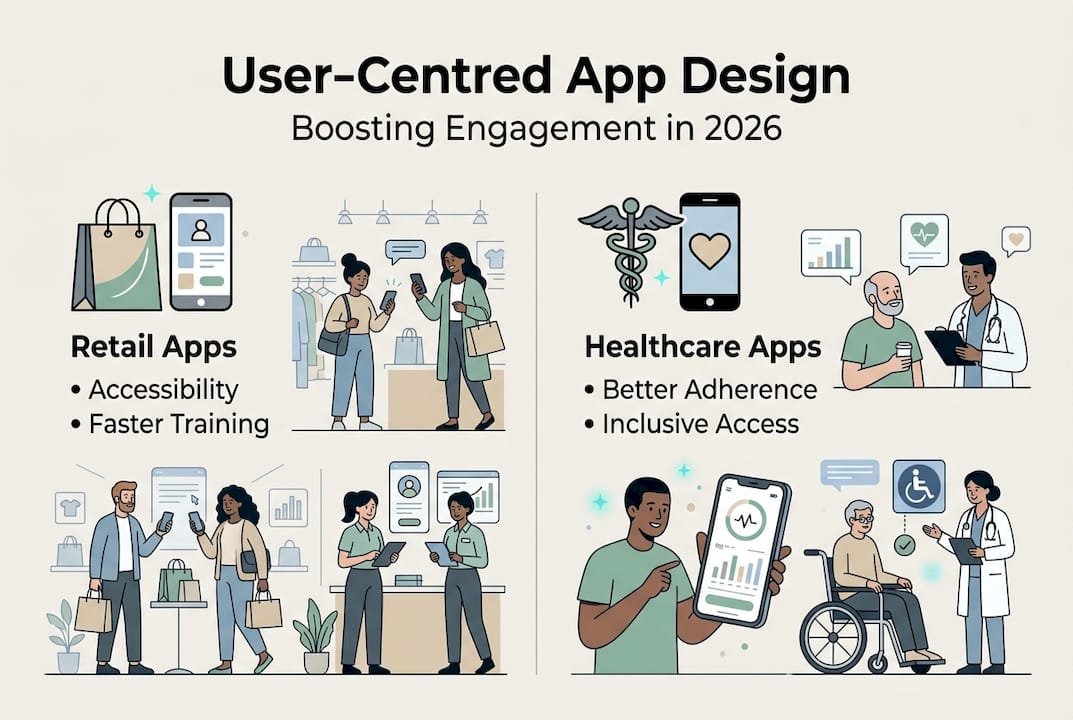
User-centred design means building applications around real user behaviours, limitations, and goals rather than developer assumptions or business preferences alone. This approach becomes especially critical in healthcare and retail where user diversity spans chronic disease patients with varying health statuses, employees managing disabilities, and customers with different technical abilities. User-centred design improves engagement and adherence in healthcare apps by tailoring interfaces to these diverse needs.
The retail sector faces similar challenges. Employees working in stores may have dyslexia, colour blindness, or limited smartphone experience. When apps ignore these realities, training time increases and errors multiply. Healthcare applications encounter even greater complexity because poor design directly impacts patient safety and treatment adherence.
Core benefits of user-centred design include:
- Tailored interactions matching user mental models and workflows
- Reduced cognitive load through intuitive navigation patterns
- Improved health outcomes via better medication adherence
- Enhanced workplace efficiency through accessible interfaces
- Lower support costs from fewer user errors
Accessibility proves especially vital for engagement. Healthcare benchmarks show low engagement in mHealth due to poor accessibility, which user-centred design addresses via adaptive UIs that improve self-management. When apps support screen readers, adjustable text sizes, and alternative input methods, users with disabilities can participate fully. This inclusive approach expands your potential user base whilst demonstrating social responsibility.
The distinction between surface-level polish and genuine user-centred design becomes clearer when examining app accessibility design principles. Authentic implementation requires continuous user research, iterative testing with real users, and willingness to rebuild features that look attractive but fail usability tests.
Challenges and nuances in applying user-centred design effectively
Despite widespread advocacy for user-centred approaches, implementation often falls short of promises. Many organisations treat user-centred design as a checkbox exercise, conducting superficial user interviews whilst making decisions based primarily on technical constraints or executive preferences. This gap between rhetoric and reality creates particular problems in healthcare settings.
User-centred design often becomes screen-centred buzzword in healthcare, ignoring systemic tradeoffs, ethics, and power dynamics, which leads to failures despite usability. When design teams focus exclusively on making screens easy to navigate, they miss deeper issues around clinical workflows, regulatory requirements, and organisational politics that determine whether apps succeed.
Ethical concerns compound these challenges. Healthcare apps collect sensitive data, influence treatment decisions, and affect vulnerable populations. A beautifully designed interface that encourages medication adherence might inadvertently pressure patients into treatments they don't fully understand or want. Power dynamics between clinicians and patients, insurance companies and providers, or employers and workers shape how apps get used regardless of interface quality.
Critical limitations of narrow user-centred approaches include:
- Ignoring systemic healthcare barriers like fragmented records
- Overlooking clinician burnout from excessive documentation
- Missing regulatory compliance requirements
- Failing to address organisational resistance to change
- Neglecting cost and reimbursement realities
Clinician burnout deserves particular attention. Electronic health record systems designed with user-centred principles still contribute to physician exhaustion when they increase documentation burden or interrupt clinical reasoning. Guideline adherence features that seem helpful in isolation may overwhelm practitioners already managing dozens of alerts daily.
"User-centred design without systemic thinking creates apps that work beautifully in isolation but fail when confronted with real healthcare complexity, organisational politics, and resource constraints."
These challenges don't invalidate user-centred design but highlight the need for broader perspectives. Understanding healthcare system challenges helps teams balance usability goals with practical constraints. Successful apps require both excellent user experience and realistic acknowledgement of the messy environments where they operate.
Integrating user-centred design with behavioural science and implementation frameworks
Combining user-centred design with behavioural theory and implementation science creates more robust solutions than either approach alone. Behavioural science explains why users make specific choices, whilst implementation science addresses how to embed new tools into existing workflows. This integration delivers measurable improvements in adoption rates and return on investment.
Key steps for effective integration include:
- Conduct detailed user research mapping current behaviours and pain points
- Develop personas representing diverse user motivations and barriers
- Apply behavioural frameworks like COM-B to identify intervention opportunities
- Design features addressing capability, opportunity, and motivation simultaneously
- Test prototypes with representative users in realistic contexts
- Measure adoption metrics and iterate based on actual usage patterns
Personas prove especially valuable when they capture behavioural drivers rather than just demographics. A retail employee persona might highlight someone who feels anxious about making mistakes in front of customers, leading to design choices that provide discreet help features rather than prominent tutorials. A chronic disease patient persona could reveal someone who forgets medications due to unpredictable daily routines, suggesting flexible reminder systems rather than fixed schedules.
Prioritising user-centred design for measurable ROI via higher engagement and sales works best when integrated with behavioural theory and personas for adoption. This evidence-based approach helps justify design investments to stakeholders focused on business outcomes.
Implementation science becomes critical for clinical decision support systems. These tools must balance usability with clinician workload, guideline accuracy, and patient safety. Combining user-centred design with implementation science for EHR clinical decision support balances usability, clinician burnout, and guideline adherence effectively.
Pro Tip: Start user research by observing actual workflows before conducting interviews. People often describe idealised versions of their behaviour rather than messy reality, so direct observation reveals pain points users themselves might not articulate.
The ROI benefits from this integrated approach extend beyond initial adoption. Apps designed with behavioural insights maintain engagement over time because they align with intrinsic motivations rather than relying on novelty. Understanding measuring app development ROI helps teams track these long-term benefits. Similarly, focusing on retail app user experience through behavioural lenses creates competitive advantages that compound over months and years.
Practical applications of user-centred design in retail and healthcare apps
Real-world implementations demonstrate how user-centred design principles translate into measurable improvements across retail and healthcare sectors. These examples illustrate both successful approaches and common pitfalls to avoid.

Retail applications face unique accessibility challenges. Retail edge cases like dyslexia and colour blindness in employee apps benefit from user-centred design via accessibility features like dark mode and intuitive icons, which reduces training time significantly. When a major retailer redesigned their employee scheduling app with these considerations, onboarding time dropped from three hours to forty minutes whilst error rates decreased by sixty-two percent.
Healthcare apps show even more dramatic results when properly designed. A diabetes self-management app that incorporated adaptive UI based on patient health literacy levels achieved seventy-eight percent sustained engagement after six months, compared to industry averages below thirty percent. The app adjusted explanation depth, visual complexity, and reminder frequency based on user behaviour patterns rather than forcing everyone through identical experiences.
| Feature Category | Retail Implementation | Healthcare Implementation | Measured Outcome | | --- | --- | --- | | Adaptive Interface | Icon-based navigation for dyslexic users | Health literacy-adjusted explanations | 40% faster task completion | | Accessibility | High contrast mode, screen reader support | Voice input for mobility limitations | 62% error reduction | | Behavioural Nudges | Shift reminder notifications | Medication adherence prompts | 78% sustained engagement | | Contextual Help | Just-in-time training tooltips | Symptom tracking guidance | 55% support cost reduction |
Priority accessibility improvements for app design include:
- Adjustable text sizes without breaking layouts
- Alternative text for all images and icons
- Keyboard navigation for users avoiding touchscreens
- Colour schemes meeting WCAG contrast ratios
- Error messages with clear recovery instructions
- Consistent navigation patterns reducing cognitive load
Pro Tip: Involve target user groups during early prototype testing rather than waiting for beta versions. A single session with five representative users often reveals critical usability issues that would cost ten times more to fix after launch.
The business case for these investments proves compelling. Organisations implementing comprehensive user-centred design report higher user satisfaction scores, lower support costs, and improved adherence rates. A healthcare provider network found that investing in accessible app design reduced call centre volume by thirty-eight percent whilst increasing patient portal usage by fifty-four percent.
Retail benefits extend beyond employee apps. Customer-facing applications designed with accessibility principles reach broader audiences and generate fewer abandoned transactions. When one grocery chain redesigned their shopping app following user-centred principles, conversion rates improved by twenty-three percent amongst users over sixty-five, a demographic they had previously struggled to engage digitally.
Discover expert mobile app design and development services
Implementing user-centred design principles effectively requires specialised expertise in research methodologies, accessibility standards, and behavioural science integration. Pocket App brings over a decade of experience designing mobile app development solutions that prioritise genuine user needs across retail and healthcare sectors.
Our application design services combine rigorous user research with iterative prototyping, ensuring your app addresses real user challenges rather than assumed requirements. We've delivered over 300 projects for organisations ranging from major retailers to healthcare providers, consistently achieving measurable improvements in engagement and functionality. Clients highlight our ability to balance ambitious feature requirements with practical usability constraints, delivering apps that users actually adopt and continue using months after launch. Explore our approach to professional app design and discover how strategic user-centred thinking transforms app outcomes.
Frequently asked questions
What is user-centred design in app development?
User-centred design focuses on building applications around the actual needs, behaviours, and limitations of end users rather than developer assumptions. This approach ensures functionality and interfaces align with real user requirements through iterative research and testing.
How does user-centred design improve app engagement?
By addressing accessibility, usability, and contextual user needs, apps become more intuitive and satisfying to use. Users are significantly more likely to adopt and consistently engage with applications tailored to their specific circumstances and capabilities.
What are common challenges in implementing user-centred design in healthcare?
Over-focusing on screen usability whilst ignoring systemic healthcare complexities creates major problems. Teams must balance clinician workload concerns, ethical considerations, and diverse patient needs whilst ensuring representative user groups participate throughout design processes.
How can retail apps benefit from user-centred design?
Improved accessibility features reduce training time and operational errors significantly. Elements like dark mode, intuitive icons, and simplified navigation enhance usability for diverse employee populations, resulting in better efficiency and job satisfaction.
Where can I learn more about measuring ROI from user-centred design in app projects?
Understanding return on investment involves tracking engagement metrics, retention rates, and business outcomes over time. Resources like measuring app ROI guides provide practical frameworks for quantifying design investments against measurable business results.