
TL;DR:
- Poor app performance erodes user trust and increases support costs silently over time.
- Faster load times and responsiveness significantly boost user engagement and retention.
- Business leaders should prioritize app performance as a strategic, ongoing commitment for success.
Why app performance matters: boost engagement and efficiency
Most businesses assume that if their app loads and processes requests without crashing, it is doing its job. That assumption is costing them more than they realise. Poor app performance rarely announces itself through complete failure. Instead, it erodes user trust gradually, drives up operational costs quietly, and chips away at brand reputation in ways that are difficult to attribute and even harder to recover from. Slow networks or unexpected user actions often undermine app performance and user experience before anyone on the development team notices. This article covers why performance is central to user engagement, staff productivity, and long-term business outcomes.
Table of Contents
- The overlooked costs of poor app performance
- How app performance drives user engagement
- Operational efficiency: the business case for high-performing apps
- Mitigating common performance pitfalls: evidence-based strategies
- Why app performance should be a boardroom priority
- Unlock better performance with expert support
- Frequently asked questions
Key Takeaways
| Point | Details |
|---|---|
| Hidden risks | Small performance lapses often lead to big business problems if ignored. |
| User engagement | Fast, reliable apps keep users coming back and drive retention. |
| Operational savings | High-performing apps reduce support costs and downtime for businesses. |
| Proactive strategies | Identifying and eliminating edge cases early prevents future failures. |
| Strategic importance | Making app performance a boardroom issue safeguards long-term success. |
The overlooked costs of poor app performance
With the stakes established, let us examine the hidden and tangible costs of failing to prioritise app performance.
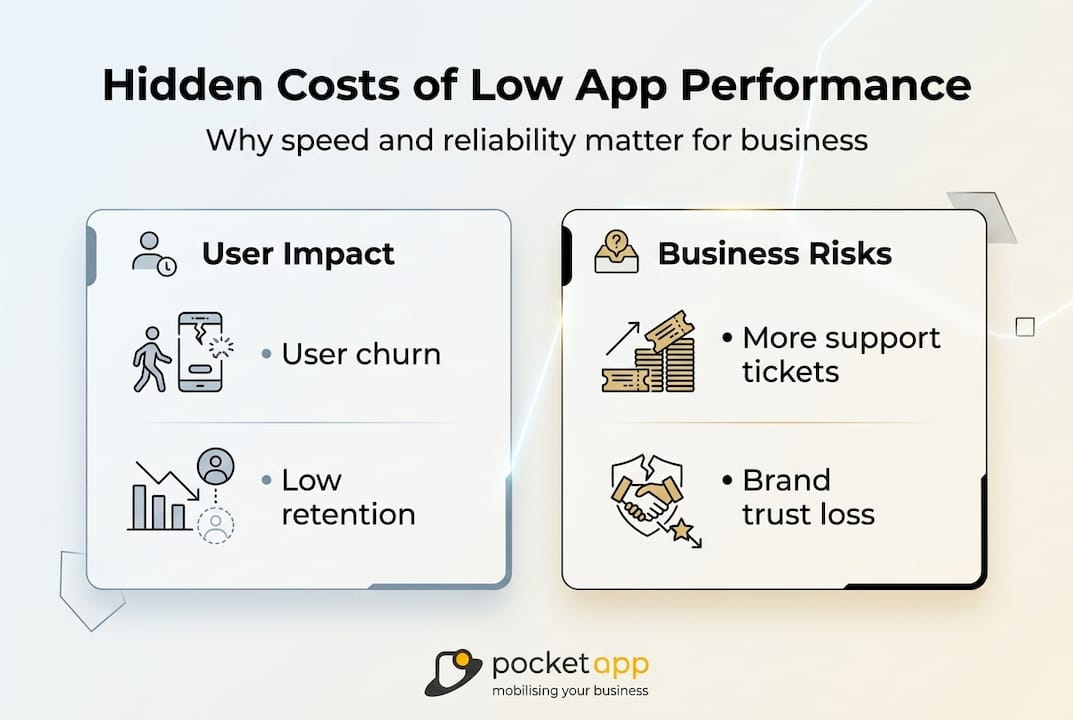
Most organisations measure app success by uptime and crash rates. These are useful metrics, but they paint an incomplete picture. An app can be technically "live" while quietly frustrating thousands of users through sluggish load times, unresponsive buttons, or inconsistent behaviour on slower connections. These subtle failures are often more damaging than outright crashes because they are harder to detect and slower to escalate through support channels.
The failure modes that matter most are not dramatic. According to real production experience, common failure modes that surface in real-world use include:
- Offline or slow network conditions causing incomplete data loads or silent errors
- Empty API responses that leave users staring at blank screens
- Background and foreground transitions breaking session continuity
- Memory pressure causing unexpected freezes on older or budget devices
- Unexpected user actions triggering inconsistent or broken states
Each of these scenarios represents a moment where a user's confidence in your product drops. A single bad experience rarely ends a relationship outright. But repeated friction does. Users do not typically file a complaint; they simply stop returning.
"The most dangerous performance problems are the ones that don't throw an error. They just quietly disappoint."
The business consequences extend well beyond user churn. When performance is inconsistent, support ticket volumes rise. Your team spends time troubleshooting edge cases rather than improving the product. Developers get pulled into reactive firefighting rather than forward-focused work. These costs are real, but rarely appear on a performance dashboard.
Brand trust is also at risk. When a customer associates your app with lag, confusion, or unreliability, that perception transfers to your wider business. In competitive markets, particularly retail, healthcare, and financial services, a poor app experience is enough to send users directly to a competitor. Achieving operational excellence with mobile apps requires treating performance as a strategic concern, not a technical afterthought.
The practical challenge is that many of these failures only appear under real-world conditions. Controlled testing environments, fast office Wi-Fi, and the latest test devices do not replicate the messy reality of a commuter using your app on a congested network, or a field worker switching between mobile data and Wi-Fi mid-session. Understanding why apps are crucial for business success means accepting that performance standards must be set against real user conditions, not ideal ones.
How app performance drives user engagement
Now that we understand the costs, let us explore how app performance tangibly boosts user engagement and retention.
Speed is not a feature; it is the foundation on which every other feature rests. If your app takes more than two or three seconds to load key content, a measurable proportion of users will abandon the session entirely. They will not pause to consider whether your onboarding is elegant or your checkout flow is seamless. They will simply leave.
Responsiveness matters just as much as raw speed. An app that loads quickly but stutters during navigation, lags on button presses, or freezes during transitions creates a sense of unreliability that is difficult to shake. Slow networks and unexpected behaviour can undermine app performance, leading to inconsistent states and poor engagement even when the underlying product design is strong.

The relationship between load time and engagement is well documented across the industry. Consider how performance benchmarks align with user behaviour:
| App load time | Estimated user drop-off | Session depth impact |
|---|---|---|
| Under 1 second | Minimal (under 5%) | High engagement maintained |
| 1 to 2 seconds | Low (5 to 10%) | Slight reduction in depth |
| 2 to 3 seconds | Moderate (15 to 25%) | Noticeable drop in actions taken |
| Over 3 seconds | High (40%+) | Severe abandonment risk |
These figures are not absolute, but the direction is consistent: every extra second costs you users and reduces the value of every interaction. For apps serving business-critical functions, whether that is field reporting, stock management, customer service, or e-commerce, that cost is compounded by the operational value each session is meant to deliver.
Improving app UX step by step involves more than aesthetic decisions. Performance directly shapes how users perceive the quality and trustworthiness of the experience. A fast, reliable app signals that your organisation is competent and cares about the user's time.
Pro Tip: When auditing performance bottlenecks, start with the most-used user journeys rather than edge cases. The login screen, home dashboard, and key transactional flow account for the majority of user experience impressions. Fix the high-traffic paths first, then systematically address lower-frequency scenarios.
The most powerful engagement drivers in high-performing apps share common characteristics. They load critical content instantly, handle errors gracefully with clear messaging, maintain smooth animation at 60 frames per second, and recover seamlessly when connectivity drops. These design tips for engagement are not luxury additions; they are the baseline expectation for users who interact with best-in-class apps daily.
- Prioritise perceived performance: use skeleton screens and progressive loading to make apps feel faster
- Cache frequently accessed data to reduce dependency on live network calls
- Provide clear, friendly feedback when something is loading or has failed
- Avoid blocking the main thread with heavy computation during user interactions
Operational efficiency: the business case for high-performing apps
Boosting user engagement is vital, but operational gains are just as compelling for UK businesses.
When an app performs reliably, the ripple effect across your organisation is significant. Staff who depend on internal apps to log data, process orders, or communicate with customers are directly affected by performance quality. A sluggish app does not just slow down one task; it slows down every task that depends on it. Multiply that across a team of twenty, fifty, or five hundred employees, and the productivity loss becomes substantial.
Edge cases and performance issues increase operational fragility and support load. When a field worker's app freezes during data entry, or a warehouse app fails to sync inventory updates reliably, the downstream consequences include manual workarounds, data errors, and management time spent on troubleshooting rather than strategy. These are real costs that rarely appear on a technology budget line, but they absolutely appear on the bottom line.
Here are the most significant operational wins that come from investing in robust app performance:
- Reduced support burden: Fewer crashes and edge case failures mean fewer support tickets, shorter resolution times, and lower helpdesk operating costs.
- Faster staff workflows: Employees complete tasks more quickly when apps are responsive, reducing time-on-task and improving throughput across the business.
- Better data quality: Apps that handle errors gracefully and sync reliably produce cleaner, more consistent data for reporting and decision-making.
- Lower development firefighting: A stable app requires less reactive patching, freeing developer time for planned improvements and new features.
- Improved compliance confidence: In regulated industries, consistent app behaviour is essential for audit trails and process integrity.
The financial argument is compelling. Businesses that invest in performance testing and monitoring during development consistently report lower post-launch support costs and faster feature release cycles. Reviewing app success tips for 2026 makes clear that performance investment before launch is significantly cheaper than reactive remediation after.
Statistic callout: Research across enterprise software consistently shows that reducing app load time by just one second can improve conversion and task completion rates by double digits. For internal business apps, even modest performance improvements translate directly into measurable efficiency gains across a workforce.
Pro Tip: Run performance tests using real devices on real networks, including 3G and congested Wi-Fi conditions. Emulators and office broadband will not reveal the bottlenecks your field users encounter daily. Pair this with analytics that capture real session performance, not just crash reports. Understanding cloud-based ROI also reveals how infrastructure choices upstream of the app influence the performance your users actually experience.
Mitigating common performance pitfalls: evidence-based strategies
To prevent these operational and engagement headaches, let us focus on concrete ways to address app performance weaknesses.
Ignoring edge cases in development leads to fragile apps that appear to work until real-world scenarios reveal fundamental weaknesses. The most effective way to address this is to shift from a reactive mindset, fixing problems as they appear in production, to a proactive one, anticipating failure modes before they reach users.
| Approach | Reactive strategy | Proactive strategy |
|---|---|---|
| When issues are caught | After user complaints | During development and QA |
| Cost of resolution | High (emergency patches, lost users) | Low (early fixes, stable release) |
| Impact on reputation | Visible and damaging | Largely invisible to users |
| Team workload | Unpredictable and stressful | Planned and manageable |
| Monitoring type | Crash reporting only | Full performance analytics |
The contrast is stark. Reactive approaches push responsibility onto users to discover failures, while proactive strategies treat performance as a quality standard built into every release cycle.
To build apps that hold up in production, development teams should cover the following edge cases as standard practice:
- Testing on low-end devices that represent the lower end of your user base's hardware
- Simulating slow and intermittent network connections throughout the user journey
- Handling empty, malformed, or delayed API responses without breaking the UI
- Testing transitions between background and foreground app states
- Stress-testing with concurrent users to surface memory and threading issues
Ongoing monitoring is equally important. A single round of pre-launch testing is not sufficient. Performance characteristics can change as your user base grows, your data volume increases, or third-party API dependencies shift. Building a streamlined app workflow includes embedding performance checkpoints into regular release cycles, not just at launch.
The most resilient apps treat performance improvement as a continuous process. Teams track key metrics such as startup time, API response time, frame rate during animations, and memory usage over time. When those metrics drift, they investigate before users notice. Investing in innovation in app design should never come at the expense of the foundational stability that makes those innovations worth using.
Why app performance should be a boardroom priority
Most organisations do not think about app performance until something breaks badly enough to generate complaints. By then, the cost is already paid, often in the form of lost users, a bruised brand, or an emergency development sprint that disrupts the wider roadmap.
The reality we see repeatedly at Pocket App is that performance is treated as a technical concern rather than a business one. CTOs understand its importance, but boards and senior decision-makers often view it as a detail to be managed by the development team. That division is a strategic mistake. App performance is digital infrastructure. Neglecting it is no different from neglecting the physical systems your business depends on. You would not defer essential maintenance on your warehouse or distribution network because it was working last month. The same logic applies here.
The most effective business leaders we work with treat performance budgets the same way they treat operational budgets. They set standards, measure against them, and invest proactively to maintain them. This business leader's app guide positions performance not as a cost, but as a competitive differentiator. Because when your app is reliably fast and your competitor's is not, users notice, and they stay.
Unlock better performance with expert support
If the performance of your app is not delivering the user engagement and operational efficiency your business needs, expert guidance can make all the difference.
At Pocket App, we have delivered over 300 mobile projects across retail, healthcare, charity, and enterprise sectors. We understand that performance is not a one-time fix; it is a strategic commitment built into every stage of development. Our mobile app development services are designed to identify and resolve performance risks before they reach your users. Whether you are building from scratch or optimising an existing product, our team brings the technical rigour and real-world experience needed to make your app perform at its best. Explore our business app projects to see how we help UK organisations achieve measurable results.
Frequently asked questions
What are the most common causes of app performance issues?
Edge cases are a leading cause of app performance failures, including slow networks, unexpected user actions, and resource constraints that are rarely replicated in controlled testing environments.
How does app performance affect user engagement?
Poor app performance directly undermines user objectives and satisfaction, with even a one-second delay significantly increasing abandonment rates and reducing the depth of each session.
What can businesses do to prevent app performance problems?
Teams should anticipate and test real-world edge cases, integrate continuous monitoring throughout the development cycle, and treat performance benchmarks as non-negotiable quality standards rather than optional targets.
Why should app performance concern business leaders?
Business consequences of poor performance include damaged brand reputation, higher operational costs, and reduced staff productivity, making it a strategic priority rather than a purely technical one.