
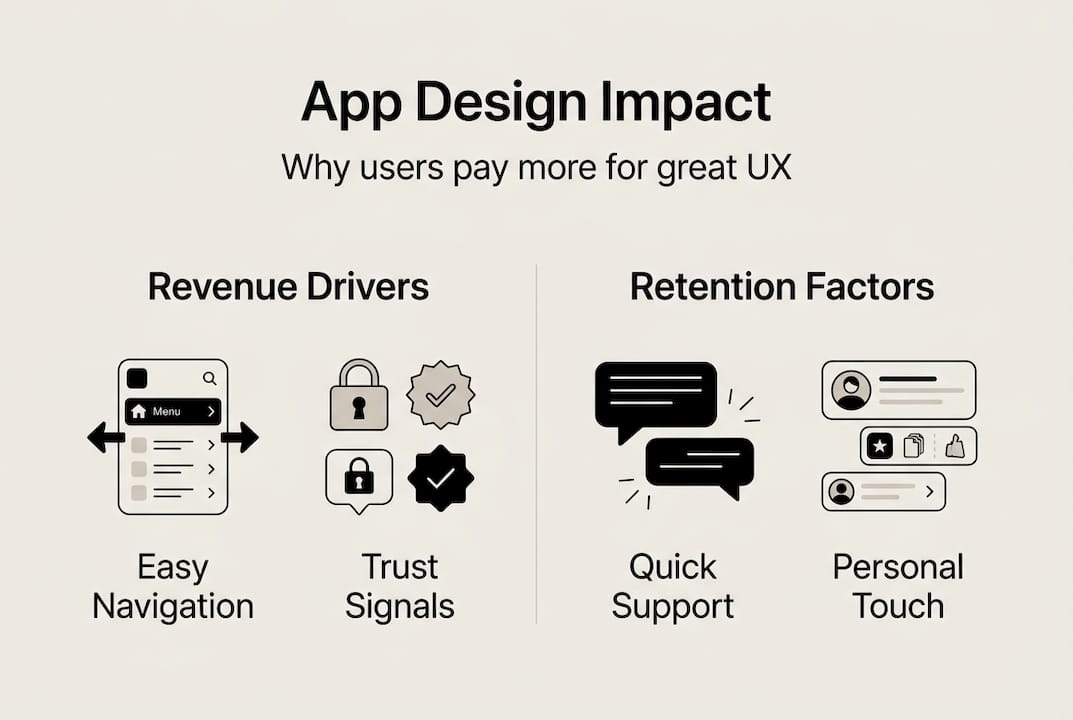
Many businesses invest heavily in app functionality while treating design as an afterthought. Yet research reveals that 86% of buyers willingly pay more for superior customer experience through design. This gap between perception and reality costs companies millions in lost revenue and user retention. Effective app design isn't just about aesthetics; it directly influences whether users stay, convert, and recommend your product. This guide explains why app design matters for business success across retail and healthcare sectors, backed by evidence and practical frameworks you can apply immediately.
Table of Contents
- Key takeaways
- How app design influences user retention and revenue
- Human-centred and accessible design principles
- Designing for edge cases and real-world challenges
- Applying data-driven design methods in retail and healthcare apps
- Explore expert app design and development services
- Frequently asked questions about why app design matters
Key Takeaways
| Point | Details |
|---|---|
| Design drives revenue | Quality design directly impacts revenue potential by increasing conversion and customer willingness to pay. |
| Performance boosts retention | Performance optimisations boost retention by 30 per cent and can lift conversions by up to 400 per cent. |
| Page speed matters | In retail, optimising page speed through design improvements delivered 29 per cent higher conversions and 44 per cent revenue growth. |
| Human centred design | Human centred design places user needs, behaviours and contexts at the core, using real user observations and iterative testing. |
| Accessibility and personalisation | Accessibility and personalisation drive engagement across industries. |
How app design influences user retention and revenue
App design directly shapes whether users continue engaging with your product or abandon it after the first session. The numbers tell a compelling story: performance optimisations boost retention by 30% and can increase conversions up to 400%. These aren't marginal gains. They represent the difference between an app that thrives and one that drains resources without delivering returns.
Consider how design affects purchasing behaviour. When customers encounter smooth navigation, fast load times, and intuitive interfaces, they perceive higher value. This perception translates into willingness to pay premium prices for apps that respect their time and cognitive load. The retail sector demonstrates this principle clearly: a jewellery store achieved 29% higher conversion rates and 44% revenue growth simply by optimising page speed through design improvements.
Performance sits at the heart of effective design. Users form judgments about your app within milliseconds. Slow loading times, clunky transitions, or confusing layouts trigger immediate abandonment. Healthcare apps face particularly high stakes since users rely on them for critical health information and medication adherence. Poor design in these contexts doesn't just lose customers; it potentially harms patient outcomes.
"86% of buyers will pay more for a superior customer experience through design, demonstrating that quality design directly impacts revenue potential."
Several design factors consistently influence retention and revenue across industries:
- Visual hierarchy that guides users naturally toward high-value actions without overwhelming them
- Responsive performance that maintains speed even under poor network conditions or heavy usage
- Consistent interaction patterns that reduce cognitive load and build user confidence
- Contextual feedback that confirms actions and prevents user uncertainty
- Streamlined flows that eliminate unnecessary steps between intent and completion
The retail and healthcare sectors both benefit from innovation in app design success principles. Retail apps convert browsers into buyers through frictionless checkout experiences and personalised product recommendations. Healthcare apps improve medication adherence and patient engagement through clear information architecture and timely reminders. Both rely on mobile app designers UK expertise to translate business goals into user-centred interfaces.
Design quality compounds over time. Users who experience well-designed apps develop loyalty and become advocates. They tolerate occasional bugs more readily and provide constructive feedback. Conversely, poor initial design impressions create lasting negative associations that no amount of functionality can overcome. Your app's design serves as the first and most persistent touchpoint with users, making it the foundation of sustainable business growth.
Human-centred and accessible design principles
Human-centred design places user needs, behaviours, and contexts at the core of every design decision. Rather than building features based on assumptions, this methodology involves observing real users, understanding their goals, and iteratively testing solutions. The approach recognises that users interact with apps whilst distracted, stressed, or multitasking. Designs must accommodate these realities rather than demanding ideal conditions.

Key methodologies include human-centred design, accessibility, performance optimisation, and personalisation. Each addresses different aspects of user experience whilst reinforcing the others. Human-centred design establishes the foundation by ensuring features solve actual problems. Accessibility extends reach to users with disabilities, representing both ethical responsibility and business opportunity. Performance optimisation ensures designs function smoothly across devices and network conditions. Personalisation tailors experiences to individual preferences and contexts.
Accessibility deserves particular attention because accessibility and personalisation are crucial for inclusion and engagement. Approximately 15% of the global population experiences some form of disability. Designing exclusively for able-bodied users excludes this substantial market segment. Moreover, accessibility features benefit everyone. Captions help users in noisy environments. Voice controls assist whilst driving. High-contrast modes reduce eye strain. These universal design principles improve experiences across user populations.
Personalisation transforms generic apps into relevant tools that users integrate into daily routines. Retail apps recommend products based on browsing history and purchase patterns. Healthcare apps adjust reminder timing based on user schedules and medication adherence patterns. This relevance increases engagement because users perceive the app as understanding their specific needs rather than broadcasting one-size-fits-all messages.
Implementing these design methodologies requires systematic approaches:
- Conduct user research through interviews, surveys, and observation to identify genuine needs and pain points
- Create user personas representing key audience segments with distinct goals and challenges
- Map user journeys to visualise how people interact with your app across different scenarios
- Build prototypes early and test them with real users before committing to full development
- Iterate based on feedback, measuring changes against clear success metrics
- Ensure colour contrast ratios meet WCAG standards for users with visual impairments
- Provide alternative text for images and proper heading structures for screen readers
- Design touch targets large enough for users with motor control challenges
Pro Tip: Integrate app accessibility design from project inception rather than retrofitting it later. Early accessibility consideration costs substantially less than redesigning completed interfaces and prevents excluding users during initial launch phases.
The business case for human-centred and accessible design extends beyond ethical considerations. These approaches reduce development costs by identifying problems early when changes cost less. They increase market reach by serving diverse user populations. They improve user satisfaction scores and app store ratings, which directly influence download rates. Most importantly, they create competitive advantages in crowded markets where personalisation in mobile apps differentiates winners from also-rans.
Designing for edge cases and real-world challenges
Edge cases represent unusual but realistic scenarios that test whether your app handles unexpected inputs gracefully or fails catastrophically. A user entering a name with special characters. Someone attempting to book an appointment at midnight. A customer with an address that doesn't fit standard formatting. These situations occur less frequently than typical use cases, yet edge cases aren't rare and significantly affect brand trust and user experience.
Ignoring edge cases creates frustration that disproportionately damages your reputation. Users encountering errors during critical tasks like checkout or appointment booking don't blame themselves. They blame your app and share negative experiences with others. Healthcare apps face particularly severe consequences since edge case failures might prevent patients from accessing medication information or booking urgent appointments. The principle of designing first for failures and edge cases builds user trust by demonstrating your app works reliably under diverse conditions.
Consider common edge case scenarios across retail and healthcare apps. A retail customer might have multiple delivery addresses, gift purchases requiring separate billing, or need to modify orders after submission. Healthcare users might manage medications for family members, require appointment rescheduling during closed hours, or need to access information whilst offline. Each scenario demands thoughtful design that accommodates reality rather than forcing users into rigid workflows.
Designing for edge cases requires systematic approaches:
- Map all possible user inputs and system states, including unusual combinations and extreme values
- Prioritise edge cases based on potential impact and likelihood, focusing first on scenarios affecting critical user tasks
- Design clear error messages that explain what went wrong and how users can resolve issues
- Provide fallback options when primary workflows fail, ensuring users can still accomplish goals through alternative paths
- Test thoroughly with diverse data sets including special characters, extreme values, and unusual formatting
- Monitor production logs to identify edge cases users encounter that testing missed
- Iterate designs based on real-world usage patterns rather than assumptions about typical behaviour
| Approach | Typical design | Edge-case-resilient design |
|---|---|---|
| Input validation | Accepts standard formats only | Handles variations gracefully with helpful guidance |
| Error handling | Generic error messages | Specific explanations with clear resolution steps |
| User flows | Single optimal path | Multiple pathways accommodating different scenarios |
| Data handling | Assumes clean, consistent data | Processes messy real-world data without breaking |
| Offline functionality | Requires constant connectivity | Provides degraded but functional offline experiences |
Pro Tip: Test your app with actual user data rather than sanitised test data to uncover hidden edge cases. Real data contains inconsistencies, special characters, and unusual patterns that reveal design weaknesses before users encounter them in production.
The art of mobile app design includes anticipating how users deviate from expected behaviours. Users rarely follow the perfect paths designers envision. They multitask, get interrupted, make mistakes, and approach tasks from unexpected angles. Designs that accommodate this messiness feel more intuitive because they match how humans actually behave rather than how we wish they would.
Edge case design also demonstrates respect for user diversity. Not everyone has typical names, addresses, or life circumstances. Apps that handle edge cases gracefully signal inclusivity and attention to detail. This perception builds trust that extends beyond individual interactions, creating loyal users who recommend your app because it works reliably when others fail.
Applying data-driven design methods in retail and healthcare apps
Data-driven design replaces assumptions with evidence by systematically testing design decisions and measuring their impact on user behaviour. Methods like A/B testing compare different design variations to identify which performs better. Randomised controlled trials (RCTs) apply rigorous scientific standards to validate whether design changes genuinely improve outcomes. Conjoint analysis reveals which features users value most when making decisions. These approaches transform design from subjective preference into measurable business strategy.
Healthcare apps particularly benefit from evidence-based design methods because they directly influence patient health outcomes. RCTs and conjoint analysis are key in healthcare app design improvement, validating whether features like medication reminders or educational content actually improve adherence. One study demonstrated that behavioural science methods increased retention and adherence in healthcare apps by applying psychological principles validated through controlled testing.
Retail apps leverage data-driven design to optimise conversion funnels and increase average order values. A/B testing reveals whether simplified checkout processes increase completion rates. Multivariate testing identifies which product image styles drive more clicks. Analytics data shows where users abandon shopping carts, highlighting friction points requiring design attention. This empirical approach removes guesswork and focuses resources on changes delivering measurable returns.
Key data-driven techniques deliver specific business benefits:
- A/B testing compares design variations to identify which increases desired behaviours like purchases or bookings
- Heatmaps reveal where users focus attention, informing layout decisions and call-to-action placement
- Session recordings show how real users navigate apps, exposing confusion points and workflow inefficiencies
- Funnel analysis identifies where users drop off during multi-step processes like registration or checkout
- Cohort analysis tracks how design changes affect different user segments over time
- Surveys and feedback mechanisms capture qualitative insights explaining quantitative patterns
| Metric | Without data-driven design | With data-driven design |
|---|---|---|
| Retail conversion rate | 2.1% baseline | 3.8% after optimised checkout flow |
| Healthcare medication adherence | 45% baseline | 68% with reminder timing optimisation |
| Retail average order value | £47 baseline | £63 with personalised recommendations |
| Healthcare app engagement | 3.2 sessions/week | 5.7 sessions/week with behavioural nudges |
| Retail cart abandonment | 72% baseline | 54% with streamlined payment options |
The mobile app design art combines creative vision with empirical validation. Designers generate innovative solutions whilst data confirms which innovations actually serve users effectively. This balance prevents both sterile designs that ignore creativity and beautiful designs that fail to achieve business objectives.
Implementing data-driven design requires establishing clear metrics before making changes. Define what success looks like for each design decision. Retail apps might measure conversion rates, average order values, or repeat purchase frequency. Healthcare apps might track medication adherence rates, appointment booking completion, or feature engagement. These metrics provide objective standards for evaluating design effectiveness.
Iteration forms the core of data-driven design. Initial designs rarely achieve optimal results. Testing reveals opportunities for refinement. Small changes compound into significant improvements over time. An app accessibility designing approach that incorporates user feedback and usage data ensures designs evolve based on real needs rather than static assumptions.
Data-driven methods also build organisational alignment around design decisions. Stakeholders often have conflicting opinions about interface choices or feature priorities. Empirical evidence replaces subjective debates with objective outcomes, focusing discussions on what actually works rather than personal preferences. This alignment accelerates decision-making and reduces costly redesigns based on shifting opinions.
Explore expert app design and development services
Transforming these design principles into successful apps requires specialised expertise across user research, interface design, and technical implementation. Pocket App brings over 300 projects of experience designing and developing mobile applications for retail, healthcare, and diverse sectors. Our approach integrates human-centred design, accessibility, performance optimisation, and data-driven iteration from project inception.
We create customised solutions that address your specific business challenges whilst delivering exceptional user experiences. Whether you need app design services for a new concept or mobile app development to bring existing designs to life, our team applies evidence-based methodologies that drive measurable results. Explore our business app development capabilities to discover how strategic design enhances brand engagement and operational effectiveness across industries.
Frequently asked questions about why app design matters
Why is app design more important than just functionality?
App design determines whether users can actually access and benefit from your functionality. Even powerful features become useless if users can't find them, understand them, or use them efficiently. Design creates the bridge between what your app can do and what users accomplish with it.
How does app design improve user retention?
Effective design reduces friction, provides clear feedback, and creates satisfying interactions that encourage repeated use. Performance optimisations prevent frustration from slow loading. Intuitive navigation helps users accomplish goals quickly. These positive experiences build habits that keep users returning rather than abandoning your app after initial downloads.
What role does accessibility play in app design?
Accessibility ensures users with disabilities can fully engage with your app whilst improving experiences for all users. Features like proper colour contrast, screen reader support, and flexible text sizing serve diverse needs. Accessible design of apps expands your market reach and demonstrates commitment to inclusive experiences.
How can businesses test if their app design works?
A/B testing compares design variations to measure which performs better on key metrics. User testing sessions reveal where people struggle or succeed with your interface. Analytics data shows actual usage patterns, drop-off points, and engagement levels. Combining these methods provides comprehensive evidence about design effectiveness.
What risks do edge cases pose if ignored?
Unhandled edge cases create failures during critical user tasks, damaging trust and driving negative reviews. Users encountering errors during checkout, booking, or information access blame your app rather than unusual circumstances. These failures disproportionately affect reputation because frustrated users share negative experiences more readily than positive ones.