
TL;DR:
- Cloud-based app development offers UK businesses cost savings of 20-50% and rapid scalability.
- Architectures include serverless, containers, and hybrid, each suited for different workload needs.
- Challenges like cold starts and vendor lock-in require strategic planning and ongoing review.
Custom mobile applications built on cloud infrastructure are delivering measurable returns for UK businesses of every size, yet many organisations still assume this territory belongs only to tech startups or global corporations. Cloud reduces costs 20-50% compared to on-premises alternatives, and the global custom software market is growing at a 22.6% compound annual rate through 2030. Whether you run a retail brand, a healthcare provider, or a B2B services firm, this guide breaks down the architectures, business benefits, real challenges, and practical steps you need to make confident decisions about your next cloud-based app project.
Table of Contents
- What is cloud-based app development?
- Key architectures and models: serverless, containers, and hybrid
- How cloud-based development drives business value
- Challenges and pitfalls in cloud app development
- Best practices for a successful cloud app project
- A practical perspective: why one-size-fits-all rarely works
- Tap expert help for your cloud app development
- Frequently asked questions
Key Takeaways
| Point | Details |
|---|---|
| Cloud cuts business costs | Shifting app development to the cloud typically lowers long-term infrastructure and management costs. |
| Hybrid models for resilience | Combining serverless and containers often gives the best flexibility and performance for custom business apps. |
| Cloud boosts ROI and agility | UK firms see rapid development cycles, scalable apps and improved engagement using cloud-based models. |
| Plan for challenges | Early awareness of pitfalls like execution limits or vendor lock-in helps you avoid costly missteps. |
What is cloud-based app development?
Cloud-based app development means building, hosting, and managing your application using remote computing resources rather than physical servers you own and maintain. Instead of buying hardware, configuring data centres, and managing IT infrastructure in-house, you provision resources from a cloud provider and pay for what you actually use. The app itself, along with its data, logic, and services, lives in the cloud and is accessible to users via any device with an internet connection.
This is fundamentally different from traditional development, where teams would deploy apps onto dedicated servers, scale by purchasing more hardware, and manage every layer of the stack themselves. Cloud-based development shifts that burden to the provider, freeing your team to focus on features, user experience, and business outcomes.
Typical use cases for UK businesses include:
- Customer-facing portals for retail, loyalty programmes, and brand engagement
- Workforce tools for field teams, logistics, or remote operations
- B2B platforms for partner management, data sharing, and reporting
- Healthcare and charity apps requiring secure, scalable data handling
The core advantages are rapid scaling (your app handles ten users or ten million without a rebuild), reduced IT burden, and the ability for distributed teams to collaborate in real time. Following cloud app development practices that prioritise modularity and reusability accelerates delivery significantly. Exploring cross-platform app approaches alongside cloud hosting also means reaching iOS and Android audiences from a single codebase.
Pro Tip: A UX investment of $1 can return $100 in value. Prioritise user experience from day one rather than retrofitting it after launch.
Key architectures and models: serverless, containers, and hybrid
Understanding the basics, it is crucial to examine how different cloud models can impact your project's agility and costs. Three architectures dominate modern cloud app development, and each suits different business scenarios.
Serverless means your code runs in response to events without you managing any server infrastructure. You upload functions, the cloud provider handles execution, and you pay only when the code runs. Containers package your application and its dependencies into portable units that run consistently across any environment. Hybrid combines both, using serverless for variable workloads and containers for services requiring persistent state or low latency.
| Model | Speed to deploy | Cost profile | Scalability | Best for |
|---|---|---|---|---|
| Serverless | Very fast | Pay-per-use | Automatic | Bursty, event-driven tasks |
| Containers | Moderate | Predictable | Manual or auto | Consistent, stateful workloads |
| Hybrid | Moderate | Balanced | Flexible | Complex, multi-service apps |
For platform selection, AWS suits breadth and enterprise scale, while GCP and Firebase excel for mobile development speed and real-time features, and Azure leads for enterprise hybrid environments. Choosing the right platform early shapes everything from your developer tooling to your long-term costs.
Serverless is excellent for bursty traffic with low operational overhead, but containers outperform it for consistent load and persistent state, making hybrid the optimal choice for most real-world business apps. Our business leader's guide explores these trade-offs in greater depth.
Pro Tip: Map your expected traffic patterns before choosing an architecture. A loyalty app with seasonal spikes suits serverless. An internal workforce tool with steady daily usage suits containers.
How cloud-based development drives business value
With architectural options in mind, let us connect the technology to the tangible benefits businesses actually realise. Cloud platforms compress the time between idea and live product significantly. Continuous integration and deployment pipelines mean new features ship in days rather than months, letting you respond to customer feedback and market shifts faster than competitors still tied to legacy infrastructure.
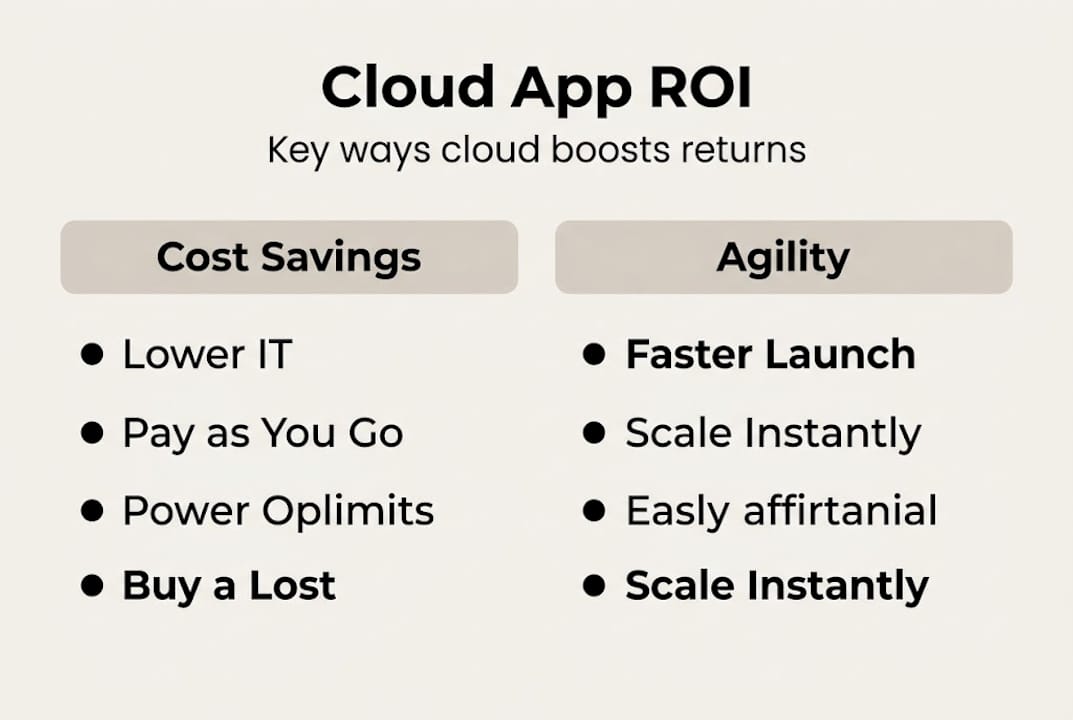
Enhanced user experience is another direct driver of commercial value. Apps that load quickly, personalise content, and stay available around the clock generate stronger engagement and repeat use. Operational excellence with mobile apps is increasingly tied to cloud-native architectures that support real-time data, push notifications, and seamless updates.

| Business metric | Cloud-based impact |
|---|---|
| Infrastructure cost | 20-50% reduction vs on-premises |
| Time to market | Weeks faster per release cycle |
| Scalability | Instant, without hardware procurement |
| UX investment return | Up to $100 per $1 spent |
The global custom software CAGR of 22.6% through 2030 signals that businesses investing now are building durable competitive advantages. Key practical benefits include:
- Reduced capital expenditure on IT infrastructure
- Faster iteration based on real user data
- Ability to scale internationally without physical expansion
- Improved security through managed cloud compliance frameworks
- Greater resilience with built-in redundancy and failover
Exploring the full range of mobile app benefits and understanding how to approach measuring app ROI will help you build a compelling internal business case.
Challenges and pitfalls in cloud app development
Of course, no technology is without its hurdles. Success means recognising and navigating these potential pitfalls before they derail your project or inflate your budget.
Common challenges include:
- Cold starts: Serverless functions that have been idle take 100 to 900 milliseconds to initialise, which can degrade user experience in latency-sensitive features
- Vendor lock-in: Building tightly around one provider's proprietary services makes migration expensive and complex later
- Execution limits: Serverless functions typically cap at 15 minutes per execution, unsuitable for long-running processes
- Debugging complexity: Distributed, event-driven architectures are harder to trace and diagnose than monolithic apps
- Unpredictable costs: High-scale traffic can generate unexpected bills if usage thresholds are not monitored carefully
- Database connection issues: Serverless functions can exhaust database connection pools under heavy concurrent load
"Cold starts, execution limits, and connection pooling issues are not edge cases. They are predictable challenges that require deliberate architectural decisions from the outset."
Mitigation strategies are well established. Provisioned concurrency keeps serverless functions warm, eliminating cold start delays for critical user journeys. Adopting open standards and abstracting provider-specific services reduces lock-in risk. Hybrid architectures that route long-running tasks to containers sidestep execution limits entirely. Reviewing app development tips and staying current with key app development trends will help your team anticipate these issues before they become costly problems.
Pro Tip: Set cloud spend alerts from day one. Unpredictable costs are almost always the result of missing monitoring, not inherent platform flaws.
Best practices for a successful cloud app project
Preparation and smart execution are what transform opportunity into business advantage. Following a structured approach dramatically improves your chances of delivering on time, within budget, and to the quality your users expect.
- Define requirements clearly. Document your user journeys, expected load, compliance needs, and integration points before writing a line of code.
- Choose your architecture deliberately. Match serverless, containers, or hybrid to your actual usage patterns, not to what is trending.
- Select platforms based on your ecosystem. If your team already uses Microsoft tools, Azure reduces friction. Mobile-first projects often benefit from Firebase's real-time capabilities.
- Prioritise security and compliance from the start. For UK businesses, GDPR compliance, data residency, and access controls must be built in, not bolted on.
- Build iteratively. Release a minimum viable product, gather real user feedback, and improve in short cycles rather than pursuing a perfect launch.
- Optimise continuously. Monitor performance, cost, and user behaviour after launch and adjust architecture as your app grows.
Hybrid models and deliberate platform selection make a measurable difference to both delivery speed and long-term cost. Vendor selection should also assess support quality, SLA commitments, and migration flexibility. Investing in innovation in app design early in the process pays dividends throughout the product lifecycle.
Pro Tip: Involve your end users in testing at every stage. Apps built without real user input consistently underperform on engagement metrics, regardless of technical quality.
A practical perspective: why one-size-fits-all rarely works
Most guides hand you a framework and suggest it applies universally. In practice, the businesses that get the most from cloud-based app development are the ones willing to question the prescribed path. We have seen projects where a fully serverless approach looked perfect on paper but introduced latency problems that damaged user retention. We have also seen container-only builds that became expensive to maintain when traffic patterns turned out to be far more variable than anticipated.
The honest truth is that future trends in app development are genuinely useful for orientation, but your architecture must start with your business context. What are your actual peak usage windows? Who are your users and how tolerant are they of delays? What does your internal team know how to maintain?
True operational efficiency comes from ongoing evaluation, not a single correct decision at the start. Build in the discipline to review your architecture every six months against real usage data. The businesses winning with cloud apps are not the ones who chose the best architecture in year one. They are the ones who kept asking whether it still fits.
Tap expert help for your cloud app development
If you are considering your next business app, partnering with dedicated experts can maximise your investment and reduce costly missteps.
At Pocket App, we have delivered over 300 custom mobile projects for brands across retail, healthcare, charity, and B2B sectors. We handle everything from initial strategy and UX design through to build, deployment, and post-launch optimisation. Our team works with you to identify the right architecture for your specific needs, not a generic template. Whether you need bespoke cloud-based apps built from scratch, or want to explore our full mobile app development services, we are ready to help. You can also learn more about our approach to mobile phone application development and get in touch to discuss your project today.
Frequently asked questions
What are the main benefits of cloud-based app development for UK businesses?
Cloud-based app development reduces infrastructure costs by 20 to 50% compared to on-premises solutions, boosts agility, and enables rapid scaling to match evolving business demands without significant capital expenditure.
How do I choose between serverless, containers, or hybrid for my app?
Choose serverless for variable or bursty workloads, containers for steady and stateful use cases, and hybrid for complex multi-service applications. Always match architecture to usage patterns rather than defaulting to the most popular option.
What challenges should I expect during cloud app development?
Expect cold starts of 100 to 900ms, potential vendor lock-in, debugging complexity in distributed systems, and unpredictable costs at scale. Hybrid architectures and proactive monitoring mitigate most of these issues effectively.
Why not run everything on-premises?
On-premises infrastructure requires significant upfront capital, limits your ability to scale quickly, and places the full burden of maintenance and security on your internal team. Cloud reduces costs 20-50% at scale and delivers far greater operational flexibility.