
You might assume off-the-shelf apps dominate the business landscape, but only 7% of businesses rely entirely on them. Most organisations invest in custom software because innovation genuinely matters. Yet many projects still fail, not from lack of creativity, but from rushed planning. This article reveals how strategic innovation in app design drives measurable success in 2026, exploring the distinct approaches required for B2B efficiency and B2C engagement, and why thorough upfront planning transforms innovative ideas into robust, user-loved applications.
Table of Contents
- Understanding Innovation's Impact On App User Experience
- The Critical Role Of Upfront Planning In Innovative App Development
- Addressing Edge Cases And Performance Challenges Through Innovation
- Tailoring Innovation For B2B Vs B2C App Design Needs
- Discover Innovative Mobile App Development With Pocket App
- Frequently Asked Questions
Key takeaways
| Point | Details |
|---|---|
| Innovation boosts satisfaction | Well-designed experiences increase customer loyalty and conversion rates across both B2B and B2C apps. |
| Tailored strategies matter | B2B users prioritise efficiency whilst B2C users seek emotional engagement, requiring distinct innovation approaches. |
| Planning prevents failure | Over half of troubled projects stem from inadequate upfront planning, not technical limitations. |
| Edge cases impact success | Addressing uncommon user scenarios prevents frustration and maintains seamless experiences. |
| Performance drives retention | Sub-2 second load times keep users productive and engaged in business applications. |
Understanding innovation's impact on app user experience
User experience defines how people feel when interacting with your app. It encompasses everything from visual design to navigation flow, response times to error handling. In 2026, UX remains the primary differentiator between apps users love and those they abandon within minutes.
Innovation in app design targets specific UX improvements that deliver measurable business results. Well-designed user experiences increase customer satisfaction, loyalty, and conversion rates, directly driving business growth. When you innovate thoughtfully, you create solutions that solve real problems elegantly rather than adding features for novelty's sake.
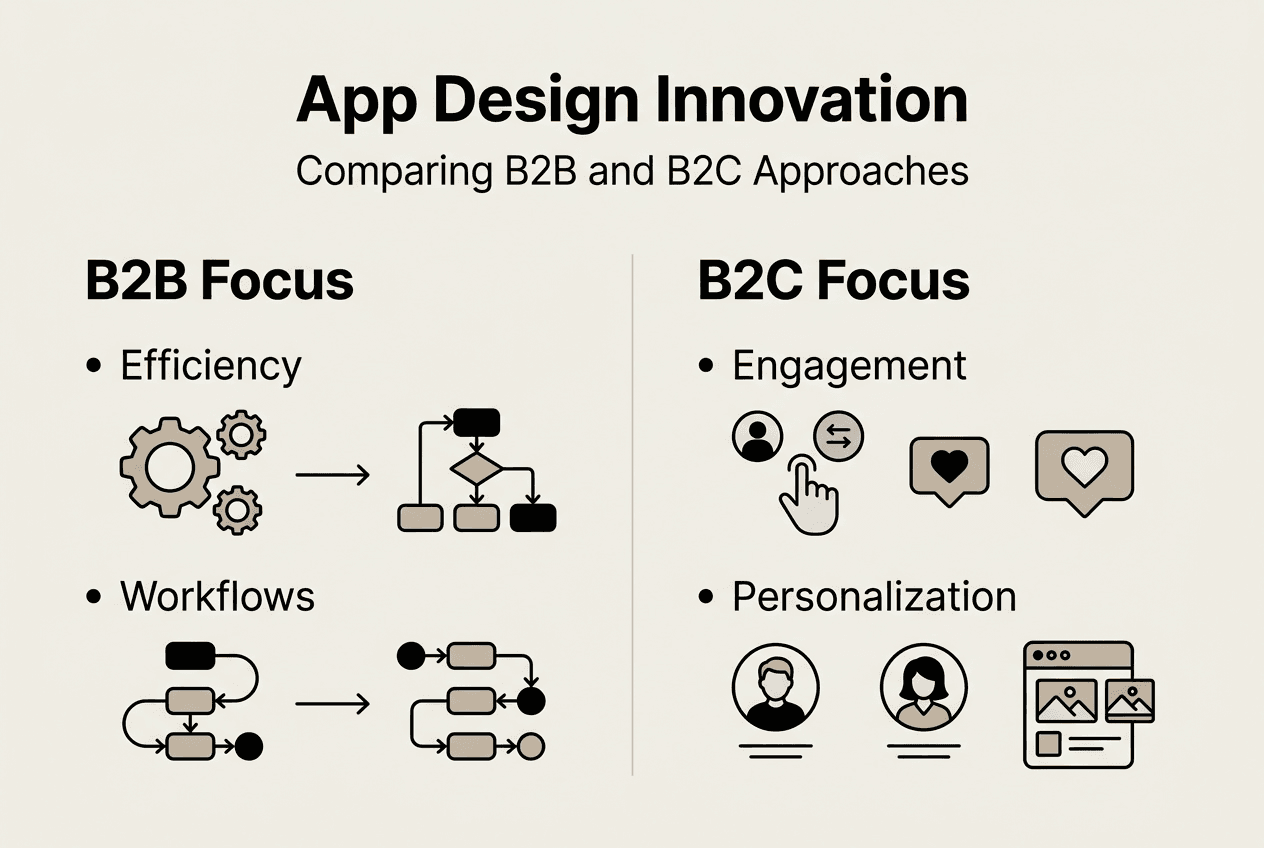
B2B and B2C apps demand fundamentally different innovation approaches. Business users need efficiency and streamlined workflows that help them complete tasks faster. Consumer apps must captivate through emotional connections and engaging interactions that keep users returning. Understanding this distinction shapes every design decision you make.
Innovative UX improvements span multiple dimensions:
- Intuitive navigation that reduces cognitive load and learning curves
- Personalised content delivery based on user behaviour and preferences
- Seamless cross-platform experiences maintaining consistency across devices
- Proactive error prevention through smart validation and helpful guidance
- Contextual assistance providing support exactly when users need it
These innovations translate directly to business outcomes. Higher satisfaction scores correlate with increased retention rates. Better conversion funnels generate more revenue. Reduced support tickets lower operational costs. When you craft engaging mobile app experiences, you invest in measurable returns.
Pro Tip: Balance delightful experiences with functional clarity. Users appreciate clever interactions, but never at the expense of completing their primary tasks efficiently.
The critical role of upfront planning in innovative app development
The software development life cycle provides a structured framework for building applications. It typically includes planning, analysis, design, development, testing, deployment, and maintenance phases. Planning and analysis form the foundation, yet many teams rush through these stages eager to start coding.
This haste proves costly. Poor upfront planning causes over half of troubled projects to fail or significantly underperform. When you skip thorough planning, innovative features often clash with business requirements, technical constraints emerge late, and scope creep derails timelines. The excitement of innovation cannot compensate for weak strategic foundations.
Effective planning ensures your innovative ideas align with real user needs and business objectives. Start by defining clear success metrics. What specific outcomes will your innovation achieve? How will you measure improvement? These questions ground creativity in accountability.
Key planning steps include:
- Conduct comprehensive user research to understand actual pain points and workflows
- Map user journeys identifying friction points where innovation delivers maximum value
- Define technical requirements and constraints before committing to specific solutions
- Create detailed specifications documenting expected behaviours and edge cases
- Build prototypes testing innovative concepts with real users before full development
- Establish realistic timelines accounting for iteration and refinement cycles
The pre-design stage sets project direction and prevents expensive mid-development pivots. Prototyping validates assumptions early when changes cost little rather than discovering flaws after launch.
"Successful innovation requires disciplined planning that balances creative ambition with practical constraints. Teams that invest time upfront avoid the costly mistakes that sink projects later."
Thorough planning also facilitates better stakeholder communication. When everyone understands the innovation strategy and expected outcomes, you gain buy-in and reduce conflicting demands. This alignment proves especially valuable in complex B2B environments where multiple departments influence requirements.
Addressing edge cases and performance challenges through innovation
Edge cases represent uncommon user scenarios that fall outside typical usage patterns. Examples include users with extremely long names that break form layouts, accounts with thousands of saved items overwhelming list views, or network interruptions during critical transactions. These situations occur less frequently but significantly impact user experience when handled poorly.

Many teams dismiss edge cases as rare enough to ignore. This mindset creates frustrating experiences for affected users who encounter broken functionality. Innovative design anticipates these scenarios and builds resilient solutions that gracefully handle unexpected inputs and conditions.
Strategies for addressing edge cases include:
- Implementing robust input validation that accepts diverse data formats
- Designing flexible layouts that adapt to varying content lengths
- Building pagination and lazy loading for large datasets
- Creating meaningful error messages guiding users toward resolution
- Providing offline functionality maintaining core features without connectivity
The impact of handling edge cases properly versus ignoring them creates stark contrasts:
| Aspect | Handling edge cases | Ignoring edge cases |
|---|---|---|
| User experience | Smooth, reliable interactions | Frequent errors and frustration |
| Support costs | Minimal tickets for uncommon scenarios | High volume addressing edge failures |
| Brand reputation | Professional, polished perception | Unreliable, unfinished impression |
| Development costs | Higher upfront investment | Expensive post-launch fixes |
Performance represents another critical innovation frontier. Speed directly influences user satisfaction and business metrics. For B2B SaaS applications, load times under 2 seconds maintain productivity and retention. Slower apps frustrate users who measure time in billable hours.
Innovative performance optimisation encompasses:
- Efficient data structures minimising memory overhead
- Smart caching strategies reducing redundant network requests
- Progressive loading displaying critical content immediately
- Background processing keeping interfaces responsive
- Code splitting delivering only necessary functionality
Iterative design approaches help identify performance bottlenecks through real user feedback. You discover which delays users notice and which optimisations deliver the most value.
Pro Tip: Test edge cases during prototyping rather than after launch. Early detection costs less and builds robustness into your foundation. Similarly, establish performance budgets before development starts to prevent gradual degradation.
Tailoring innovation for B2B vs B2C app design needs
B2B and B2C users approach apps with fundamentally different motivations and expectations. Business users treat apps as productivity tools helping them complete work efficiently. B2B users prioritise efficiency and task completion over delightful experiences. They value speed, accuracy, and seamless integration with existing workflows.
Consumer users seek entertainment, convenience, or emotional satisfaction. They download apps voluntarily and abandon them freely if experiences disappoint. B2C success depends on capturing attention, building habits, and creating memorable interactions that differentiate your app from countless alternatives.
Innovation approaches for B2B apps focus on:
- Streamlined workflows eliminating unnecessary steps
- Powerful search and filtering for quick information access
- Bulk actions enabling efficient mass operations
- Customisable dashboards surfacing relevant metrics
- Robust permissions supporting complex organisational structures
- Integration capabilities connecting with enterprise systems
B2C innovation priorities differ substantially:
- Engaging onboarding creating positive first impressions
- Personalised recommendations driving discovery and engagement
- Social features fostering community and sharing
- Gamification elements encouraging continued usage | Emotional design creating memorable brand connections
- Frictionless transactions minimising purchase barriers
Both B2B and B2C platforms aim to create engaging experiences but require tailored strategies matching user contexts. The following table illustrates typical priorities and corresponding innovative solutions:
| User type | Primary priority | Secondary priority | Innovative solution example |
|---|---|---|---|
| B2B | Task efficiency | Data accuracy | Keyboard shortcuts and smart autocomplete |
| B2C | Engagement | Convenience | Personalised content feeds and one-tap actions |
| B2B | Integration | Scalability | API-first architecture with flexible workflows |
| B2C | Discovery | Delight | Interactive tutorials and surprise rewards |
Product managers must consider several factors when innovating for each audience:
- Learning curve tolerance: B2B users accept complexity for power; B2C users demand immediate intuitiveness
- Decision-making process: B2B involves multiple stakeholders; B2C centres on individual preferences
- Usage frequency: B2B apps see daily intensive use; B2C varies from habitual to occasional
- Success metrics: B2B measures productivity gains; B2C tracks engagement and retention
- Competitive landscape: B2B emphasises features and integration; B2C competes on experience and brand
Understanding these distinctions prevents misaligned innovation. A B2B app borrowing B2C gamification might annoy professional users seeking efficiency. Conversely, B2C apps lacking emotional resonance fail to build the loyalty needed for sustainable growth. User experience for retail apps demonstrates how consumer-focused innovation drives engagement and conversion.
Tailored innovation improves adoption rates and user satisfaction because solutions match actual needs rather than generic best practices. You create apps users genuinely want to use, not just apps they must tolerate.
Discover innovative mobile app development with Pocket App
Transforming innovative concepts into successful mobile applications requires both creative vision and technical expertise. Pocket App combines strategic planning with award-winning design to deliver apps that users love and businesses depend on. Our portfolio spans over 300 projects across retail, healthcare, charity, and enterprise sectors, demonstrating proven capability in both B2B and B2C contexts.
Whether you need mobile app development bringing innovative features to life or app design services crafting experiences that resonate with your audience, our team guides you from initial concept through successful launch. We specialise in the thorough upfront planning that prevents project failures whilst maintaining the creative flexibility that drives genuine innovation.
Pro Tip: Engage with expert design teams during your earliest planning stages. Early collaboration maximises innovation benefits by aligning creative possibilities with technical realities and business objectives from the start.
Frequently asked questions
What is the most important aspect of innovation in app design?
Innovation primarily improves user satisfaction, loyalty, and conversion rates, which directly drive business growth. It also encompasses efficient problem-solving and performance optimisation that create competitive advantages. The most valuable innovations solve real user problems elegantly rather than adding features for novelty.
How does innovation differ between B2B and B2C app design?
B2B innovation focuses on efficiency and task completion, helping professional users work faster and more accurately. B2C innovation prioritises engagement and emotional appeal, creating memorable experiences that build loyalty. Understanding these distinct priorities ensures your innovation strategy matches actual user needs and contexts.
Why is upfront planning critical for successful app innovation?
Poor planning causes over half of troubled projects to fail or significantly underperform expectations. Thorough planning ensures innovation aligns with business goals and user needs before expensive development begins. It prevents scope creep, identifies technical constraints early, and establishes clear success metrics guiding the entire project.
What challenges do edge cases present in app design?
Edge cases represent unexpected user scenarios that can severely impair user experience when ignored. They create frustrating errors for affected users and generate support costs addressing failures. Innovative design anticipates these situations and builds resilient solutions that handle uncommon inputs and conditions gracefully.
How can performance impact innovation in business apps?
Fast load times under 2 seconds improve productivity and retention in SaaS applications where users measure time in billable hours. Performance optimisation represents a key innovation aspect that benefits business users through responsive interfaces and efficient workflows. Slow apps frustrate professional users regardless of feature sophistication.