
Mobile apps save businesses thousands of hours annually whilst cutting operational costs dramatically. De Mandemakers Groep saved 3,000 hours per year through strategic mobile app deployment, yet many leaders still view apps as mere marketing tools. In 2026, mobile applications have evolved into essential operational infrastructure that transforms workflows, eliminates manual errors, and delivers measurable returns within months. This guide explores precisely why custom mobile apps have become indispensable for businesses seeking competitive advantage through enhanced efficiency, accuracy, and employee satisfaction.
Table of Contents
- How Mobile Apps Save Time And Reduce Costs
- Customisation And Accuracy: Tailored Solutions For Business Challenges
- The Importance Of Strategic App Architecture In 2026
- Measuring Business Impact And Return On Investment From Mobile Apps
- Discover Expert Mobile App Development Services
- Frequently Asked Questions About Mobile Apps For Business
Key takeaways
| Point | Details |
|---|---|
| Time savings | Mobile apps eliminate thousands of manual hours annually through workflow automation |
| Custom solutions | Bespoke apps address unique industry challenges that generic software cannot solve |
| Architecture matters | Strategic technical foundations determine scalability, security, and long-term success |
| Measurable ROI | Custom apps deliver quantifiable returns within months through efficiency gains |
| Accuracy improvements | Mobile solutions reduce errors by up to 85% whilst accelerating reporting processes |
How mobile apps save time and reduce costs
Mobile apps transform operational economics by eliminating repetitive manual tasks that consume staff hours. De Mandemakers Groep saved 3,000 hours per year after implementing custom mobile solutions, demonstrating the substantial impact on resource allocation. The company also reduced staff overtime by around a dozen hours daily through automated processes that previously required manual intervention. These aren't isolated results. Businesses across sectors report similar efficiency gains when mobile apps replace paper-based systems and disconnected workflows.
Operational speed improvements extend beyond simple time savings. Mobile app adoption delivers a 60% increase in operational speed for administrative teams, enabling them to process more work without expanding headcount. This velocity advantage compounds over time, creating sustainable competitive differentiation. Faster processing means quicker customer responses, reduced backlogs, and improved team morale as staff escape tedious manual data entry.
Consider which workflows consume the most time in your organisation:
- Inventory management and stock tracking across multiple locations
- Field service reporting and inspection documentation
- Customer order processing and status updates
- Employee scheduling and shift management
- Quality assurance checks and compliance audits
- Sales team activity logging and pipeline updates
Each represents an opportunity for mobile automation to reclaim hundreds or thousands of annual hours. The beauty of mobile solutions lies in their ability to capture data at the point of activity, eliminating duplicate entry and reducing the lag between action and documentation. Your field technicians complete inspections directly in the app rather than scribbling notes for later transcription. Sales representatives log customer interactions immediately rather than reconstructing conversations from memory at day's end.
Pro Tip: Prioritise mobile app development for the single most time-consuming manual process in your business first, then expand to other areas once you've proven ROI and refined your implementation approach.
The financial impact extends beyond labour cost savings. Reduced errors mean fewer warranty claims, compliance penalties, and customer service escalations. Faster processing cycles improve cash flow as invoices reach customers sooner. Enhanced data visibility enables better inventory optimisation, reducing carrying costs. When you examine operational efficiency case studies across industries, the pattern becomes clear: mobile apps don't just save time, they fundamentally improve business economics.
Customisation and accuracy: tailored solutions for business challenges
Generic software forces businesses to adapt their processes to fit rigid templates. Custom mobile apps reverse this equation, moulding technology around your specific operational requirements. This distinction matters enormously when dealing with unique industry constraints or environmental conditions. A cooling tower inspection app must function in harsh outdoor environments with glare, moisture, and temperature extremes. Standard consumer apps fail under these conditions, whilst purpose-built solutions thrive.

Mobile apps improve accuracy in data collection by 85% compared to manual methods, eliminating transcription errors and ensuring consistent data capture. This accuracy improvement cascades through your entire operation. Better data quality means more reliable analytics, improved forecasting, and confident decision-making. Regulatory compliance becomes simpler when audit trails are automatic and complete. Customer service improves when teams access accurate, current information rather than outdated records.
Effective custom business apps share these essential characteristics:
- Interface design optimised for actual usage conditions, including monochrome displays for outdoor visibility and large touch targets for gloved operation
- Offline functionality ensuring field workers remain productive without constant connectivity, with automatic synchronisation when networks become available
- Automated reporting that transforms captured data into actionable insights without manual compilation, saving hours of administrative work
- Integration capabilities connecting seamlessly with existing enterprise systems, eliminating data silos and duplicate entry
- Role-based access controls protecting sensitive information whilst ensuring each user sees precisely what they need
- Customisable workflows reflecting your actual business processes rather than forcing adoption of generic templates
The reporting acceleration alone justifies investment for many organisations. Mobile apps accelerate reporting by 50%, enabling field teams to complete 30 or more additional inspections monthly per inspector. This productivity multiplication doesn't require working longer hours. It stems from eliminating the gap between field work and documentation. Inspectors photograph issues, select findings from customised checklists, and generate complete reports instantly rather than spending evenings typing up handwritten notes.
"The combination of improved accuracy and faster reporting creates a multiplier effect on business performance, enabling teams to serve more customers with higher quality whilst reducing operational stress."
Customisation extends to industry-specific requirements that generic platforms cannot address. Healthcare apps must comply with stringent patient data regulations. Financial services apps require robust security protocols. Manufacturing apps need integration with IoT sensors and production equipment. Retail apps must handle complex inventory across multiple channels. Better business practices with apps emerge when technology adapts to your sector's unique demands rather than forcing workarounds.
The importance of strategic app architecture in 2026
App architecture determines whether your mobile solution scales gracefully or collapses under growth. Poor architectural decisions create technical debt that compounds over time, eventually requiring expensive rebuilds. 71% of organisations report missing architectural strategy causes delays and budget overruns, highlighting how foundational these decisions are. You cannot retrofit solid architecture onto a poorly planned app any more than you can add a basement to a completed house.
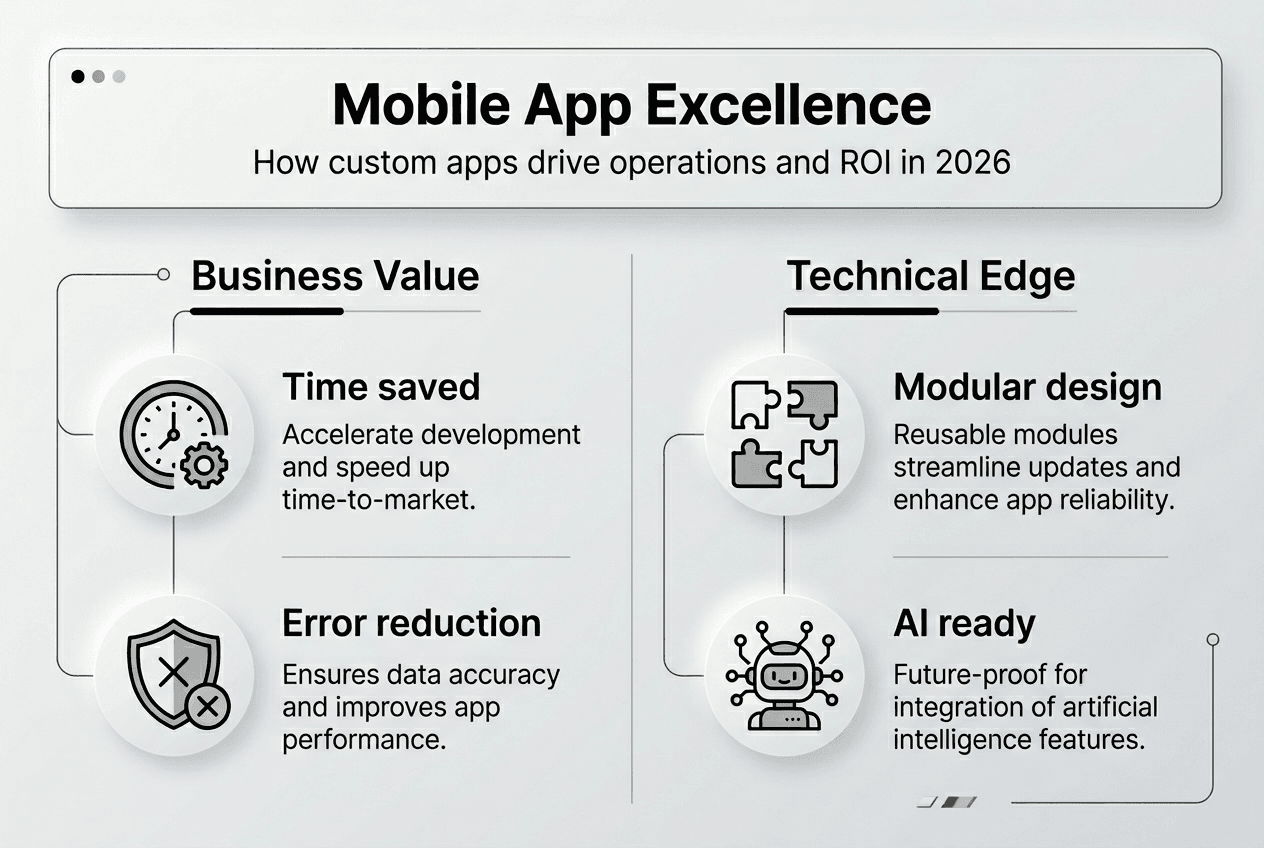
Modern enterprise apps demand sophisticated technical foundations that traditional approaches cannot provide. The architectural requirements for business apps in 2026 differ substantially from consumer app patterns:
| Traditional approach | Modern enterprise architecture |
|---|---|
| Monolithic codebase difficult to maintain | Modular microservices enabling independent updates |
| Cloud-dependent with no offline capability | Robust offline-first design with intelligent sync |
| Basic security through obscurity | Multi-layered security with encryption and compliance |
| Manual scaling requiring infrastructure changes | Auto-scaling cloud infrastructure adapting to demand |
| Limited integration requiring custom development | API-first design enabling seamless system connections |
Flutter enterprise app architecture in 2026 addresses scalability, AI integration, compliance requirements, and long-term maintainability from the initial design phase. This forward-thinking approach prevents the technical limitations that plague apps built without strategic planning. Your app must accommodate future growth, regulatory changes, and technology evolution without requiring complete rewrites.
Security and compliance deserve particular attention in enterprise architecture. Data breaches cost businesses millions in remediation, regulatory fines, and reputation damage. Your mobile app architecture must incorporate encryption at rest and in transit, secure authentication protocols, and comprehensive audit logging. Industry-specific regulations add further requirements. Financial services apps need PCI compliance. Healthcare apps require adherence to medical data protection standards. Government contractor apps must meet stringent security certifications.
Pro Tip: Invest time in architectural planning before writing a single line of code, engaging experienced architects who understand both current requirements and likely future needs to avoid expensive rework later.
AI integration represents another critical architectural consideration for 2026. Businesses increasingly expect mobile apps to provide intelligent recommendations, predictive analytics, and automated decision support. Your architecture must accommodate machine learning models, whether deployed locally on devices or accessed through cloud services. This capability enables apps that learn from usage patterns, anticipate user needs, and continuously improve performance.
Modularity ensures your app evolves without becoming unmaintainable. Well-architected apps separate concerns cleanly, allowing teams to update payment processing without touching inventory management or modify reporting without risking core functionality. This separation accelerates development, reduces testing burden, and minimises the risk of updates introducing unexpected problems. The app development tips for 2026 emphasise architectural decisions as the foundation for sustainable success.
Measuring business impact and return on investment from mobile apps
Custom mobile apps deliver measurable returns that justify investment through improved efficiency, reduced costs, and enhanced revenue generation. Custom-built apps have significantly higher ROI compared to generic platforms because they address specific business challenges rather than offering broad, shallow functionality. The key lies in defining clear success metrics before development begins, then tracking them rigorously post-deployment.
Typical ROI timelines and metrics for custom business apps:
| Metric category | Measurement approach | Typical improvement | Timeline to realise |
|---|---|---|---|
| Labour efficiency | Hours saved monthly | 30-60% reduction | 2-4 months |
| Error rates | Defects per transaction | 70-85% decrease | 1-3 months |
| Processing speed | Transactions per hour | 40-60% increase | 1-2 months |
| Customer satisfaction | NPS or CSAT scores | 15-25 point gain | 3-6 months |
| Revenue per employee | Sales divided by headcount | 20-40% growth | 4-8 months |
Expert development services can translate app benefits into measurable ROI within months by focusing on high-impact workflows and ensuring proper integration with existing systems. The difference between successful and disappointing app projects often comes down to implementation quality and change management rather than the concept itself. Your brilliant app idea delivers no value if employees resist adoption or technical issues prevent reliable operation.
Key business functions improved through strategic mobile app deployment include:
- Sales team productivity through mobile CRM access, automated activity logging, and instant quote generation
- Field service efficiency via optimised routing, digital work orders, and real-time parts inventory visibility
- Customer engagement through personalised experiences, loyalty programmes, and seamless omnichannel interactions
- Supply chain visibility with real-time tracking, automated reordering, and predictive inventory management
- Employee onboarding and training through interactive mobile learning modules and performance support tools
- Quality control and compliance via digital checklists, photo documentation, and automated audit trails
Industry adoption trends reinforce the strategic importance of mobile apps for business. Global app downloads continue growing as smartphones become the primary computing device for billions of users. Businesses that delay mobile investment risk falling behind competitors who leverage apps for operational advantage. The question isn't whether to invest in mobile apps but rather which processes to mobilise first and how to maximise return.
Measurement discipline separates successful app projects from disappointing ones. Establish baseline metrics before launch, then track improvements monthly. Don't rely on subjective impressions. Quantify time savings, error reductions, and productivity gains. Survey users regularly to understand adoption barriers and identify enhancement opportunities. The benefits of mobile app development multiply when you continuously refine based on actual usage data rather than assumptions.
Discover expert mobile app development services
Transforming operational challenges into mobile solutions requires experienced partners who understand both technology and business strategy. Pocket App specialises in creating custom mobile applications that deliver measurable ROI through enhanced efficiency, accuracy, and user satisfaction. Our approach combines strategic discovery to identify high-impact opportunities, user-centred design ensuring intuitive experiences, and robust development delivering reliable, scalable solutions.
With over 300 successful projects across retail, healthcare, charity, and business sectors, we've refined our methodology to maximise value whilst minimising risk. Our professional mobile app development services cover the complete lifecycle from initial concept through deployment and ongoing support. We prioritise expert application design that balances aesthetic appeal with functional excellence, ensuring your app delights users whilst solving real business problems. Whether you need business app development solutions for internal operations or customer-facing engagement, our team brings the technical expertise and industry knowledge to transform your vision into reality.
Frequently asked questions about mobile apps for business
Why invest in a custom mobile app instead of off-the-shelf solutions?
Custom apps address your specific business processes, environmental conditions, and integration requirements that generic software cannot accommodate. Off-the-shelf solutions force you to adapt workflows to fit their limitations, reducing efficiency gains. Custom development ensures the technology serves your needs rather than constraining your operations.
How long does it typically take to see ROI from business mobile apps?
Most organisations observe measurable improvements within two to four months of deployment, with labour efficiency gains appearing first. Full ROI typically materialises within six to twelve months depending on implementation scope and adoption rates. Quick wins in error reduction and processing speed often justify investment before broader benefits emerge.
What are the critical success factors for enterprise mobile app projects?
Strategic architecture planning, clear success metrics, strong executive sponsorship, and comprehensive user training determine project outcomes. Technical excellence matters less than ensuring the app solves real problems and integrates seamlessly with existing workflows. Change management and adoption support often prove more important than feature richness.
Can mobile apps integrate with existing business systems effectively?
Modern mobile apps connect seamlessly with ERP, CRM, inventory management, and other enterprise systems through APIs and integration platforms. Well-architected apps eliminate data silos whilst maintaining security and compliance requirements. Integration capabilities should be a primary consideration during vendor selection and architectural planning.
How do mobile apps improve employee satisfaction alongside operational gains?
Mobile apps reduce frustrating manual tasks, eliminate duplicate data entry, and provide instant access to information employees need for their work. Field workers particularly appreciate tools that simplify documentation and reduce evening administrative work. When technology genuinely makes jobs easier rather than adding complexity, satisfaction and retention both improve.