
TL;DR:
- A B2B mobile solution enables complex, role-based transactions and integrations with enterprise systems. Such apps improve efficiency by increasing adoption, reducing manual errors, and enabling offline access in low-connectivity environments. Successful projects require prioritizing backend logic, workflows, and offline capability over aesthetics and single features.
A B2B mobile solution is a mobile application or platform built specifically to support business-to-business transactions, workflows, and operational processes between companies. Unlike consumer apps, these platforms handle contract pricing, multi-user approval chains, ERP integration, and role-based access. The industry term you will encounter most often is enterprise mobile solution, though B2B mobile application is equally standard. Mobile internet now accounts for nearly 50% of global web traffic, and that shift is forcing every distributor, field service operator, and wholesale buyer to reconsider how their teams and customers interact on mobile. This guide explains what these solutions do, why they outperform generic apps, and what to watch for when deploying one.
What is a B2B mobile solution and how does it differ from a consumer app?
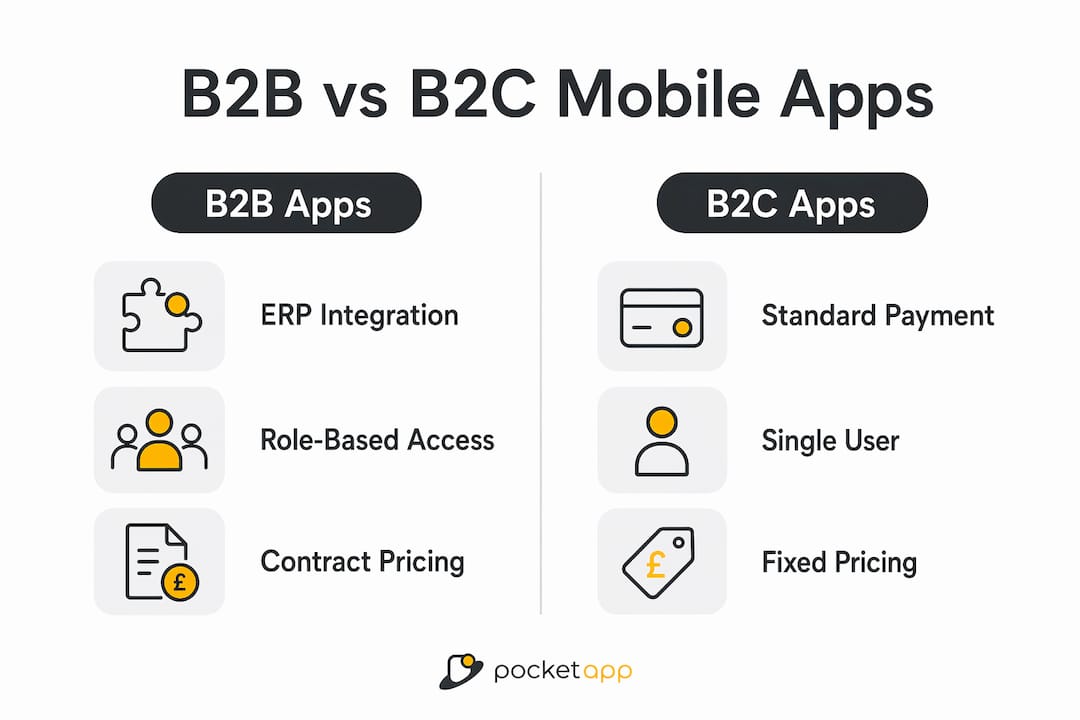
A B2B mobile solution is defined by the complexity it must handle beneath a clean interface. Consumer apps serve a single user with a single price. B2B mobile applications serve procurement managers, sales reps, warehouse staff, and finance approvers, each with different permissions and different pricing agreements.

The table below shows the sharpest contrasts between the two categories.
| Feature | B2B mobile solution | Consumer (B2C) app |
|---|---|---|
| Pricing model | Contract-specific, negotiated rates | Fixed retail price |
| User structure | Role-based access, approval hierarchies | Single user account |
| Order workflow | Purchase order creation, multi-step approval | Add to basket, checkout |
| Backend integration | ERP, inventory, CRM systems | Payment gateway only |
| Offline capability | Required for field and warehouse use | Optional |
| AI features | Sales copilot, scheduling, recommendations | Personalisation only |
The core distinction is backend depth. A B2C app connects to a payment gateway. A B2B mobile platform connects to an ERP, an inventory management system, and often a CRM, pulling live stock levels, account-specific pricing, and order history simultaneously.
B2B apps must combine consumer-like intuitive UI with complex features including role-based access, negotiated pricing, and multi-user approvals. That combination is the defining design challenge of the category. Get the UI wrong and adoption collapses. Get the backend wrong and the business logic breaks.
AI-powered B2B apps now incorporate features like sales copilots and product recommendations to support sales reps during order taking. This moves the mobile app from a passive order entry tool to an active selling assistant.
Pro Tip: When evaluating any B2B mobile platform, ask the vendor to demonstrate the approval workflow for a purchase order that exceeds a spending limit. That single test reveals more about the platform's B2B maturity than any feature list.
How do B2B mobile solutions improve operational efficiency?
The efficiency gains from enterprise mobile solutions are measurable, not theoretical. The strongest evidence comes from distribution and field service, two sectors where mobile technology for B2B has reached genuine maturity.
-
Customer adoption at scale. One distributor achieved 90% customer adoption of their mobile ordering app within three months of launch. That figure shows how quickly buyers switch to self-service when the experience matches what they expect from consumer platforms.
-
Reduced call centre dependency. Another distributor recorded a 40% reduction in call centre volume after deploying a self-service ordering portal. Fewer inbound calls means lower staffing costs and faster order processing for buyers who previously waited on hold.
-
Shorter technician travel times. AI-powered scheduling in field service mobile apps reduces technician travel time by 30%. That is not a marginal gain. For a team of 50 engineers, a 30% reduction in travel translates directly into more jobs completed per day.
-
Elimination of manual order errors. B2B order-taking apps integrate with ERP and inventory systems to automate validation and remove manual entry errors. Sales reps stop re-keying orders from paper forms, and the system flags stock issues before the order is confirmed.
The pattern across these examples is consistent. Mobile solutions for businesses remove friction at the point where a human previously had to intervene. That friction, whether a phone call, a paper form, or a manual data entry step, is where errors and delays accumulate.
Pro Tip: Before building a business case for a B2B mobile solution, map every manual handoff in your current order or service workflow. Each handoff is a measurable cost centre that a well-built app can eliminate.
Offline capability is a less visible but equally important efficiency driver. Offline-first architecture is critical for field workers to maintain usability and data integrity in low or zero connectivity environments. A field engineer who loses signal should not lose their job sheet. Apps built on offline-first principles cache data locally and sync when connectivity returns, keeping work moving regardless of network conditions. For more on how mobile apps drive operational excellence, the link covers sector-specific examples in depth.
What challenges must businesses consider before deploying a B2B mobile solution?
Deploying a B2B mobile application is more complex than launching a consumer product. The risks are real, and most stem from underestimating the gap between a visually appealing interface and a functionally complete platform.
The most common pitfalls are:
- Prioritising aesthetics over logic. Ignoring backend complexity while focusing solely on UI aesthetics results in poor user adoption despite a visually appealing app. A beautiful screen that cannot handle split shipments or account-specific discounts will be abandoned within weeks.
- Ignoring connectivity realities. Field workers, warehouse staff, and delivery drivers regularly operate in low-signal environments. An app without offline capability and a reliable sync engine will fail in practice, regardless of how well it performs in a Wi-Fi demo.
- Underestimating customisation requirements. B2B relationships are not uniform. One customer may have a 60-day payment term and a negotiated 15% discount. Another may require purchase order approval from three managers. The platform must handle both without custom code for every account.
- Neglecting user hierarchy design. Role-based access is not a feature to add later. If a junior sales rep can see a competitor's pricing tier, or a warehouse picker can approve their own orders, the system has a structural problem that no patch will fix cleanly.
"The 'consumerisation of B2B' is mandatory, but it must incorporate sophisticated layers for pricing, roles, and approvals to maintain business viability." — Shopify Enterprise Blog
Handling offline data conflicts with a proper sync engine is equally non-negotiable. When two users update the same record offline and both sync simultaneously, the app needs a defined conflict resolution rule. Without one, data loss is inevitable. AI for enterprise business process optimisation is increasingly being applied to this problem, using machine learning to predict and resolve sync conflicts before they affect users.
What real-world use cases show B2B mobile solutions working?
Theory becomes credible when grounded in specific deployments. The following use cases represent the categories where B2B mobile strategy delivers the clearest return.
Field service management
Mobileforce AI provides a field service management platform where AI scheduling assigns jobs to technicians based on location, skill set, and current workload. The 30% reduction in travel time cited earlier comes directly from this optimisation layer. Dispatchers stop manually assigning jobs, and technicians receive updated schedules on their mobile devices in real time. For a deeper look at AI in mobile apps for business, the practical applications extend well beyond scheduling.
Wholesale distribution and order taking
WizOrder is a B2B order-taking app built for wholesale distributors and sales reps. It integrates with ERP systems to give reps live stock levels, account pricing, and order history during a customer visit. The AI sales copilot within WizOrder surfaces product recommendations based on purchase history, turning a routine reorder call into an upselling opportunity. Self-service ordering portals built on the same principles replicate the convenience of consumer platforms like Amazon, making 24/7 ordering available to trade buyers without any sales rep involvement.
Mobile commerce and omnichannel buying
B2B buyers increasingly expect to move between a desktop portal, a mobile app, and a sales rep conversation without losing context. The most advanced B2B mobile platforms now support this omnichannel model, where an order started on a desktop can be approved on a mobile device and fulfilled via an ERP integration. This mirrors the innovative app features that are reshaping how UK businesses engage their trade customers.
| Use case | Key capability | Primary benefit |
|---|---|---|
| Field service management | AI scheduling, offline job sheets | 30% less travel time |
| Wholesale order taking | ERP integration, AI copilot | Fewer errors, higher order value |
| Self-service ordering portal | 24/7 access, account pricing | 40% fewer inbound calls |
| Omnichannel B2B commerce | Cross-device continuity | Faster buyer decisions |
Key takeaways
A B2B mobile solution delivers measurable operational gains only when it combines deep backend integration, role-based logic, and offline capability with a consumer-grade interface.
| Point | Details |
|---|---|
| Definition matters | A B2B mobile solution handles ERP integration, contract pricing, and approval workflows that consumer apps cannot. |
| Efficiency is proven | Deployments show 90% adoption rates and 40% reductions in call centre volume within months. |
| AI adds real value | AI scheduling cuts technician travel by 30%, turning mobile apps into active operational tools. |
| Offline capability is non-negotiable | Field workers need apps that function without connectivity and sync reliably when it returns. |
| Design must serve logic | A visually polished app that ignores backend complexity will fail adoption regardless of its appearance. |
Why I think most B2B mobile projects fail before they start
After working across more than 300 mobile projects, the pattern I see most often is this: businesses commission a B2B mobile app with a consumer mindset. They spend the first month debating colour palettes and icon styles. They spend the last month discovering that their ERP does not expose the API endpoints the app needs.
The projects that succeed start from the opposite direction. They map the workflow first. They identify every pricing rule, every approval threshold, and every offline scenario before a single screen is designed. The interface is the last problem to solve, not the first.
I am also sceptical of vendors who lead with AI features before demonstrating solid offline sync. AI scheduling is genuinely useful, as the Mobileforce data shows. But an AI recommendation engine is worthless if the app crashes when a sales rep walks into a warehouse with no signal. Get the foundations right, then add intelligence on top.
The other thing I would push back on is the assumption that a B2B mobile solution is a one-time build. The businesses I have seen get the most value treat their app as a product with a roadmap. They release, measure adoption, identify the workflows that still generate support calls, and iterate. That cycle is where the real efficiency gains compound over time. Teams who want a practical starting point for maximising sales productivity with mobile apps will find the framework there directly applicable.
— Paul
How Pocketapp builds B2B mobile solutions that work in practice
Pocketapp has delivered enterprise mobile app development for clients across retail, healthcare, and distribution, with a portfolio of over 300 projects spanning both B2B and B2C sectors. The team's approach starts with a structured discovery phase that maps workflows, user roles, and integration requirements before any design work begins.
For businesses that need to reach users across iOS and Android without doubling development costs, Pocketapp's cross-platform app development service delivers a single codebase that performs natively on both platforms. Whether you need a field service app with offline capability, a wholesale ordering portal with ERP integration, or a self-service B2B commerce platform, Pocketapp's team brings the technical depth and design rigour to build it correctly from the start. Get in touch to discuss your requirements.
FAQ
What is a B2B mobile solution?
A B2B mobile solution is a mobile application or platform built to support business-to-business transactions and workflows, including ERP integration, contract pricing, and multi-user approval processes. It differs from consumer apps by handling complex organisational logic rather than simple individual purchases.
How does a B2B mobile app integrate with an ERP system?
B2B mobile apps connect to ERP systems via APIs to pull live inventory data, account-specific pricing, and order history in real time. This integration eliminates manual data entry and reduces order errors at the point of sale.
What is offline-first architecture in a B2B mobile app?
Offline-first architecture means the app stores data locally on the device and continues to function without an internet connection. When connectivity returns, the app syncs changes back to the server, preventing data loss for field workers in low-signal environments.
How long does it take to achieve adoption of a B2B mobile ordering app?
One distributor reached 90% customer adoption within three months of launching a mobile ordering app. Adoption speed depends on how closely the app's experience matches what buyers already expect from consumer platforms.
What role does AI play in B2B mobile solutions?
AI in B2B mobile solutions handles scheduling optimisation, sales recommendations, and copilot features that support reps during customer visits. AI-powered scheduling alone has been shown to reduce technician travel time by 30% in field service deployments.