
Many business owners struggle with app development decisions, facing confusing options and seemingly high costs. Yet hybrid app development offers a practical solution that reduces expenses whilst improving user experience. This guide explains how hybrid apps work and why they benefit retail, healthcare, and nonprofit organisations seeking efficient digital solutions in 2026.
Table of Contents
- Understanding Hybrid App Development
- Advantages And Cost Benefits For Businesses
- Popular Frameworks And Market Trends In 2026
- Security And Compliance Considerations In Hybrid Apps
- Real-World Impact: Business Success With Hybrid Apps
- Enhance Your Business With Expert Hybrid App Development
- Frequently Asked Questions
Key takeaways
| Point | Details |
|---|---|
| Cost efficiency | Hybrid apps cut development time by 30-40% and reduce costs by 20-30% through single codebase deployment. |
| Cross-platform reach | One codebase serves iOS, Android, and web platforms, simplifying maintenance and updates significantly. |
| Security compliance | Proper encryption and secure authentication enable hybrid apps to meet strict regulations like HIPAA. |
| Business impact | Successful implementations deliver measurable gains in sales, user satisfaction, and operational efficiency. |
| Framework dominance | Flutter commands 46% market share whilst React Native holds 35-38% in 2026 cross-platform development. |
Understanding hybrid app development
Hybrid mobile app development fuses native and web app advantages, using a single codebase built with HTML, CSS, and JavaScript. This approach lets businesses deploy applications across multiple platforms simultaneously, reducing both development time and ongoing maintenance costs.
The technology wraps web code inside a native container, granting access to device features like cameras, GPS, and push notifications. Users experience an app that feels native whilst developers maintain just one codebase. This architectural choice particularly suits business applications where cross-platform consistency matters more than graphics-intensive gaming performance.
Hybrid apps bridge the gap between fully native and web applications, offering several distinct advantages:
- Faster time to market through simultaneous multi-platform deployment
- Simplified updates that push changes to all platforms at once
- Lower development costs via code reuse across iOS and Android
- Consistent user experience regardless of device choice
- Access to native device capabilities when needed
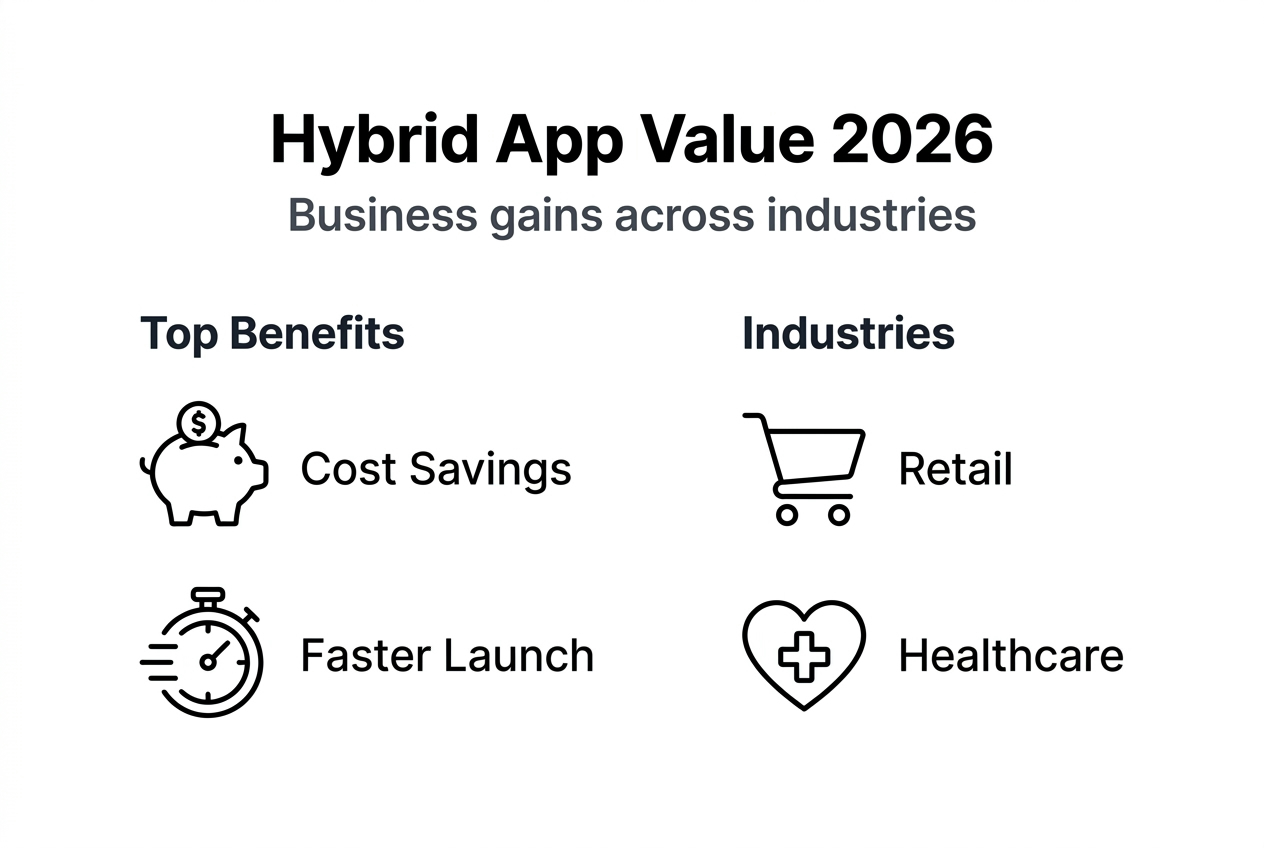
Retail businesses benefit from unified inventory systems across channels. Healthcare providers deploy patient portals that work on any device. Nonprofit organisations reach broader audiences without managing separate codebases. The hybrid approach delivers efficiency where it matters most for business operations.
Advantages and cost benefits for businesses
Business decision makers care about return on investment, and hybrid development delivers measurable savings. Research shows development time reductions of 30-40% alongside cost decreases of 20-30% compared to building separate native applications. These savings stem from maintaining one codebase instead of two or three platform-specific versions.

Faster deployment speeds business agility significantly. When market conditions shift or customer needs evolve, hybrid apps enable quicker responses than traditional development cycles allow. Updates roll out simultaneously across platforms, keeping all users current without staggered releases.
User acceptance drives hybrid app success beyond pure cost metrics. Intuitive mobile experiences reduce training costs substantially, helping employees adopt new tools faster. Healthcare staff access patient records seamlessly. Retail associates check inventory on shop floors. Nonprofit volunteers coordinate activities efficiently.
Key business benefits of mobile app development through hybrid approaches include:
- Reduced technical debt from maintaining fewer codebases
- Lower ongoing maintenance expenses through unified updates
- Faster feature rollout responding to competitive pressures
- Improved employee productivity via consistent interfaces
- Better customer engagement across all touchpoints
Smart organisations also consider outsourcing app development to specialists who bring framework expertise and best practices. External teams often deliver faster whilst internal staff focus on core business operations.
Pro Tip: Conduct stakeholder user testing early in development to identify interface issues before they become expensive redesigns affecting multiple platforms.
Popular frameworks and market trends in 2026
Framework selection shapes long-term app success, making it crucial to understand the 2026 landscape. Flutter holds approximately 46% market share amongst cross-platform developers, whilst React Native commands 35-38%. Stack Overflow's 2025 survey recorded Flutter at 9.12% overall developer usage, reflecting its growing prominence.
Flutter offers hot reload functionality that lets developers see changes instantly without restarting applications. This feature accelerates development cycles dramatically, cutting iteration time from minutes to seconds. Google's backing ensures regular updates and strong community support.
React Native leverages JavaScript knowledge widespread amongst web developers, reducing learning curves for teams transitioning to mobile. Facebook's continued investment maintains its position despite Flutter's gains. Both frameworks access native device features through plugins, though implementation approaches differ.
| Framework | Market Share | Key Strength | Best For |
|---|---|---|---|
| Flutter | 46% | Hot reload, native performance | Complex UIs, high performance needs |
| React Native | 35-38% | JavaScript familiarity, large ecosystem | Teams with web development background |
| Ionic | 8-10% | Web technology focus, rapid prototyping | Simple business applications |
| Xamarin | 5-7% | Microsoft integration, C# development | Enterprise Microsoft environments |
Framework choice impacts maintenance costs over years, not just initial development. Popular frameworks receive more community plugins, security patches, and talent availability. Niche frameworks might offer specific advantages but risk obsolescence or limited support.
Developing cross-platform apps requires balancing technical capabilities against business requirements. Healthcare apps needing offline functionality favour frameworks with robust local storage. Retail applications prioritising visual appeal might choose Flutter's rendering engine. Nonprofits working with limited budgets often select frameworks matching existing team skills.
Pro Tip: Select frameworks aligned with your organisation's long-term technical strategy and available talent, not just current popularity metrics.
Security and compliance considerations in hybrid apps
Security vulnerabilities threaten business operations, customer trust, and regulatory compliance simultaneously. Hybrid apps face unique challenges because they bridge web and native environments, potentially exposing attack surfaces in both domains. Healthcare organisations handling patient data and nonprofits managing donor information must prioritise robust security architectures.
Secure authentication, data encryption, and protected API calls form the foundation of trustworthy hybrid applications. The Open Web Application Security Project identifies the top mobile security risks annually, providing guidance that development teams must incorporate from project inception.
Critical security practices include:
- End-to-end encryption for data in transit and at rest
- Multi-factor authentication protecting user accounts
- Secure API endpoints with proper authentication tokens
- Regular security audits identifying emerging vulnerabilities
- Compliance with sector-specific regulations like HIPAA or GDPR
Healthcare applications face particularly stringent requirements. Patient privacy laws demand documented security controls, audit trails, and breach notification procedures. Hybrid apps meeting these standards require careful planning from initial architecture through ongoing maintenance.
Retail apps handling payment information must comply with PCI DSS standards. Nonprofit organisations collecting donations need secure payment processing and donor data protection. Each sector brings specific regulatory frameworks that development teams must understand thoroughly.
Neglecting security creates cascading problems beyond immediate data breaches. Regulatory fines damage finances. Reputation damage drives customers away. Recovery costs exceed prevention investments substantially. Insurance premiums rise after incidents. Legal liabilities multiply with each affected user.
Before launching any hybrid app, complete this security checklist:
- Penetration testing by independent security specialists
- Code review focusing on common vulnerability patterns
- Secure credential storage using platform keychains
- Regular dependency updates patching known exploits
- Incident response plan documenting breach procedures
Security considerations for mobile app development extend beyond technical controls to organisational policies. Staff training, access controls, and change management procedures protect applications throughout their lifecycle.
Real-world impact: business success with hybrid apps
Measurable results demonstrate hybrid app value better than theoretical benefits. Tribesquare's work with Justrite exemplifies transformative outcomes possible through expert hybrid development. The project delivered a 180% increase in digital sales, proving that well-executed apps drive substantial commercial gains.
Technical improvements supported business results directly:
| Metric | Achievement | Business Impact |
|---|---|---|
| App crash rate | Under 1% | Reliable user experience builds trust |
| ERP sync latency | Below 5 seconds | Real-time inventory prevents overselling |
| User satisfaction | 4.6★ rating | Positive reviews drive organic growth |
| Development timeline | 6 months recovery | Fast delivery enabled business agility |
App stability matters enormously for user retention. Crash rates below 1% keep customers engaged rather than frustrated. Real-time synchronisation with enterprise systems ensures accurate product availability, preventing disappointed customers and abandoned carts. High satisfaction ratings translate to App Store visibility and organic user acquisition.
Development speed enabled Justrite to respond quickly to market opportunities. Six months from troubled legacy app to thriving hybrid solution demonstrates how choosing the right type of mobile app for business needs accelerates time to value.
Beyond metrics, qualitative feedback reveals success factors:
"The design is clean and intuitive. Our customers immediately understood how to browse products and complete purchases without training or support calls."
Clean design reduces support costs whilst improving conversion rates. Intuitive interfaces mean customers complete desired actions without friction. These user experience qualities emerge from leveraging user feedback throughout iterative design processes.
Successful hybrid projects share common characteristics:
- Dedicated project oversight ensuring consistent vision
- Regular stakeholder communication preventing misalignment
- Iterative development incorporating user feedback early
- Technical excellence in architecture and code quality
- Post-launch support maintaining performance standards
These case study results prove hybrid apps deliver tangible business value when developed with expertise and strategic focus. The combination of cost efficiency, rapid deployment, and measurable outcomes makes hybrid development compelling for organisations across sectors.
Enhance your business with expert hybrid app development
Transforming your business operations through mobile technology requires more than just choosing hybrid development. You need partners who understand your sector's unique challenges and regulatory requirements whilst delivering secure, scalable applications that users genuinely enjoy.
Professional mobile app development services maximise hybrid app benefits through proven methodologies and technical expertise. Whether you operate in retail, healthcare, or nonprofit sectors, specialist developers bring frameworks, security protocols, and user experience knowledge that internal teams often lack.
Cross-platform app development best practices evolve constantly as frameworks mature and user expectations rise. Experienced development partners stay current with these changes, ensuring your application leverages the latest capabilities whilst avoiding deprecated approaches.
Pocket App specialises in bespoke mobile apps development tailored to specific business requirements across diverse industries. Our portfolio demonstrates consistent delivery of user-focused applications that enhance operational efficiency whilst meeting strict security standards. Contact us to discuss how hybrid app development can transform your organisation's digital presence and drive measurable business growth.
Frequently asked questions
How does hybrid app development differ from native and web apps?
Hybrid apps combine a single codebase like web applications with native device capabilities, offering cross-platform compatibility with near-native performance. They sit between purely web-based apps running in browsers and fully native apps built separately for each platform. This middle ground provides cost efficiency whilst accessing device features like cameras and GPS.
Can hybrid apps meet strict healthcare data regulations?
Yes, properly architected hybrid apps securely manage sensitive healthcare data through encryption, secure authentication, and compliant API implementations. Development teams must implement HIPAA technical safeguards including access controls, audit logging, and transmission security. Regular security audits and penetration testing verify ongoing compliance as threats evolve.
What factors affect the cost savings of hybrid apps?
Code reuse across platforms, faster development cycles, reduced training requirements, and simplified maintenance all contribute to hybrid app cost advantages. Single codebase deployment eliminates duplicate development effort for iOS and Android versions. Unified updates reduce ongoing maintenance expenses substantially compared to managing multiple native applications separately.
Are there limitations to hybrid app performance?
Whilst continuously improving, hybrid apps may face constraints in graphics-intensive applications or accessing cutting-edge device-specific functions compared to fully native development. Gaming applications requiring maximum graphics performance often benefit from native development. However, business applications prioritising consistent user experience across platforms typically gain more from hybrid efficiency than they lose in marginal performance differences.
Which industries gain most from hybrid apps?
Retail, healthcare, and nonprofit organisations benefit substantially from hybrid apps' flexible, cost-effective, and user-friendly solutions addressing their specific operational needs. Retailers need consistent shopping experiences across devices. Healthcare providers require secure patient portals accessible anywhere. Nonprofits maximise limited budgets whilst reaching broad audiences effectively.