
TL;DR:
- A successful B2C app strategy focuses on retention, engagement, and lifetime value beyond just downloads. It requires clear purpose, integrated marketing, optimized user experience, and continuous measurement to sustain growth in a competitive market. Aligning product development with data-driven marketing efforts ensures long-term user retention and revenue.
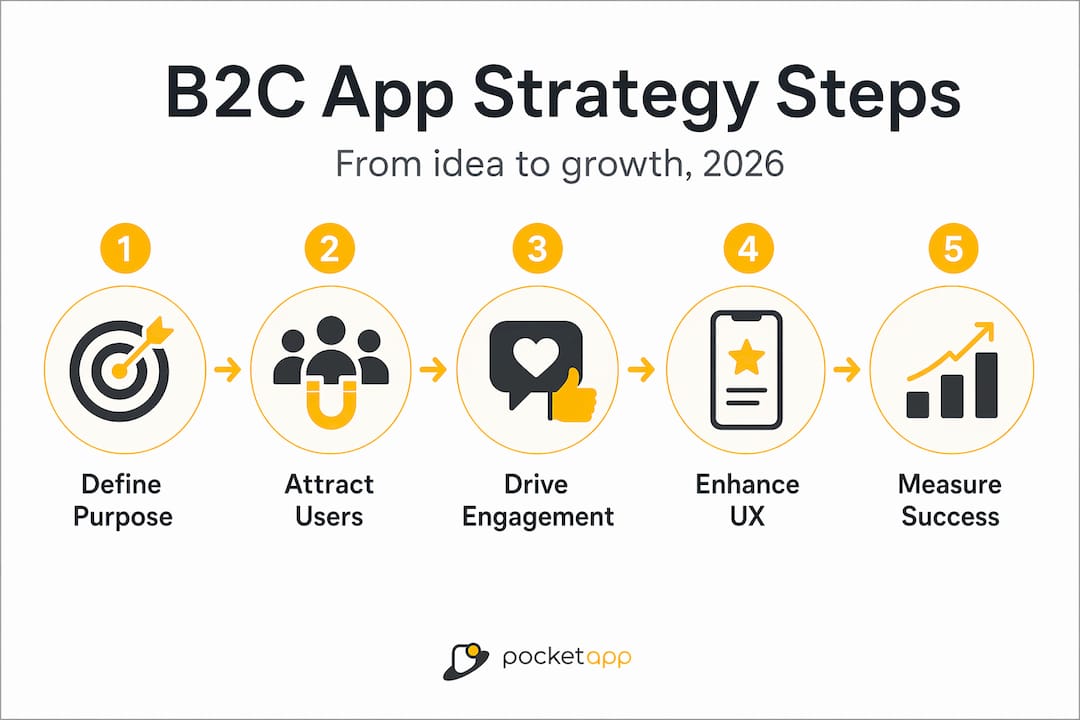
Most businesses launching a consumer app make the same mistake: they treat downloads as the finish line. A strong what is b2c app strategy understanding flips that thinking entirely. Downloads are the starting pistol, not the trophy. The real measure of a B2C app's success is what happens after the install — whether users stay, spend, and return. With millions of apps competing for attention in 2026, the difference between an app that grows and one that stagnates comes down to strategy. Not luck, not budget alone, but a deliberate plan connecting purpose, user experience, marketing, and measurement.
Table of Contents
- Key takeaways
- What is B2C app strategy and why does it matter?
- Defining your app's purpose and goals
- Marketing strategies for B2C apps in 2026
- Enhancing UX to drive retention and engagement
- Internal alignment and technology for growth
- Measuring success and refining your strategy
- My honest take on what actually drives B2C app success
- Build a B2C app that delivers real results
- FAQ
Key takeaways
| Point | Details |
|---|---|
| Strategy goes beyond installs | A B2C app strategy must address retention, engagement, and lifetime value — not just acquisition. |
| Define purpose before marketing | Clarifying your app's core goal shapes every feature, campaign, and user journey decision. |
| Day 1 retention is a health check | If fewer than 20% of users return on Day 1, fix onboarding before scaling spend. |
| Full-funnel marketing wins | The most effective B2C app growth strategies combine paid acquisition, ASO, personalisation, and lifecycle campaigns. |
| Measure what actually matters | Track engagement depth, retention rates, and revenue per user alongside installs to judge real performance. |
What is B2C app strategy and why does it matter?
A B2C app strategy is the structured plan that defines how a consumer-facing mobile application will attract, engage, and retain users over time. It covers everything from why the app exists and what it offers, to how it is marketed, how the user experience is designed, and how success is measured. Think of it as the blueprint that connects your business goals to the specific actions taken inside and outside the app.
What it is not is a one-time decision made at launch. The mobile market in 2026 is saturated, fast-moving, and unforgiving. Defining the app's core purpose before development avoids wasted cost and builds a coherent feature roadmap aligned with real user needs. Without that clarity, you end up building features nobody asked for and marketing an experience that does not hold people's attention.
A proper B2C app strategy answers three questions. What problem does this app solve for a real consumer? How will we get the right people to discover and install it? And how will we keep those people coming back in a way that generates sustainable revenue?
Defining your app's purpose and goals
Before you touch a marketing budget or start planning campaigns, you need to answer the most basic question: what is this app actually for? Not in a vague "it improves customer engagement" sense, but specifically. Is it a loyalty platform designed to increase purchase frequency among existing customers? An e-commerce app aimed at converting mobile browsers into buyers? A content or community app built for brand affinity and long-term retention?
The answer to that question changes everything. It determines which features get built first, how the onboarding flow is designed, what metrics matter, and where marketing spend goes. Here is what defining that purpose looks like in practice:
- Loyalty-focused apps prioritise repeat behaviour mechanics like points, rewards, and personalised offers. Retention metrics and push notification engagement are the core KPIs.
- E-commerce apps are built around conversion rate, basket size, and purchase frequency. Every UX decision serves the transaction.
- Engagement or community apps measure daily active users, session length, and content interaction. The product itself is the retention mechanism.
- Hybrid apps (loyalty plus commerce, for instance) need a clear primary goal to avoid building a product that tries to do everything and does nothing particularly well.
Once the purpose is fixed, resource allocation becomes straightforward. You know what to build, what to measure, and where leaky user journeys need fixing.
Pro Tip: Before investing in paid user acquisition, audit your existing funnel. Map the user journey from first open to the core action your app is built around. If fewer than half of new users reach that core action, fix the funnel first. Pouring budget into a leaky experience accelerates loss, not growth.
Marketing strategies for B2C apps in 2026
B2C app marketing in 2026 is not about picking one channel and pushing hard. It is a full-funnel discipline that connects awareness, acquisition, activation, and retention into a single, coherent system.

The shift away from pure install-volume campaigns has been significant. Performance marketers now judge every channel by direct ROI metrics. 54% of mobile app marketers use TV advertising specifically to drive subscriptions and in-app purchases, rather than brand awareness alone. That is a meaningful indicator of where the industry's expectations have moved.
Here is how a well-rounded B2C app marketing strategy comes together in 2026:
- App Store Optimisation (ASO). This is your lowest-cost acquisition lever. High-quality visuals and keyword optimisation improve both app store traffic and conversion rates. In a crowded marketplace, ASO now focuses as much on conversion rate optimisation as on discovery. Getting someone to your listing means nothing if the screenshots and description do not close the deal. Pocketapp's guide on app store listing optimisation is a practical starting point.
- Paid performance marketing. In-app advertising significantly outperforms mobile web placements. In-app ad click-through rates sit at 0.54% versus 0.23% for mobile web. That gap matters when you are optimising cost per install and cost per action at scale.
- Organic and social discovery. B2C marketers must treat social media as a search engine, creating content that answers real user questions relevant to their app's niche. Community building on platforms like TikTok, Reddit, and Instagram drives genuine, lasting discovery without paid dependency.
- Personalised lifecycle campaigns. Email, SMS, and push notifications stop being noise when they are relevant. Personalised automated flows generate up to 30x more revenue per recipient than batch-and-blast campaigns. That figure alone makes the case for investing in segmentation and automation.
Pro Tip: Do not split your marketing budget evenly across every channel by default. Test two or three channels with small budgets, identify where your cost per quality user is lowest, then concentrate spend. Spread too thin and you will learn nothing.
Enhancing UX to drive retention and engagement
You can have flawless marketing and still watch your app die if the experience inside it fails users. B2C app user engagement lives or dies in the first few sessions. Day 1 retention above 20% is the baseline benchmark for viability. Below that, scaling acquisition campaigns is pointless. You are filling a bucket with a hole in it.
Onboarding is where most apps lose users permanently. The goal is to get someone to their first meaningful moment of value as quickly as possible. Every step that delays that moment is a step where someone will drop off.
Beyond onboarding, consider these UX factors that directly affect B2C app success factors:
- Personalisation at scale. Mobile-first shopping experiences now account for 63% of total retail e-commerce revenue. Users expect the app to know their preferences, surface relevant content, and reduce the effort required to find value. Pocketapp's resource on personalised app experiences covers this well.
- Cross-channel consistency. If your email looks one way, your push notifications another, and the in-app experience is something else entirely, users feel friction without knowing why. Consistency across every touchpoint reinforces trust and brand recognition.
- Friction mapping. Analytics tools exist to show you exactly where users abandon flows. Use them. Every significant drop-off in a user journey is a solvable problem, not an inevitable one.
| UX factor | Impact on retention | Priority |
|---|---|---|
| Onboarding completion rate | Directly sets Day 1 retention baseline | High |
| Time-to-value (first key action) | Shorter time increases activation rate | High |
| Personalised content feeds | Increases session frequency and depth | Medium |
| Cross-channel message consistency | Reduces confusion and builds trust | Medium |
| In-app feedback mechanisms | Surfaces friction before users churn | Medium |
Pro Tip: Run iterative usability tests with real users every quarter, not just at launch. AI-powered tools can now analyse session recordings at scale and flag drop-off patterns you would never spot manually. Treat UX as a continuous improvement process, not a one-time deliverable.
Internal alignment and technology for growth
A B2C app strategy is only as strong as the teams executing it. One of the most consistent findings from high-growth apps is that product and performance marketing teams must collaborate closely, rather than operating in separate silos.
Why does this matter practically? Lifecycle marketing depends on product features. If your marketing team wants to send a re-engagement push campaign but the app lacks a deep-linking feature to direct users to the right screen, the campaign underperforms. If your product team ships a new feature but marketing is not aligned on the messaging, adoption suffers. The two must work from a shared understanding of the user journey and shared KPIs.
Here is what effective cross-functional alignment looks like in a B2C app context:
- A shared data layer that both product and marketing teams can access and act on
- Weekly or biweekly reviews of full-funnel KPIs including Return On Ad Spend (ROAS), customer lifetime value (CLV), churn rate, and click-through rate (CTR)
- A documented experimentation framework so that both teams run tests consistently and share learnings
- AI and automation tools configured to trigger personalised campaigns based on in-app behaviour, reducing manual effort and improving campaign efficiency by 25% in some cases
The mobile app analytics guide from Pocketapp covers how to track and act on user behaviour data in a way that connects both product and marketing decisions.
Measuring success and refining your strategy
Knowing what to measure separates businesses that grow from those that spin their wheels. For B2C apps in 2026, the critical KPIs go well beyond the install count:
- Retention rates at Day 1, Day 7, and Day 30 tell you whether the product experience holds people
- Engagement depth, measured by session frequency and the actions users take per session
- Revenue per user, whether that is average revenue per user (ARPU) or customer lifetime value (CLV)
- Churn rate, the percentage of users who stop engaging over a given period
- Conversion rate from install to first purchase or first meaningful action
Once you have a baseline on these numbers, the work becomes iterative. Retention-focused marketing reduces churn and improves lifetime value significantly more than acquisition-only approaches. The job is to collect data, generate insight, test a change, measure the result, and repeat. That cycle is what B2C app growth strategies are built on over the long term.
Pro Tip: Split your marketing budget deliberately: roughly 50% on acquisition, 30% on retargeting lapsed users, and 20% on lifecycle campaigns for active users. Adjust the split quarterly based on where your data shows the highest return. Most businesses underinvest in retargeting and lifecycle, which is where the best ROI typically hides.
My honest take on what actually drives B2C app success
I have worked with enough apps over the years to say this plainly: the biggest waste of money I see is businesses scaling paid acquisition before their retention is healthy. They get excited about growth numbers, the installs go up, and then six weeks later they wonder why revenue is not following. The answer is almost always the same. The product experience was not ready for the users they attracted.
What genuinely moves the needle is treating the product and the marketing as one system, not two separate workstreams. Strategic, data-driven promotion with funnel optimisation is now non-negotiable for visibility. The market is pay-to-play. But the businesses that win are the ones who audit their user journey before they turn the spend dial up.
Personalisation is the most underused growth lever I encounter. Not because businesses do not believe in it, but because it requires product and marketing to work together, and that alignment is genuinely hard to build. When it works, though, the numbers are striking. It is the difference between an app that feels like it was built for a million people and one that feels like it was built for you.
My final point is this: every touchpoint is a conversion opportunity. The onboarding screen, the push notification, the empty state in a new feature. If you are not treating each of these as deliberate moments in a user's relationship with your app, you are leaving retention on the table.
— Paul
Build a B2C app that delivers real results
At Pocketapp, we have built and launched over 300 mobile applications for brands across retail, charity, healthcare, and consumer engagement. We understand that a great B2C app is not just built well technically. It is designed with a clear strategy behind every screen.
Whether you are starting from scratch or looking to improve the performance of an existing app, Pocketapp's services span the full picture: from mobile app development and UX-focused app design through to store listing optimisation. We help businesses reduce wasted budget, improve user engagement, and build apps that grow sustainably. If you are ready to build a B2C app strategy that goes beyond downloads, get in touch with the Pocketapp team.
FAQ
What is a B2C app strategy?
A B2C app strategy is a structured plan that defines how a consumer-facing mobile app will acquire, engage, and retain users. It connects business goals to product decisions, marketing activity, and performance measurement.
What is a B2C app?
A B2C (business-to-consumer) app is a mobile application designed for direct use by consumers, rather than business users. Examples include retail shopping apps, loyalty programmes, fitness trackers, and media streaming services.
How do I improve user engagement in my B2C app?
Focus on three areas: optimise onboarding so users reach their first moment of value quickly, use personalised in-app experiences and lifecycle campaigns, and track engagement analytics to identify and fix friction points in user journeys.
What KPIs matter most for B2C app success?
The most critical KPIs are Day 1, Day 7, and Day 30 retention rates, engagement depth, churn rate, revenue per user, and conversion rate from install to first key action. Install volume alone is not a reliable measure of success.
How much should I spend on acquisition versus retention marketing?
A practical starting point is roughly 50% on acquisition, 30% on retargeting lapsed users, and 20% on lifecycle campaigns for active users. Adjust quarterly based on where your data shows the highest return on investment.