
Building a custom mobile app can transform how your business engages customers, streamlines operations, and stands out in competitive markets. Yet many business owners in healthcare, retail, and nonprofit sectors face uncertainty about where to start, what resources they need, and how to ensure their investment delivers real results. This guide walks you through the complete process of developing effective mobile apps, from initial planning through launch and beyond, giving you the expert knowledge to make confident decisions and achieve measurable business outcomes.
Table of Contents
- Key Takeaways
- Understanding why your business needs a mobile app
- Essential preparation before starting app development
- Step-by-step mobile app development process
- Verifying success and maintaining your mobile app
- How Pocket App supports your mobile app development journey
- Frequently asked questions
Key Takeaways
| Point | Details |
|---|---|
| Clear objectives | Define specific, measurable goals to guide development and benchmarking. |
| Know development options | Evaluate custom, off the shelf and hybrid solutions to match needs and budget. |
| Plan development steps | Create a structured roadmap from planning through launch with clear milestones. |
| Avoid common pitfalls | Identify and mitigate risks such as scope creep and unclear requirements early. |
| Verify post launch | Define post launch metrics and monitor performance to confirm business outcomes. |
Understanding why your business needs a mobile app
Mobile applications have become essential tools for businesses seeking deeper customer relationships and operational efficiency. Custom mobile apps can significantly enhance user engagement and operational workflows in healthcare, retail, and nonprofit sectors by providing personalised experiences that desktop websites and generic software simply cannot match. Patients can book appointments instantly, shoppers can browse inventory with augmented reality features, and donors can track their charitable impact in real time.
Beyond customer-facing benefits, mobile apps streamline internal operations dramatically. Staff can access inventory systems from the shop floor, healthcare professionals can update patient records at the bedside, and nonprofit coordinators can manage volunteers through mobile dashboards. These improvements reduce administrative burden and allow your team to focus on high-value activities rather than paperwork.
Mobile apps also build brand loyalty through consistent touchpoints. Push notifications keep your organisation top of mind without being intrusive, whilst personalised content recommendations show users you understand their preferences. In competitive markets, a well-designed app signals professionalism and innovation, differentiating your business from competitors still relying solely on traditional channels.
Pro tip: Start by identifying one specific pain point your app will solve rather than trying to replicate every business function. A focused app that excels at solving a real problem will outperform a bloated one that does everything poorly.
"The best mobile apps don't just digitise existing processes; they reimagine how customers and staff interact with your organisation to create entirely new value."
Consider which aspects of your business would benefit most from mobile accessibility. Healthcare providers might prioritise appointment scheduling and test result access, whilst retailers could focus on inventory browsing and loyalty programme integration. Nonprofits often find success with donation processing and volunteer coordination features. Understanding these priorities guides every subsequent decision in your mobile app development journey.
Essential preparation before starting app development
Successful app development begins long before any code gets written. Clear objectives and understanding target audience needs are crucial for creating mobile solutions that deliver genuine business value. Start by defining specific, measurable goals: do you want to increase customer retention by 25%, reduce appointment no-shows by 40%, or generate 15% of revenue through mobile channels within 12 months? Concrete targets keep development focused and provide benchmarks for measuring success.

User research forms the foundation of effective app design. Interview existing customers, patients, or donors to understand their frustrations with current processes and what features would genuinely improve their experience. Shadow staff members to observe workflow bottlenecks that mobile tools could eliminate. This research often reveals surprising insights that challenge initial assumptions about what users actually need versus what stakeholders think they want.
Budgeting requires honest assessment of available resources and expected returns. Simple apps with basic functionality might cost £25,000 to £50,000, whilst complex applications with custom features, integrations, and advanced security can exceed £150,000. Factor in ongoing costs for hosting, maintenance, updates, and marketing. Creating a phased approach allows you to launch core features first, then expand based on user feedback and proven value.
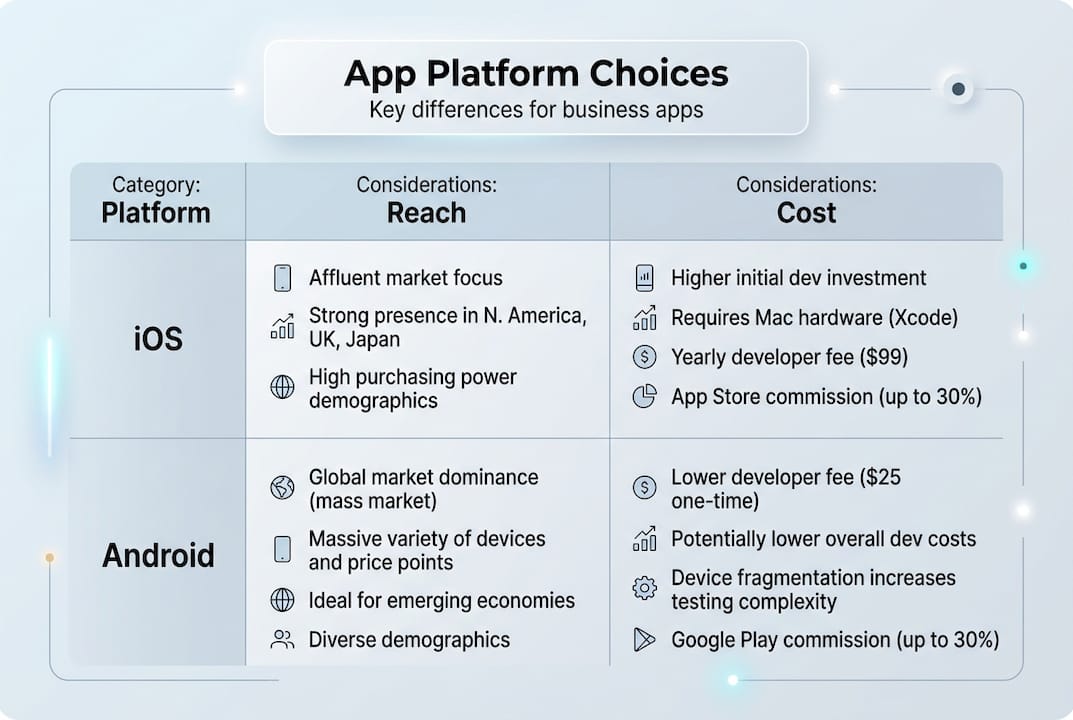
Platform decisions significantly impact development costs and reach. iOS apps access affluent users with high engagement rates but require Apple's approval process. Android dominates global market share and offers more flexibility but fragments across countless device types. Cross-platform frameworks let you build once and deploy everywhere, reducing costs whilst maintaining broad reach. Your choice should reflect where your target users actually are, not just personal preference.
| Platform approach | Best for | Typical cost | Development time |
|---|---|---|---|
| iOS only | Premium brands, healthcare | £30,000-£80,000 | 3-5 months |
| Android only | Broad consumer reach | £30,000-£80,000 | 3-5 months |
| Cross-platform | Budget-conscious, rapid launch | £40,000-£100,000 | 4-6 months |
| Native both | Maximum performance | £60,000-£160,000 | 6-9 months |
Pro tip: Create a minimum viable product (MVP) roadmap that identifies must-have features for launch versus nice-to-have enhancements for future releases. This approach gets your app to market faster whilst controlling costs.
Timeline planning must account for realistic development phases plus buffer for unexpected challenges. Discovery and planning typically require 2 to 4 weeks, design takes 4 to 6 weeks, development spans 8 to 16 weeks, and testing needs 2 to 4 weeks. Add time for app store review processes and soft launch periods. Rushing development to meet arbitrary deadlines inevitably compromises quality and creates technical debt that costs more to fix later. Following a comprehensive app development guide for business founders helps you set realistic expectations and milestones.
Document everything during preparation. Create a detailed requirements specification that describes every feature, user journey, and technical requirement. This document becomes the contract between stakeholders and developers, reducing misunderstandings and scope creep. Include wireframes showing basic screen layouts and user flow in app design diagrams mapping how users navigate through tasks. These visual tools reveal gaps in logic before expensive development begins.
Step-by-step mobile app development process
Once preparation is complete, development follows a structured sequence that transforms concepts into working software. Following a structured process ensures quality mobile apps meeting business and user needs whilst staying on budget and schedule.
-
Design user interfaces and experiences. Create detailed mockups showing exactly how every screen will look and function. Apply app design principles that prioritise clarity, consistency, and ease of use. Test designs with real users through clickable prototypes before committing to development. Iterate based on feedback to refine navigation, visual hierarchy, and interaction patterns. Great design feels intuitive because it matches how users naturally think and work.
-
Develop frontend and backend systems. Frontend developers build the visible interface users interact with, implementing designs in code that runs smoothly across devices. Backend developers create server infrastructure, databases, and APIs that power app functionality. This includes user authentication, data storage, business logic, and integrations with existing systems. Choose technology stacks based on performance requirements, scalability needs, and team expertise rather than trendy frameworks.
-
Integrate third-party services and APIs. Most apps connect to external services for payments, analytics, mapping, notifications, and more. Carefully evaluate each integration for security, reliability, and cost. Document API dependencies and create fallback strategies for when external services experience downtime. Proper integration architecture prevents single points of failure and maintains app stability even when third parties have issues.
-
Conduct comprehensive testing. Quality assurance teams systematically test every feature across multiple devices, operating system versions, and network conditions. Functional testing verifies features work correctly, usability testing ensures interfaces make sense to real users, performance testing confirms speed and responsiveness, and security testing identifies vulnerabilities. Automated testing catches regressions quickly whilst manual testing reveals subtle user experience issues.
-
Deploy to app stores and launch. Prepare store listings with compelling descriptions, screenshots, and preview videos that communicate value clearly. Submit apps for review, addressing any rejection reasons promptly. Plan a phased rollout starting with a small user group to catch any issues before full launch. Coordinate marketing efforts to drive initial downloads and engagement.
| Development phase | Duration | Key deliverables | Success metrics |
|---|---|---|---|
| Design | 4-6 weeks | Mockups, prototypes, style guide | User testing feedback scores |
| Development | 8-16 weeks | Working frontend and backend | Feature completion rate |
| Testing | 2-4 weeks | Bug reports, test documentation | Defect resolution percentage |
| Deployment | 1-2 weeks | Store listings, launch plan | Download and activation rates |
Pro tip: Implement analytics from day one to track how users actually behave in your app. Real usage data reveals which features matter most and where users struggle, guiding future improvements far better than opinions or assumptions.
Working with an experienced mobile app development company accelerates this process significantly. Professional developers bring proven methodologies, reusable components, and hard-won expertise that prevents common pitfalls. They also provide objective perspectives that challenge assumptions and suggest better approaches you might not have considered.
Communication throughout development keeps projects on track. Establish regular check-ins where developers demonstrate progress, stakeholders provide feedback, and everyone aligns on priorities. Agile methodologies with two-week sprints create natural rhythm and accountability. Transparent communication about challenges allows teams to solve problems collaboratively rather than letting issues fester until they become crises.
Verifying success and maintaining your mobile app
Launching your app marks the beginning of ongoing optimisation, not the end of development. Ongoing verification and maintenance are vital for sustainable app success and user satisfaction in competitive markets where expectations constantly evolve.
Track key performance indicators that align with your original objectives. Monitor daily active users, session duration, feature adoption rates, conversion percentages, and retention curves. Compare metrics against benchmarks to identify trends early. Sudden drops in engagement signal problems requiring immediate attention, whilst gradual improvements validate your strategy. Set up automated alerts for critical metrics so you can respond quickly to issues.
Collect user feedback through multiple channels. In-app surveys capture sentiment at key moments, app store reviews reveal public perception, support tickets highlight recurring problems, and user interviews provide deep qualitative insights. Analyse feedback systematically to identify patterns rather than reacting to individual complaints. Prioritise improvements that affect the most users or solve the most painful problems.
- Release regular updates that fix bugs, improve performance, and add requested features. Users expect apps to evolve continuously, and frequent updates signal active development and commitment to quality.
- Monitor crash reports and error logs to identify stability issues affecting user experience. Prioritise fixes based on frequency and severity of problems.
- Optimise performance by analysing load times, battery consumption, and data usage. Small improvements compound into significantly better experiences.
- Refresh content regularly to keep users engaged and give them reasons to return. Stale apps quickly lose relevance.
Pro tip: Create a public roadmap showing planned features and improvements. This transparency builds trust with users, reduces duplicate feature requests, and demonstrates your commitment to ongoing development.
Security maintenance protects both your business and users. Apply operating system updates promptly, patch vulnerabilities as they're discovered, and conduct regular security audits. Implement mobile app security considerations including encryption for sensitive data, secure authentication mechanisms, and compliance with regulations like GDPR. Security breaches destroy trust instantly and can result in significant financial and reputational damage.
Scale infrastructure as usage grows to maintain performance. Monitor server capacity, database performance, and API response times. Plan for traffic spikes around launches, promotions, or seasonal peaks. Cloud infrastructure makes scaling easier but requires careful cost management to avoid unexpected bills. Balance performance needs against budget constraints by optimising code efficiency before simply adding more servers.
Build a maintenance budget into ongoing operations. Plan to spend 15% to 20% of initial development costs annually on updates, hosting, support, and incremental improvements. This investment protects your initial outlay and ensures your app remains competitive. Apps that receive minimal maintenance quickly become outdated, buggy, and irrelevant, wasting the entire initial investment.
How Pocket App supports your mobile app development journey
Navigating mobile app development requires expertise across design, technology, security, and industry-specific requirements. Pocket App brings over 300 completed projects spanning healthcare, retail, and nonprofit sectors, delivering tailored solutions that drive engagement and operational efficiency. Our team handles everything from strategic discovery through mobile phone app development to ongoing support, ensuring your app succeeds in competitive markets.
Our app design services create intuitive interfaces that users love, whilst our technical expertise ensures robust performance across platforms. We prioritise mobile app security services to protect sensitive data and maintain compliance with industry regulations. Whether you need iOS, Android, or cross-platform solutions, we deliver apps that achieve your business objectives whilst exceeding user expectations. Let's discuss how we can transform your mobile app vision into reality.
Frequently asked questions
What are the common challenges in mobile app development?
Balancing budget constraints against feature ambitions often creates tension throughout projects. Ensuring user adoption requires ongoing marketing and engagement strategies beyond just building great software. Technical complexities multiply when supporting multiple platforms, device types, and operating system versions simultaneously. Security compliance demands constant vigilance and expertise in evolving regulations. Clear planning, realistic scoping, and experienced development partners help overcome these challenges systematically.
How long does it typically take to develop a custom mobile app?
Development timelines span 3 to 9 months depending on complexity, feature scope, and integration requirements. Simple apps with basic functionality might launch in 12 to 16 weeks, whilst complex applications with custom features, extensive integrations, and rigorous security requirements often need 6 to 9 months. Early planning with detailed requirements, responsive stakeholder feedback, and experienced development teams can streamline timelines significantly. Rushing development to meet arbitrary deadlines typically backfires by creating technical debt and quality issues.
What platforms should my business app support?
Choose iOS, Android, or cross-platform mobile app development based on where your target users actually spend time, your budget constraints, and required functionality. iOS reaches affluent users with high engagement but limits you to Apple devices. Android dominates global market share and offers broader reach across price points. Cross-platform frameworks deliver cost-efficient development whilst maintaining presence on both ecosystems, making them ideal for businesses seeking maximum reach with controlled budgets.
How do you ensure data security in mobile apps?
Implement encryption for data in transit and at rest, secure authentication with multi-factor options, regular security audits by independent experts, and strict compliance with GDPR and industry-specific regulations. Apply principle of least privilege for data access, validate all inputs to prevent injection attacks, and keep dependencies updated to patch known vulnerabilities. Mobile app data security requires ongoing maintenance and monitoring rather than one-time implementation, as threats constantly evolve and new vulnerabilities emerge regularly.