
TL;DR:
- Mobile apps transform mission awareness from passive broadcasts into active, ongoing supporter engagement. They use personalized content, notifications, and gamification to foster habit formation, trust, and measurable impact for charities and corporate social responsibility programs.
- Implementing iterative design, respecting privacy, and focusing on human narratives and simplicity are crucial for long-term success in mission-driven mobile applications.
Mobile apps are reshaping how charities and corporate organisations communicate their purpose, yet many still treat mission awareness as a broadcast activity — push out a newsletter, post an update, hope someone reads it. That assumption is costly. Mobile apps convert mission awareness from a one-way, passive experience into ongoing, on-the-go engagement that supporters can act upon immediately. This article explores the mechanisms, features, and real-world strategies that UK nonprofits and businesses are using right now to turn awareness into measurable impact.
Table of Contents
- Why mission awareness matters for today's organisations
- Core features: How apps turn awareness into active participation
- The science of engagement: Gamification and behaviour change
- Notifications, privacy, and best practice for mission-driven apps
- A fresh perspective: Why iteration and simplicity matter most in mission apps
- Explore our solutions for mission-driven mobile apps
- Frequently asked questions
Key Takeaways
| Point | Details |
|---|---|
| Active engagement over passive reach | Mobile apps transform mission awareness into measurable, ongoing supporter involvement. |
| Balanced gamification drives participation | Thoughtful use of rewards, reminders, and challenges increases habit-formation and sustained engagement. |
| Notifications and privacy are critical | Respecting user preferences and ensuring data security are essential for adoption and trust. |
| Continuous iteration ensures app success | Analytics and agile updates are crucial to refine features and maximise mission impact. |
Why mission awareness matters for today's organisations
Mission awareness has evolved well beyond the traditional newsletter or annual report. For charities and corporate social responsibility (CSR) teams alike, it now represents a strategic lever that influences donor retention, volunteer recruitment, employee participation, and public trust. If your audience cannot clearly articulate what your organisation stands for and why it matters, all your programme spending becomes significantly less effective.
The shift is partly cultural and partly technological. Supporters and employees today expect more than static information. They want to participate, track progress, and feel genuinely connected to the outcomes of their engagement. Digital solutions now offer something traditional communications never could: real behaviour change and habit tracking at scale.
Consider the evidence from UK corporate programmes. Corporate cause programmes using apps to make mission-aligned actions trackable and socially engaging report very high rates of habit uptake amongst participants. This is not simply because apps are novel. It is because they create persistent, personalised feedback loops that newsletters and static web pages structurally cannot replicate.
"Mission awareness is not a communications exercise — it is a participation architecture. When your app gives supporters something to do with that awareness, you move from passive knowledge to active identity."
For organisations exploring apps for charity engagement, the opportunity is not just to inform but to fundamentally shift how supporters relate to your cause. That distinction matters enormously when budgets are tight and impact must be evidenced.
Key reasons mission awareness is now a strategic priority:
- Donor and volunteer retention rises significantly when supporters feel embedded in ongoing progress, not just informed after the fact
- Employee engagement in CSR programmes improves when participation is visible, measurable, and socially connected
- Brand trust among the public strengthens when an organisation's mission is communicated through consistent, credible channels
- Data collection from app interactions allows organisations to refine messaging and prove impact to funders
Core features: How apps turn awareness into active participation
Understanding why mission awareness matters sets the context. The more pressing question is how apps actually deliver on that promise. The answer lies in a carefully designed combination of content delivery, notification strategy, and frictionless action pathways.
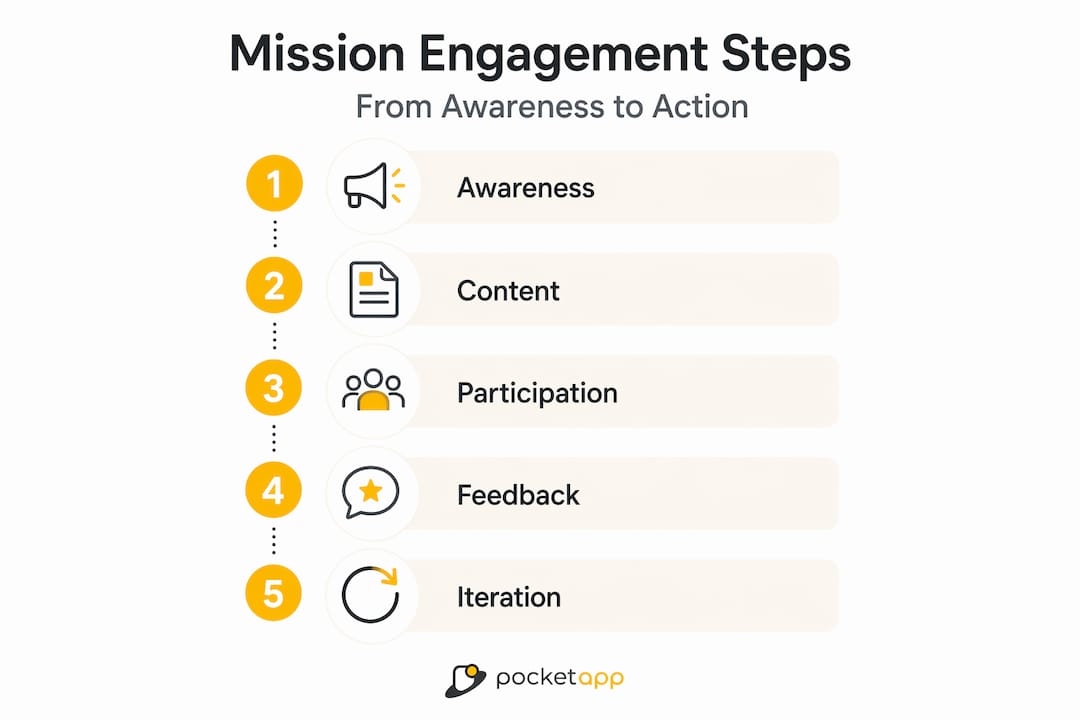
At the most basic level, apps allow supporters to access mission stories and sponsor actions directly from their pocket, with configurable reminders and notifications keeping them connected between visits. That accessibility alone is transformative compared with relying on someone to open an email or visit a website unprompted.

| Feature | Traditional channel | Mobile app |
|---|---|---|
| Content delivery | Email/newsletter (periodic) | Push notifications and in-app feeds (real-time) |
| Supporter actions | Form submission or cheque | In-app giving, sharing, or sponsorship in seconds |
| Feedback loop | Quarterly reports | Live progress tracking and impact updates |
| Personalisation | Segment-level | Individual preference and behaviour-driven |
| Community | Forum or social media | In-app peer sharing and leaderboards |
The table above makes the structural difference clear. Where traditional channels deliver information periodically and broadly, apps deliver it contextually and individually. That personalisation is what drives donor engagement strategies that actually move the needle on retention and giving frequency.
Rich content sits at the heart of this. Story-based features, such as video updates from beneficiaries, photo diaries, and written case studies, keep supporters emotionally invested. Emotional connection is what converts a one-time donor into a long-term advocate. When a supporter can open an app, watch a 90-second update from the person their monthly contribution supports, and instantly share that story with their network, the awareness cycle becomes self-sustaining.
Pro Tip: Build your app's content architecture around stories first and statistics second. Impact numbers are important, but human narratives are what prompt users to share your mission with their own networks, effectively expanding your reach at no additional cost.
For corporate teams using apps for social good, the participation model extends further. Employees can log volunteering hours, complete challenges tied to corporate values, and see their collective contribution measured in real time. This transparency reinforces organisational identity and gives employees a tangible reason to stay engaged with the programme throughout the year, not just during set-piece events.
The science of engagement: Gamification and behaviour change
With the core features established, it is worth examining the psychological principles that make app-based mission engagement genuinely effective over the long term. Gamification, the application of game-design elements in non-game contexts, is the primary mechanism most successful mission apps deploy.
Pairing content delivery with lifecycle messaging, using notifications and in-app prompts calibrated to the user's stage in their journey, is a proven methodology for measurable behaviour change. The key word here is calibrated. Gamification only works when it aligns with what the user actually values.
Elements that drive genuine habit formation in mission apps:
- Progress indicators — showing supporters how close they are to a personal or collective milestone creates genuine urgency without manufactured pressure
- Streak mechanics — rewarding consistent daily or weekly actions reinforces the habit of checking in with your organisation's mission
- Peer visibility — leaderboards and team challenges harness social motivation, particularly in corporate CSR programmes where colleagues can see each other's contributions
- Tiered recognition — badges or acknowledgements that reflect real commitment levels (rather than trivial achievements) build long-term loyalty
- Challenge-based giving — time-limited missions tied to specific outcomes, such as funding a school place by a set date, combine urgency with clarity of impact
For UX tips for charity apps, the critical design principle is restraint. Too many gamification layers create cognitive overload and can actually reduce engagement. Users who joined your app to support a cause they care about do not want to feel as though they are playing a video game. The mechanics must feel purposeful and proportionate.
| Gamification approach | Effective when | Counterproductive when |
|---|---|---|
| Streak tracking | Action is simple and daily | Action requires significant effort each time |
| Leaderboards | Participants are in the same team | Competition feels forced or inappropriate |
| Badges and tiers | Milestones reflect genuine commitment | Awarded too frequently for minor actions |
| Challenges | Tied to real, time-bound outcomes | Disconnected from the actual mission |
The event management app context offers a useful parallel. Organisations that run fundraising events have seen significant increases in pre-event engagement when app challenges and countdowns are built into the participant experience. The same psychology transfers directly to ongoing mission programmes.
Pro Tip: Start with one or two gamification features and measure their impact before adding more. A single well-tuned mechanic, like a team progress bar for a corporate giving campaign, will consistently outperform a cluttered app with five underperforming ones.
Notifications, privacy, and best practice for mission-driven apps
Meaningful engagement cannot occur without respecting users' boundaries and data. This is particularly important in the UK, where GDPR (General Data Protection Regulation) compliance is both a legal requirement and a significant factor in whether users trust your organisation enough to download your app in the first place.
Notifications are the most powerful tool in the mission app toolkit. They are also the easiest to misuse. Effective notifications strategy requires careful assignment to channels, respect for privacy, and a taxonomy (a structured classification of notification types) aligned with what users actually want to hear about.
"A single poorly timed or irrelevant notification can undo weeks of positive engagement. Users do not forgive apps that interrupt them without good reason — they simply uninstall them."
Practical best practices for notification design in mission-driven apps:
- Segment by preference — allow users to choose which types of updates they receive at the point of onboarding and revisit those choices periodically
- Respect local time — a notification sent at 7am feels helpful; one sent at 11pm feels intrusive, regardless of the content
- Prioritise relevance over frequency — one highly relevant notification per week outperforms daily generic reminders by a significant margin
- Make opting out easy — counterintuitively, giving users granular control over notifications increases overall retention because they trust you more
- Test delivery windows — A/B test different send times to identify when your specific audience is most receptive
Data privacy best practices are not just a legal checklist. They are a trust signal. In the charity sector, where supporters are sharing personal values and financial information, safeguarding user trust through transparent data practices is a direct competitive advantage. An organisation that communicates clearly about how it handles user data will consistently outperform one that buries that information in a lengthy privacy policy.
GDPR compliance in UK mission apps specifically requires clear consent mechanisms for notifications and data collection, straightforward rights management for users who want to export or delete their data, and robust security protocols protecting any financial or personally identifiable information stored within the app.
A fresh perspective: Why iteration and simplicity matter most in mission apps
Here is something most app briefs get fundamentally wrong: they treat the first version as a finished product rather than a starting hypothesis. Organisations invest months in designing elaborate feature sets — challenges, gamification layers, content libraries, notification frameworks — and then launch as though the work is done. It rarely is.
The honest truth is that analytics and A/B testing reveal that effectiveness varies considerably between audiences, and overcomplicated gamification frequently reduces rather than increases engagement. What reads well in a product specification often feels entirely different to a real user under real conditions.
We have seen this pattern play out repeatedly across mission-focused projects. An organisation builds what they believe is an aspirational, feature-rich engagement tool. Users download it, explore briefly, and then drift away. Not because the cause lacks merit, but because the app asks too much of them too soon. Onboarding is complex, the gamification feels disconnected from the actual mission, and the notifications arrive in bursts rather than being spaced meaningfully.
The antidote is simple but requires organisational courage: launch lean, measure honestly, and iterate quickly. A focused app with three genuinely useful features will build a more engaged user base than a cluttered app with fifteen average ones. The organisations achieving operational excellence through apps share a common characteristic — they treat their first release as version one of an ongoing product, not a destination.
That mindset requires something many organisations find uncomfortable: admitting that their initial assumptions about what users want were partially wrong. Analytics will show it clearly. Users will abandon certain screens, ignore specific features, and engage unexpectedly with elements that seemed secondary during planning. The organisations that act on those signals quickly, adjusting content, simplifying flows, or restructuring notification timing, are consistently the ones whose mission apps generate lasting engagement.
The other dimension frequently underestimated is content freshness. An app whose mission stories, challenges, and impact updates feel stale after three months will not retain supporters through month six. Building a realistic content calendar into your app strategy from the outset is not a minor operational detail — it is a primary driver of long-term success.
Explore our solutions for mission-driven mobile apps
After learning what drives lasting mission awareness, the natural next step is finding a development partner who understands both the technical and strategic dimensions of building apps for purpose-led organisations.
At Pocket App, we bring deep sector expertise across charity, CSR, and corporate engagement to every project. From initial discovery through to deployment and iteration support, our team designs mobile experiences that translate organisational mission into genuine user behaviour change. Whether you are a nonprofit looking to build stronger connections with donors and volunteers, or a corporate team seeking to amplify your CSR programme, our mobile app development process is built around your specific goals and audiences. Explore our business app development solutions and discover how a tailored approach can make your mission impossible to ignore.
Frequently asked questions
What is the main advantage of using mobile apps for mission awareness?
Mobile apps turn passive awareness into direct, ongoing engagement by enabling instant actions and tailored communications. Unlike static channels, apps create persistent feedback loops that keep supporters actively connected to your mission.
How do app notifications boost supporter engagement?
Well-designed notifications prompt supporters to act at key moments and sustain interaction through reminders and useful updates. According to effective notifications strategy, the most important operational considerations are channel assignment, timing, and alignment with user goals.
Are gamification features always effective in mission apps?
Gamification increases engagement when balanced and targeted, but can cause users to disengage if overused or too complex. Overcomplicated gamification frequently reduces impact rather than amplifying it, particularly when mechanics feel disconnected from the mission itself.
What privacy concerns should UK charities consider in app design?
UK charities must comply with GDPR, ensure responsible notification practices, and design with user trust and data privacy in mind. Data security and transparent consent mechanisms are significant factors in whether supporters choose to adopt and retain your app.
How can organisations measure the impact of mission apps?
Impact can be measured through analytics around usage, engagement, and behaviour change, including the uptake of desired habits. Corporate programme data demonstrates that app-based mission programmes can report very high rates of claimed behaviour change amongst active participants.