
TL;DR:
- Effective industry apps prioritize intuitive user experience, compliance, integration, and personalization.
- Custom solutions outperform generic ones by fitting specific workflows and reducing silos.
- Sector-specific apps have demonstrated measurable improvements like reduced no-shows, task times, and volunteer recruitment.
Choosing the right mobile app solution is harder than it looks. The market is saturated with platforms claiming to transform operations, yet most business leaders in retail, healthcare, and the nonprofit sector are still searching for concrete proof that these tools actually deliver. What separates a genuinely effective app from a costly distraction? Real-world outcomes. The examples, criteria, and comparisons in this article are drawn from sectors where getting it wrong has serious consequences, whether that means missed patient appointments, disengaged volunteers, or inefficient shop floors. Read on to find approaches that are measurable, repeatable, and directly relevant to your industry.
Table of Contents
- Key criteria for effective industry app solutions
- Healthcare: Secure communication apps cut costs and boost engagement
- Retail: Mobile solutions cut task time and drive engagement
- Nonprofit: Volunteer management at scale with app solutions
- Comparing industry app solutions: What works best where?
- A fresh perspective: Why tailored app solutions beat off-the-shelf packages
- Tailored app solutions for your business goals
- Frequently asked questions
Key Takeaways
| Point | Details |
|---|---|
| Define clear criteria | Select apps with proven impact, compliance, UX, and integration for your industry. |
| Use real-world examples | Benchmarked cases in healthcare and nonprofits show measurable gains from specialist app adoption. |
| Prioritise personalisation | Apps that personalise experience and offer easy self-service see higher engagement and better results. |
| Customise for the sector | Tailoring app solutions to fit operational quirks delivers more efficiency and engagement than off-the-shelf tools. |
Key criteria for effective industry app solutions
Before looking at specific examples, it helps to establish what success actually looks like. The strongest app solutions across industries share a set of common qualities, though the weighting of each varies by sector.
At the foundation is user experience. An app that requires extensive training to use will fail in environments with high staff turnover or seasonal workers. Intuitive UX is not a luxury feature. It is the baseline for adoption. Patient communication research confirms that intuitive UX is vital for low-training staff, and that privacy and personalisation directly boost engagement, while omnichannel approaches and integration prevent information silos.
Beyond UX, successful apps tend to share the following characteristics:
- Regulatory compliance: Healthcare apps must meet HIPAA standards; retail apps handling payment data need PCI compliance. Non-negotiable.
- Two-way communication: Messaging that flows both ways, not just broadcast alerts, increases engagement meaningfully.
- Personalisation and rewards: Personalisation in apps keeps users returning, whether they are patients booking follow-up appointments or loyalty programme members checking points balances.
- Omnichannel connectivity: Bridging online and offline interactions ensures a consistent experience across every touchpoint.
- API and system integration: API or EMR integration is essential to avoid siloed information that slows down teams and frustrates users.
- Self-service capabilities: Allowing users to manage their own tasks, from scheduling to onboarding, scales far more efficiently than manual coordination.
Pro Tip: Before selecting any app solution, map out your staff's digital literacy level and your existing system architecture. An app that cannot connect to your CRM, EMR, or stock management system will create more problems than it solves.
Any credible vendor should also be able to demonstrate how their platform supports digital engagement tools that go beyond basic notifications. Engagement requires depth, not just touchpoints.
Healthcare: Secure communication apps cut costs and boost engagement
Healthcare is an industry where the consequences of poor communication are tangible. Missed appointments, duplicated records, and frustrated patients all carry real financial and human costs. The Curogram platform offers one of the most striking documented turnarounds in this space.
Family Care Centre, a US-based primary care provider, adopted Curogram to replace fragmented phone-based communications. The results were significant. No-shows fell by 56% and the centre saved $249,000 annually in operational costs. These are not projections. They are audited outcomes from a real deployment.
Here is a summary of the key performance improvements:
| Metric | Before Curogram | After Curogram |
|---|---|---|
| No-show rate | 25% | 11% |
| Weekly staff hours saved | Baseline | 30+ hours |
| Phone volume reduction | Baseline | 57% lower |
| Patient satisfaction improvement | Baseline | +40% |
| Annual operational saving | £0 | $249,000 |
The platform works because it combines HIPAA-compliant two-way messaging with automated reminders and patient self-service tools. Staff are not chasing appointments by phone. Patients are not left waiting for information. Both sides of the communication are managed through a single, secure interface.
The broader implications for overcoming healthcare issues through mobile are significant. As one administrator noted after the switch:
"We reduced our front desk call volume so dramatically that staff could refocus on in-clinic patient care rather than administrative backlog."
For organisations exploring mobile apps in digital healthcare, this case illustrates the financial return that follows when the right communication infrastructure replaces legacy processes. The mHealth app benefits extend well beyond convenience. They reshape how clinical teams allocate their time.
Retail: Mobile solutions cut task time and drive engagement
Retail environments move fast. Staff change regularly, footfall is unpredictable, and the gap between a good and poor customer experience is often measured in seconds. Mobile apps that succeed in this environment are built around simplicity and speed.
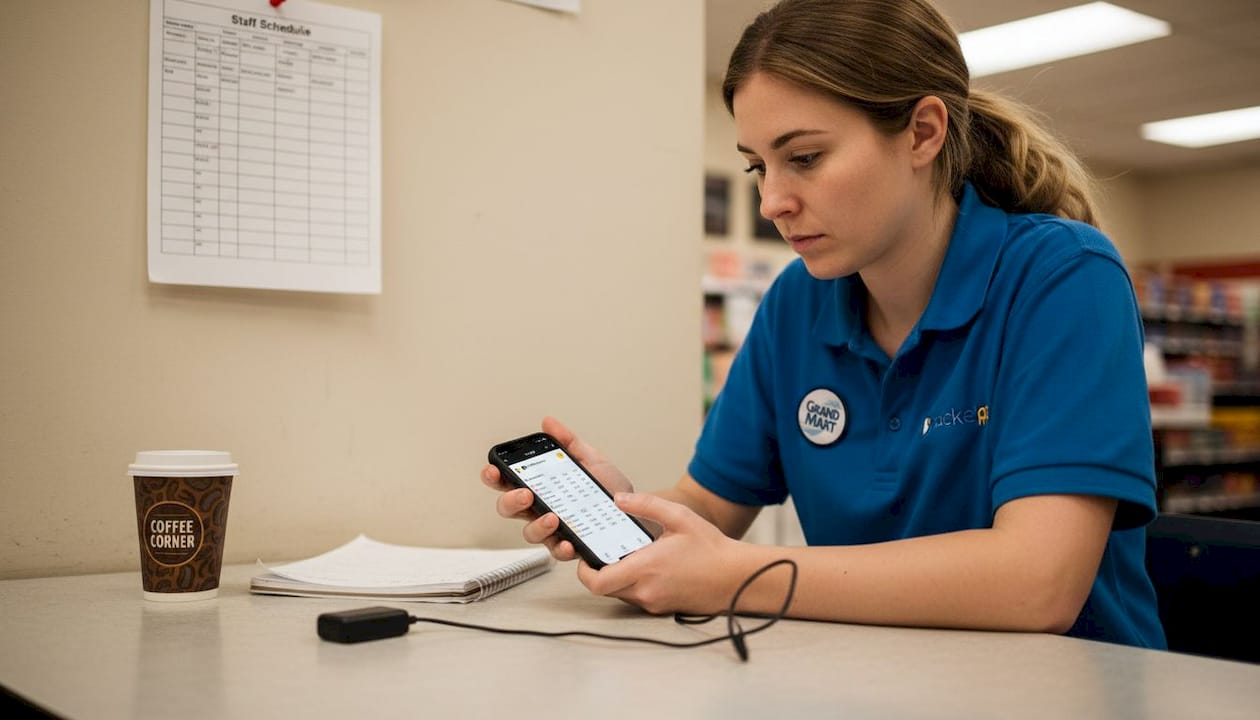
The evidence is clear: retail task times have been halved through well-designed app automation and improved UX. That is a significant productivity gain in an industry with thin margins and high operational pressure.
The retail apps that perform best share several design and functional traits:
- Fast onboarding: Staff should be able to use the app effectively within minutes, not days. Seasonal workers cannot afford week-long training cycles.
- Automated task management: Stock checks, task assignment, and daily reporting handled through the app rather than paper or legacy systems.
- Personalised customer engagement: Push notifications, loyalty rewards, and browsing history integration keep shoppers returning and spending more.
- Real-time data visibility: Managers see what is happening on the shop floor without needing to be physically present.
Pro Tip: Retail apps with built-in gamification, such as shift completion badges or team performance dashboards, consistently outperform those without. Engagement features are not just for customers. Staff motivation matters too.
Good app design tips in a retail context prioritise flow over features. A checkout assistant does not need fifteen functions. They need two or three that work perfectly. User-centred design disciplines ensure that development teams do not build what they think users want. They build what users actually need.
The downstream effect on customers is equally important. When staff operate efficiently and confidently, the in-store experience improves. Loyalty programmes, in particular, benefit from app integration. Keeping users engaged beyond the initial download requires a continuous loop of personalised value, and retail apps are well positioned to deliver that through purchase history data.
Nonprofit: Volunteer management at scale with app solutions
Nonprofits face a unique challenge. Their workforce is largely unpaid, highly motivated but inconsistently available, and often recruited and deployed in large surges during crisis periods. Spreadsheets and email chains simply cannot manage that complexity.
The SF-Marin Food Bank case study is one of the most compelling examples in the sector. Using the Get Connected platform, the organisation recruited 50,000 volunteers and tracked over 146,000 volunteer hours, scaling across 25 fixed locations and 20 pop-up distribution pantries.
The features that made this possible included:
- Self-service onboarding: Volunteers signed up, selected roles, and received orientation materials without staff intervention.
- Intelligent scheduling: The system matched volunteer availability with shift requirements automatically.
- Centralised communication: Updates, cancellations, and urgent appeals reached the entire volunteer base instantly.
- Engagement and hours tracking: Every shift was logged, enabling recognition programmes and grant reporting.
- Crisis scalability: During the pandemic, the platform handled a sudden surge in both demand and volunteer supply without operational collapse.
For organisations looking to develop apps for social good, this demonstrates how technology enables scale that human coordination alone cannot achieve. The ability to engage donors and volunteers through a single platform also reduces the administrative overhead that often consumes disproportionate nonprofit resources. An innovative approach like Overdub shows the creative range possible when mobile is used boldly.
Comparing industry app solutions: What works best where?
Each sector has distinct priorities. A comparison framework helps decision-makers identify which features matter most for their context.
| Feature | Healthcare | Retail | Nonprofit |
|---|---|---|---|
| Compliance priority | HIPAA/data privacy | PCI/GDPR | GDPR/grant reporting |
| Primary user | Patient and clinician | Staff and customer | Volunteer and coordinator |
| Core function | Secure messaging, scheduling | Task management, loyalty | Recruitment, scheduling |
| Key outcome | Fewer no-shows, saved staff time | Halved task times, staff efficiency | Volunteer scale and retention |
| Integration need | EMR/EHR systems | POS and stock management | CRM and donor databases |
The statistical benchmarks tell an equally clear story. Healthcare engagement data shows a median engagement index of 67.6% for a well-implemented HIV management app. Broader sector benchmarks indicate healthcare operational costs drop by 20 to 40% with the right platform, retail task times are halved with automation, and SF-Marin recruited 50,000 volunteers through a single app deployment.
The pattern is consistent. Apps designed for the specific demands of an industry outperform generic solutions. The differences are not marginal. They are transformational.
A fresh perspective: Why tailored app solutions beat off-the-shelf packages
The conventional assumption is that off-the-shelf apps are good enough for most organisations. They are faster to deploy, cheaper upfront, and backed by large support teams. That logic holds until you look at the data.
Off-the-shelf solutions fail most visibly when integration is critical. A healthcare platform that cannot connect to an existing EMR system creates a parallel workflow, which means double entry, errors, and frustrated staff. A retail app that cannot talk to your stock management system becomes an island of data. A volunteer platform without a link to your donor CRM misses the cross-engagement opportunities that sustain long-term growth.
Bespoke development, by contrast, is built around your workflows, your compliance requirements, and your users' actual behaviour. The best apps for productivity in any sector are those that disappear into the working day. Users stop thinking about the app and start thinking about the outcome. That invisibility only happens when the product fits the environment precisely.
The lesson from every case study in this article is the same. Sector-specific investment in the right technology, built or configured to match your exact operational context, consistently produces outcomes that generic packages cannot replicate.
Tailored app solutions for your business goals
If these case studies have prompted questions about what a purpose-built app could achieve for your organisation, we can help you work through the answer.
At Pocket App, our mobile app development services are built around sector understanding, not just technical execution. With over 300 projects delivered across retail, healthcare, charity, and consumer sectors, we know how to align technology with the specific pressures and goals your organisation faces. Our business app development experts combine strategic discovery with high-quality UX/UI design to ensure every product we build delivers measurable value from day one. Reach out to start a conversation about what a tailored solution could look like for your team.
Frequently asked questions
What are the most important features in industry-specific app solutions?
Intuitive UX, secure communication, integration with business systems, and the ability to scale efficiently are essential. UX and integration together prevent the information silos that undermine adoption and operational performance.
How do healthcare apps improve operational performance?
Healthcare apps reduce missed appointments, free up staff time, and raise patient satisfaction scores measurably. No-shows fell by 56% in one documented case following the introduction of secure two-way messaging.
How can nonprofit organisations use mobile apps effectively?
Nonprofits can use apps to manage volunteer recruitment, shift scheduling, and engagement tracking at scale. SF-Marin recruited 50,000 volunteers over two years using a single purpose-built platform.
Are custom apps better than off-the-shelf solutions for business?
Custom apps are better when your workflows, compliance requirements, or integration needs fall outside what generic products support. Off-the-shelf tools often create workarounds rather than solving the underlying operational challenge.
Recommended
- Pocket App | 5 apps to maximise employee engagement in the countdown to 2018
- Innovative app features to boost UK business growth
- Proven mobile app branding strategies: boost engagement
- Pocket App | Mobile enablement of the workforce – three key components of an enterprise app
- Employee Retention Solutions, Lower Turnover | OpenElevator