
TL;DR:
- Mobile fundraising now emphasizes seamless, interactive donor experiences beyond traditional text campaigns.
- Gamification features significantly increase donation amounts, especially among low-involvement supporters.
- Apps foster long-term donor loyalty through real-time updates, recurring gifts, and personalized stewardship.
Mobile fundraising is no longer about a single text message asking for a pound. UK charities that rely solely on traditional outreach are quietly losing ground to organisations that have made their donation journey seamless, interactive, and genuinely compelling. Research confirms that gamification features significantly enhance donation amounts for charities, suggesting the opportunity is far greater than most nonprofits realise. In this article, we explore how mobile apps are reshaping UK fundraising, what features deliver the strongest results, and how your organisation can shift from one-off gifts to a sustainable, app-powered model that keeps donors coming back.
Table of Contents
- The evolution of mobile fundraising solutions
- How mobile apps boost donor engagement
- Gamification: Making fundraising interactive and motivating
- From one-off gifts to sustainable fundraising models
- Why traditional fundraising limits your potential
- Take the next step with bespoke mobile app solutions
- Frequently asked questions
Key Takeaways
| Point | Details |
|---|---|
| Mobile apps increase engagement | Apps provide real-time updates and interactive features that motivate donors to give more frequently. |
| Gamification enhances donations | Structured gamification elements can significantly boost donation amounts, backed by peer-reviewed research. |
| Sustainable fundraising is achievable | Mobile platforms shift nonprofits from one-off events to ongoing recurring giving models with stewardship embedded. |
| Custom solutions drive results | UK charities benefit most from tailored mobile app strategies that align with their fundraising goals. |
The evolution of mobile fundraising solutions
Not long ago, mobile fundraising meant a short code and a text message. Campaigns would spike around televised appeals, then go quiet for months. Donor relationships were transactional rather than relational, and charities had little visibility into what motivated a supporter to give again. That model worked well enough when competition for attention was low, but the landscape has changed dramatically.
Smartphones have become the primary way people discover causes, share campaigns, and make payments. This shift has pushed charities to think far beyond the text-to-donate era. Supporter-led fundraising via smartphone apps, including features like Tap to Pay and real-time donation tracking, are now being piloted by forward-thinking UK organisations. These pilots represent a genuine turning point: fundraising can now happen anywhere, at any moment, without friction.
The benefits of this shift extend well beyond convenience. Mobile-first experiences foster ongoing supporter involvement rather than one-off moments of generosity. When a donor can check the progress of a campaign, see how their contribution made a difference, or challenge a friend to match their gift, the relationship deepens. Mobile engagement for nonprofits builds this kind of sustained connection in ways that email newsletters and fundraising galas simply cannot replicate.
Digital platforms also simplify peer-to-peer fundraising, enabling supporters to create personal pages, share them on social media, and collect donations on behalf of your charity. Key developments that define this new era include:
- Tap to Pay integration enabling street fundraisers to accept contactless donations instantly
- Real-time campaign dashboards that show progress and motivate further giving
- Peer-to-peer tools that turn loyal donors into active fundraisers
- Push notifications that keep supporters connected between campaigns
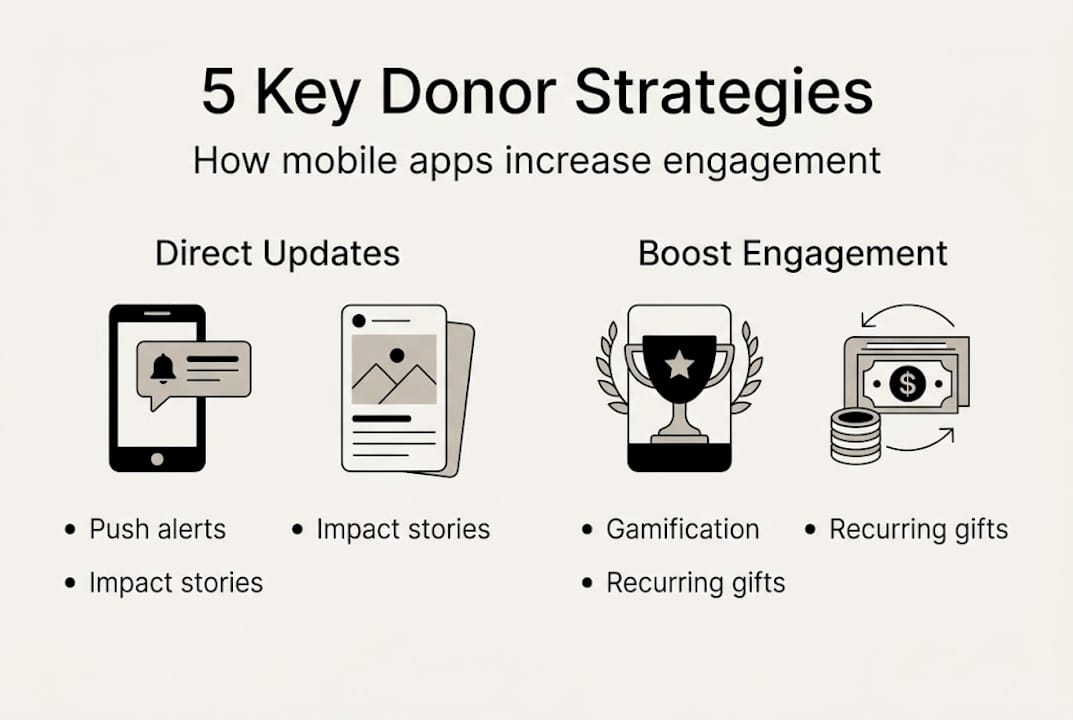
- Impact stories delivered directly to the app, closing the loop between donation and outcome
"The future of fundraising is in the hands of supporters, quite literally. Smartphone apps are giving charities the tools to meet donors where they already are."
Exploring mobile apps for social impact shows just how broad the possibilities are for organisations willing to embrace this shift.
How mobile apps boost donor engagement
Understanding the mechanics behind donor engagement helps you build an app that converts interest into long-term loyalty. Mobile apps do this through several interconnected mechanisms, each reinforcing the others.
First, apps deliver updates and impact stories directly to a supporter's pocket. A donor who gives to a food bank campaign and then receives a notification saying "Your gift helped feed 12 families this week" is far more likely to give again. This kind of continuous engagement and impact reporting transforms a transaction into a relationship.
Second, structured donation journeys guide first-time givers toward repeat giving. Rather than leaving donors to navigate a complex website, an app presents clear options, pre-set amounts, and one-tap payment flows. This reduces drop-off at the point of giving and makes upgrading from a one-off gift to a monthly direct debit feel natural.
Third, stewardship tools within apps nurture donor relationships over time. Thanking donors personally, sharing behind-the-scenes content, and offering exclusive updates for app users all build a sense of belonging that encourages sustained support.
Here is how app-based engagement compares to traditional channels:
| Feature | Traditional channels | Mobile app |
|---|---|---|
| Donation speed | Slow (forms, post) | Instant (one tap) |
| Impact updates | Infrequent (newsletters) | Real-time notifications |
| Recurring giving | Manual setup | In-app, frictionless |
| Peer-to-peer tools | Limited | Built-in sharing |
| Donor stewardship | Reactive | Proactive and automated |
To build a high-performing donation journey within your app, consider these steps:
- Onboard donors warmly with a personalised welcome and a clear explanation of impact
- Present pre-set donation amounts based on what similar donors have given
- Enable one-tap recurring gifts with simple upgrade prompts
- Deliver impact reports automatically after each donation clears
- Invite donors into the community through challenges, milestones, and peer activity
A strong donor engagement study reinforces that interactive, gamified features within apps elevate both the frequency and value of donations.
Pro Tip: Test your push notification timing carefully. Messages sent at 6pm on a weekday consistently outperform those sent during work hours, because supporters are more relaxed and receptive to cause-related content in the early evening.
If you want to go deeper on tactics, our guide to increasing donor engagement covers practical strategies for driving downloads and sustained activity. You can also explore approaches to improving donor retention through thoughtful app design.
Gamification: Making fundraising interactive and motivating
As donor engagement increases, gamification further energises fundraising campaigns. Gamification means applying game-like mechanics to non-game contexts, and in charity fundraising it can be genuinely transformative.
The most effective gamification features in fundraising apps include:
- Donation leaderboards that celebrate top fundraisers and inspire friendly competition
- Milestone badges awarded when donors reach giving anniversaries or cumulative totals
- Challenge mechanics where donors unlock a reward or trigger a matched gift by sharing the campaign
- Progress bars showing how close a campaign is to its target, creating urgency
- Streaks that reward consistent monthly giving with visual recognition
The evidence for these approaches is compelling. Structured gamification significantly enhances donation amounts, though the effect varies depending on donor involvement. Specifically, the research found that gamification works especially well for low-involvement donors, those who feel a weaker personal connection to the cause, because it gives them an alternative motivator. High-involvement donors, those deeply committed to the mission, are less dependent on game mechanics and respond better to mission-driven content.
| Donor type | Gamification impact | Best approach |
|---|---|---|
| Low involvement | High positive impact | Leaderboards, badges, challenges |
| High involvement | Moderate impact | Impact storytelling, mission updates |
| Lapsed donors | Strong re-engagement | Milestone rewards, comeback challenges |
For UK nonprofits, this distinction matters enormously when designing your app. A blanket gamification approach risks alienating your most committed supporters while failing to activate the casual donors who represent significant untapped potential. The academic evidence on gamification supports a segmented strategy.
Pro Tip: Introduce gamification gradually. Launch with one mechanic, such as a progress bar, and measure its effect before adding leaderboards or badges. Too many features at once can confuse donors and dilute the impact of each.
Our resources on gamification strategies and charity app success stories offer real-world examples of these principles in action.
From one-off gifts to sustainable fundraising models
Leveraging gamification and donor engagement is just the beginning; sustainable fundraising models are the natural progression. The real prize for UK charities is not a spike in donations during a campaign. It is a reliable, growing stream of income from supporters who give repeatedly because they feel genuinely connected to the cause.
Mobile apps make this possible by removing friction from recurring giving. A well-designed donation journey presents the monthly option prominently, explains the difference a regular gift makes, and allows donors to set up a direct debit in under a minute. Converting one-time donors into repeat givers requires continuous stewardship and optimised donation UX, both of which apps deliver by design.
Consider the following features that support a sustainable model:
- Recurring gift prompts shown at the point of donation, framed around annual impact
- Easy upgrade flows allowing monthly donors to increase their gift with a single tap
- Personalised thank-you messages triggered automatically after each payment
- Anniversary recognition celebrating how long a donor has supported the cause
- Annual impact summaries showing the cumulative difference a donor has made
Personalised stewardship drives repeat giving because it makes donors feel seen rather than processed. An app that remembers a supporter's name, tracks their giving history, and surfaces relevant content based on their interests creates a fundamentally different experience from a generic email newsletter.
Impact reporting is particularly powerful for retention. When donors can see exactly what their money achieved, scepticism about charity efficiency dissolves. Some UK charities are already shifting their model away from events toward ongoing app-based fundraising, using the app as the primary channel for donor communication, stewardship, and giving.
"The charities seeing the strongest growth are those treating their app not as a campaign tool, but as a permanent home for their donor community."
For organisations that do still rely on events, mobile apps for event management can bridge the gap between in-person fundraising and ongoing digital engagement.
Why traditional fundraising limits your potential
Having explored approaches to sustainable fundraising, let us consider why traditional methods may be holding you back. Many UK nonprofits still rely on annual events, direct mail, and telephone campaigns as their primary fundraising channels. These methods are not without merit, but they share a critical flaw: they are episodic. They create moments of giving rather than cultures of generosity.
Traditional methods miss real-time engagement opportunities. When a news story puts your cause in the spotlight, your supporters are ready to act. If your only donation channel is a website form that takes four steps to complete, you will lose that momentum before the page loads. Mobile apps eliminate that gap entirely.
There is also the matter of data. App-based fundraising generates rich behavioural data: which campaigns drive the most engagement, which notification messages prompt donations, and which donor segments respond to gamification. This information enables rapid, evidence-based decisions that traditional methods simply cannot support.
Organisations that have embraced mobile-first fundraising report faster growth and stronger donor relationships. The lesson from these early adopters is clear: the barrier to switching is lower than it appears, and the upside is substantial. Investing in mobile app branding is as much a strategic decision as a creative one, because it shapes how donors perceive and interact with your cause every single day.
Take the next step with bespoke mobile app solutions
If you are ready to move beyond the limitations of traditional fundraising and build something that genuinely transforms how your charity connects with donors, Pocket App can help.
With over 300 projects delivered and deep experience working with charities and social good organisations, we design and build mobile apps tailored to your fundraising goals and donor engagement needs. Our mobile app development process covers everything from discovery and UX design through to launch and ongoing optimisation. Whether you need a standalone fundraising app or a broader mobile phone app solution that serves volunteers, donors, and staff alike, we bring the technical expertise and sector knowledge to make it a success. Get in touch to explore what is possible for your organisation.
Frequently asked questions
How do mobile apps improve fundraising for charities?
Mobile apps boost fundraising by increasing donor engagement through real-time updates, gamified donation journeys, and streamlined payment tools that remove barriers to giving.
What features should a nonprofit fundraising app include?
Essential features include recurring donation options, push notifications, impact reporting, and gamification elements such as badges and leaderboards, alongside secure payment integration.
Does gamification really work for charity fundraising?
Yes. Studies show that gamification raises donations significantly, particularly for low-involvement donors who respond strongly to interactive mechanics and friendly competition.
How can UK charities start using mobile apps for fundraising?
Partner with experienced mobile app developers to design and launch an app tailored to your goals. UK pilot projects show that charities adopting smartphone fundraising tools are already seeing measurable improvements in donor retention and campaign performance.