
TL;DR:
- Custom mobile apps better align with specific workflows, compliance, and user needs than off-the-shelf solutions.
- Sector-specific apps deliver measurable results, such as increased sales, efficiency, and donor retention.
- Investing in ongoing iteration and development turns mobile apps into strategic, long-term assets.
Over 70% of UK online sales are now made via mobile, yet the majority of UK businesses still rely on generic, off-the-shelf apps that were never built with their sector in mind. That mismatch quietly costs you: in missed conversions, frustrated staff, and workflows that bend around software rather than the other way round. Custom mobile apps are not simply a premium alternative. They are a structural advantage, and the businesses seeing the strongest returns are the ones who understood that early. This guide explains why sector-specific development matters, what it looks like in practice, and how to decide whether it is the right move for your organisation.
Table of Contents
- The limitations of off-the-shelf apps versus custom solutions
- Custom mobile apps in action: Retail, healthcare, and nonprofit case studies
- Building for the future: Why sector-specific customisation is indispensable
- Off-the-shelf versus custom: Costs, risks, and when to choose each
- Why the most successful UK organisations treat apps as strategic assets
- How to take the next step towards a tailored mobile app
- Frequently asked questions
Key Takeaways
| Point | Details |
|---|---|
| Custom apps close critical gaps | Tailored solutions ensure your unique workflow, compliance, and user needs are fully addressed. |
| Proven sector impact | UK retail, healthcare, and nonprofit sectors report 15-26% gains in engagement and efficiency with bespoke apps. |
| Long-term value outweighs upfront costs | While custom takes longer and costs more initially, it saves time, reduces risks, and boosts ROI over generic solutions. |
| Strategic planning is key | Effective discovery and ongoing improvement are what separate great mobile solutions from mediocre ones. |
The limitations of off-the-shelf apps versus custom solutions
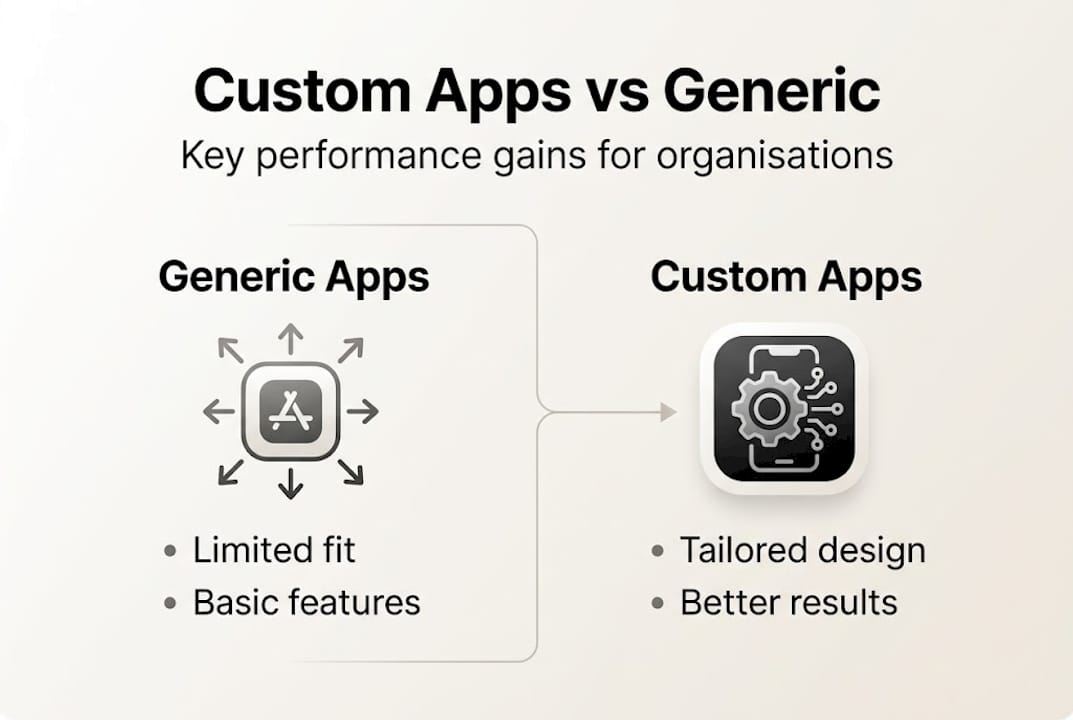
Off-the-shelf apps are pre-built software products sold to many businesses at once. They are quick to deploy, relatively cheap, and adequate for generic tasks. Custom mobile apps, by contrast, are designed around your specific workflows, users, and regulatory environment from the ground up.
The problem with generic solutions is not what they do. It is what they cannot do. Off-the-shelf apps typically meet only 70 to 80% of business requirements, leaving costly and risky gaps. That final 20 to 30% is rarely trivial. It tends to cover the most operationally critical functions: integrations with existing CRM systems, compliance with sector regulations, or the user experience that determines whether your customers actually engage with the product.
Consider the difference in practice:
| Feature | Off-the-shelf app | Custom mobile app |
|---|---|---|
| Initial setup speed | Fast | Longer (weeks to months) |
| Cost at launch | Lower | Higher |
| Workflow alignment | Partial | Full |
| Data ownership | Vendor-controlled | Organisation-controlled |
| Regulatory compliance | Generic | Sector-specific |
| Scalability | Limited by vendor | Built to your roadmap |
The gaps in generic solutions tend to cluster around three areas:
- Workflow misalignment: Staff adapt their processes to the software, not the other way round, leading to workarounds that introduce errors and slow output.
- Poor user experience: Generic interfaces are designed for the broadest possible audience, which often means they serve no single audience particularly well.
- Compliance risk: Sectors like healthcare and finance have strict data handling requirements. A generic app may not meet GDPR obligations or NHS data standards, exposing your organisation to regulatory risk.
Starting with effective app discovery is what separates teams who build something genuinely useful from those who end up with an expensive disappointment. When you properly scope your requirements before a line of code is written, the finished product reflects your business rather than fighting it. For organisations still undecided, the case for investing in mobile apps is increasingly difficult to argue against.
Custom mobile apps in action: Retail, healthcare, and nonprofit case studies
Theory is useful, but outcomes are more persuasive. Across retail, healthcare, and the nonprofit sector, UK organisations are seeing measurable results from custom mobile development.
Retail
Over 70% of UK online sales are now made via mobile apps, with Waitrose recording 175,000 activations in just three months after launching a tailored mobile experience. Bespoke retail apps enable real-time inventory visibility, personalised push notifications, and loyalty programme integration that generic apps simply cannot replicate at scale. The result is higher basket value, stronger repeat purchase behaviour, and conversion rates that reflect genuine intent rather than friction-induced drop-off.
The evidence for retail app performance is consistent: tailored experiences increase session length and reduce abandonment at the point of purchase.
Healthcare
The NHS App is one of the most instructive examples in UK public sector technology. NHS App adoption delivers a 20% reduction in administrative burden, with 1.5 million appointments saved and 5.7 million staff hours freed. That is not a marginal efficiency gain. It is a structural shift in how care is delivered and administered.

For private healthcare providers, the lesson is equally clear. Custom apps that allow patients to book, communicate, and manage their care reduce front-desk overhead and dramatically improve the patient experience.
Nonprofits
For charities and nonprofits, the financial case for custom apps is sometimes harder to make internally. But the numbers support it. Custom mobile apps drive a 26% increase in donor retention and allow organisations to replace costly third-party systems with tools built precisely for their volunteer structures and fieldwork needs.
Here is a summary of results across sectors:
| Sector | Key metric | Result |
|---|---|---|
| Retail | App activations | 175,000 in 3 months (Waitrose) |
| Healthcare | Admin reduction | 20% via NHS App |
| Nonprofit | Donor retention increase | 26% |
Organisations supporting UK sector efficiencies consistently find that purpose-built tools outperform generic alternatives on every meaningful metric. For charities specifically, charity app engagement is a proven lever for sustainable fundraising and volunteer retention.
Building for the future: Why sector-specific customisation is indispensable
Knowing that custom apps deliver results is one thing. Understanding how they are built well is what helps decision-makers hold developers accountable and invest with confidence.
A well-run custom mobile app project follows a clear sequence:
- Discovery: Structured workshops with stakeholders to map workflows, user needs, and technical requirements. This stage is where assumptions are challenged and real problems are identified.
- Design: Bespoke UI/UX designed around your actual users, not a hypothetical average user. Visual design, information architecture, and accessibility are all sector-informed.
- Build: Development using agreed technology, with regular sprint reviews to catch issues early and keep the product aligned with business objectives.
- Integration: Connecting the app to your existing systems (CRM, ERP, NHS data standards, donor management platforms) so data flows without manual intervention.
- Iteration: Post-launch monitoring, user feedback loops, and continuous improvement cycles that compound over time.
Sector input at every stage is what separates a functional app from a transformative one. NHS compliance requires specific data handling protocols. Retail apps need live CRM and stock system feeds. Nonprofit fieldwork demands offline capability for areas with poor connectivity.
"Discovery sessions, tailored UI/UX, and specific integrations are essential for long-term ROI and regulatory compliance." Why businesses need a custom app underlines this point directly.
Long-term scalability is another factor that off-the-shelf tools cannot match. When your business grows, a custom app grows with it because you own the architecture. There is no vendor permission required to add a feature or integrate a new system.
Pro Tip: Insist on a formal discovery session before signing any development contract. Teams that skip this stage almost always encounter expensive rework later. A thorough project discovery guide can help you understand exactly what to expect and ask for.
Off-the-shelf versus custom: Costs, risks, and when to choose each
This is where many business leaders get stuck. Custom apps cost more at the outset, and that number can be daunting. But the comparison requires more than a headline price check.
Off-the-shelf apps are 30 to 50% cheaper up front, but risk poor fit and higher long-term costs. Custom apps enable flexibility, security, and unique functions that generic tools cannot match. The total cost of ownership (TCO), which factors in workarounds, retraining, data migration, and integration failures, often tells a very different story.
There are scenarios where a generic app is the right answer:
- Your use case is simple, low-risk, and does not involve sensitive data.
- You need something operational within days and have time to reassess later.
- The feature gap is genuinely small and manageable with manual workarounds.
But the warning signs that you need a custom solution are hard to ignore:
- Integration requirements: You need the app to talk to existing business systems in real time.
- Security and compliance: You operate in healthcare, finance, or any regulated sector.
- Unique workflows: Your operational processes do not map onto standard software templates.
- Vendor dependency: Subscription fee increases, feature removal, or vendor collapse would create serious risk.
The sector efficiency evidence consistently shows that organisations with complex, user-facing needs recover the additional upfront investment within 12 to 18 months through efficiency savings and revenue gains.
Pro Tip: Before comparing quotes, build a simple TCO model covering three years. Include licence fees, integration workaround costs, staff time lost to manual processes, and any regulatory risk exposure. The gap between off-the-shelf and custom often narrows significantly when you do the maths properly.
Why the most successful UK organisations treat apps as strategic assets
Here is the distinction that rarely gets discussed in procurement conversations: choosing the right type of app is only part of the equation. The organisations achieving compounding gains from mobile technology are not just making good build decisions. They are treating their apps as living, evolving products rather than one-time purchases.
The common failure mode is to approve a development budget, launch an app, and then consider the project complete. That mindset produces tools that feel dated within 18 months and cannot adapt when user behaviour or business requirements shift.
The organisations we see achieving the strongest long-term returns invest in continuous iteration. They measure actual user behaviour post-launch, act on what the data shows, and build improvement cycles into their operational planning. Effective app planning lays the groundwork for this from day one.
The uncomfortable truth is that a brilliantly built app with no post-launch strategy will underperform a well-iterated one every time. Adaptability and measurement are not optional extras. They are what turns an app from a cost centre into a defensible competitive advantage.
How to take the next step towards a tailored mobile app
If the evidence above reflects challenges your organisation is already facing, the most useful next step is a structured conversation rather than a commitment to a full build.
At Pocket App, we work with UK businesses across retail, healthcare, and the nonprofit sector to design and deliver mobile solutions that are built around real operational needs, not generic templates. With over 300 projects completed, our process begins with discovery and ends with measurable outcomes. Explore our bespoke mobile app development services to understand how we approach each project, or review our enterprise solutions if you are working at scale across a complex organisation. We would be glad to help you define the right approach.
Frequently asked questions
How much does a custom mobile app cost for UK businesses?
Custom apps cost 30 to 50% more up front than off-the-shelf alternatives, but they typically deliver a better total cost of ownership over three years by eliminating workarounds, integration failures, and licence dependency.
How do custom mobile apps improve operational efficiency?
They align directly with your workflows, automate manual tasks, and connect with existing business systems. The NHS App saved 1.5 million appointments and reduced administrative burden by 20%, demonstrating what targeted digital tools can achieve.
Do custom mobile apps offer better security than generic apps?
Yes. Custom apps can be tailored to meet sector-specific compliance requirements, including GDPR, NHS data standards, and financial regulations, in ways that off-the-shelf products simply cannot accommodate.
How quickly can a UK business deploy a custom mobile app?
Custom projects take longer than buying an off-the-shelf product because they include discovery workshops, iterative testing, and system integration. Discovery and planning add time upfront but prevent the costly rework that undermines generic solutions down the line.