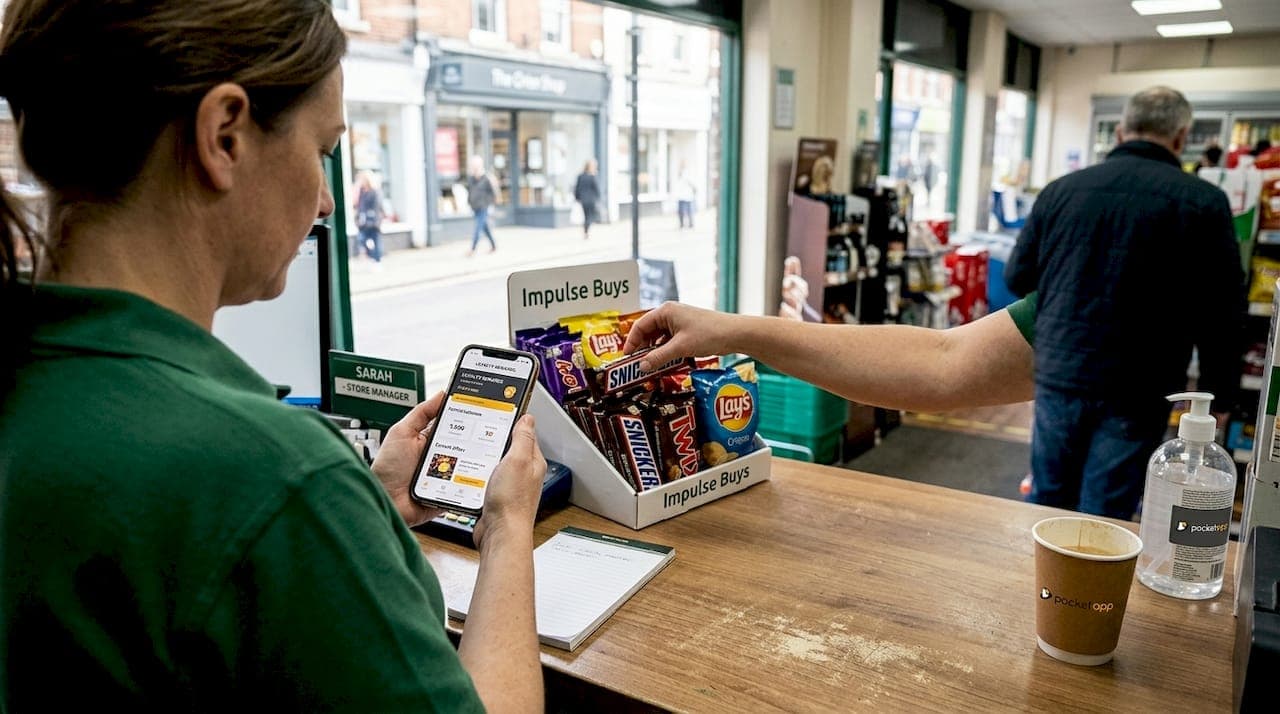
John Lewis app users are 3x more valuable than non-app customers, shopping more frequently across every channel. That single statistic should make any UK retail decision-maker sit up. Mobile apps are no longer a digital experiment or a box-ticking exercise. They are becoming the primary relationship between retailers and their most loyal customers. This guide breaks down the strategic value, measurable benefits, key features, and honest risks of retail mobile apps, so you can make a confident, informed decision for your business.
Table of Contents
- Understanding the strategic value of mobile apps in retail
- Key benefits of mobile apps for UK retailers
- What features make a retail mobile app succeed?
- Potential challenges and when a mobile app might not be right
- How to decide: is a mobile app right for your retail business?
- Explore custom mobile app solutions for your retail business
- Frequently asked questions
Key Takeaways
| Point | Details |
|---|---|
| App users spend more | Mobile app adopters shop more frequently and have higher lifetime value than non-app users. |
| Loyalty programmes drive engagement | Apps with integrated loyalty features see impressive adoption and repeat custom, as proven by Tesco and Waitrose. |
| Not always a must-have | Mobile apps suit high-repeat, loyalty-focused retailers but aren't cost-effective for every business model. |
| App features matter | Personalised notifications, seamless payments, and intuitive design deliver the biggest business impact. |
| Plan before investing | Carefully assess readiness, resources, and business fit before committing to custom mobile app development. |
Understanding the strategic value of mobile apps in retail
Mobile apps give retailers something no other channel can match: a direct, always-on connection to customers. Your app sits on their phone, travels with them, and can reach them at precisely the right moment. That is a fundamentally different relationship from a website visit or a promotional email.
The strategic power comes from several interconnected capabilities:
- Push notifications that reach customers instantly, without competing with email inboxes
- Location-based marketing that triggers relevant offers when a customer is near your store
- Loyalty scheme integration that rewards behaviour and builds habitual purchasing
- Omnichannel continuity that links browsing, in-store visits, and online purchases into one seamless journey
As the evidence shows, mobile apps deliver superior engagement through push notifications, personalised offers, loyalty integration, and geolocation services, leading to higher retention and repeat purchases. This is not theoretical. It is measurable and repeatable.
"The app is not just another sales channel. It is the connective tissue between your physical stores, your website, and your customer relationships."
For retailers exploring the benefits for UK businesses, the case is increasingly clear. Understanding the reasons to develop a mobile app starts with recognising that apps create data-rich, personalised experiences that static websites simply cannot replicate. Tracking the right mobile app metrics from day one ensures your investment is measurable from the outset.
Key benefits of mobile apps for UK retailers
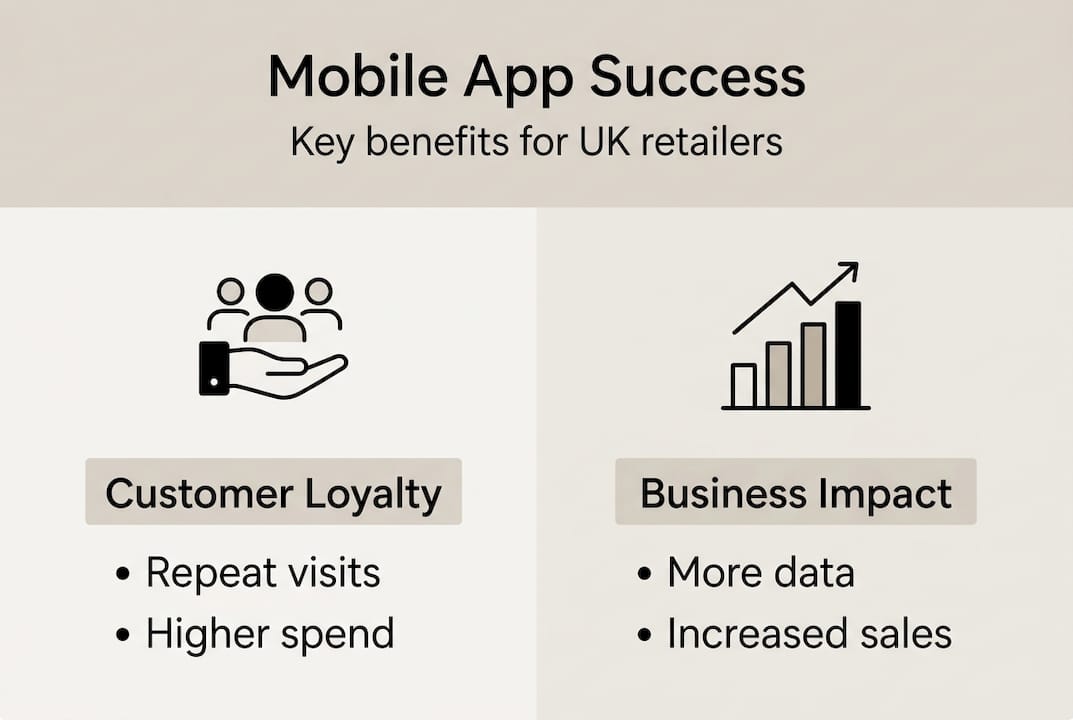
The business case for retail apps is no longer built on aspiration. It is built on results from UK brands you already know.
| Retailer | App benefit | Measurable outcome |
|---|---|---|
| John Lewis | Customer lifetime value | App users 3x more valuable |
| Tesco | Clubcard loyalty adoption | 90 to 97% adoption in key groups |
| Waitrose | Live Activities feature | 175,000 activations recorded |
| Primark | Digital loyalty launch | Rapid adoption across age groups |
These are not outliers. They reflect a broader pattern: customers who engage with a retailer's app spend more, visit more often, and are significantly harder to lose to a competitor.
The benefits extend well beyond loyalty points:
- First-party data collection on browsing habits, purchase history, and in-app behaviour enables genuinely personalised marketing
- AI-driven personalisation uses that data to surface the right product at the right time
- Operational efficiency improves when customer service queries, order tracking, and returns are handled within the app
- Omnichannel integration means a customer can check stock on their phone, reserve in-store, and collect the same day
Exploring loyalty programme case studies reveals how these outcomes are achieved in practice. The gains in operational efficiency in UK retail are equally significant, particularly for retailers managing complex stock and fulfilment operations. Getting user experience in retail apps right is what separates apps that customers return to from those they delete after one use.
What features make a retail mobile app succeed?
Not all app features deliver equal value. The retailers seeing the strongest returns are investing in specific capabilities that directly influence purchasing behaviour and loyalty.
Here are the features that consistently drive results, ranked by business impact:
- Personalised push notifications tied to browsing history, location, or purchase patterns
- Integrated loyalty schemes with real-time points balances and exclusive app-only rewards
- Seamless payment and digital receipts that reduce friction at the point of purchase
- Geolocation triggers that activate relevant offers when customers are nearby
- Wishlists and save-for-later functionality that keeps customers engaged between purchases
- Appointment booking and click-and-collect that bridge the digital and physical experience
| Feature | Customer benefit | Business impact |
|---|---|---|
| Push notifications | Timely, relevant offers | Higher conversion rates |
| Loyalty integration | Reward visibility | Increased repeat visits |
| Geolocation | Contextual relevance | Uplift in footfall |
| Digital receipts | Convenience | Reduced service costs |
| AI personalisation | Relevant product discovery | Higher average order value |
Retail apps enable rich first-party data collection on browsing, purchases, and behaviour, which powers the AI-driven personalisation that makes these features so effective. Without that data layer, even well-designed features underperform.
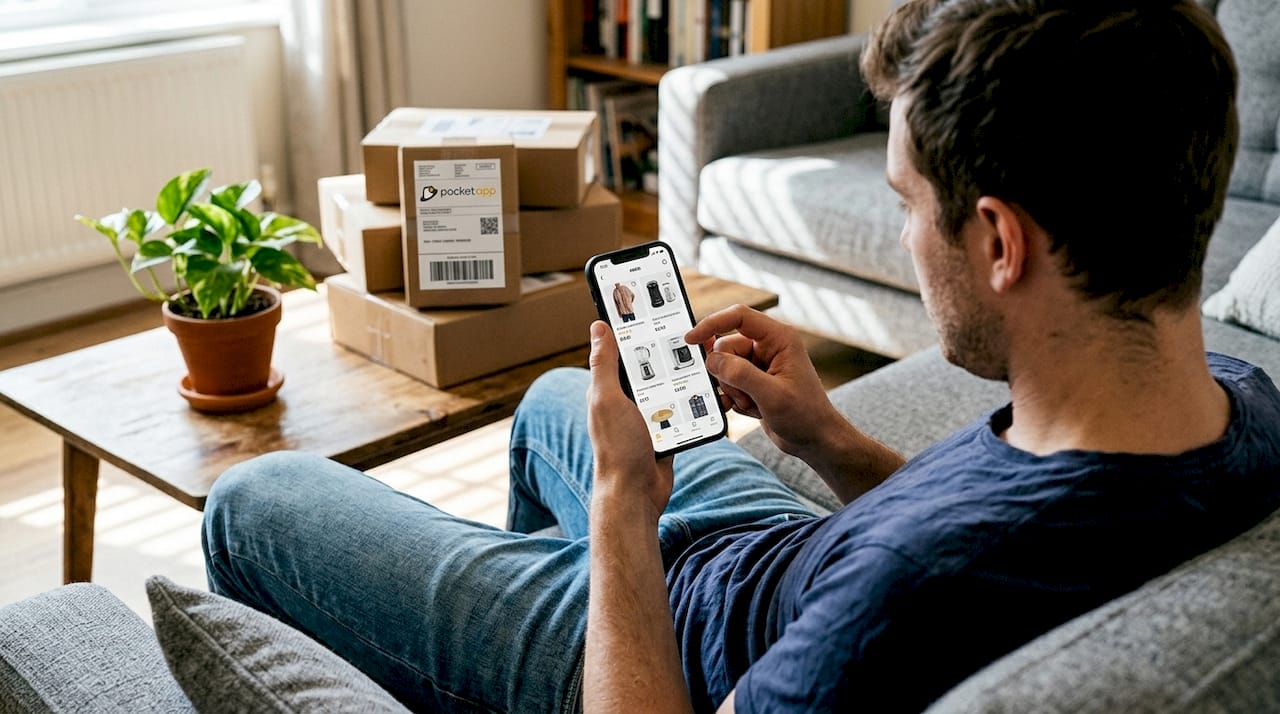
Pro Tip: Prioritise user-centred app design from the very first wireframe. An app that is difficult to navigate will be deleted within days, regardless of how sophisticated its features are.
Pairing strong features with effective marketing strategies ensures your app reaches the right audience at launch and continues to grow its user base. Adding engagement through gamification can further increase session frequency and time spent in-app, particularly for younger demographics.
Potential challenges and when a mobile app might not be right
Honesty matters here. Mobile apps are not the right investment for every retailer, and understanding the risks is just as important as understanding the rewards.
The most common challenges include:
- High upfront development costs, often twice the cost of a comparable web solution
- App store approval processes that can delay critical updates by days or weeks
- Platform fragmentation across iOS and Android, requiring ongoing maintenance for both
- Low adoption risk if the app does not offer genuine value beyond the website
- Privacy and data concerns that require careful handling to maintain customer trust
"An app that monitors staff performance can generate significant backlash if employees feel surveilled rather than supported."
The Morrisons staff performance app situation illustrates this clearly. Internal apps that track productivity can face serious opposition if the rollout is not handled with transparency and genuine staff engagement.
For customer-facing apps, the risk is different but equally real. If your retail model relies on infrequent, one-off purchases, the economics of app development rarely stack up. A customer who buys a sofa once every seven years is unlikely to keep your app installed. In these cases, a well-optimised mobile website or a progressive web app (PWA) will deliver better reach at lower cost.
The importance for business success of choosing the right digital channel cannot be overstated. The wrong choice wastes budget and diverts attention from channels that would actually move the needle.
Pro Tip: Before committing to native app development, map your customer's purchase frequency and average lifetime value. If the numbers do not support sustained engagement, a PWA may be the smarter starting point.
How to decide: is a mobile app right for your retail business?
With a clear picture of both the opportunity and the risks, the decision comes down to a structured assessment of your specific business context.
Work through these questions before committing to development:
- How often do your customers purchase? Apps deliver the strongest ROI for retailers with monthly or more frequent purchase cycles.
- Do you have an existing loyalty programme? If yes, an app can supercharge it. If not, consider whether you have the infrastructure to support one.
- What is your current customer lifetime value? Use this as your baseline to model the uplift an app could realistically deliver.
- Can you resource ongoing development? An app is not a one-time project. Budget for regular updates, new features, and platform maintenance.
- What does your D30 retention look like? Retail retention benchmarks show top-performing apps retain around 35% of users at 30 days. If your model cannot support that level of engagement, reconsider.
- Is your team ready? Staff training, customer support, and internal processes all need to adapt when an app launches.
Tracking your DAU/MAU ratio (daily active users divided by monthly active users) tells you how sticky your app is. A ratio above 0.2 is generally considered healthy for retail. Below that, engagement is weak and churn will follow.
For retailers looking to boost sales team productivity, internal-facing app features can complement customer-facing ones, creating a joined-up digital operation that improves both the customer experience and staff performance.
Explore custom mobile app solutions for your retail business
If the evidence in this article has resonated with your own retail challenges, the logical next step is exploring what a purpose-built app could look like for your business. Every retailer's situation is different, and the most effective apps are those designed around your specific customers, your loyalty model, and your operational goals.
At Pocket App, we have delivered over 300 projects for UK brands across retail, charity, healthcare, and consumer engagement. Our team supports clients from initial discovery through to launch and beyond, ensuring every feature earns its place. Whether you are starting from scratch or evolving an existing digital product, our custom mobile app development service is built around your objectives. Explore our approach to bespoke app design and see how we translate retail strategy into apps that customers actually use.
Frequently asked questions
What is the main advantage of retail mobile apps over mobile websites?
Apps deliver superior engagement through push notifications, personalised offers, and seamless loyalty schemes, driving retention that mobile websites cannot match. The direct, persistent presence on a customer's device is itself a significant advantage.
Are mobile apps better for every type of retailer?
Apps work best for retailers with high repeat purchase rates and a loyalty focus. For businesses with lower repeat rates or tighter budgets, web apps or PWAs often deliver better reach at lower cost.
How do UK retailers measure the success of mobile apps?
Key metrics include DAU/MAU ratio, 30-day retention rates, customer lifetime value, and churn. Top retail apps retain around 35% of users at the 30-day mark.
What are the main risks or downsides of launching a retail app?
High upfront costs, app store approval delays, and the risk of poor adoption are the most common pitfalls. Apps that monitor staff behaviour can also generate significant internal opposition if not introduced carefully.