
Many UK business owners mistakenly believe mobile apps are luxuries reserved for large corporations or e-commerce giants. In reality, custom mobile applications deliver measurable operational efficiency gains and customer engagement improvements for businesses of all sizes. This guide explores why investing in custom mobile apps makes strategic sense in 2026, covering how apps streamline workflows, enhance customer retention, enable data-driven decisions, and expand market reach. Whether you operate in retail, healthcare, professional services, or manufacturing, understanding these benefits helps you evaluate whether mobile app investment aligns with your growth objectives.
Table of Contents
- How Custom Mobile Apps Boost Operational Efficiency
- Enhancing Customer Engagement And Retention With Mobile Apps
- Leveraging Real-Time Data And Expanding Market Reach With Mobile Apps
- Key Considerations For Investing In Custom Mobile Apps In 2026
- Explore Expert Mobile App Development Services
- Frequently Asked Questions About Investing In Mobile Apps
Key takeaways
| Point | Details |
|---|---|
| Operational efficiency | Custom mobile apps automate repetitive tasks and reduce errors, saving time and improving productivity across teams. |
| Customer engagement | Apps enable personalised experiences and direct communication, with businesses seeing 40-50% higher engagement metrics. |
| Data-driven decisions | Real-time mobile data access speeds decision cycles, with 15-20% improved accuracy reported by businesses using app analytics. |
| Market expansion | Apps help UK businesses reach new customer segments cost-effectively without heavy advertising spend. |
| Security and scalability | Robust authentication, encryption, and microservices architecture ensure apps grow safely with your business. |
How custom mobile apps boost operational efficiency
Custom mobile apps transform daily business operations by eliminating manual bottlenecks and standardising workflows. When you invest in tailored digital tools, your team gains immediate access to critical information regardless of location, accelerating collaboration and reducing delays. Custom mobile apps improve ROI by reducing repeated manual work and streamlining operations that previously consumed hours of staff time.

Automation stands as the primary efficiency driver. Apps handle repetitive data entry, approval routing, inventory tracking, and reporting tasks that traditionally required manual intervention. This automation reduces human error whilst freeing your team to focus on strategic activities that genuinely require human judgement. A field service business, for example, can automate job scheduling, route optimisation, and customer notifications through a single app interface.
Workflow optimisation occurs when apps enforce standardised procedures across your organisation. Instead of relying on individual memory or paper checklists, employees follow digital workflows that guide them through complex processes step by step. This consistency improves quality control and makes training new staff significantly faster. Mobile apps boost operational efficiency across UK sectors by adapting these workflows to industry-specific requirements.
Integration capabilities amplify efficiency gains further. Custom apps connect with your existing CRM, ERP, accounting, and communication systems, creating a unified digital ecosystem. Data flows automatically between platforms, eliminating duplicate entry and ensuring everyone works from the same accurate information. This integration becomes especially valuable as your business scales and system complexity increases.
Key operational benefits include:
- Real-time access to customer records, inventory levels, and business metrics from any location
- Automated task assignment and progress tracking that keeps projects moving forward
- Digital signature capture and document management that eliminates paper-based delays
- Instant communication channels between field staff and office teams
- Standardised reporting that provides consistent visibility into performance metrics
Mobile app solutions for remote work efficiency have become particularly valuable as UK businesses embrace flexible working arrangements. Apps ensure remote teams maintain productivity levels comparable to office-based work.
Pro Tip: Regularly review and update workflows within your app to maintain efficiency as business processes evolve and market conditions change.
Enhancing customer engagement and retention with mobile apps
Mobile apps create persistent touchpoints with customers that email and websites cannot match. Your app sits on customer devices, providing instant access to your services whilst enabling personalised experiences that build loyalty over time. Businesses with dedicated mobile apps experience 40-50% higher engagement metrics compared to those relying solely on traditional digital channels.
Personalisation transforms generic interactions into tailored experiences. Apps track user preferences, purchase history, and browsing behaviour to deliver relevant content, product recommendations, and offers. This data-driven personalisation makes customers feel understood rather than marketed to. An AI-powered recommendation engine within your app can suggest products or services based on individual usage patterns, dramatically increasing conversion rates.
Push notifications provide direct communication channels that cut through inbox clutter. Unlike emails that may go unread for days, notifications appear immediately on customer devices with high visibility. You can announce new products, share exclusive offers, send appointment reminders, or provide order updates. The key lies in sending valuable, timely messages rather than generic promotions that prompt users to disable notifications.
Behavioural tracking enables continuous improvement. Custom apps support customer retention by tracking user actions and revealing which features resonate and which create friction. This insight allows you to refine the customer journey based on actual usage data rather than assumptions. You might discover that customers abandon purchases at a specific checkout step, prompting targeted improvements.
Security builds trust that underpins long-term relationships. Customers share sensitive personal and financial information through apps, making robust data protection non-negotiable. Implementing multi-factor authentication, end-to-end encryption, and transparent privacy policies demonstrates your commitment to safeguarding customer data. This trust becomes a competitive advantage in markets where data breaches regularly make headlines.
Mobile apps deliver measurable customer engagement benefits:
- Increased repeat purchases through convenient reordering and personalised recommendations
- Higher customer lifetime value as engaged users spend more over time
- Reduced churn rates when apps solve genuine customer problems effectively
- Enhanced brand loyalty through consistent, quality interactions
- Valuable customer feedback collected through in-app surveys and ratings
- Community building via social features that connect users with shared interests
Personalisation in mobile apps extends beyond product recommendations to encompass interface customisation, content filtering, and adaptive functionality that evolves with user needs. Why mobile apps are crucial becomes evident when examining retention metrics across industries.
Pro Tip: Use app analytics to continuously tailor experiences and avoid generic interactions that fail to resonate with your diverse customer base.
Leveraging real-time data and expanding market reach with mobile apps
Real-time data access fundamentally changes how quickly your business responds to opportunities and challenges. Mobile apps provide instant visibility into sales trends, inventory levels, customer behaviour, and operational metrics that previously required manual reporting cycles. Real-time data access helps teams make quicker decisions and reach new markets without the heavy advertising spend traditional expansion requires.
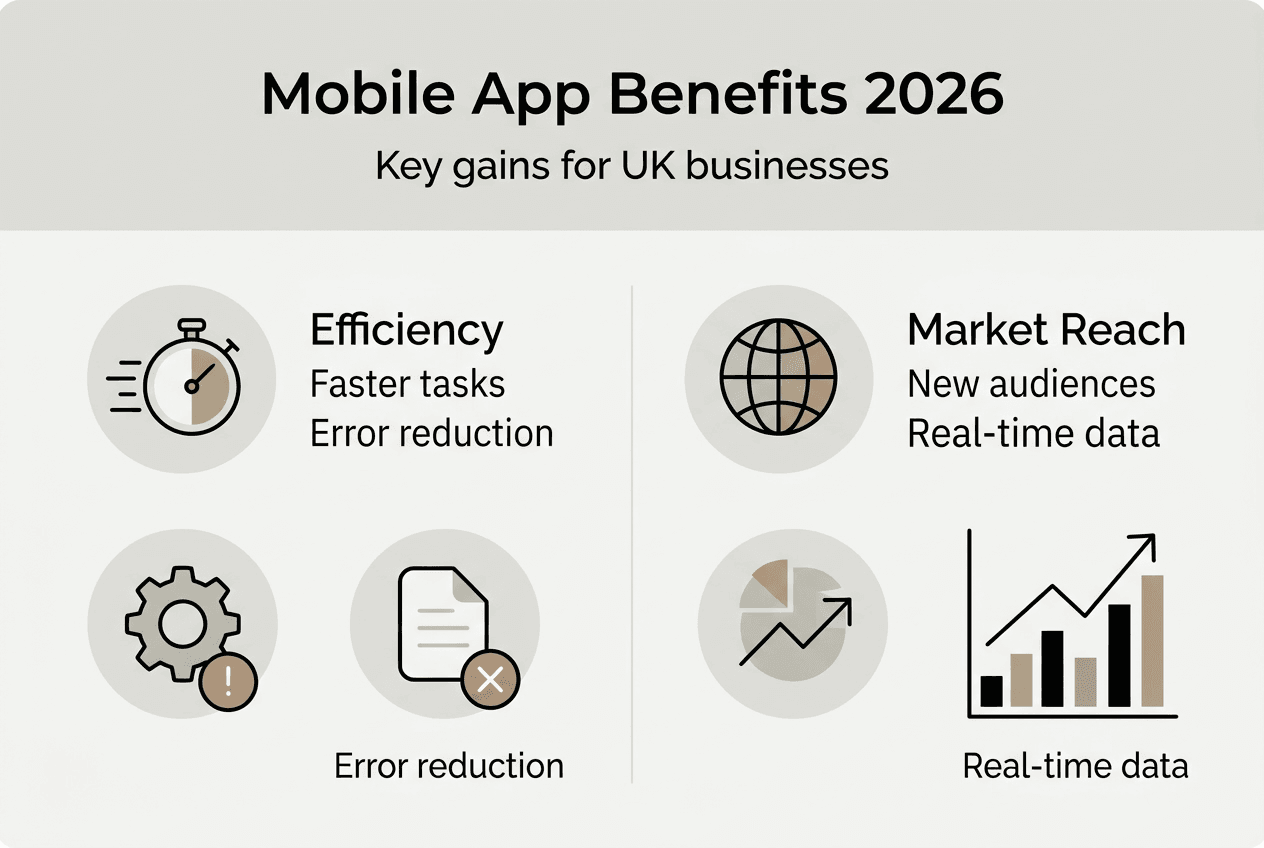
Decision-making accuracy improves dramatically when leaders work from current rather than historical data. Businesses leveraging mobile app analytics see 15-20% improvement in decision-making accuracy because they spot patterns and anomalies as they emerge. A retail manager can adjust staffing levels based on live foot traffic data. A manufacturer can reroute shipments when supply chain disruptions occur. These agile responses create competitive advantages in fast-moving markets.
| Decision Factor | Before Mobile Apps | After Mobile Apps |
|---|---|---|
| Data freshness | Daily or weekly reports | Real-time dashboards |
| Response time | Hours to days | Minutes to hours |
| Decision accuracy | Based on historical trends | Based on current conditions |
| Team alignment | Periodic meetings | Continuous visibility |
| Market responsiveness | Reactive to changes | Proactive adjustments |
Market reach expansion becomes cost-effective when apps serve as direct customer channels. Instead of relying on expensive advertising to attract attention, your app provides ongoing value that keeps your brand top-of-mind. You can test new products with existing app users before broader launches, gathering feedback that reduces market risk. Geographic expansion becomes simpler when your app delivers services to new regions without requiring physical presence.
App analytics reveal customer segments and usage patterns you might otherwise miss. You discover that a product designed for one demographic actually resonates with another, opening unexpected market opportunities. Location data shows where demand concentrates, informing decisions about physical expansion or targeted marketing. Behavioural analytics identify power users who become brand advocates and influence wider adoption.
Practical strategies for using data insights to scale market reach:
- Analyse user acquisition channels to identify which marketing efforts deliver highest-quality customers
- Monitor feature usage to prioritise development resources on capabilities that drive engagement
- Segment customers by behaviour patterns rather than demographics for more effective targeting
- Track customer journey metrics to identify and eliminate friction points that limit growth
- Benchmark performance against industry standards to spot improvement opportunities
- Use predictive analytics to forecast demand and optimise inventory or capacity planning
App development trends 2026 highlight the growing importance of AI-powered analytics that surface insights automatically rather than requiring manual analysis. Mobile app analytics and personalisation work together to create virtuous cycles where better data enables better experiences that generate more valuable data.
The mobile app market continues expanding rapidly, with UK businesses across sectors recognising apps as essential rather than optional channels. This growth creates opportunities for early movers to establish strong positions before markets become saturated.
Key considerations for investing in custom mobile apps in 2026
Security requirements have intensified as mobile apps handle increasingly sensitive business and customer data. Security is paramount with mobile apps, requiring robust authentication, encryption protocols, and regular vulnerability audits. Multi-factor authentication adds critical protection layers beyond simple passwords. End-to-end encryption ensures data remains secure during transmission and storage. Regular security audits identify and address vulnerabilities before they can be exploited.
Technical architecture decisions made during initial development determine how well your app scales as your business grows. Expert techniques like microservices and API gateways ensure scalability by breaking applications into independent components that can be updated and scaled individually. This modular approach prevents the technical debt that plagues monolithic applications, where changes in one area create unexpected problems elsewhere.
Microservices architecture organises app functionality into discrete services that communicate through well-defined interfaces. Each service handles a specific business capability like user authentication, payment processing, or inventory management. This separation allows different teams to work on different services simultaneously without conflicts. When demand increases for a particular service, you scale just that component rather than the entire application.
API gateways manage secure, efficient data access in complex app environments. They act as single entry points that route requests to appropriate services, handle authentication, enforce rate limits, and aggregate responses. This centralised management simplifies security whilst improving performance through caching and load balancing.
| Aspect | Traditional Apps | Custom Mobile Apps |
|---|---|---|
| Scalability | Limited, requires rebuilding | Modular, scales by component |
| Security | Basic authentication | Multi-layered protection |
| Flexibility | Rigid feature set | Adaptable to changing needs |
| Integration | Standalone systems | Connects existing platforms |
| Updates | Disruptive, risky | Continuous, incremental |
| Cost over time | High maintenance burden | Efficient, predictable |
When evaluating potential app development partners, ask these critical questions:
- How do you approach security testing and vulnerability management throughout development?
- What architecture patterns do you recommend for apps that need to scale significantly?
- How do you handle data privacy compliance with UK GDPR requirements?
- What ongoing maintenance and support services do you provide post-launch?
- How do you future-proof apps against evolving mobile platforms and user expectations?
- What metrics do you track to measure app performance and user satisfaction?
Expert business app development requires balancing immediate functionality needs with long-term flexibility. Experienced developers anticipate how your requirements will evolve and build foundations that accommodate growth without requiring complete rebuilds. Mobile application design principles emphasise creating intuitive interfaces that reduce training requirements whilst maximising user productivity.
Cloud infrastructure decisions impact both performance and cost. Choosing between public cloud platforms, private hosting, or hybrid approaches depends on your data sensitivity, compliance requirements, and budget constraints. Cloud services offer scalability and reliability but require careful cost management to avoid unexpected expenses as usage grows.
Explore expert mobile app development services
Transforming these insights into tangible business results requires partnering with experienced mobile app developers who understand both technology and business strategy. Pocket App specialises in creating custom mobile applications tailored to your specific operational goals and customer needs. With over 300 successful projects across retail, healthcare, charity, and professional services sectors, we bring proven expertise in delivering scalable, secure, and user-focused solutions.
Our approach combines strategic discovery, high-quality UX/UI design, comprehensive development, and cross-platform deployment to ensure your app delivers measurable value from launch. Whether you need to streamline internal operations, enhance customer engagement, or expand into new markets, our team helps you navigate technical decisions and prioritise features that drive ROI. Explore our mobile app development services to see how we transform business challenges into elegant mobile solutions. Connect with our expert business application development team to discuss your specific requirements, or learn about our cross platform mobile app development capabilities that maximise reach whilst controlling costs.
Frequently asked questions about investing in mobile apps
What is the average cost of developing a custom mobile app?
Custom mobile app development costs vary significantly based on complexity, features, and platform requirements, typically ranging from £25,000 to £150,000 for UK businesses. Simple apps with basic functionality sit at the lower end, whilst sophisticated enterprise applications with extensive integrations and advanced features require larger investments. Ongoing maintenance and updates add approximately 15-20% of initial development costs annually.
How long does it take to develop a custom mobile app for business?
Development timelines typically span 3-9 months depending on app complexity and feature requirements. This includes discovery and planning (2-4 weeks), design (3-6 weeks), development (8-20 weeks), testing (2-4 weeks), and deployment preparation. Rushed timelines often compromise quality, whilst extended projects may miss market opportunities. Experienced developers provide realistic schedules that balance speed with thoroughness.
Can mobile apps integrate with existing business software?
Modern custom apps integrate seamlessly with existing CRM, ERP, accounting, and communication platforms through APIs and middleware solutions. This integration eliminates data silos and ensures information flows automatically between systems. Benefits of mobile app development include connecting previously disconnected business processes into unified workflows that improve efficiency and data accuracy.
What ongoing maintenance does a business need after launching an app?
Post-launch maintenance includes regular security updates, operating system compatibility updates, bug fixes, performance optimisation, and feature enhancements based on user feedback. Plan for quarterly updates addressing platform changes and monthly monitoring of performance metrics. Budget approximately 15-20% of initial development costs annually for maintenance, with additional investment for major feature additions or redesigns.
How do mobile apps improve customer loyalty and retention?
Apps improve loyalty by providing convenient access to services, personalised experiences, exclusive offers, and direct communication channels that strengthen customer relationships. Push notifications keep your brand visible without being intrusive, whilst loyalty programmes integrated into apps reward repeat business automatically. The convenience factor alone reduces friction that might otherwise drive customers to competitors, whilst personalisation makes interactions feel valuable rather than transactional.
Recommended
- Why choose a UK app developer for your business in 2026
- Pocket App | Why Mobile Apps are Crucial for a Successful Business
- Pocket App | Importance of mobile apps for small business in 2023 & beyond
- Pocket App | 10 Benefits of Mobile App Development for Your Businesses
- Mobile Access for Pet Cameras: 63% Improved Safety