
TL;DR:
- Off-the-shelf apps often lack the depth needed for complex business workflows, making custom solutions more effective. Building bespoke apps enables greater integration, ownership, scalability, and compliance, ultimately transforming technology costs into strategic assets. Proper discovery and expert development are essential to mitigate challenges and ensure long-term operational and financial benefits.
Off-the-shelf apps promise simplicity, but they rarely deliver the depth that growing businesses actually need. If your operations involve specific workflows, legacy systems, or a user base with distinct expectations, understanding why choose custom mobile solutions is less a philosophical question and more a practical one. Generic tools work well for simple tasks. The moment your requirements exceed what a standard product can handle, you are paying for features you do not need while missing the ones you do. This article unpacks the operational, financial, and strategic case for building bespoke.
Table of Contents
- Key takeaways
- Custom vs off-the-shelf: what actually differs
- Operational efficiency: where custom apps deliver
- Financial and strategic advantages
- Challenges worth understanding before you commit
- Is a custom mobile solution right for your business?
- My take on the custom vs template debate
- How Pocketapp can help you build something that lasts
- FAQ
Key takeaways
| Point | Details |
|---|---|
| Custom beats generic for complexity | Off-the-shelf apps impose rigid limitations; custom builds match your exact workflows and data structures. |
| Integration drives efficiency | Custom apps connect directly to ERP, CRM, and legacy systems, eliminating manual workarounds and data silos. |
| Ownership has long-term value | Owning your source code converts technology spend from a recurring cost into a strategic business asset. |
| Discovery prevents costly mistakes | A thorough planning phase reduces scope changes, budget overruns, and failed deployments before they happen. |
| Scalability is built in, not bolted on | Custom architecture grows with your business without forcing expensive rebuilds or hitting user caps. |
Custom vs off-the-shelf: what actually differs
Custom mobile solutions are bespoke applications built around your specific business processes, user needs, and technical environment. They are not adapted templates or white-labelled products with your logo applied. Every screen, workflow, and data model is designed with your organisation in mind from the outset.
Off-the-shelf apps take the opposite approach. They are built for the broadest possible audience, which means they accommodate the most common use cases but rarely the most specific ones. They ship fast, cost less upfront, and require minimal technical setup. For early-stage businesses testing an idea or teams needing a quick productivity tool, they make sense.
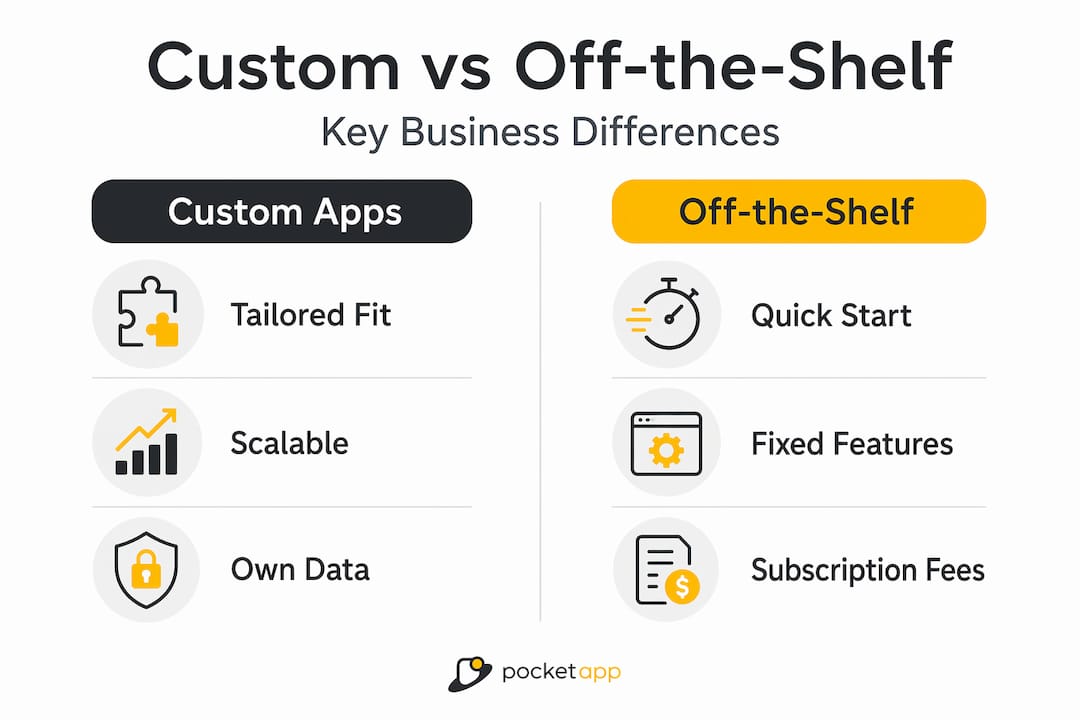
The fundamental differences become clear when you compare them directly:
| Factor | Custom mobile solution | Off-the-shelf app |
|---|---|---|
| Ownership | You own the source code and IP | Vendor owns the product |
| Flexibility | Built to your exact requirements | Limited to vendor-defined features |
| Integration | Deep, purpose-built connections | Generic APIs, often restricted |
| Scalability | Designed for your growth path | Subject to vendor pricing tiers |
| Security | Tailored controls and compliance | Standardised, one-size approach |
| Long-term cost | Fixed build cost, low marginal cost | Fees scale with users or usage |
The advantages of tailored mobile solutions show most clearly in that last row. SaaS costs grow linearly with headcount, while custom app maintenance costs flatten after the initial build. For organisations with large or growing user bases, this shift from variable to fixed cost is significant.
- Workflows are mapped to your processes, not adapted to fit a generic product
- Data models reflect your actual business objects and relationships
- User experience is designed for your specific audience, not a generalised persona
- Compliance is addressed at the architecture level, not patched on afterwards
Operational efficiency: where custom apps deliver
The clearest argument for custom mobile app development is what happens to day-to-day operations. Custom apps integrate directly with existing ERP, CRM, and legacy systems, improving data flow and operational visibility while reducing manual effort. That last part matters more than most businesses initially realise. Every time a member of staff re-enters data from one system into another, you are spending money on a problem that bespoke software eliminates.

Automation is the natural extension of this. When your app is built around your workflow, repetitive tasks become triggers and rules rather than manual steps. Approval chains, notifications, reporting, and field data capture can all be handled in the background. Staff focus on decisions, not data entry.
Scalable architecture is another advantage that only becomes visible over time. Off-the-shelf tools often impose user caps, feature restrictions, or pricing tiers that punish growth. A custom build designed from the start for your expected scale avoids expensive rebuilds three years down the line when your team doubles or your product range expands.
Tailored UX and UI for specific audiences achieves higher engagement and faster loading times because there is no feature bloat slowing the app down. When users only see what is relevant to their role, adoption rates rise and support requests fall. This is the importance of personalised mobile solutions in practice: relevance drives engagement.
Pro Tip: Invest in a dedicated discovery phase before a single line of code is written. Mapping your workflows, data requirements, and user journeys at the start prevents the expensive scope changes that derail most development projects. Pocketapp's app discovery process covers exactly this.
Financial and strategic advantages
One of the most persistent misconceptions about why opt for custom solutions is that they are simply more expensive. The upfront investment is higher. That is true. But the comparison rarely accounts for what you spend on licensing, per-user fees, and workarounds over five years.
Source code ownership converts technology cost from operational expenditure to capital expenditure, and it creates a defensible technical advantage. During mergers, acquisitions, or investment rounds, owning your technology stack adds measurable value to the business in a way that a SaaS subscription never can.
| Scenario | Custom app | Off-the-shelf |
|---|---|---|
| 50 users over 3 years | Fixed build + low maintenance | Per-user fees compounding annually |
| New feature requirement | Build once, own it | Dependent on vendor roadmap |
| Business sale or investment | IP adds to company valuation | No transferable asset |
| Compliance requirement change | Update your own codebase | Wait for vendor update |
Custom encryption, access controls, and multi-factor authentication protect sensitive business data more effectively than generic apps. For organisations operating under GDPR, FCA regulations, or sector-specific standards, this is not optional. It is a compliance requirement that custom builds address at the architecture level.
Competitive differentiation is the strategic point most businesses undervalue. Custom apps allow businesses to own their technology and adapt quickly to market changes, unlike off-the-shelf tools that lock you into a vendor's product roadmap. Your competitors can buy the same SaaS tool you use. They cannot replicate your bespoke app.
Pro Tip: When evaluating upfront costs, model the total cost of ownership over 36 to 60 months, including licensing fees, per-user charges, integration costs, and workarounds. Custom builds frequently become more cost-effective within two to three years, particularly for teams above 30 users.
Challenges worth understanding before you commit
Choosing to build a custom mobile solution is not without genuine complexity. The advantages of tailored mobile solutions are real, but so are the challenges. Going in with clear expectations protects your project and your budget.
- Longer lead times. A well-built custom app typically takes three to nine months from discovery to deployment, depending on complexity. Off-the-shelf tools can be live in days.
- Higher initial investment. The upfront cost of custom mobile app development is greater than a monthly SaaS subscription. The business case needs to account for this clearly.
- Discovery is non-negotiable. Skipping or rushing discovery is the most common cause of scope changes, budget overruns, and project failures. A thorough two to four week discovery phase produces the feature list, data model, and architecture needed for a predictable build.
- Ongoing maintenance. Custom apps need updates, security patches, and ongoing development support. Factor this into your total cost planning from the beginning.
- Development expertise matters. The quality of your development partner directly affects the outcome. Poorly architected custom apps can end up costing more than the problem they were meant to solve.
Risk mitigation is straightforward when planned for. Phased releases, where you build core functionality first and expand iteratively, reduce financial exposure and allow real-world feedback to shape development. A hybrid approach, using off-the-shelf tools for non-critical functions and custom builds for the differentiating workflows, is also worth considering.
Is a custom mobile solution right for your business?
Not every organisation needs a fully bespoke application. The decision depends on the complexity of your operations, your growth trajectory, and whether mobile technology is a source of competitive advantage for you or simply a support function.
Custom mobile solutions are best suited when:
- Your workflows are specific enough that no existing product maps to them without significant compromise
- You need deep integration with proprietary or legacy systems that generic APIs cannot reach
- Mobile is central to your customer experience or employee productivity, not just a convenience feature
- Your user base is large enough that per-user licensing fees make SaaS financially inefficient over time
- You operate in a regulated sector where compliance controls need to be built into the architecture, not added later
If you are testing a new product concept, have a small team, or need a basic tool with no integration requirements, an off-the-shelf product or a cross-platform development approach may serve you better in the short term.
The questions worth asking before making a decision include: Does our current mobile tool limit what we can do or how fast we can grow? Are we paying for features we never use while missing ones we need? Is our competitor using the same product we are, and does that concern us? If the answers point consistently in one direction, the case for custom is clear. For a more structured view on this, Pocketapp's business mobile app guide walks through the decision framework in detail.
My take on the custom vs template debate
I have seen both ends of this. Projects where a well-resourced team convinced themselves they could build everything from scratch and underdelivered. And projects where a business limped along on an inadequate off-the-shelf tool for years because the conversation about custom never happened seriously.
What I have learned is that the businesses who gain the most from custom builds are the ones who treat the app as a long-term asset rather than a short-term fix. They invest properly in discovery, they think about who owns the code and what that means in three years, and they choose a development partner whose process they trust, not just the cheapest quote.
The misconception I encounter most often is that custom equals complicated and expensive. In reality, extended discovery improves project predictability and reduces costly rework. The complexity lives in the planning, where it belongs, not in the build itself.
My honest view: if your business has real operational complexity, genuine scale ambitions, or a customer experience that depends on mobile, off-the-shelf tools are a short-term solution to a long-term problem. The organisations I have seen thrive are the ones who stopped renting technology and started owning it.
— Paul
How Pocketapp can help you build something that lasts
If this article has clarified why custom mobile solutions make sense for your organisation, the natural next step is finding a development partner who can deliver on that promise.
Pocketapp is a UK-based mobile app development company with a portfolio of over 300 projects across retail, healthcare, charity, and enterprise sectors. Clients including WWF, Dechra, and Crocus have trusted Pocketapp to build bespoke apps that perform under real-world conditions. The team covers the full build lifecycle, from strategic discovery and UX/UI design through to deployment and ongoing support. Whether you need a customer-facing app or an internal tool to replace a broken process, Pocketapp's mobile app development services are built around your specific requirements, not a generic template. Get in touch to discuss your project.
FAQ
What are the main advantages of custom mobile solutions?
Custom mobile solutions offer deep integration with existing systems, tailored user experiences, scalable architecture, and ownership of the source code as a business asset. Unlike off-the-shelf apps, they are built around your specific workflows rather than adapted from a generic product.
How do custom apps compare to off-the-shelf tools on cost?
The upfront cost of custom development is higher, but SaaS fees grow with headcount while custom app maintenance costs level off after the build. Most organisations find custom builds become cost-effective within two to three years, particularly at scale.
Why does the discovery phase matter so much?
Skipping detailed discovery is the most common cause of mid-project scope changes and budget overruns. A structured discovery phase produces a precise feature list and technical architecture that makes the rest of the build predictable.
When is an off-the-shelf app the better choice?
Off-the-shelf tools work well for early-stage testing, small teams with simple needs, or non-critical functions where speed of deployment outweighs the need for customisation. They are a practical starting point when the business case for a custom build has not yet been established.
Can a custom app improve security and regulatory compliance?
Yes. Custom apps allow tailored security controls including custom encryption, multi-factor authentication, and role-based access, making them better suited to regulated sectors such as healthcare, finance, or any business handling personal data under GDPR.