
TL;DR:
- Custom apps are tailored to unique business workflows, enhancing operational efficiency and customer engagement.
- They provide scalable, integrated solutions that protect long-term competitive advantage and data ownership.
- Off-the-shelf apps offer quick deployment but often incur hidden costs and limit growth potential.
Choosing the right mobile app strategy can make the difference between a business that genuinely connects with its customers and one that's constantly wrestling with software that almost fits. For UK organisations in retail, healthcare, field services, and beyond, the gap between a generic off-the-shelf solution and a purpose-built custom app is not merely technical. It translates directly into revenue, customer loyalty, and operational efficiency. This article walks through the practical benefits of custom app development, compares it honestly with off-the-shelf alternatives, and helps you decide which path makes the most sense for your business goals.
Table of Contents
- How does custom app development work?
- Boosting customer engagement through bespoke mobile apps
- Streamlining business operations: real-world savings
- Custom vs off-the-shelf apps: head-to-head comparison
- Key considerations before choosing custom app development
- Why 'off-the-shelf' is riskier for ambitious UK businesses
- How to get started with custom app development in the UK
- Frequently asked questions
Key Takeaways
| Point | Details |
|---|---|
| Tailored solutions | Custom app development aligns technology with your unique business needs for maximum impact. |
| Proven operational gains | UK case studies show custom apps slash costs and boost efficiency compared to off-the-shelf solutions. |
| Competitive advantage | Bespoke apps let you innovate and respond faster than rivals using generic platforms. |
| Superior customer experience | Personalisation, push notifications and offline access increase engagement and loyalty. |
How does custom app development work?
Custom app development is the process of building a mobile application specifically for your organisation's unique requirements, rather than adapting your processes to fit a pre-packaged product. Every screen, feature, and integration is designed around how your business actually operates.
Off-the-shelf apps can be attractive at first glance. They deploy quickly, carry a lower upfront cost, and often come with ready-made features. However, off-the-shelf options frequently lead to workarounds and scaling limits that erode those early savings. When your business evolves, a generic platform tends to hold you back rather than grow with you.
The typical custom development process moves through four clear stages:
- Discovery and requirements: Defining business goals, user needs, technical constraints, and compliance requirements
- UX/UI design: Prototyping and testing interfaces tailored to your specific users, whether they are patients, shop assistants, or field engineers
- Build and integration: Writing the application code and connecting it to existing systems such as CRM, ERP, or stock management platforms
- Launch and iteration: Deploying to iOS, Android, or both, then refining based on real user feedback
Custom development tends to be the stronger choice when your workflows are genuinely unique, when you operate in a regulated sector, or when the volume of users or transactions demands precise performance. Sectors such as retail, healthcare, logistics, and professional services gain the most from tailored app solutions because their operational complexity rarely fits neatly into a generic product.
"The right mobile application is not the one with the most features. It's the one built around the way your teams and customers actually work."
Pro Tip: Before approaching any developer, map out your three most frustrating workflow bottlenecks. These become the non-negotiable requirements that will distinguish a genuinely useful custom app from one that merely looks impressive.
Boosting customer engagement through bespoke mobile apps
With custom app foundations explained, it's time to focus on their real-world impact, starting with customer engagement. A bespoke app gives you direct control over how customers experience your brand on mobile, and that control creates measurable advantages.
Generic apps often bundle engagement features that are either too broad or not relevant to your audience. A custom build, by contrast, lets you implement exactly what your customers need:
- Targeted push notifications triggered by purchase history, location, or health milestones rather than broad, irrelevant blasts
- Personalised content feeds that surface relevant products, services, or health information based on each user's profile
- Offline access for customers and staff in areas with poor connectivity, ensuring the app remains useful in a hospital ward or a rural retail outlet
- Loyalty integrations connected directly to your CRM so rewards feel seamless rather than bolted on
In retail and healthcare settings, these features work together to lift both retention and satisfaction. A retail app that remembers a customer's preferred brands and notifies them of relevant promotions generates repeat visits. A patient-facing healthcare app that offers appointment reminders, test results, and direct messaging keeps patients engaged between appointments and reduces no-show rates significantly.
Improved customer engagement through push notifications, personalisation, and offline access has been documented across both retail and healthcare contexts, and the pattern is consistent: apps built around user behaviour outperform generic tools on every engagement metric.
Achieving operational excellence with mobile apps is not just about back-end efficiency. It begins the moment a customer opens your app and finds an experience that feels built for them.
Pro Tip: Design your push notification strategy before you start building. Notifications that feel intrusive kill engagement fast. Plan the triggers, frequency, and content categories during the discovery phase, not as an afterthought.
Streamlining business operations: real-world savings
Deepening engagement is only half the story. Custom apps also drive measurable gains on the operations side, and in some cases, the numbers are striking.
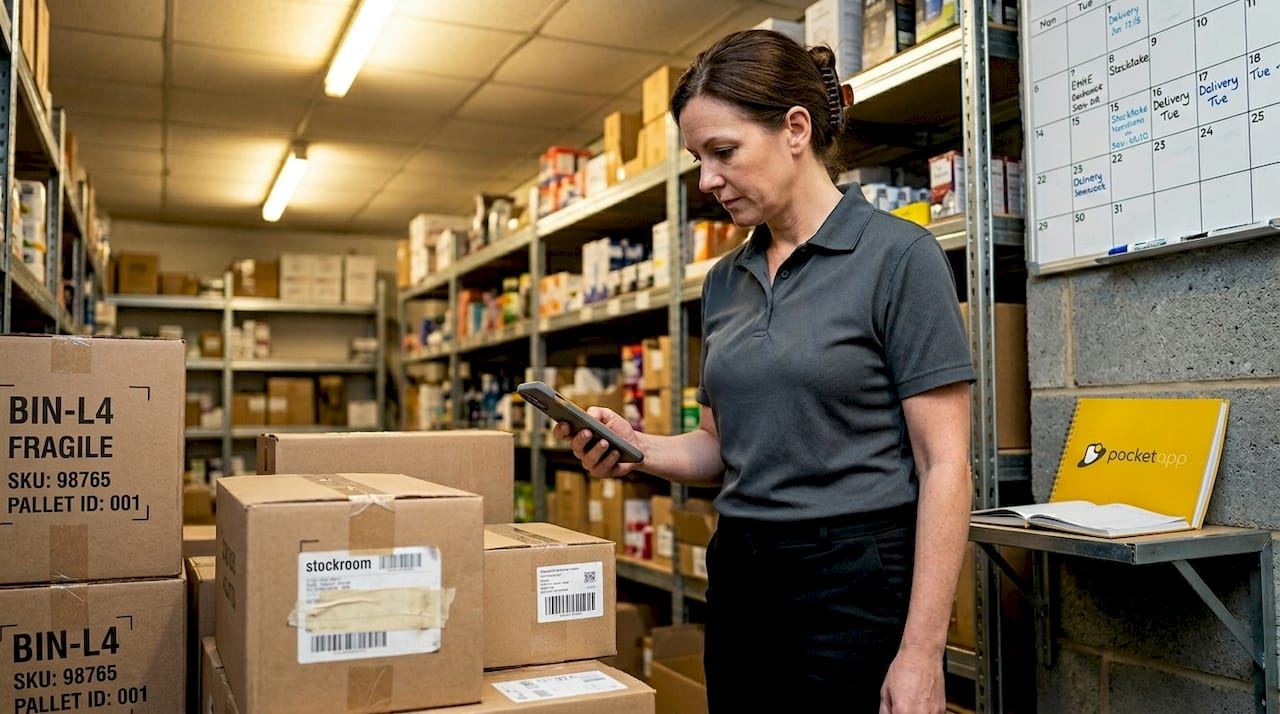
In retail, real-time inventory tracking through custom software has enabled UK businesses to reduce stockouts and overstock by up to 42%, with one retail chain documenting £3.2 million in annual savings following a custom solution rollout. Those figures are not outliers. They reflect what happens when an app is built around actual stock management workflows rather than forcing staff to adapt to a generic inventory tool.
Healthcare organisations see different but equally significant gains. Custom healthcare apps reduce administrative burden by approximately 20%, improve coordination between clinical teams, and provide the infrastructure for telemedicine services that patients increasingly expect.
| KPI | Before custom app | After custom app |
|---|---|---|
| Retail stockout rate | 18% of SKUs monthly | Under 11% of SKUs monthly |
| Healthcare admin time per patient | 45 minutes | 36 minutes |
| Order processing time (retail) | 4.2 hours average | 1.8 hours average |
| Patient appointment no-shows | 22% | 14% |
| Staff error rate (data entry) | 8% | Under 2% |
These improvements are not coincidental. They come from apps that mirror real processes, enforce the right validation rules, and surface the right data at the right moment for the person using them.
Key operational improvements seen across UK sectors include:
- Faster onboarding for new employees through guided in-app workflows
- Reduced reliance on paper-based processes and the errors they introduce
- Better audit trails for compliance in regulated industries
- Real-time dashboards that give managers accurate visibility without waiting for manual reports
- Seamless integration with mobile apps in digital transformation strategies already underway in the business
"The businesses that move first on custom digital tools tend to establish operational advantages that competitors struggle to replicate, because the advantage is embedded in processes, not just technology."
Custom vs off-the-shelf apps: head-to-head comparison
To sharpen your decision, here's a direct comparison between custom and off-the-shelf mobile apps across the criteria that matter most to business leaders.
| Criteria | Custom app | Off-the-shelf app |
|---|---|---|
| Initial deployment speed | Longer (weeks to months) | Faster (days to weeks) |
| Upfront cost | Higher | Lower |
| Scalability | Built to your growth plan | Limited by vendor roadmap |
| Fit to your processes | Exact | Approximate |
| Integration with existing systems | Fully configurable | Often limited or costly |
| Long-term flexibility | High | Dependent on vendor |
| Hidden costs | Minimal if well-scoped | Workarounds, add-ons, manual fixes |
| Competitive differentiation | High | Low (shared with all users) |
The hidden costs column deserves particular attention. Off-the-shelf solutions that initially look economical often accumulate costs through third-party integrations, manual workarounds, staff time spent compensating for missing features, and eventually a migration to something better.
When does it make clear sense to go custom? Consider these scenarios:
- Your workflows are sector-specific and no generic product covers them adequately
- You need tight integration with proprietary or legacy internal systems
- Your customer base expects a branded, premium digital experience
- You operate in a regulated sector such as healthcare or financial services where compliance cannot be compromised
- You are scaling rapidly and need an app that grows without expensive re-platforming
- Your competitive strategy depends on differentiation through digital experience
Off-the-shelf products serve a purpose. For straightforward use cases with standard requirements and tight initial budgets, they can be entirely appropriate. But for ambitious UK businesses with distinct processes or growth ambitions, the limitations tend to surface quickly.
Key considerations before choosing custom app development
It is essential to understand not just what is possible, but what is right for your business. Here is a strategic checklist to guide your thinking before you commit to a development partner.
Assess your actual requirements first. Be honest about whether a generic product could serve 90% of your needs. If the answer is yes and the 10% gap is tolerable, custom may not be warranted yet. If that 10% gap creates daily friction for staff or customers, it is almost certainly worth addressing properly.
Budget realistically, including ongoing costs. Custom development requires investment in design, build, testing, launch, and post-launch support. Many businesses underestimate the support phase. Plan for ongoing iterations, security updates, and feature additions as your business and user expectations evolve.
Factor in timeframes. A well-scoped custom app for a mid-sized UK business typically takes three to six months from initial discovery to launch. Build this into your planning. Rushing the requirements phase is the single most common cause of budget overruns.
Plan for sector-specific requirements early. Healthcare apps in the UK must comply with NHS data standards and often MHRA guidance. Retail apps handling payment data must meet PCI DSS requirements. These compliance layers affect architecture decisions made at the very start of the project, not at the end.
Considerations that often get overlooked include:
- Who internally will own the relationship with the development partner?
- How will you gather and act on user feedback post-launch?
- What does success look like at three months, six months, and one year?
- Does the developer have experience in your specific sector?
- What happens to your app if the development partner's circumstances change?
The UK custom software market was valued at £1.9 billion by 2024, with the global mobile app market forecast to reach $32.86 billion by 2030 and efficiency gains from custom solutions ranging from 40% to 74%. These figures reflect a broader shift: custom development is no longer the preserve of large enterprises. Mid-sized UK businesses are increasingly recognising the strategic value of owning their digital tools rather than renting access to someone else's generic version.
Staying across mobile app trends will also help you build with future needs in mind rather than solving only today's problems.
Pro Tip: Ask any prospective development partner to show you case studies from your own sector. Generic portfolios are less revealing than evidence of solved problems that actually match yours. Ask specifically how they handled compliance requirements or legacy system integrations in similar projects.
Why 'off-the-shelf' is riskier for ambitious UK businesses
Even with all the practical considerations laid out, there's a broader truth worth stating plainly. Businesses that default to off-the-shelf apps because they are cheaper or faster to deploy often discover the real cost later, and it rarely shows up on the initial invoice.
The risk is not just financial. It is strategic. When your customer-facing app looks and behaves identically to a competitor's because you are both using the same platform, you have handed away a significant differentiator. The customer cannot tell the difference between your brand and theirs at the digital touchpoint that increasingly defines the relationship.
From our experience working across retail, healthcare, charity, and consumer engagement projects, the pattern is consistent. Businesses that choose off-the-shelf solutions to save time in year one frequently spend years two and three building workarounds, paying for integrations the platform was never designed to handle, and ultimately commissioning a custom build anyway. The difference is they have spent two years of competitive ground on a solution that was never quite right.
The organisations that outpace their peers do so because their digital tools are built around genuine competitive advantages, not borrowed from a vendor catalogue. Operational excellence is not something you can achieve with software designed for someone else's business model.
There is also the question of data ownership and integration depth. With a bespoke app, every data point, every user behaviour, every operational metric feeds back into systems you control. With an off-the-shelf platform, that data often lives in the vendor's infrastructure, accessible only through their reporting tools and subject to their terms.
For any UK business serious about using digital capability as a genuine competitive weapon, building is nearly always the more defensible long-term choice.
How to get started with custom app development in the UK
Ready to move from evaluation to action? Choosing the right development partner is where strategy becomes reality.
At Pocket App, we have delivered over 300 mobile projects across retail, healthcare, charity, and B2B sectors, always starting from a thorough discovery process that ensures every build solves genuine business problems. Our approach to the development of mobile apps covers everything from initial scoping and UX design through to launch and ongoing support. Whether you are building a consumer-facing retail app or an operational tool for clinical teams, our business app development expertise means you get a product designed for real-world use, not a theoretical brief. We also specialise in cross-platform app expertise, ensuring your investment reaches users on both iOS and Android without duplicating costs. Get in touch to arrange a discovery conversation and find out what a purpose-built app could do for your business.
Frequently asked questions
How much does custom app development cost in the UK?
Costs vary significantly depending on scope, integrations, and ongoing support requirements. Most custom app projects for UK businesses start from several thousand pounds for simpler builds, rising considerably for complex, multi-platform solutions with deep system integrations.
What is the main advantage of custom app development over off-the-shelf apps?
The primary advantage is precise fit to your unique business processes and growth plans. Off-the-shelf apps create workarounds and scaling limitations that custom solutions are designed to avoid from the outset.
How do custom apps improve operational efficiency?
Custom apps eliminate manual workarounds, streamline workflows to match real processes, and surface accurate data at the right moment. In retail, for example, custom inventory tracking has cut stockouts and overstock by up to 42% in documented UK deployments.
Which sectors benefit most from custom app development?
Retail and healthcare consistently show the largest efficiency and engagement gains, but any sector with distinctive workflows or high customer interaction volumes stands to benefit. Healthcare apps alone have demonstrated a 20% reduction in administrative burden alongside improved patient coordination and telemedicine capability.