
TL;DR:
- Many UK businesses believe off-the-shelf apps are the most cost-effective solutions due to lower upfront costs and quick setup. However, the long-term expenses from licensing, manual workarounds, and limited scalability often make bespoke apps a smarter investment. Control over data, tailored workflows, and future-proof scalability are key advantages that bespoke solutions offer, especially in regulated sectors.
Most UK businesses assume off-the-shelf apps are the sensible, cost-effective default. The monthly subscription looks reasonable, the setup seems quick, and the decision feels low-risk. But when you actually map out why choose bespoke app solutions against the real total cost of packaged software, including licensing tiers, manual workarounds, and integration bolt-ons, the comparison shifts considerably. This article cuts through the assumption that off-the-shelf always wins on price, and lays out exactly when and why a tailored app is the smarter long-term decision for your business.
Table of Contents
- Understanding the true cost of off-the-shelf software
- How bespoke apps deliver flexibility, control, and competitive advantage
- Evaluating the investment: costs and ROI of bespoke app development
- Choosing the right approach: bespoke, off-the-shelf, or hybrid solutions
- Rethinking bespoke apps: what most businesses miss
- How Pocket App can help your bespoke app journey
- Frequently asked questions
Key Takeaways
| Point | Details |
|---|---|
| Hidden off-the-shelf costs | Labour, multiple licenses, and workarounds can make off-the-shelf software more expensive over time. |
| Bespoke flexibility and control | Custom apps fit unique workflows, giving businesses full data ownership and competitive edge. |
| Investment payback | Typical bespoke app investments pay back in two to five years through efficiency gains. |
| Decision framework | A hybrid approach often balances standard needs and unique features best. |
| Discovery phase importance | Thorough upfront planning prevents budget overruns and ensures software meets requirements. |
Understanding the true cost of off-the-shelf software
The sticker price of a SaaS tool is almost never its true cost. As your headcount grows, licensing fees scale with it, and SaaS costs can reach £30,000 to £50,000 annually across three or four tools for a team of 50. That figure does not include the time your staff spend working around the gaps these tools leave.
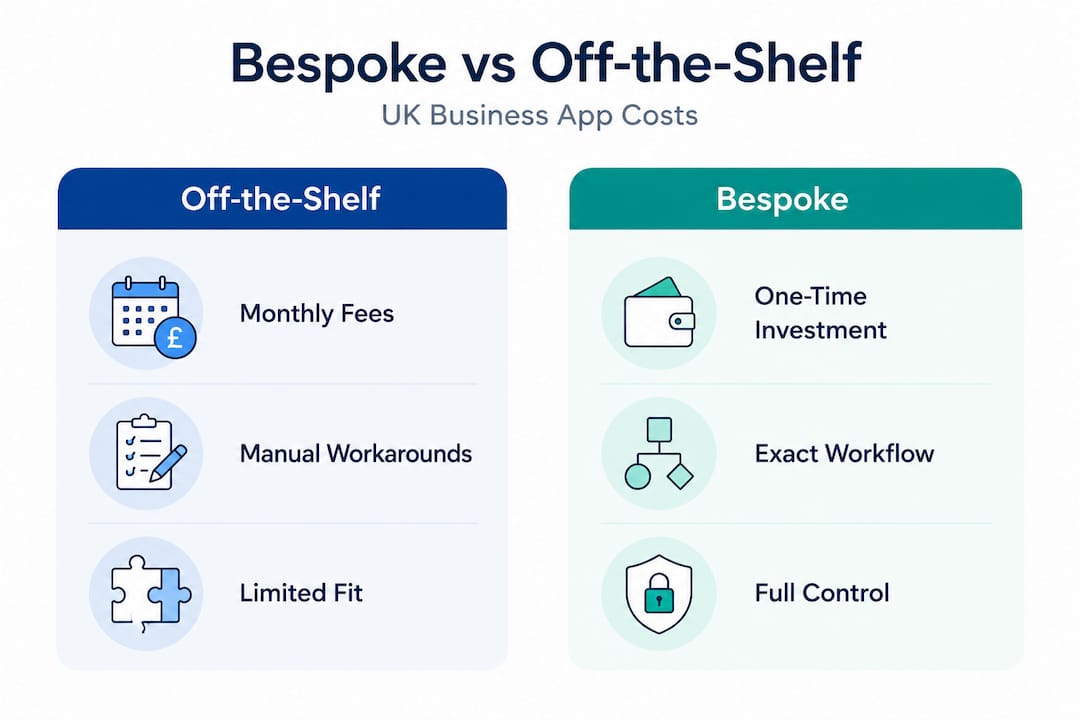
Manual data entry between systems is one of the most damaging hidden costs, yet it is almost invisible until you measure it. More than 10 hours weekly spent re-entering data across platforms translates to £15,000 to £20,000 in annual labour costs alone. Most operations managers never do that calculation because the hours are distributed across the team in small daily doses.
The deeper problem is cultural. Workarounds, once embedded, become "the way we do things." Staff onboard into broken processes and assume they are normal. By the time the inefficiency is visible to leadership, it has become load-bearing. Understanding the key benefits of custom app development makes it far easier to see what businesses are actually paying to avoid.
Common hidden costs of off-the-shelf software:
- Per-seat licensing that rises sharply at growth milestones
- Separate subscriptions for tools that should integrate natively
- Staff time spent copying data between systems manually
- Consultant fees for integration work between incompatible platforms
- Productivity loss from using a tool that does not match your workflow
| Cost category | Off-the-shelf (50 staff) | Bespoke investment |
|---|---|---|
| Annual licensing | £30,000 to £50,000 | None after build |
| Integration work | £5,000 to £15,000 | Built in from day one |
| Manual labour (data entry) | £15,000 to £20,000 | Largely eliminated |
| Customisation limits | Ongoing friction | Fully resolved |
Pro Tip: Before approaching any developer, audit your team's manual workarounds for a single week. Log every time someone copies data between tools, reformats a spreadsheet, or exports a report manually. The total will almost certainly surprise you.
How bespoke apps deliver flexibility, control, and competitive advantage
The most important word in "bespoke app" is not bespoke. It is control. When your software is built around your processes rather than your processes being bent to fit software, the entire organisation moves more fluidly. Custom applications provide flexibility and control that off-the-shelf cannot match, and with AI now accelerating development, the cost and complexity gap has narrowed considerably.

Data ownership is a specific advantage that rarely gets the attention it deserves. With SaaS platforms, your business data lives in someone else's infrastructure, governed by their terms. A bespoke app means you own the architecture and the data entirely, which matters enormously for businesses in healthcare, financial services, and other sectors with strict governance requirements. You can read more on this point in our guide to tailored solutions for UK businesses.
Scalability is another area where bespoke solutions outperform. Off-the-shelf tools are built for the average user, which means growth often hits artificial ceilings: feature limits on lower tiers, data caps, or simply functionality that was never designed for your scale. A bespoke app is designed with your growth trajectory in mind, and ensuring scalability from the build phase means you are not rebuilding from scratch in three years.
"Custom applications provide flexibility, alignment and control that off-the-shelf cannot, accelerated by AI reducing development cost and complexity." RSM Technology Blog
Key advantages of bespoke app solutions for businesses:
- Processes are built into the app, not worked around it
- Full data ownership and governance from day one
- Features your competitors cannot replicate from a catalogue
- No enforced upgrades that break your existing workflows
- Built to your compliance and security requirements
| Factor | Off-the-shelf | Bespoke |
|---|---|---|
| Workflow fit | Approximate | Exact |
| Data ownership | Vendor-controlled | You own it |
| Competitive differentiation | Identical to competitors | Unique to your business |
| Scalability | Tier-limited | Built to your roadmap |
| Ongoing licensing | Perpetual | No recurring fees |
Pro Tip: When scoping a bespoke project, identify the two or three workflows that are genuinely unique to your business. Those are the features that will deliver the most competitive value and are impossible to replicate from any off-the-shelf catalogue.
Evaluating the investment: costs and ROI of bespoke app development
Bespoke does not mean unaffordable. It means the investment is front-loaded rather than spread across years of licensing. Small bespoke tools cost £20,000 to £60,000, while mid-range platforms with integrations range from £60,000 to £200,000, with payback periods of two to five years when saving 40 hours per week at £25 per hour. That is a saving of £52,000 annually, which means a £100,000 investment pays for itself in under two years in the right scenario.
The biggest risk to ROI is not the build cost. It is scope creep, which almost always originates from vague requirements. Projects without detailed specifications run over budget, often significantly. A discovery phase that produces a full functional specification is not a nice-to-have; it is the single most effective cost control mechanism available. You can explore this further in our section on measuring ROI in app development.
How to control costs in a bespoke app project:
- Invest in a discovery phase before any code is written
- Produce a detailed functional specification and get sign-off before development starts
- Phase the build: launch a core product first, then add features based on real user feedback
- Define your integration requirements fully at the outset to avoid retrofit costs later
- Plan for post-launch maintenance in your budget from the beginning, not as an afterthought
| Project type | Typical cost range | Indicative payback period |
|---|---|---|
| Small internal tool | £20,000 to £60,000 | 1 to 2 years |
| Mid-range platform | £60,000 to £200,000 | 2 to 4 years |
| Enterprise-grade system | £200,000 and above | 3 to 5 years |
Consider your bespoke mobile app design as a long-term asset rather than a project cost. The right framing changes what you are willing to invest and how you measure success.
Pro Tip: Ask any developer you are evaluating how they handle scope changes mid-project. A clear change control process is a strong signal that the team knows what causes projects to overrun and has built a discipline around preventing it.
Choosing the right approach: bespoke, off-the-shelf, or hybrid solutions
Not every business process needs a bespoke solution. The most commercially sensible approach is to match the tool to the task. Commodity functions such as payroll, email, or video conferencing are well-served by established SaaS tools. But processes that differentiate you from competitors, or that require deep integration with proprietary data, are exactly where bespoke earns its place. A hybrid model that uses SaaS for commodity functions while customising peripheral modules for competitive advantage is increasingly the architecture smart SMEs are choosing.
The hidden cost that erodes the appeal of SaaS, especially as organisations mature, is integration effort. Most businesses overlook 20 to 30 per cent integration overhead and the upgrade lock-ins that come with off-the-shelf platforms. When a vendor pushes a major update, your integrations can break. You then pay again to fix a problem you did not create. Apps that drive engagement and efficiency are rarely built entirely from packaged components.
Decision criteria for each approach:
- Bespoke: Unique workflows, competitive differentiation, regulatory requirements, proprietary data
- Off-the-shelf: Commodity needs, limited budget, fast time to market, standard processes
- Hybrid: Mix of standard and unique needs, phased investment, existing SaaS infrastructure
| Scenario | Recommended approach |
|---|---|
| Your process is genuinely unique | Bespoke |
| You need to launch within weeks | Off-the-shelf or hybrid |
| You have both unique and standard needs | Hybrid |
| Compliance or data control is critical | Bespoke |
| Budget is highly constrained short-term | Off-the-shelf, with a bespoke roadmap |
Rethinking bespoke apps: what most businesses miss
Here is the uncomfortable reality most bespoke app conversations skip: the technology is rarely what determines whether a project succeeds. Organisational readiness does. Businesses that succeed with bespoke development have someone internally who owns the project, can articulate requirements clearly, and has the bandwidth to review, give feedback, and make decisions. Businesses that fail often do not.
Skipping the discovery phase is one of the most expensive decisions a business can make, not because discovery is magical, but because it forces everyone to agree on what is actually being built before a single line of code is written. Scope creep is not a developer problem. It is a requirements problem. Developers can only build what they are told to build.
For businesses in regulated sectors, there is another dimension entirely. For UK regulated industries, embedding compliance from day one is not optional. Generic tools lack the specific controls, audit trails, and data governance that sectors like healthcare, financial services, and legal require. Bespoke apps built with compliance embedded from the architecture level can reduce audit risk and future regulatory exposure significantly. Our work with clients on operational excellence consistently shows that the organisations most satisfied with their bespoke investment treated it as a business transformation project, not a technology project.
The strategic difference is this: the businesses that get the most from bespoke apps go into the process knowing exactly which problems they need to solve, having already mapped the inefficiencies, and with a clear owner who can guide the project through discovery, design, and build. That combination of clarity and commitment is what separates a high-performing bespoke app from one that collects dust.
How Pocket App can help your bespoke app journey
With over 300 projects delivered for clients including WWF, Dechra, and Crocus, Pocket App understands what it takes to turn a complex set of business requirements into a mobile app that genuinely works.
Our process begins with disciplined discovery, because the quality of the specification determines the quality of the outcome. From there, our team guides you through design, development, and deployment with a clear focus on your users and your commercial goals. Whether you need mobile app development services built from the ground up, expert bespoke mobile apps development, or dedicated app design services to bring your vision to life, we work with businesses across retail, healthcare, charity, and B2B sectors to deliver solutions built around your needs, not a generic template.
Frequently asked questions
When does it make sense to invest in bespoke app development versus off-the-shelf software?
Bespoke development is worth considering when your business processes are genuinely unique, when off-the-shelf tools require costly workarounds, or when data ownership and integration control are priorities. Custom software makes sense when the costs of not having it exceed the costs of building it.
How long does it typically take to recoup the investment in bespoke software?
The payback period most commonly falls between two and five years, depending on how much labour and inefficiency the app removes. Saving 40 hours per week at £25 per hour generates £52,000 annually, making a mid-range investment recoverable within two years in favourable conditions.
What are the risks of skipping a discovery phase before bespoke development?
Skipping discovery almost always results in vague specifications, scope creep, and a finished product that does not reflect actual business needs. Projects without detailed specs routinely run over budget and over time.
Can bespoke apps help with compliance and regulatory requirements?
Yes. Bespoke apps allow compliance controls, audit trails, and data governance to be embedded at the architecture level rather than added as an afterthought. For UK regulated sectors, this approach reduces audit risk and ongoing regulatory exposure considerably.
Is a hybrid approach combining bespoke and off-the-shelf software effective?
For many businesses, a hybrid model is the most practical choice. A hybrid architecture uses SaaS for commodity functions while applying bespoke development only where it delivers genuine competitive or operational advantage, balancing investment with flexibility.