
TL;DR:
- User research helps ensure app relevance, usability, and business viability throughout development and after launch. It uncovers genuine user needs, reduces waste, and improves decision-making by informing design and feature choices early and continuously. Integrating research findings into the product lifecycle fosters better user experiences, lowers costs, and drives sustainable growth.
User research is the discipline of studying real users to ensure an app is relevant, usable, and commercially viable before and after launch. Product teams that skip it are essentially building on assumption, and research confirms that studying users before, during, and after release directly improves business outcomes. The industry term is UX research, though "user research" is the phrase most product managers reach for when making the case to stakeholders. Understanding why user research drives app success is not a philosophical exercise. It is a practical argument for where your development budget goes and whether your app survives its first year.
Why user research drives app success from the first decision
The most expensive mistake in app development is building something nobody wants. CB Insights consistently reports that "no market need" is the leading cause of startup failure, and the same logic applies to individual app features. Signal evaluation tests whether a user complaint or feature request reflects a genuine job to be done, or simply noise. Without that filter, teams spend months building in the wrong direction.
The distinction between a real user need and a superficial request is not always obvious. A user might ask for a dark mode, but the underlying need is reducing eye strain during evening use. Research surfaces the actual need, which then informs a broader set of design decisions. The UX Collective describes this as the quietest and most consequential decision in product discovery. Getting it wrong means every subsequent sprint is wasted effort.
Consider what happens when teams skip this step. An app built for a healthcare client might add a complex symptom tracker because a few vocal users requested it, only to discover through post-launch research that the majority of users wanted faster appointment booking. The tracker goes unused. The booking flow remains broken. Both problems were avoidable.
- Evaluate signals before committing to discovery: test whether a complaint reflects a genuine user need or a one-off preference
- Map feature requests to user jobs to be done, not to the literal request
- Use competitor benchmarking to identify gaps users cannot yet articulate
- Prioritise research on high-risk, high-effort features first
Pro Tip: Run a five-minute "signal test" with three to five users before adding any new feature to your backlog. Ask them to describe the last time they experienced the problem the feature is meant to solve. If they struggle to recall a specific instance, the signal is weak.
How does user research improve app usability?
Usability is where user research produces its most measurable returns. Testing with five targeted users can surface 80 to 85 per cent of critical usability issues in a mobile app. That figure means a single afternoon of structured testing can identify the majority of friction points before a single line of production code is written.

The mechanism is straightforward. When real users attempt real tasks on a prototype or early build, they reveal assumptions the design team did not know it had made. A navigation pattern that feels obvious to the person who designed it becomes a source of confusion for someone encountering it for the first time. Iterative prototyping with real users, as the Interaction Design Foundation describes, improves UX progressively rather than in a single leap.
The empathy deficit is a related risk. Teams that do not practise radical empathy, meaning genuine effort to understand unarticulated user experiences, build products that function correctly but feel wrong. An app for a charity like WWF needs to resonate emotionally with donors, not just process transactions efficiently. Emotional resonance is only discoverable through qualitative research.
Here is a practical sequence for embedding usability research into your development cycle:
- Define tasks, not features. Write test scenarios based on what users are trying to accomplish, not what your app does.
- Recruit representative users. Five users from your actual audience outperform twenty users who are not your audience.
- Run think-aloud sessions. Ask participants to narrate their actions as they complete tasks. The commentary reveals reasoning that screen recordings cannot capture.
- Categorise findings by severity. Not every usability issue is equal. Prioritise blockers over annoyances.
- Feed findings directly into the next sprint. Research that sits in a report and never reaches the design backlog has zero impact.
Pro Tip: For improving app UX on a tight timeline, run moderated remote sessions using tools like Maze or Lookback. You can complete a full usability round in under a week without recruiting participants in person.
What is the business value of user research?
The return on investment from UX research is real but often misunderstood. Most product teams expect a direct line from research spend to revenue. The actual mechanism is more indirect and, in many ways, more powerful. Research influence on decision-making is the primary driver of value. When research changes a product decision, it prevents a bad outcome upstream, which compounds across every subsequent decision that builds on it.
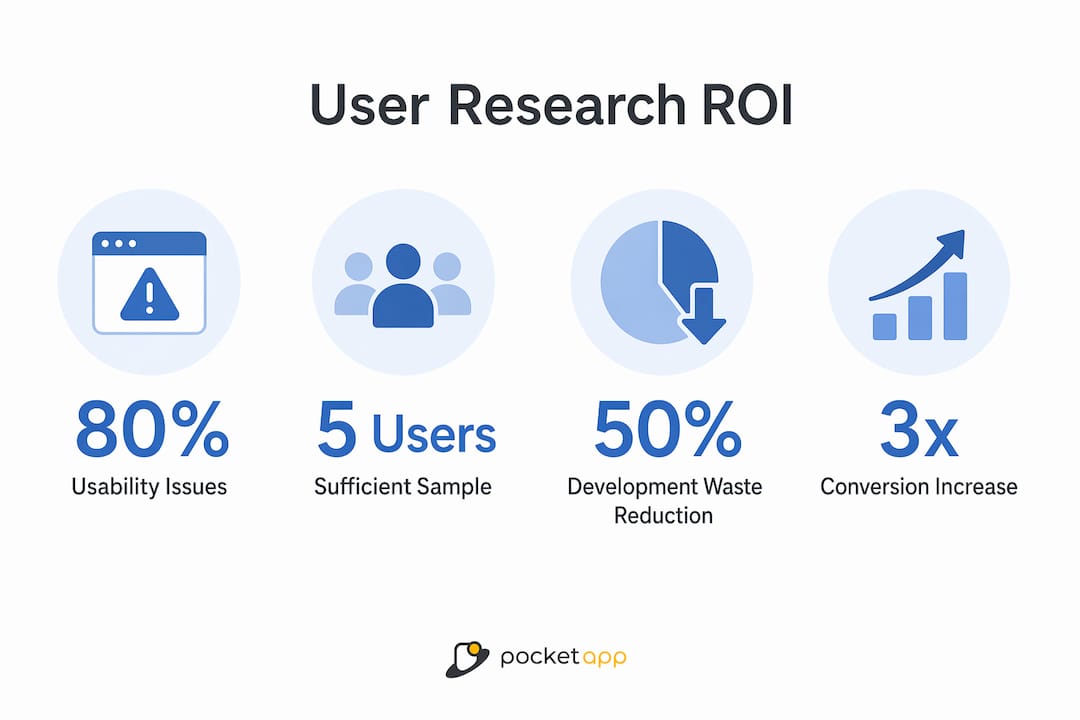
The Condens framework for measuring research impact distinguishes between execution impact and influence impact. Execution impact covers direct outcomes: increased retention, higher conversion, reduced support tickets. Influence impact covers the decisions that were made differently because of research. Both matter, but influence drives results at a scale that execution alone cannot achieve.
| Business outcome | How user research contributes |
|---|---|
| Reduced development waste | Signal evaluation prevents building features with no genuine user demand |
| Higher user retention | Usability testing removes friction that causes users to abandon the app |
| Faster product decisions | Evidence replaces internal debate, shortening decision cycles |
| Lower support costs | Intuitive design reduces the volume of user queries and complaints |
| Stronger commercial case | ROI evidence from post-launch studies supports investment in future development |
Quantifying UX research ROI is genuinely difficult, and any product manager who claims otherwise is oversimplifying. The honest approach is to track a combination of metrics: user growth, session length, task completion rates, and Net Promoter Score alongside qualitative evidence of decisions changed. Companies like Crocus, which Pocketapp has worked with, demonstrate that apps built on research-driven design achieve higher engagement because they reflect how users actually think about the product domain, not how the development team imagined they would.
When should user research happen in the app lifecycle?
The answer is continuously, not once. Iterative small studies are more effective than a single large research project because each round informs a redesign, and the redesign creates new questions that the next round answers. A one-shot usability test before launch misses the entire post-launch evolution of user behaviour.
The practical structure looks like this:
- Pre-discovery: Evaluate signals to determine which problems are worth investigating. Use interviews, diary studies, and competitor analysis to map the user's world before writing a single requirement.
- Concept validation: Test low-fidelity prototypes with representative users to confirm the proposed solution addresses the right problem. This is where the majority of bad ideas should be killed cheaply.
- Development cycles: Run moderated usability sessions on each major feature before it moves to production. App usability testing at this stage catches integration issues that prototype testing cannot surface.
- Post-launch: Conduct adoption studies at 30, 60, and 90 days to assess whether users are finding and using the features you built. Combine analytics with qualitative interviews to understand the "why" behind the numbers.
- Ongoing: Treat user feedback as a continuous input stream. Scheduled quarterly research reviews prevent the product from drifting away from user needs as the market evolves.
The critical operational step is linking research findings to backlog items explicitly. Research that lives in a Confluence page nobody reads is not research. It is documentation. The moment a finding is attached to a specific design or engineering ticket, it becomes a decision driver. That is the difference between research as an activity and research as a practice.
Validating ideas early with target users, before committing to full discovery, is the single highest-leverage moment in the entire lifecycle. Teams that build this habit consistently ship products with stronger product-market fit than those who validate after the fact.
Key takeaways
User research drives app success by de-risking decisions at every stage, from signal evaluation through post-launch adoption, and its primary value lies in the quality of decisions it changes rather than the metrics it directly produces.
| Point | Details |
|---|---|
| Signal evaluation prevents waste | Test whether a feature request reflects a genuine user need before committing development resources. |
| Five users reveal most issues | Targeted usability testing with five representative users surfaces 80 to 85 per cent of critical friction points. |
| Influence impact compounds | Research that changes upstream decisions prevents compounding errors across the entire product lifecycle. |
| Continuous beats one-off | Iterative research rounds tied to redesigns outperform single pre-launch studies in cumulative learning. |
| Link findings to backlog items | Attaching research outputs to specific tickets is what converts evidence into product decisions. |
The uncomfortable truth about research in most product teams
I have worked on enough app projects to recognise a pattern that rarely gets discussed openly. Most teams do not skip user research because they think it is unimportant. They skip it because they are afraid of what it will tell them. There is a particular kind of organisational discomfort that comes from spending three months on a feature and then watching a user struggle to find it in a five-minute test. The temptation is to dismiss the finding as an outlier.
The teams that build genuinely successful apps are the ones that have learned to welcome that discomfort. They treat a usability failure in testing as a cheap lesson rather than a personal criticism. The alternative is discovering the same failure at scale, after launch, in the form of one-star reviews and declining retention curves.
The other thing I would push back on is the idea that qualitative research is somehow less rigorous than quantitative data. Analytics tell you what users are doing. Research tells you why. You need both, but in my experience, the "why" is where the product decisions actually live. A drop-off at step three of your onboarding flow is a data point. Understanding that users are confused by the permission request at that step is the insight that fixes it.
If you are a product manager trying to build a research culture in your team, start with one thing: make research findings visible. Put them on the wall, in the sprint review, in the product roadmap. The moment research becomes part of the conversation rather than a separate deliverable, its influence on decisions increases dramatically.
— Paul
How Pocketapp builds research into every project
At Pocketapp, user research is not a phase that happens before development starts. It is woven into every stage of the project, from initial discovery through post-launch iteration. With over 300 projects delivered for clients including WWF, Dechra, and Crocus, the team has seen directly how research-driven design produces apps that users return to and businesses can measure.
If you are planning a new app or improving an existing one, Pocketapp's mobile app development service integrates structured user research at every decision point. The result is an app built on evidence rather than assumption. Speak to the team about how a research-led approach can reduce your development risk and improve your product outcomes from day one.
FAQ
What is user research in app development?
User research is the practice of studying real users to understand their needs, behaviours, and frustrations before and during app development. It includes methods such as interviews, usability testing, surveys, and A/B testing to inform design and product decisions.
How many users do you need for usability testing?
Testing with five targeted users can reveal 80 to 85 per cent of critical usability issues in a mobile app. Larger samples add diminishing returns on problem discovery, making small iterative rounds more cost-effective than single large studies.
Why does user research reduce development costs?
User research identifies flawed assumptions and weak feature signals before development begins, preventing teams from building features that users do not need or cannot use. Fixing a design problem in a prototype costs a fraction of fixing it in a shipped product.
How do you measure the ROI of user research?
ROI is measured through a combination of direct outcomes, such as improved retention and conversion rates, and influence impact, meaning the quality of product decisions that research changed. Tracking both gives a more complete picture than revenue metrics alone.
When should user research start in a project?
User research should begin at the signal evaluation stage, before discovery, to test whether a problem is worth investigating. It then continues through concept validation, development cycles, and post-launch adoption studies as a continuous practice rather than a one-time activity.