
TL;DR:
- A mobile MVP is a live, functional app designed to test one core business hypothesis with real users.
- It includes only essential features like user authentication, a single core journey, and basic analytics.
A mobile MVP (minimum viable product) is a working app built with the fewest features needed to test your single most important business hypothesis with real users. The term comes from Eric Ries's Lean Startup methodology, but the mobile context adds specific constraints around platform choice, onboarding, and analytics that most general definitions skip. If you are an entrepreneur or product manager deciding whether to build a full app, understanding the mobile MVP definition is the decision that saves you months of wasted development time.
What is a mobile MVP and why does it matter?
A mobile MVP is not a stripped-down version of your final product. It is a purpose-built tool for validated learning, designed to answer one question: does this core value proposition work for real users? That distinction matters enormously. A stripped-down product tries to do everything the full version does, just with fewer features. A true MVP does one thing well and measures whether users actually want it.

The goal is to reduce wasted investment before you commit to full development. Validated learning through MVPs prevents teams from building products based on assumptions rather than evidence. Founders who skip this stage routinely spend six to twelve months building apps that real users never adopt.
Mobile adds a layer of complexity that web MVPs do not face. You must choose between iOS, Android, or cross-platform from day one. That choice affects your timeline, your audience, and the quality of feedback you collect.
What are the essential features of an effective mobile MVP?
The minimum functional elements of a mobile MVP are fewer than most founders expect. A working MVP needs three things: basic user authentication, a single core user journey, and simple analytics to track behaviour. Everything else is optional at this stage.
What to include
- User authentication: Email and password login, or a social sign-in via Google or Apple. Nothing more complex.
- Core user journey: The one flow that delivers your value proposition. For a food delivery app, that is browsing, selecting, and placing an order. For a fitness tracker, it is logging a workout and seeing a result.
- Basic analytics: Tools like Mixpanel or Firebase Analytics to track whether users complete the core journey without dropping off.
What to leave out
- Advanced account settings and profile customisation
- Push notification systems beyond the most basic alerts
- Polished UI animations and micro-interactions
- Edge case handling and complex error states
- Onboarding tutorials. Most users ignore tutorials entirely, so your core flow must be intuitive enough to explain itself.
Platform choice: cross-platform vs native first
Most mobile MVPs are best built cross-platform using React Native or Flutter, which lets you launch on both iOS and Android simultaneously. That doubles your feedback pool without doubling your budget. An iOS-only approach makes sense only when your target audience is demonstrably iPhone-heavy, such as premium consumer finance or certain healthcare applications. Pocketapp uses both React Native and Flutter depending on the project's specific performance requirements, and the choice genuinely affects how quickly you can iterate post-launch.
Pro Tip: Before choosing your platform, check your target demographic's device split using tools like Statista or App Annie. A 70% Android audience makes a cross-platform or Android-first approach the obvious call.
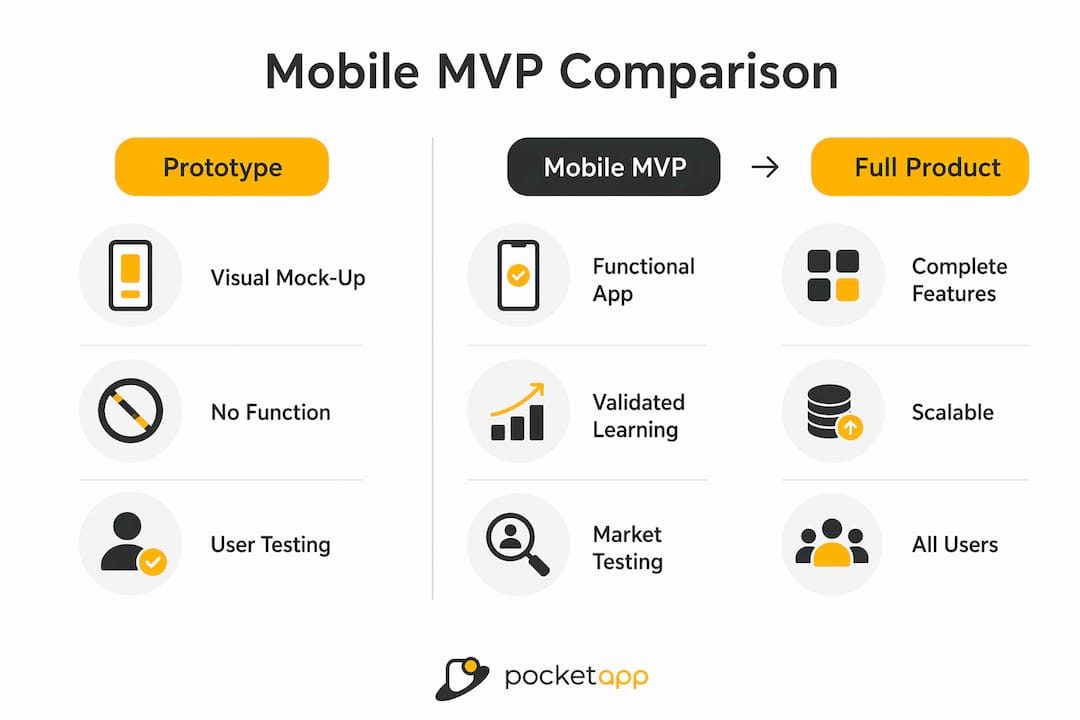
How does a mobile MVP differ from a prototype or full product?
The confusion between these three terms causes real damage to product timelines and budgets. They are not interchangeable.
| Prototype | Mobile MVP | Full product | |
|---|---|---|---|
| Functional? | No. Visual or interactive mock-up only. | Yes. Live, working app with real users. | Yes. Complete feature set. |
| Users | Internal team or design reviewers. | Real target users in the market. | All users at scale. |
| Purpose | Validate design and flow concepts. | Test the single riskiest business hypothesis. | Deliver the complete value proposition. |
| Analytics | None required. | Simple behavioural tracking. | Full analytics and reporting suite. |
| Timeline | Days to weeks. | 12–21 weeks depending on core journey complexity. | Six months to two-plus years. |
An MVP is a live product, not a mock-up. That is the most important distinction. A prototype never reaches real users. An MVP does, and the data it generates is what justifies or redirects your next investment.
The full product comparison is equally important. A full product aims to cover all use cases and user types. An MVP deliberately ignores most of them to focus on the one hypothesis that, if wrong, would kill the entire business. Treating your MVP as a beta version of the full product is one of the most common and costly mistakes in mobile app development.
What are the common mistakes founders make with mobile MVPs?
The biggest mistake is building a lite version of the full product rather than a focused learning tool. Founders who treat MVPs as lite products create unnecessary complexity and technical debt that slows every subsequent development sprint. You end up maintaining code for features that have never been validated.
The second most damaging mistake is emotional attachment to non-essential features. Founders often cling to polished design and beloved features that have nothing to do with the core hypothesis. This is understandable. You have spent months thinking about this product. But an MVP is a learning tool, not a statement of your vision.
Common pitfalls to watch for:
- Feature creep: Adding "just one more" feature before launch, which delays the feedback you actually need.
- Neglecting analytics: Launching without Mixpanel, Firebase, or equivalent tracking means you collect no usable data. You are flying blind.
- Underestimating timelines: Even a focused MVP takes 12–21 weeks when built properly. Founders who budget for six weeks end up cutting corners on the analytics infrastructure that makes the whole exercise worthwhile.
- Skipping the riskiest assumption: Building features that feel safe rather than testing the one assumption that could invalidate the entire product. This is the most subtle and most expensive mistake.
Pocketapp's discovery process specifically addresses this last point. Before a single line of code is written, the team works with founders to identify the single riskiest assumption and design the MVP around testing it. That discipline is what separates a useful MVP from an expensive prototype. You can read more about common app development mistakes that affect startups at every stage.
Pro Tip: Write your riskiest assumption as a single sentence before you scope your MVP. If your MVP does not directly test that sentence, you are building the wrong thing.
How do you use a mobile MVP to validate your market?
Validation is not about collecting compliments. It is about measuring whether users complete the core action you built the app around. The key success metric for a mobile MVP is the percentage of users who complete the core journey without friction, tracked through behavioural analytics rather than acquisition numbers alone.
A practical validation process works in four stages:
-
Define your success metric before launch. Decide what "working" looks like. For a marketplace MVP, it might be a user completing a transaction. For a productivity tool, it might be returning to the app on three consecutive days. Without a pre-defined metric, you will rationalise any result as success.
-
Track behaviour, not just downloads. Downloads tell you about marketing. Behaviour tells you about product. Use mobile app analytics to map where users drop off in the core journey. A drop-off at step three of a five-step flow is a specific, fixable problem. A low download number is a marketing problem, not a product problem.
-
Gather structured user feedback. Qualitative feedback from ten users who completed the core journey is worth more than a survey of 500 downloads. Use in-app prompts, short interviews, or tools like Typeform to ask specific questions about the core flow. Pocketapp's approach to iterative app design treats this feedback loop as the engine of post-MVP development.
-
Prioritise your next features with real data. After your first validation cycle, you have evidence. Use it. Features that users request repeatedly and that align with your core hypothesis go to the top of the backlog. Features that feel logical but that no user has asked for go to the bottom. This is how validated learning guides product-market fit rather than intuition.
The discipline of using data to prioritise is what separates teams that build great products from teams that build busy ones. A step-by-step development guide for business founders covers how this process maps to a full project timeline.
Key takeaways
A mobile MVP is the smallest working app that tests your riskiest business hypothesis with real users, not a lite version of the final product.
| Point | Details |
|---|---|
| MVP definition | A mobile MVP is a live, functional app built to test one core hypothesis, not a stripped-down final product. |
| Essential components | Every MVP needs user authentication, a single core journey, and basic analytics. Nothing more at launch. |
| MVP vs prototype | A prototype is a non-functional mock-up. An MVP is live, used by real people, and generates measurable data. |
| Common mistakes | Feature creep, neglecting analytics, and treating the MVP as a lite product are the three most damaging errors. |
| Validation method | Measure core journey completion through behavioural analytics, not download counts or user ratings. |
The uncomfortable truth about building a mobile MVP
The hardest part of building a mobile MVP is not technical. It is psychological. Every founder I have worked with has a list of features they consider non-negotiable. When you sit down and map those features against the single riskiest assumption, most of them disappear. That is an uncomfortable process, and it should be.
Building a true MVP requires hard choices to remove features you genuinely believe in. The ones that survive that process are the ones worth building. The ones that do not survive were always assumptions dressed up as requirements.
What I have observed consistently is that the teams who build the best MVPs treat the exercise as an engineering decision first. They ask: what is the minimum measurement infrastructure we need to know if this works? That framing keeps the scope honest. It also means the codebase stays clean, which matters enormously when you need to pivot quickly based on what you learn.
The design question follows the same logic. Successful MVPs rely on an intuitive core flow that requires no tutorial. If your MVP needs a walkthrough to make sense, the UX has failed before a single user has opened it. Simplicity in design is not a compromise at the MVP stage. It is the goal. The art of minimalist design for startups makes this case convincingly: clarity beats completeness every time.
The founders who get the most from their MVPs are the ones who go in genuinely willing to be wrong. That willingness is what makes the data useful.
— Paul
Pocketapp's approach to mobile MVP development
Pocketapp has delivered over 300 mobile projects for clients including WWF, Dechra, and Crocus, which means the team has seen every variation of the MVP mistakes described above.
For entrepreneurs and product managers ready to build a mobile MVP, Pocketapp offers a structured discovery process that identifies your riskiest assumption before scoping begins. The team builds cross-platform MVPs using React Native and Flutter, covering both iOS and Android from day one. Every project includes the analytics infrastructure needed to generate real validation data, not just a working app. If you are planning a mobile MVP and want a development partner with a track record of building for validated learning, get in touch with Pocketapp to discuss your project.
FAQ
What is the mobile MVP definition in simple terms?
A mobile MVP is the smallest working version of an app that tests whether your core idea has real demand. It includes only the features needed to validate one specific business hypothesis with real users.
How long does mobile MVP development take?
MVP development typically takes 12–21 weeks, depending on the complexity of the core user journey. This includes authentication, the primary flow, and basic analytics.
What are the best mobile MVP examples?
Early versions of Uber, Instagram, and Airbnb are the most cited mobile MVP examples. Each launched with a single core journey: requesting a ride, sharing a photo, or booking a room, with no secondary features at all.
Should a mobile MVP be built for iOS or Android first?
Cross-platform tools like React Native and Flutter make simultaneous iOS and Android launch the most practical choice for most MVPs. iOS-first is only justified when your specific audience is demonstrably iPhone-heavy.
What is the difference between a mobile MVP and a beta version?
A beta version is a near-complete product tested for bugs before full release. A mobile MVP is a minimal product built to test whether the core concept is worth developing further. They serve entirely different purposes.