
Many businesses assume that building for both iOS and Android means running two separate projects, two budgets, and twice the headaches. That assumption is costing organisations real money and time. Cross platform development has shifted dramatically over the past few years, moving far beyond the clunky webview approaches of the past into something genuinely capable of meeting most business needs. This guide breaks down exactly what cross platform development is, how it compares to other approaches, and how to decide whether it is the right strategy for your organisation.
Table of Contents
- Defining cross platform development
- How cross platform compares to native and hybrid app development
- The business case for cross platform mobile apps
- Choosing the right cross platform framework
- Our take: What most businesses miss about cross platform development
- Advance your app strategy with expert cross platform solutions
- Frequently asked questions
Key Takeaways
| Point | Details |
|---|---|
| One codebase, many platforms | Cross platform development enables you to launch apps on both iOS and Android with less duplication. |
| Significant business advantages | Faster development and lower costs give your organisation a competitive edge. |
| Choose mature frameworks | Select well-supported solutions like Flutter or React Native for reliability and future-proofing. |
| Mind the project scope | Cross platform is ideal for most business apps but not all situations, so align your approach with actual needs. |
Defining cross platform development
At its core, cross platform development means writing a single codebase that produces apps capable of running on multiple operating systems, most commonly iOS and Android. Rather than building and maintaining two entirely separate native apps, your development team writes code once and deploys it across platforms. The result for your business is a consistent product that reaches your full audience without doubling your investment.
The concept is not new, but the quality has changed enormously. Early cross platform tools relied on webview technology, essentially wrapping a website inside an app shell. The experience was often sluggish, visually inconsistent, and frustrating for users. Those limitations gave cross platform a poor reputation in some circles, and that reputation has lingered longer than it deserves.
Modern frameworks have changed the picture entirely. Tools like Flutter (built by Google) and React Native (built by Meta) compile code into genuinely native components rather than rendering through a browser engine. The gap between these compiled frameworks and fully native apps has narrowed to the point where most business applications are indistinguishable to end users.
For a thorough cross-platform development overview, the key business benefits now include:
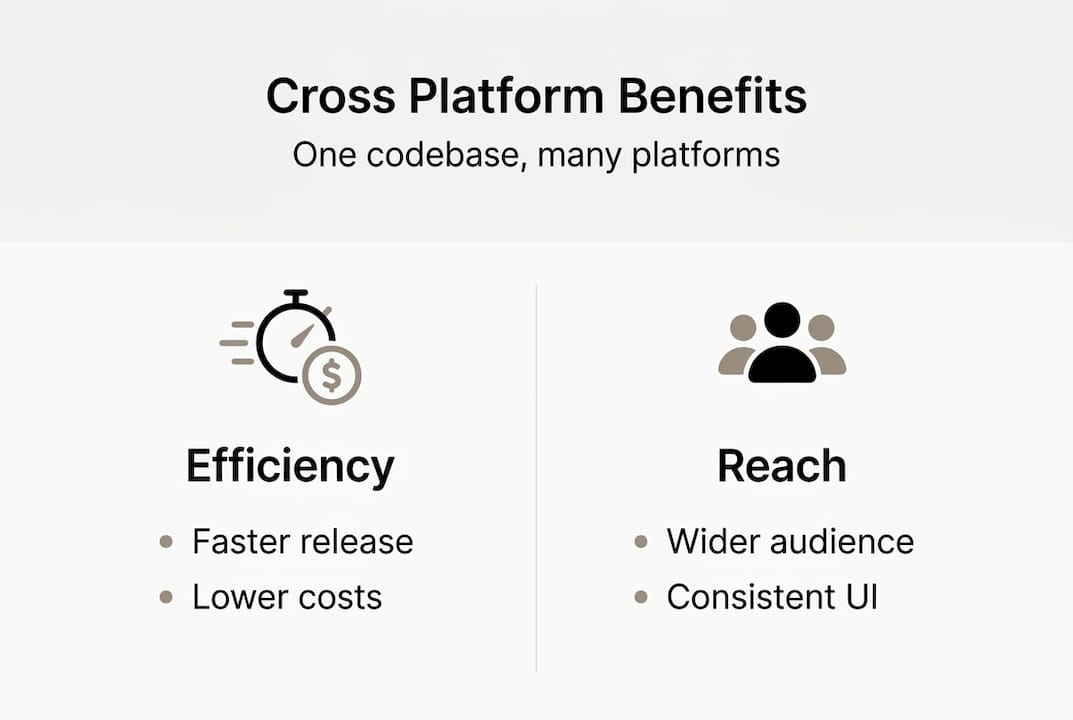
- Reduced development time: A single shared codebase means fewer hours to build and test.
- Lower overall cost: 30 to 50% cost savings compared to building separate native apps.
- Wider audience reach: One release covers both major platforms simultaneously.
- Streamlined updates: Push changes across iOS and Android at the same time, with no version drift.
If you are exploring developing cross-platform apps for the first time, understanding this evolution is essential. The technology your business evaluates today is not the hybrid app of 2014.
How cross platform compares to native and hybrid app development
Understanding the basic definition sets the stage. Now let's see how cross platform stacks up against the alternatives your business might consider.
The three main approaches are native, hybrid (webview), and cross platform compiled frameworks. Each has a distinct profile of strengths and trade-offs. The table below gives a clear overview:
| Approach | Development cost | Performance | User experience | Best for |
|---|---|---|---|---|
| Native | High | Excellent | Best possible | Performance-critical or complex apps |
| Hybrid (webview) | Low | Poor to moderate | Inconsistent | Simple internal tools only |
| Cross platform (compiled) | Moderate | Very good | Near-native | Most business apps |
Native development gives you the best possible performance and deepest access to device hardware. The trade-off is cost. Building and maintaining separate iOS and Android codebases requires two specialist teams, two sets of release cycles, and ongoing duplication of effort. For most business applications, that investment is difficult to justify.

Hybrid webview apps sit at the other extreme. They are cheap to build but inferior to true cross-platform compiled frameworks in almost every meaningful measure. Performance is inconsistent, the user experience often feels off, and the approach is losing ground fast as better alternatives become mainstream.
Modern cross platform compiled frameworks occupy the practical sweet spot. 80 to 95% of native performance is now achievable with mature frameworks, which is more than sufficient for the vast majority of business use cases. The key factors that separate this category from old-style hybrid development are:
- Compiled native UI components rather than webview rendering
- Strong backing from major technology companies
- Active developer communities and regular updates
- Genuine platform-specific behaviour and design patterns
"For most business apps, the performance gap between cross platform compiled frameworks and native development is no longer a meaningful barrier to adoption."
For a detailed breakdown, our web app vs hybrid app vs native app comparison and our guide to cross-platform pros and cons cover the nuances in full.
The business case for cross platform mobile apps
Once you understand the toolset, it is essential to assess the concrete business value of cross platform development.
The market is signalling strong confidence in this approach. The cross platform mobile app market is projected to reach $25.6 billion in 2026, reflecting sustained investment from businesses that have already recognised the strategic advantage. That is not hype. It is organisations voting with their budgets.
The data on efficiency is equally compelling. Cross platform development can deliver 30 to 40% faster release cycles and up to 50% cost savings compared to building native apps for each platform separately. For businesses launching a new product or testing a concept, that speed advantage can be the difference between capturing a market and missing it.
| Business scenario | Cross platform suitable? | Reason |
|---|---|---|
| Customer engagement app | Yes | Wide reach, consistent experience |
| MVP or proof of concept | Yes | Speed and cost efficiency |
| Internal operations tool | Yes | Functionality over peak performance |
| High-end 3D gaming app | No | Requires maximum native performance |
| Specialist hardware integration | No | Deep device access needed |
The industry cross-platform growth trend reinforces this pattern. Businesses in retail, healthcare, charity, and B2B services are consistently finding that cross platform meets their requirements without the overhead of native development.
Pro Tip: Stick to mature, well-supported frameworks with active communities. Niche or poorly maintained frameworks may seem attractive initially but create significant risk when you need updates, security patches, or new platform features.
Choosing the right cross platform framework
Knowing the market advantage, the next logical question is: which framework should your business trust?
Not all cross platform frameworks are equal. The choice you make here will shape your app's long-term maintainability, performance, and the availability of skilled developers. For business applications, mature frameworks backed by large vendors are strongly advisable. Smaller or niche frameworks carry real risk: slower updates, smaller talent pools, and uncertain futures.
In 2026, the two dominant choices for business apps are:
- Flutter (Google): Excellent performance, a rich component library, and strong adoption across industries. Particularly well-suited to visually polished consumer and B2B apps.
- React Native (Meta): Mature ecosystem, large developer community, and strong integration with JavaScript tooling. A solid choice for teams with existing web development expertise.
A practical framework selection process for your business should follow these steps:
- Define your app's core requirements including performance needs, device features, and expected user volume.
- Assess your existing team's skills to determine whether Flutter or React Native aligns with what you already have.
- Evaluate community and vendor support by checking update frequency, documentation quality, and community size.
- Review case studies from businesses in your sector to see which framework has delivered reliable results.
- Prototype before committing by building a small proof of concept to validate your choice before full investment.
For a deeper look at tooling decisions, our guide to cross-platform tools and practices walks through the selection process in detail.
Pro Tip: Prioritise frameworks with strong backing, comprehensive documentation, and active development. A framework that is well-supported today but abandoned in two years is a liability, not an asset.
Our take: What most businesses miss about cross platform development
All the evidence and comparisons aside, there is still a vital context businesses need before they decide. And it is rarely discussed in framework comparison articles.
The real differentiator in a successful cross platform project is not which framework you choose. It is whether your project scope is honest and your understanding of end-user needs is accurate. We have seen businesses invest in technically sound frameworks and still produce apps that fail to engage users, simply because the discovery phase was rushed or skipped entirely.
Conventional wisdom still overstates the performance gap between cross platform and native. Even genuinely demanding apps often do not require the ultra-native performance that native-only advocates insist upon. Most business apps need reliability, speed, and a clean user experience. Cross platform delivers all three when implemented well.
What truly separates successful projects is team expertise, process clarity, and a commitment to ongoing support after launch. The balancing act of cross platform development is less about technical trade-offs and more about strategic alignment. Choose the right partner, scope your project honestly, and the framework becomes a secondary concern.
Advance your app strategy with expert cross platform solutions
If your business is ready to capture the benefits of cross platform development, the next step is working with a team that has delivered it across diverse sectors and real-world constraints.
At Pocket App, our cross platform app development work spans over 300 projects for organisations ranging from global charities to major retailers. We bring strategic discovery, rigorous UX design, and technical depth to every engagement. Whether you are scoping your first app or rethinking an existing one, our mobile app development team can help you move from idea to a live, high-performing product. Get in touch to discuss your requirements and find out which approach will deliver the best results for your organisation.
Frequently asked questions
What is the primary benefit of cross platform development?
It allows you to build one app that runs on multiple platforms, reducing both development time and costs. Development is 30 to 40% faster with cost savings of up to 50% compared to native.
Are there any drawbacks to using cross platform frameworks?
Performance may not always match native apps, but for most business needs the gap is minimal. Modern frameworks reach 80 to 95% of native performance when using mature options like Flutter or React Native.
How do I choose the best cross platform framework for my business?
Choose a mature, widely supported option backed by large vendors such as Flutter or React Native. Stick to mature frameworks backed by Google or Meta and avoid niche or poorly maintained alternatives.
Is cross platform development suitable for high-performance or graphics-heavy apps?
For highly specialised apps demanding extreme performance, native development may remain preferable, but cross platform covers the vast majority of business scenarios effectively.
Recommended
- Pocket App | Developing Cross-Platform Apps: Pros, Cons, and Best Practices
- Pocket App | Cross-Platform App Development: Best Tools and Practices
- Pocket App | Use Our Extensive Cross Platform Application Development For Your Business
- Pocket App | Industry Leading Cross-Platform Application Development Services