
TL;DR:
- Running a structured donor engagement program with timely stewardship and segmentation significantly boosts retention and lifetime value. Implementing a 90-day sequence, personalized outreach, and clear KPIs helps build stronger long-term supporter relationships. Most failures stem from poor sequencing and neglecting stewardship, which can be addressed with technology and dedicated ownership.
The fastest way to lift donor retention and lifetime value is to run a structured programme: identify your supporters, qualify their potential, cultivate the relationship, make a well-timed ask, and steward them into long-term advocates. That sequence, often expressed as Ask → Thank → Report → Repeat, is the backbone of every high-performing fundraising operation. This playbook gives you a ready-to-use plan, a 90-day timeline, and a simple dashboard to track progress from day one.
Start this week:
- Send a personal thank-you to every donor who gave in the last 30 days (phone or handwritten note, not just an automated receipt).
- Run a basic engagement score on your CRM: flag anyone who has not opened an email or attended an event in 90 days as "at risk."
- Schedule three board stewardship calls for your top ten donors before the end of the month.
90-day at-a-glance: Week 1 focuses on data hygiene and immediate stewardship. Month 1 builds your segmented welcome series and cadence. Months 2–3 introduce impact reporting, upgrade asks, and a first retention review. By day 90, first-time donor retention and email open rates should both be moving in the right direction.
Table of Contents
- What does the donor engagement lifecycle actually look like?
- How to build your donor engagement plan step by step
- How should you segment and personalise donor communications?
- Which engagement tactics actually move retention?
- What should you measure and how do you build a simple dashboard?
- How do you turn one-off donors into long-term supporters?
- How do digital channels and apps support donor engagement in the UK?
- What should your next 90 days look like?
- Key takeaways
- Why most donor engagement plans fail before they start
- How Pocketapp helps charities build better donor relationships
- Useful sources
- FAQ
What does the donor engagement lifecycle actually look like?
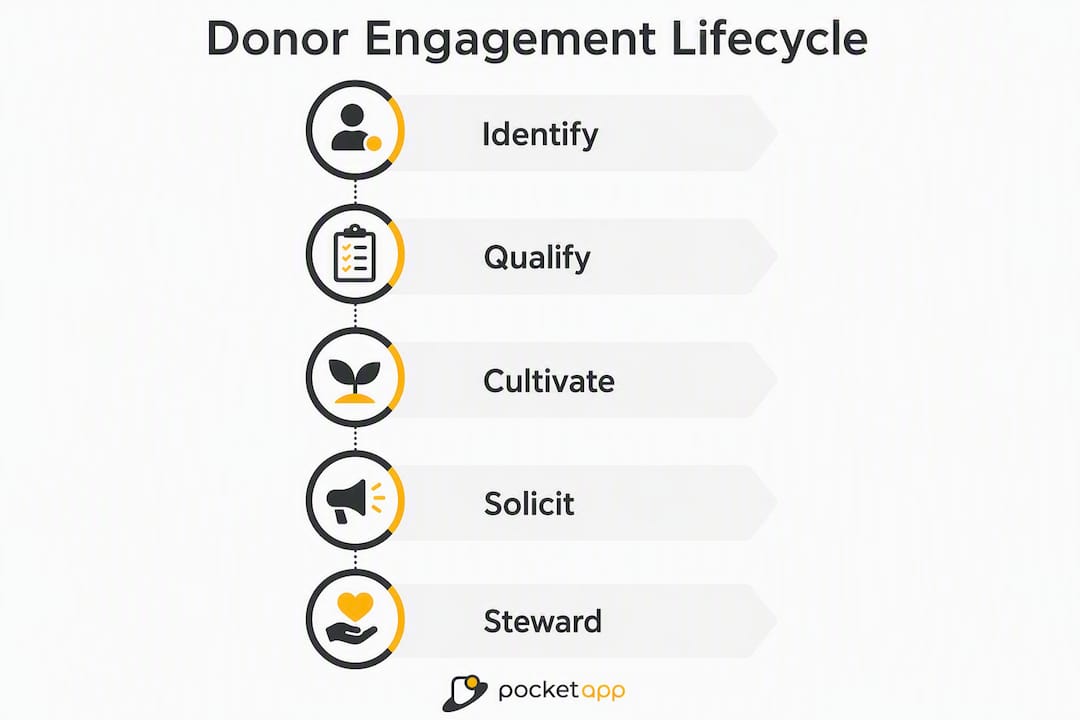
The donor engagement lifecycle runs through five stages: identification, qualification, cultivation, solicitation, and stewardship. Many frameworks simplify this to the cycle of Ask → Thank → Report → Repeat, which works well as an operational shorthand for day-to-day fundraising. Each stage has a distinct job and measurable outcome, and for major-gift work, qualification sits explicitly between identification and cultivation.

How to build your donor engagement plan step by step
A step-by-step donor engagement plan works best when it separates new-donor onboarding from re-engagement of lapsed supporters. Here is a template you can copy and adapt.

New donor: first 90 days
Week 1
- Send an automated gift receipt within 30 minutes of the donation.
- Make a personal phone call or send a handwritten note within 48 hours for gifts above your internal threshold (many teams set this at £100 or £250).
- Add the donor to your CRM with full contact details, gift amount, channel, and stated interests.
- Assign a relationship owner (fundraiser or board member) for mid-to-high-value donors.
Month 1 (days 8–30)
- Send a segmented welcome email series (three emails over two weeks: welcome, mission story, impact proof).
- Share a first impact update showing specifically what their gift is doing.
- Invite them to one low-barrier engagement opportunity: a virtual tour, a volunteer taster, or a community update webinar.
- Log all interactions in your CRM and update the engagement score.
Months 2–3 (days 31–90)
- Send a personalised mid-cycle update referencing their specific gift.
- Make a second personal outreach (call or personal email) from a board member or programme lead.
- Introduce a soft upgrade ask if engagement signals are strong (two or more email opens, event attendance, or a survey response).
- Run a 90-day retention review: flag anyone with no engagement as "at risk" and trigger a recovery sequence.
Resourcing note: Weeks 1–4 require roughly 2–3 hours per week of relationship-manager time for a portfolio of 50 new donors. Automation handles receipts and the welcome series; personal outreach is the non-negotiable manual step.
Lapsed donor re-engagement stream
- Day 1: Personalised "we miss you" email referencing their last gift and its impact.
- Day 14: Impact story email with no ask.
- Day 30: Soft ask with a lower entry point than their last gift.
- Day 60: If no response, move to a low-frequency nurture list and review quarterly.
Pro Tip: Keep your re-engagement window realistic. If a donor has been silent for more than 18 months, a two-touch sequence is usually enough before moving them to a dormant segment. Chasing too hard costs staff time and risks an unsubscribe.
How should you segment and personalise donor communications?
Treating small-dollar recurring donors the same as major-gift prospects reduces relevance and accelerates churn. Segmentation does not need to be complex to be effective. Start with five data fields and build from there.
Minimum data fields for useful segmentation:
- Recency (date of last gift)
- Frequency (number of gifts in the last 12 months)
- Monetary value (average and largest gift)
- Preferred channel (email, post, phone, social)
- Stated interests (programme area, volunteering, events)
Three practical segments and what to say to each
Segment 1: New small-dollar recurring donors (monthly gift under £25) These donors are building a habit. Your job is to reinforce it. Lead with impact per pound ("your £10 a month funds X"), keep communications brief, and celebrate milestones (first anniversary, 12th gift). Avoid heavy asks for upgrades in the first six months.
Segment 2: Mid-value volunteers (one-off or irregular gifts, active volunteers) Volunteering is a strong predictor of future giving. Acknowledge their time explicitly, share stories from the programmes they support, and invite them to exclusive briefings or behind-the-scenes updates. A volunteer-to-donor conversion ask works well at the six-month mark.
Segment 3: Major-gift prospects (capacity score high, gifts above £500) These donors need a relationship, not a mailing list. Assign a named relationship manager, schedule face-to-face or video meetings, and involve board members in stewardship. Communications should be personal, specific, and infrequent enough to feel considered rather than automated.
Personalisation in your app or digital platform can extend this segmentation logic into push notifications, in-app content, and event invitations, making each touchpoint feel relevant rather than broadcast.
Which engagement tactics actually move retention?
Not all tactics are equal. A simple impact-versus-effort lens helps you prioritise limited staff time.
High impact, low effort:
- Personalised thank-you calls (board or programme lead, 90 seconds, within 48 hours of a significant gift)
- Segmented welcome email series (three emails, automated after initial setup)
- Impact updates tied to a donor's specific gift or programme area
High impact, higher effort:
- In-person or virtual donor events with programme access
- Volunteer opportunities with a clear link back to the cause
- One-to-one stewardship meetings for major-gift prospects
Lower return for most teams:
- Generic mass newsletters with no segmentation
- Social media posts with no direct donor follow-up
- Unsolicited merchandise or branded gifts
Suggested ongoing cadence
- Weekly: Monitor engagement scores; flag at-risk donors; send any scheduled automated touchpoints.
- Monthly: Send one non-ask communication (impact story, programme update, or community news) to your full active list.
- Quarterly: Personal outreach to your top 20% of donors; board stewardship calls; retention review.
The 70/30 communications rule is a reliable guide: around seventy per cent of your contacts should be non-ask (impact stories, volunteer invitations, exclusive updates), with thirty per cent being asks. Teams that flip this ratio see faster donor fatigue and higher churn.
Pro Tip: Sequence matters as much as frequency. A donor who receives an ask immediately after their first gift, with no impact update in between, is far more likely to lapse than one who receives two non-ask touches first. Build the relationship before you return to the ask.
What should you measure and how do you build a simple dashboard?
Core KPIs fall into three categories: retention, engagement, and value. Here is a mini-dashboard template your team can implement in a spreadsheet or CRM report within a day.
| KPI | Definition | Month 1 target | Month 3 target |
|---|---|---|---|
| First-time donor retention | % of new donors who give again within 12 months | Baseline established | Improving versus baseline |
| Overall retention rate | % of all active donors who give again year-on-year | Baseline established | Improving trend |
| Email open rate | Opens ÷ delivered × 100 | 25%+ | 30%+ |
| Event attendance rate | Attendees ÷ invitees × 100 | Baseline established | 10% above baseline |
| Engagement score (Cold/Warm/Hot) | Composite of recency, email opens, event attendance, volunteering | All donors scored | At-risk list actioned |
| Average gift value | Total gifts ÷ number of donors | Baseline established | Stable or improving |
How to build a Cold/Warm/Hot engagement score
Assign points for each signal: a gift in the last 90 days (3 points), an email open in the last 30 days (1 point), event attendance in the last 6 months (2 points), a volunteer session (2 points), a survey response (1 point). Score above 5 = Hot; 2–4 = Warm; 0–1 = Cold. Review monthly and trigger recovery sequences for anyone dropping from Warm to Cold.
AI-driven engagement tools can automate this scoring and surface at-risk donors before they lapse, which is particularly useful for teams managing large portfolios with limited staff.
How do you turn one-off donors into long-term supporters?
First-time donor attrition can be very high when organisations fail to follow up promptly. The critical window is the first 90 days, and the sequence is straightforward.
The 90-day stewardship timeline
- Within 48 hours: Automated receipt plus a personal call or note for gifts above your threshold. A 90-second call from a board member or programme lead at this point can improve first-time retention by 20–30%.
- Day 7: Welcome email from the CEO or programme director (not the fundraising team), referencing the specific programme the gift supports.
- Day 30: Impact update: one concrete story or statistic showing what their gift has done. Keep it to 150 words and one image.
- Day 60: Non-ask touchpoint: a volunteer invitation, an event, or a behind-the-scenes update.
- Day 90: Personalised follow-up from the relationship manager. If engagement signals are strong, introduce a soft upgrade or recurring-gift ask.
Stewardship touches by donor band
- Under £100: Automated welcome series, monthly impact email, annual thank-you.
- £100–£499: All of the above, plus one personal call per year and an event invitation.
- £500+: Named relationship manager, quarterly personal contact, board involvement, bespoke impact reporting.
Board members are an underused stewardship asset. Trained and briefed properly, they provide a level of personal connection that a fundraiser alone cannot replicate. A short briefing note (donor name, gift history, interests, suggested talking points) is all most board members need to make an effective call.
Red-flag behaviours to watch:
- No email opens for 60+ days
- Declined or lapsed recurring gift
- No response to two consecutive personal outreach attempts
- Unsubscribe from one channel (often a precursor to full disengagement)
When you spot these signals, trigger a rapid recovery sequence: a personal call first, then a re-engagement email with a compelling impact story, then a reduced-frequency nurture track if there is still no response.
How do digital channels and apps support donor engagement in the UK?
Multi-channel approaches increase touchpoints without overwhelming donors, and mobile optimisation is now a baseline expectation, not a differentiator. UK charities that have invested in mobile-first donation pages, push notifications, and in-app impact updates report faster first-touch response times and stronger engagement scores.
A bespoke charity app can compress the critical 48-hour stewardship window to minutes: push a personalised thank-you the moment a gift is processed, trigger an impact story when a campaign milestone is hit, and surface a volunteer invitation based on a donor's stated interests. The result is a more human experience delivered at scale.
Which channels work best depends on your audience, but the general hierarchy for UK charities is: email (highest reach), SMS (highest open rate for time-sensitive messages), push notifications via app (highest engagement for opted-in supporters), and social media (best for community-building and acquisition rather than retention).
Commissioning checklist for a charity app or digital build
If you are considering commissioning a mobile app for donor engagement, brief your development partner on these requirements:
- Donor authentication and saved payment methods
- CRM integration (two-way data sync with your existing system)
- Push notification capability with consent management
- In-app impact updates and campaign progress tracking
- Event check-in and volunteer management features
- Accessibility compliance (WCAG 2.1 AA as a minimum)
- Analytics dashboard for engagement scoring
GDPR and data protection: UK charities must comply with the UK GDPR and the Data Protection Act 2018. Practical requirements include: capturing explicit consent for each communication channel separately, applying data minimisation (collect only what you will use), maintaining a clear record of consent, and honouring opt-outs within 10 days. Your app or CRM should log consent at the point of capture and make it auditable. For detailed guidance on building apps that handle donor data securely, Pocketapp's data security guide for nonprofit apps covers the practical steps.
Pro Tip: Before commissioning a bespoke build, audit your existing CRM workflows. Many charities can achieve 70–80% of the engagement gains they need by improving their CRM segmentation, automations, and email templates. A bespoke app adds the most value when you have already optimised the basics and need to reduce friction for donors who prefer mobile-first interactions.
What should your next 90 days look like?
If you implement this plan well, you should see measurable movement in first-time donor retention and email engagement within 90 days. The single most important intervention is the 48-hour personal thank-you: it costs almost nothing and has the greatest impact on whether a new donor gives again.
Month 1 priorities:
- Establish baseline KPIs (retention rate, email open rate, engagement scores).
- Launch the segmented welcome series for all new donors.
- Complete board stewardship call training and schedule the first round of calls.
- Audit CRM data quality and fill gaps in the five core segmentation fields.
Month 3 priorities:
- Run the first 90-day retention review and action the at-risk list.
- Deliver the first round of personalised impact updates.
- Review the 70/30 communications ratio across all channels.
- Assess whether a mobile-first upgrade (app or improved mobile donation page) would reduce friction for your highest-value segment.
Month 1 metric targets: Email open rate above 25%, all new donors scored in the CRM, at-risk list identified and actioned.
Month 3 metric targets: First-time retention rate improving versus baseline, email open rate at 30%+, at least one board stewardship call completed per top-20 donor.
Teams that follow this sequence consistently report stronger second-gift rates and a more engaged donor base within two fundraising cycles.
Key takeaways
A structured donor engagement programme built around the identify → qualify → cultivate → ask → steward cycle, with a 90-day stewardship sequence and a 70/30 non-ask-to-ask communications ratio, is the most reliable way to improve first-time donor retention and lifetime value.
| Point | Details |
|---|---|
| The 90-day window is critical | First-time attrition can reach 75–80%; a 48-hour thank-you and 30-day impact update are the highest-leverage interventions. |
| Segment before you communicate | Five data fields (recency, frequency, value, channel, interests) are enough to create meaningful segments and avoid irrelevant messaging. |
| Use the 70/30 rule | Seventy per cent of communications should be non-ask; reversing this ratio accelerates donor fatigue and churn. |
| Measure beyond gifts | Track email opens, event attendance, volunteer hours, and engagement scores alongside donation data for a complete picture. |
| Pocketapp accelerates delivery | A bespoke charity app or mobile-first workflow from Pocketapp compresses the critical stewardship window and automates engagement scoring at scale. |
Why most donor engagement plans fail before they start
The conventional wisdom says the biggest barrier to donor engagement is budget. In practice, it is usually sequencing. Charities invest in CRM systems, email platforms, and event programmes, then deploy them in the wrong order: they ask before they cultivate, they report after they have already lost the donor, and they treat stewardship as a post-campaign task rather than an always-on discipline.
The 90-day window is where most relationships are won or lost, and it is also where most teams are least prepared. The first gift arrives, an automated receipt goes out, and then nothing happens for six weeks while the fundraising team focuses on the next campaign. By the time the impact update lands, the donor has already mentally moved on.
The fix is not more technology. It is a clear sequence with named owners and non-negotiable timings. Technology, including a well-built charity app, makes that sequence faster and more consistent, but it cannot replace the decision to prioritise stewardship as a first-order activity rather than an afterthought.
Board involvement is the most underused lever in this space. A two-minute call from a trustee carries more weight than a dozen automated emails, and most boards are willing to make those calls when they are properly briefed and given a simple script. The charities that do this well treat board stewardship as a structured programme, not an occasional favour.
How Pocketapp helps charities build better donor relationships
Charities that want to compress the critical stewardship window and automate engagement scoring at scale have a clear route: a bespoke mobile app or mobile-first workflow built specifically for donor follow-up and measurement. Pocketapp has delivered over 300 projects across charity, retail, and healthcare, including donor-facing apps that integrate directly with CRM systems, push personalised thank-yous within minutes of a gift, and surface impact updates based on a donor's stated interests.
The practical difference is speed and consistency. Manual stewardship processes depend on staff availability; a well-built app delivers the 48-hour touch every time, for every donor, regardless of team capacity. Pocketapp's discovery process starts with a workshop to map your existing donor journey, identify the highest-friction points, and recommend whether a bespoke build or an optimised mobile workflow is the right fit for your organisation.
To discuss a donor engagement app or a mobile-first fundraising build, speak to the Pocketapp team about a discovery conversation.
Useful sources
A short list of authoritative resources for UK fundraisers who want to go deeper on any section of this guide.
- BBB Wise Giving Alliance (give.org): Donor Trust Report — Research on what donors expect from charities in terms of transparency and communication.
- Charity Navigator — A reference point for accountability standards and financial health metrics that donors increasingly check before giving.
- Philanthropy News Digest — Insight into how next-generation donors are changing giving behaviour and what that means for engagement strategy.
- Pocketapp: Mobile apps drive donor engagement — Practical guidance on how mobile apps sustain donor relationships and increase conversion for UK charities.
- Pocketapp: The role of apps in donor engagement — A guide to app features and use-cases specifically for charities considering a digital build.
FAQ
What are the stages of donor engagement?
The donor engagement lifecycle runs through five stages: identification, qualification, cultivation, solicitation, and stewardship. Many frameworks simplify this to the cycle of Ask → Thank → Report → Repeat, which works well as an operational shorthand for day-to-day fundraising.
How do you create a donor engagement plan?
Start by segmenting your existing donors using recency, frequency, and gift value, then build a 90-day sequence for new donors that includes a 48-hour personal thank-you, a 30-day impact update, and a 60–90-day follow-up. Assign named owners to each step and track progress in your CRM.
What are the steps for engaging a new donor effectively?
Send an automated receipt immediately, follow up with a personal call or note within 48 hours for gifts above your threshold, deliver a segmented welcome email series over the first two weeks, share an impact update by day 30, and make a second personal contact by day 90.
What are the four pillars of the donor experience?
Definitions vary across frameworks, but a widely used version covers: communication (timely, relevant, multi-channel contact), recognition (personalised thanks and acknowledgement), impact (clear reporting on what gifts achieve), and community (making donors feel part of something larger than a transaction). These four pillars map directly onto the cultivation and stewardship stages of the engagement lifecycle.