
TL;DR:
- Mobile apps are essential for nonprofits to nurture long-term donor relationships through personalized communication and frictionless recurring giving. They support increased retention, higher lifetime value, and meaningful stewardship by integrating targeted features like milestone notifications, multiple payment options, and tailored messaging. Success depends on a strategic focus on relationship-building, security, and continuous data-driven optimization, not just technology.
Mobile apps are the most direct channel nonprofits have for building lasting donor relationships, enabling personalised communication, frictionless giving, and the kind of sustained commitment that transforms one-off supporters into lifelong advocates. The role of apps in donor engagement goes well beyond digital convenience. Apps function as the primary infrastructure for recurring giving programmes, stewardship journeys, and real-time donor motivation. Organisations like the American Cancer Society have demonstrated this with purpose-built fundraising tools, while research from Blackbaud Institute confirms that recurring giving is now the defining metric of long-term fundraising health. This guide examines how mobile apps achieve these outcomes and what nonprofit leaders need to know to act on them.
How do apps shape recurring giving and donor lifetime value?
Recurring donors are the most valuable segment in any nonprofit's portfolio, and mobile apps are the primary mechanism for acquiring and retaining them. Recurring donors retain at 78 to 80%, compared to roughly 32% for one-time givers, and maintain an average relationship of 7.7 years versus 1.7 years for single donors. That gap in relationship length translates directly into lifetime value that dwarfs any single campaign.
The structural challenge is that most organisations are not capitalising on this. Monthly donors generate 84% of recurring revenue, yet the median nonprofit has only 4% of its donor base on recurring schedules, and many acquire zero new recurring donors in a given year. Apps address this gap by embedding recurring giving options into every donation moment, making the monthly commitment the default rather than the exception.
The design elements that drive this outcome are specific. Well-built apps present recurring giving as the primary option at checkout, use milestone notifications to reinforce the donor's cumulative impact, and send personalised stewardship messages that acknowledge the relationship rather than just the transaction. Blackbaud's 2025 Trends in Giving report recommends that nonprofits focus app strategy explicitly on recurring donation UX and stewardship, treating it as a long-term engagement channel rather than a payment mechanism.
- Present monthly giving as the default option at the point of donation, not a secondary toggle
- Use in-app impact milestones to show donors the cumulative effect of their giving over time
- Send automated stewardship messages tied to giving anniversaries and programme updates
- Track lapsed recurring donors and trigger re-engagement sequences before cancellation occurs
Pro Tip: Do not rely on passive prompts to convert one-time donors to monthly givers. Explicit upgrade journeys with persuasive, low-friction steps consistently outperform generic "upgrade your gift" banners. Design a dedicated in-app flow that walks the donor through the decision with clear impact framing.
What features make a donor engagement app genuinely effective?
The most effective donor engagement apps, in the industry's own terminology often called "fundraising apps" or "supporter apps", combine transactional capability with relationship-building features that keep donors connected between giving moments. The American Cancer Society's FUNdraising app illustrates this well: it combines event registration, multiple payment methods, automated receipts, thank-you sending, fundraising progress tracking, and achievement badges in a single experience.
Payment flexibility is foundational. Accepting PayPal, Apple Pay, Google Pay, and Venmo removes the friction that causes donors to abandon the giving process mid-flow. Each additional payment method reduces drop-off at checkout, and for mobile users in particular, native wallet integrations make the difference between a completed gift and an abandoned one.
Stewardship features are where most apps underperform. Automated receipts are table stakes. What separates strong apps from weak ones is the quality of the follow-up: personalised thank-you notes that reference the specific campaign, progress bars showing how the donor's contribution moves the organisation toward a goal, and community features that connect supporters to one another. Forums, peer-to-peer fundraising feeds, and social sharing tools create a sense of belonging that no email newsletter can replicate.
Push notifications function as digital nudges, and their design requires care. Research from large-scale smartphone field experiments confirms that push notifications influence mobile microgiving, but their effectiveness depends on both the incentive offered and the visibility of the donation to others. A poorly timed or generic notification trains donors to ignore the app entirely.
Pro Tip: When designing notification strategy, consider the interplay between incentive magnitude and social visibility. Thoughtful notification design that respects donor privacy preferences while leveraging social proof will consistently outperform broadcast-style messaging.
How do behavioural economics and data analytics improve giving outcomes?
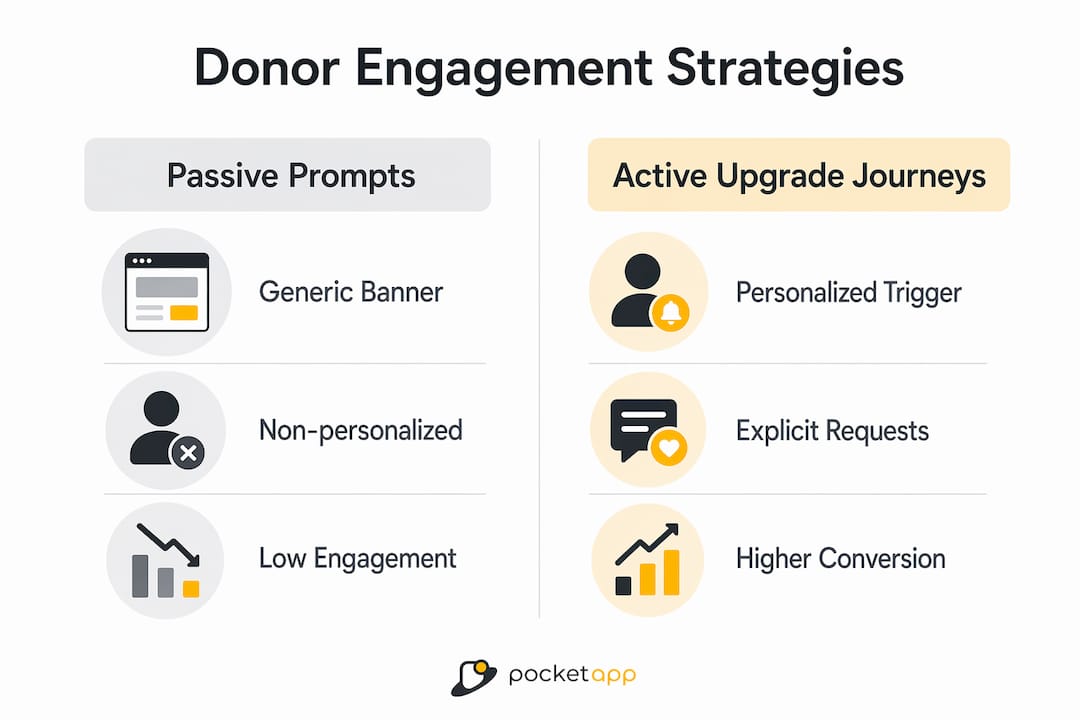
| Approach | Passive prompt | Active upgrade journey |
|---|---|---|
| Trigger | Generic banner or pop-up | Personalised in-app flow with impact framing |
| Conversion rate | Low, easily dismissed | Significantly higher with clear decision steps |
| Donor experience | Interruptive, transactional | Consultative, relationship-building |
| Long-term retention | Minimal uplift | Supports sustained monthly giving |
| Data captured | Click or ignore | Preference data, giving motivation, objections |
Behavioural economics gives nonprofit app designers a practical toolkit for increasing both giving frequency and gift size. The core insight from mobile microgiving research is that donors respond to two distinct forces: the financial incentive attached to a gift (matched donations, for example) and the social visibility of their giving to peers. Apps that surface both levers thoughtfully, rather than defaulting to one, produce better outcomes across donor segments.
AI-powered stewardship tools now allow nonprofits to build tailored plans for mid-level and major gift donors based on individual preferences and giving history. This is not a future capability. Blackbaud and similar platforms already embed these tools into their fundraising suites, and the nonprofits using them report measurable improvements in retention and upgrade rates. The personal connection remains the driver of donor motivation; AI simply makes it possible to deliver that connection at scale.
Timing matters as much as content. Data analytics embedded in well-built apps identify the moments when individual donors are most likely to engage: after a programme update, following a news event connected to the cause, or on the anniversary of their first gift. Sending the right message at the right moment is not guesswork when the app is capturing and acting on behavioural data continuously.
What should nonprofits consider when adopting a donor engagement app?
Selecting or building a mobile app for donor engagement requires decisions across four distinct areas, and getting any one of them wrong undermines the others.
-
Separate the engagement layer from the payment layer. Mobile-native engagement works best when the motivational overlay, coaching messages, milestones, and real-time encouragement, sits separately from the payment processing system. An overlay approach lets you update the engagement experience without touching the transactional infrastructure, which reduces risk and speeds iteration.
-
Prioritise user experience from the first screen. Charity apps that bury the donation button, require account creation before giving, or present cluttered interfaces lose donors before they reach the giving moment. UX best practices for charity apps consistently point to progressive disclosure, clear impact language, and minimal tap counts as the variables that most directly affect conversion.
-
Build a payment retry system that works silently. Silent payment failures cost nonprofits real recurring revenue every month. A donor whose card declines is rarely aware of it, and without an automated retry sequence and a clear communication flow, that recurring gift is simply lost. The app must monitor retry attempts and send appropriately timed, non-alarming messages to resolve the issue.
-
Design for donor data security from the outset. Donors share financial and personal information with your app. GDPR compliance is the legal floor in the UK, not the ceiling. Encryption, clear data retention policies, and transparent opt-in processes for communications build the trust that sustains long-term relationships. Cutting corners on security is the fastest way to lose a donor permanently.
-
Use a structured checklist before launch. A fundraising app checklist covering payment methods, notification permissions, accessibility standards, and stewardship flows will surface gaps before they reach donors. Launching with missing features is far more damaging than delaying to get them right.
Key takeaways
Mobile apps drive donor retention and lifetime value by making recurring giving the default, not the exception, through personalised stewardship and frictionless payment design.
| Point | Details |
|---|---|
| Recurring giving is the priority | Recurring donors retain at 78 to 80% and give for an average of 7.7 years, making them the highest-value segment to cultivate. |
| Active upgrade journeys outperform passive prompts | Explicit in-app flows with impact framing convert one-time donors to monthly givers far more reliably than generic banners. |
| Push notifications require careful design | Notification effectiveness depends on incentive magnitude and social visibility; poorly designed nudges train donors to disengage. |
| Payment retry systems protect recurring revenue | Silent card failures cost nonprofits real money; automated retry sequences and clear donor communications are non-negotiable. |
| Separate engagement from transaction layers | Motivational overlays built independently of payment infrastructure allow faster iteration and lower technical risk. |
Why the technology is only half the answer
I have worked on enough charity app projects to say this with confidence: the nonprofits that get the most from mobile technology are not the ones with the most features. They are the ones that treat the app as an extension of a human relationship, not a replacement for it.
The data on recurring giving is striking, and the tools available in 2026 are genuinely capable. But I have seen organisations deploy sophisticated push notification systems and watch engagement drop, because the messages felt automated and impersonal. Donors know when they are being managed by an algorithm, and they respond accordingly.
What actually works is using the app to deliver moments that feel personal at scale. A message that references a donor's specific programme interest, sent at a moment the data suggests they are receptive, and followed by a genuine human response when they reply. That combination is what mobile apps drive when they are built with the donor relationship as the design brief, not the donation transaction.
The other thing I would caution against is treating recurring giving as a set-and-forget revenue stream. The upgrade journey is the beginning of a deeper relationship, not the end of an acquisition process. Nonprofits that invest in post-upgrade stewardship, using the app to celebrate milestones, share impact, and invite deeper involvement, see retention rates that justify every pound spent on development.
Measure everything, but do not optimise for the metric that is easiest to track. Open rates and click-throughs tell you something. Relationship length and upgrade rates tell you far more.
— Paul
How Pocketapp can help your nonprofit build a better donor app
Pocketapp has delivered over 300 mobile app projects across charity, retail, healthcare, and consumer sectors, including work for WWF and other mission-driven organisations. If your nonprofit is ready to move beyond a basic donation page and build a mobile experience that genuinely cultivates donor relationships, Pocketapp's team brings the UX expertise, technical depth, and sector understanding to make that happen.
From custom app development that separates your engagement layer from your payment infrastructure, to app design services focused on conversion and stewardship, Pocketapp builds to the brief that matters most for nonprofits: long-term donor relationships, not just completed transactions. Speak to the team about what a bespoke donor engagement app could do for your recurring giving programme.
FAQ
What is the role of apps in donor engagement?
Mobile apps serve as the primary channel for personalised donor communication, recurring giving management, and stewardship at scale. They enable nonprofits to deliver timely, relevant interactions that build long-term supporter relationships beyond the point of donation.
How do apps improve donor retention rates?
Apps support recurring giving programmes, which retain donors at 78 to 80% compared to roughly 32% for one-time givers. Features like milestone notifications, automated stewardship messages, and payment retry systems all contribute to keeping donors active and committed.
What app features matter most for fundraising outcomes?
Multiple payment methods, personalised thank-you flows, push notification nudges, and in-app progress tracking are the features most directly linked to improved giving rates. The American Cancer Society's FUNdraising app combines all of these in a single supporter experience.
How should nonprofits handle failed recurring payments in their app?
Silent payment failures are a significant source of lost recurring revenue. Apps should include an automated retry system that attempts the payment multiple times and sends appropriately timed, non-alarming messages to donors to resolve card issues before the gift lapses permanently.
Do nonprofits need to build a custom app or can they use an existing platform?
Both approaches are valid depending on scale and budget. A mobile engagement overlay built on top of an existing fundraising platform can deliver coaching, milestones, and personalised messaging without replacing the transactional system. Custom apps offer greater control over UX and stewardship design for organisations with more complex needs.