
Beacon-enabled apps use Bluetooth Low Energy to trigger location-aware actions the moment a phone enters range of a small transmitter, which makes them well suited to contextual retail offers, indoor navigation and asset tracking. The three benefits that consistently justify the investment are proximity engagement, precise indoor location and real-time visibility of physical assets. Retailers, venue operators, hospitals, logistics teams and event organisers should all be looking at this technology seriously.
TL;DR:
- Deployments should focus on a single use case, zone, and key performance indicator to ensure measurable success and avoid data reliability issues.
- Proper site surveys, calibration, and continuous monitoring are essential for accurate signal detection and reducing jittery, unreliable results.
- Combining Bluetooth beacons with geofencing significantly improves accuracy and overall effectiveness in location-based applications.
- Common pitfalls include neglecting privacy, poor calibration, and lack of measurement plans, which hinder project success and stakeholder trust.
- Initial pilots should be narrow, tested thoroughly, and include clear measurement strategies to validate value before scaling up.
Table of Contents
- How BLE beacons work and which protocols matter
- Top beacon app use cases worth scoping
- Sector examples and real-world pay-offs
- Getting the deployment right: hardware, site survey and RSSI
- Measuring success: KPIs and quick pilot tests
- Limitations, privacy and the pitfalls that catch teams out
- Pocket App's perspective on scoping beacon projects
- Security implications beyond privacy
- Where beacon technology is heading
- Editorial take: the pragmatic case for starting small
- How Pocket App can help deliver your beacon-enabled app
- Sources
- FAQ
How BLE beacons work and which protocols matter
A BLE beacon is a small, battery-powered transmitter that continuously broadcasts advertising packets. Nearby phones scan for these packets passively, with no pairing required, and read a small payload identifying the beacon's location or purpose. That's the mechanical core of every beacon app use case you'll encounter: a broadcast, a scan, and an app deciding what to do with the result.
Distance gets estimated using Received Signal Strength Indicator (RSSI), a noisy measurement that weakens as the phone moves away from the transmitter. RSSI alone is unreliable. It bounces around due to reflections off walls, interference from other radios and even body shielding, which is why any serious deployment filters the raw signal before treating it as a position.
Three protocols dominate the beacon app use cases stakeholders actually deploy:
- iBeacon — Apple's format, strong on background wake-up in iOS apps, using a UUID/Major/Minor structure to identify a location or exhibit.
- Eddystone — Google's open format, which added URL and telemetry frames on top of a UID frame, enabling "Physical Web" style interactions and fleet health reporting.
- AltBeacon — an open-source alternative built to avoid vendor lock-in, useful where cross-platform parity matters more than ecosystem convenience.
The choice between iBeacon vs Eddystone isn't purely technical. Eddystone's URL frame lets a browser open a page without a dedicated app installed, which reduces friction for one-off interactions such as museum plaques or transport info points. But that convenience comes with inconsistent cross-platform behaviour, particularly on iOS, so most retail and enterprise deployments still build a dedicated app and use iBeacon or a hybrid approach for reliable background detection.
Top beacon app use cases worth scoping
Most beacon technology applications fall into a handful of categories, each with a distinct payoff that justifies the hardware and integration cost.
- Retail proximity marketing. Beacons trigger personalised offers, loyalty prompts or aisle-specific navigation when a shopper lingers near a display, turning passive browsing into a measurable engagement moment.
- In store navigation app deployments. Malls, airports and hospitals use beacon grids to power turn-by-turn indoor wayfinding where GPS simply doesn't reach.
- Buy-online-pickup-in-store alerts. A beacon near the collection point notifies staff the moment a customer arrives, cutting the awkward wait at the counter.
- Asset tracking in hospitals and warehouses. Tagging trolleys, infusion pumps and pallets with beacons gives staff a live map of equipment, replacing the old routine of walking floor to floor.
- Events and stadia. Contactless check-in, personalised match-day itineraries and sponsor activations near specific zones all lean on the same underlying proximity logic.
- Cultural venues and exhibitions. A beacon near an exhibit triggers audio or text commentary automatically, while dwell-time data feeds back into curatorial decisions.
- Logistics and cold chain monitoring. Beacons with environmental sensors report temperature and detect gate or vehicle proximity, flagging problems before a shipment is ruined.
Combining beacons with wider geofencing accuracy tends to outperform using either technique alone: geofencing pulls a nearby shopper toward the store, and beacons take over once they're inside for finer in-store micro-location. That pairing, rather than beacons in isolation, is where most of the strongest beacon app use cases actually live.
Sector examples and real-world pay-offs
Abstract use cases only convince stakeholders once they're attached to numbers, even directional ones. Here's how the categories above tend to play out on the ground.
- A high-street retailer piloting aisle-level beacon promotions typically reports a conversion lift among shoppers who received a contextual offer versus those who didn't, alongside faster BOPIS collection because staff get an arrival alert instead of watching the door.
- A hospital tagging portable equipment with beacons cuts the time nurses spend physically searching for infusion pumps or wheelchairs, freeing clinical time for patient care rather than corridor walks.
- A logistics operator running cold-chain beacons on refrigerated pallets catches temperature excursions in transit rather than at the depot, reducing spoiled stock and giving drivers an earlier alert window.
- A stadium deploying beacon-based contactless check-in shortens entry queues and lets sponsors trigger a personalised message only to fans standing near their activation zone, rather than blasting everyone in the ground.
- A museum wiring exhibits with beacons for automatic audio guides sees longer dwell time at tagged pieces, and gains genuinely granular visitor analytics that a paper floor plan never could.
None of these outcomes require exotic engineering. They come from disciplined deployment and a clear measurement plan, which is exactly where most beacon projects actually go wrong.
Getting the deployment right: hardware, site survey and RSSI
The gap between a beacon pilot that works and one that produces confusing, jittery results almost always comes down to planning that happens before a single device goes live. A proper site survey and TX power calibration prevents the signal overlap that makes two adjacent zones fire at once.
- Walk the site first and map physical obstructions, metal shelving and Wi-Fi congestion before fixing a single beacon.
- Space beacons roughly 4 to 8 metres apart for trilateration, using at least three RSSI readings per fix.
- Apply RSSI smoothing, such as a rolling average or Kalman filter, before converting signal strength into a distance estimate.
- Balance the advertising interval against battery life: shorter intervals cut detection latency but drain batteries faster.
- Build telemetry into the fleet from day one so battery, temperature and uptime get monitored remotely rather than discovered by a dead beacon in aisle nine.
- Confirm background scan permissions and limitations on both iOS and Android early, since cross-platform behaviour differs enough to break a naive single-codebase assumption.
Pro Tip: Treat calibration as a cycle, not a one-off task. Professional deployments survey, pilot, tune and monitor continuously; treating a beacon grid as "set and forget" is the single most common cause of degraded accuracy over the following months.
Measuring success: KPIs and quick pilot tests
A beacon pilot without a measurement plan is just an expensive light show. Fix the KPIs before hardware ships.
- Track engagement lift near beacons against a control area with no triggers active.
- Measure conversion, dwell time and pickup fulfilment time as your primary business metrics.
- Combine app analytics, POS data, beacon telemetry and staff logs rather than relying on any single source.
- Run an A/B test on trigger windows and hold out a comparable zone with beacons switched off.
- Spot-check accuracy manually by walking known distances and comparing them against the app's estimate.
Limitations, privacy and the pitfalls that catch teams out
Beacon projects run into the same handful of problems repeatedly. GDPR compliance demands clear notification and genuine data minimisation, not a buried consent checkbox nobody reads. Technically, RSSI noise, interference between nearby stores and multi-floor ambiguity remain persistent headaches even after calibration.
The reality check: even well-calibrated deployments treat signal readings as estimates, not exact positions, which is why any serious beacon app use case builds in fallback logic rather than trusting a single RSSI value.
- Battery replacement and device health checks are an ongoing operational cost, not a one-off setup fee.
- Notification fatigue kills engagement fast if every aisle fires an offer at every visit.
- Poorly timed prompts, such as a promotion firing seconds after a shopper walks in, read as intrusive rather than helpful.
- Privacy perception matters as much as actual compliance: a vague "we use your location" line erodes trust quicker than the data collection itself.
Pocket App's perspective on scoping beacon projects
Pocket App has built location and engagement features across retail, healthcare and brand engagement projects for clients including WWF and Dechra. Our discovery and prototyping approach for location features starts with the use case, not the hardware. A tight pilot checklist covers objectives, success criteria, integration points and measurement before a single beacon is ordered.
Security implications beyond privacy
Privacy governs what a beacon app collects about a person. Security governs whether the system itself can be trusted, and that's a separate risk category stakeholders sometimes overlook.
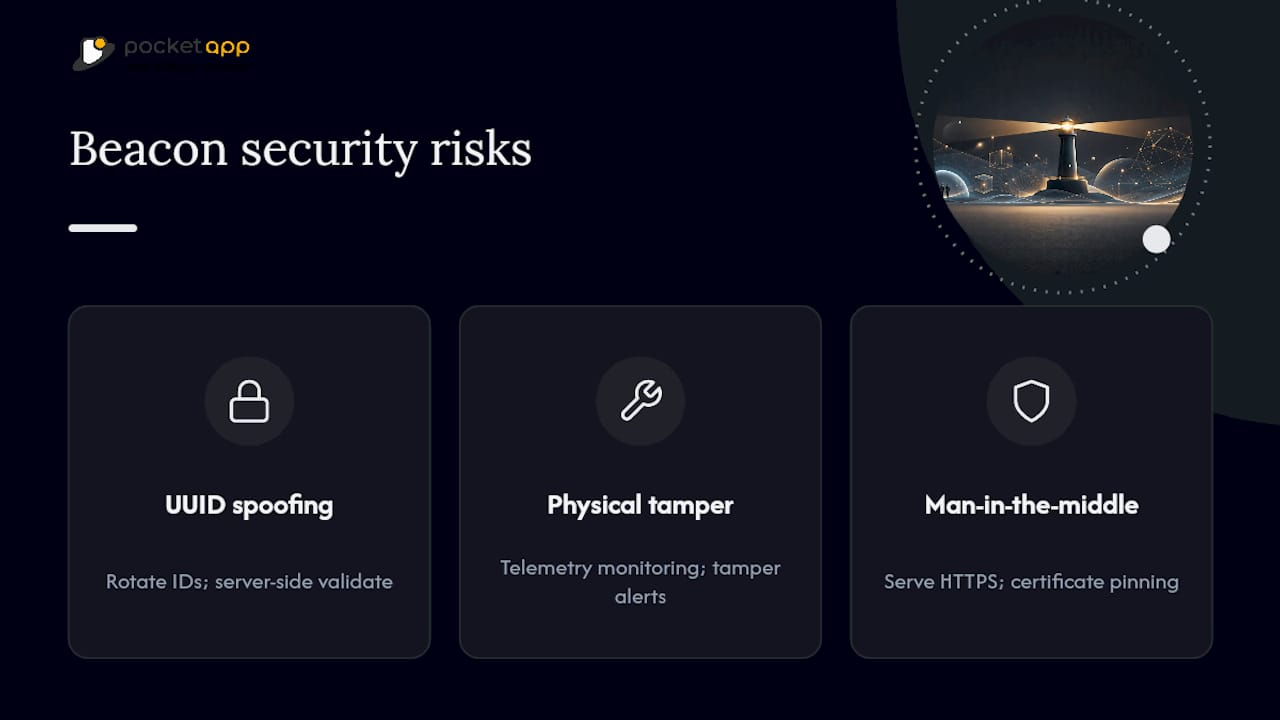
Beacon UUIDs, once known, can be spoofed by a third party broadcasting the same identifier to trigger unauthorised actions or intercept an app's expected behaviour. This matters most where beacons authorise something, such as unlocking a door or confirming a delivery, rather than simply displaying a message. Mitigation starts with rotating identifiers where the SDK supports it and validating beacon signals server-side rather than trusting the client app's read in isolation.
Physical tampering is a quieter risk. A beacon mounted in a public space can be removed, relocated or opened, and a fleet without telemetry monitoring won't notice until someone complains that the feature has stopped working. Encrypted telemetry channels and tamper-alert firmware close that gap for higher-value deployments, such as hospital asset tags where a missing beacon could mean a missing piece of equipment.
Man-in-the-middle risk exists wherever a beacon triggers an app to fetch content from a URL, as Eddystone-URL frames do. Serving that content over HTTPS with certificate pinning, and never trusting an unauthenticated payload to trigger a sensitive action, closes the most common exploitation path. None of this is exotic. It's the same discipline any connected device fleet needs, applied to a technology that's easy to treat as harmless because the hardware itself looks trivial.
Where beacon technology is heading
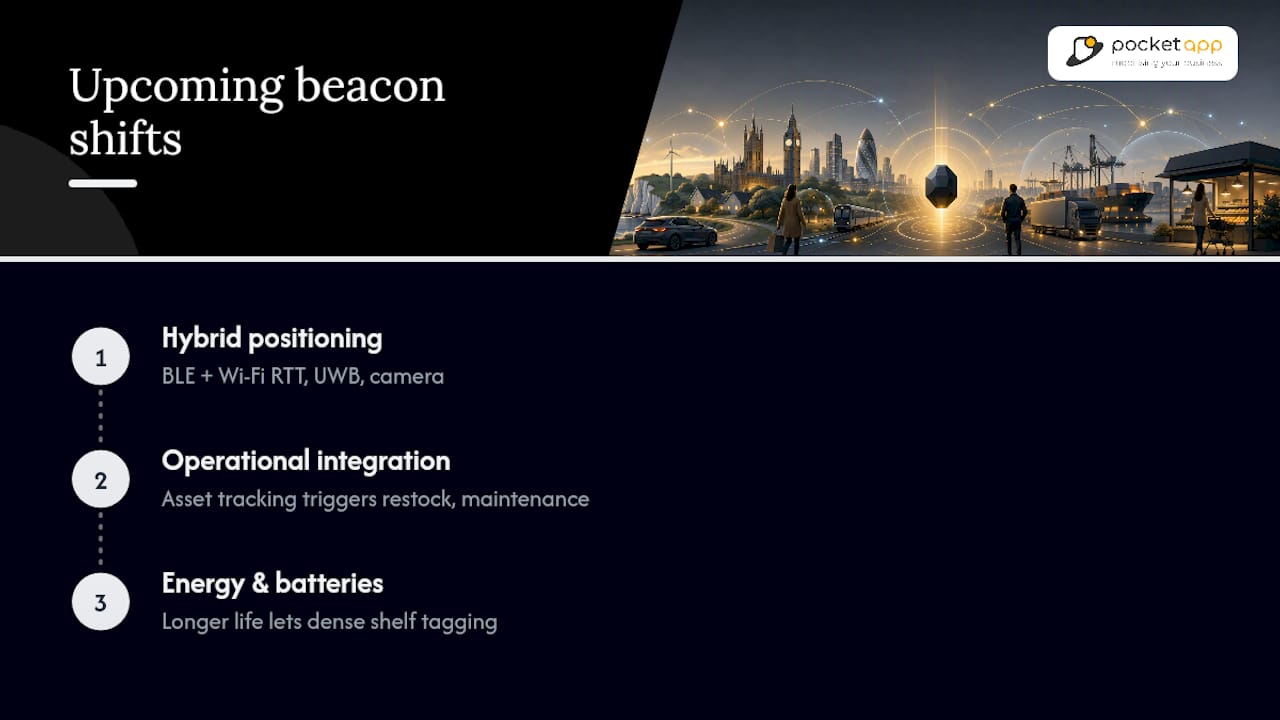
Beacon hardware itself has plateaued somewhat. What's moving is how beacons integrate with everything else a venue or retailer already runs. Expect three shifts to matter over the next few years.
First, hybrid positioning is becoming the default rather than the exception. Pure beacon triangulation has known limits indoors, so more deployments blend BLE with Wi-Fi RTT, ultra-wideband and even camera-based sensing to sharpen accuracy in the toughest spots, such as multi-floor atriums.
Second, beacons are increasingly feeding operational systems rather than just marketing ones. Asset-tracking data that once sat in a dashboard nobody checked is now triggering automated restocking, maintenance scheduling and staff allocation, closing the loop between detection and action.
Third, battery and energy harvesting improvements are extending beacon lifespans well past the multi-year mark that used to require awkward mid-cycle replacement cycles, which lowers the total cost of larger fleets considerably. Combined with cheaper silicon, that makes dense deployments, tagging every shelf rather than every aisle, economically realistic in a way they weren't a few years ago.
None of this changes the fundamentals covered above. It does mean the bar for what counts as a compelling beacon app use case keeps rising, and pilots scoped narrowly today should leave room to expand into these hybrid, operational models later.
Editorial take: the pragmatic case for starting small
The conventional advice on beacon deployment tends to obsess over hardware selection, iBeacon vs Eddystone vs AltBeacon, when the actual failure point is almost always measurement discipline. Teams that skip a proper baseline, or launch across an entire estate before validating a single zone, end up with data nobody trusts and a project that quietly dies at renewal time.
What the evidence in this piece actually supports is a narrow first bet: one use case, one zone, one KPI you can defend in a board meeting. Retail proximity offers and asset tracking in a single ward or warehouse aisle are the two categories with the clearest, fastest-to-prove pay-off. Indoor navigation and stadium activations are compelling but demand more infrastructure before they pay for themselves.
The overrated part of most beacon pitches is the hardware itself. The underrated part is the discipline of running an actual pilot with a control area, because that's the only way anyone finds out whether the signal was ever worth chasing.
— Paul
How Pocket App can help deliver your beacon-enabled app
A practical alternative to a lengthy in-house build is available for teams who need a beacon pilot scoped and proven before committing to a full rollout. Where a DIY approach means guessing at RSSI thresholds and learning platform quirks the hard way, a structured process turning guesswork into a path from concept to working app can draw on work across retail, healthcare and brand engagement for organisations including WWF and Dechra.
If you're not ready to commit to a full build, a Mobile App Clinic is the lower-risk starting point: a focused session to stress-test your beacon use case, flag technical risks early and scope what a pilot would actually need. From there, our end-to-end process takes the idea through interactive prototyping and agile builds to a deployed, supported app. Book a clinic or get in touch to discuss your project.
Sources
For deeper technical grounding, see Shopify's guide to proximity marketing, the BLEFYI beacon primer and ArcGIS's deployment strategy documentation. Pocket App's blog covers consumer engagement in more depth.
- Beacon technology in retail: A 2026 guide to proximity marketing - Shopify
- BLE Beacons Explained: iBeacon, Eddystone, and AltBeacon — BLEFYI
- Beacon deployment strategies — ArcGIS documentation
- Meet Google’s Eddystone, a flexible open-source iBeacon fighter — Ars Technica
FAQ
What is a beacon app used for?
A beacon app detects nearby Bluetooth Low Energy transmitters and triggers location-aware actions, such as sending a shopper a personalised offer, guiding a visitor through a building, or alerting staff that a piece of equipment has moved. The specific beacon app use cases vary by sector, but the underlying mechanism, proximity detection triggering a contextual response, stays the same.
What can a beacon be used for beyond marketing?
Beyond retail promotions, beacons support indoor navigation, asset tracking in hospitals and warehouses, contactless event check-in, exhibit-triggered content in museums, and environmental monitoring in cold-chain logistics. Any scenario where knowing a device's precise indoor position matters is a candidate.
What are the disadvantages of beacons?
RSSI-based distance estimates are inherently noisy and require filtering, and multi-floor or multi-store environments can cause signal ambiguity even after calibration. Ongoing costs include battery replacement, ongoing telemetry monitoring, and the risk of notification fatigue if offers fire too often or at the wrong moment.
What are some practical applications of Bluetooth beacons in stores?
Bluetooth beacons in stores commonly power aisle-level product promotions, buy-online-pickup-in-store arrival alerts, and loyalty-linked offers triggered as a shopper approaches a specific display. Pairing beacons with wider geofencing, rather than relying on beacons alone, tends to produce a stronger conversion lift once a shopper is inside the store.
How much does it cost to build a beacon-enabled app?
Cost depends heavily on scope, hardware fleet size and integration complexity, so Pocket App doesn't publish a fixed price for this kind of project. A Mobile App Clinic is the fastest way to get a realistic scope and estimate for your specific use case.