
An application PoC (proof of concept) is a focused technical experiment that answers one question: can this idea work, given our constraints? Before you write a single line of production code, scope a single success criterion, then run a one-week development spike to test it.
Your next 48–72 hours, concretely:
- Write one hypothesis in the form "We believe [technical approach] will achieve [measurable outcome] for [user or system]."
- Identify the single riskiest assumption in that hypothesis and define a pass/fail threshold for it.
- Assign one engineer and one stakeholder to own the PoC, agree a timebox, and schedule a readout.
Key takeaways
A well-scoped application PoC, with a single measurable hypothesis and a fixed timebox, is the most reliable way to validate a technical idea before committing to a full build.
| Point | Details |
|---|---|
| Define one hypothesis | Write a single testable hypothesis with a numeric pass/fail threshold before any code is written. |
| Tactical vs strategic PoC | Tactical PoCs suit quick-win tests (replatforming); strategic PoCs suit transformational changes and need stricter governance. |
| Typical duration | Most app development PoCs run for two to six weeks; a hard end date must be set before the work begins. |
| Acceptance criteria first | Define success metrics and get stakeholder sign-off before building; this converts the readout into a decision, not a debate. |
| Pocketapp as PoC partner | Pocketapp delivers structured PoC scoping workshops and builds across mobile, AI, and enterprise integration for UK clients. |
Table of Contents
- Why run an application PoC before committing to a build?
- What is the difference between a PoC, a prototype, and an MVP?
- When should you run a PoC, and how do you pick the right scope?
- How to build an application PoC: a step-by-step process
- How do you measure PoC success and set acceptance criteria?
- What are the most common PoC pitfalls and how do you avoid them?
- Real-world PoC examples: AI features, enterprise integration, and replatforming
- What should you do after the PoC: pilot, MVP, or stop?
- How Pocketapp runs PoCs: a UK example
- An honest view on what makes PoCs succeed or fail
- Pocketapp can help you scope and deliver a PoC
- Further reading and primary sources
- Sources
- FAQ
Why run an application PoC before committing to a build?
The business case is straightforward. A PoC surfaces whether a technical approach is viable before a team spends weeks or months on architecture, design, and delivery. According to Atlassian, a proof of concept is a small-scale demonstration that a specific idea, method, or product is technically feasible and viable, and it sits early in the project workflow precisely to prevent expensive misdirection.
For UK product teams, this matters at the procurement stage. Many organisations require a technical feasibility report before a steering committee will approve a development budget. A well-documented PoC provides exactly that evidence, in a form that non-technical stakeholders can evaluate and sign off.
The core benefits break down into two categories.
Business benefits:
- Faster validation of an idea before significant budget is committed
- Reduced wasted development spend on approaches that will not scale
- Concrete evidence to support investor or procurement board approval
- Clearer scope for vendor selection or internal team planning
Technical benefits:
- De-risks critical architectural assumptions before they are baked into production code
- Validates third-party API or integration behaviour under realistic conditions
- Surfaces non-functional constraints (latency, throughput, data volume) early
- Produces a working artefact that the team can demo, not just describe
GeeksforGeeks notes that a PoC is a verification methodology used early in the software lifecycle to validate feasibility, reduce wasted investment, and test risky assumptions. The same source cautions that PoCs can become resource-intensive if they are over-scoped, which is why a tight hypothesis and a fixed timebox are non-negotiable.
What is the difference between a PoC, a prototype, and an MVP?
Teams frequently conflate these three artefacts, and the confusion leads to over-building. Each one answers a different question.
Microsoft's app modernisation guidance distinguishes between tactical PoCs and strategic PoCs. A tactical PoC is a lower-effort, quick-win test, typically used for replatforming or containerising an existing service. A strategic PoC is a higher-effort undertaking that validates a transformational change, such as a large-scale refactor or a new AI-driven capability, and requires stricter planning and stakeholder governance.
| Artefact | Primary question | Fidelity | Audience | Typical timeframe |
|---|---|---|---|---|
| PoC | Can this technically work? | Low — functional, not polished | Engineering and technical stakeholders | 1–4 weeks |
| Prototype | What should this feel like? | Medium — visual and interactive | Product, design, and business stakeholders | 1–3 weeks |
| MVP | Will real users pay for or use this? | High — production-grade core | End users and commercial stakeholders | 6 weeks |
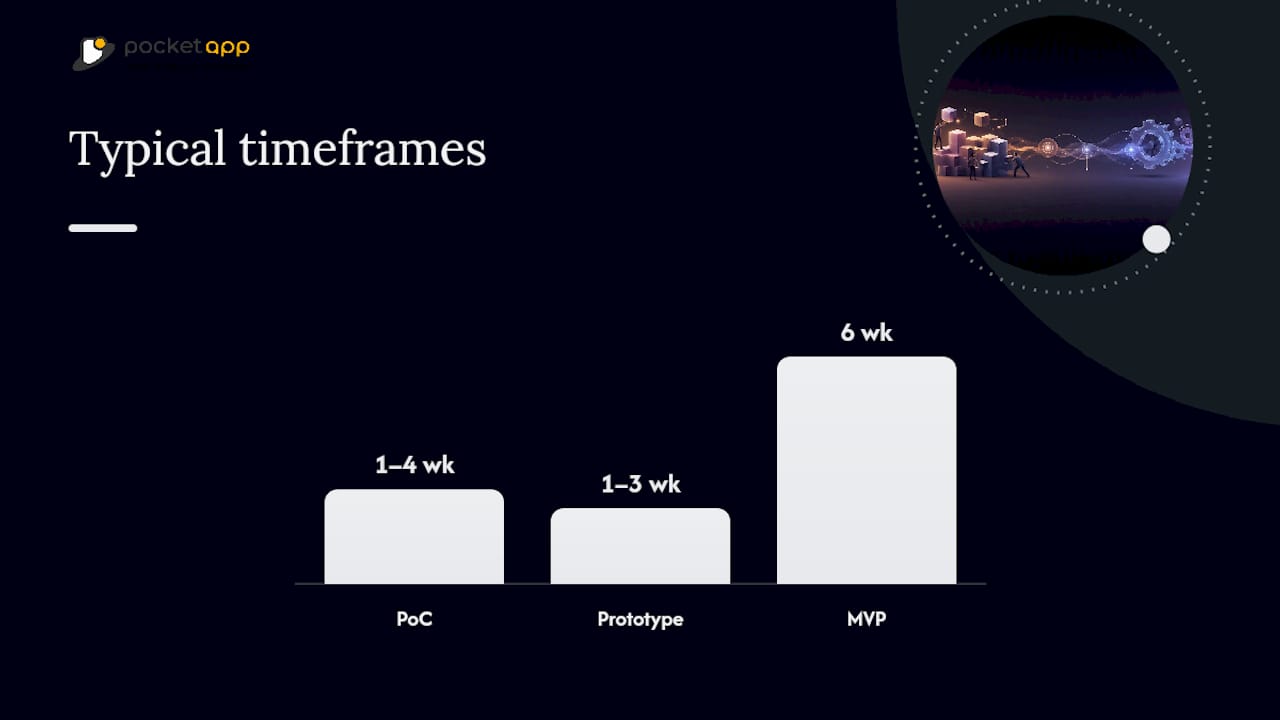
The practical rule: build a PoC when the risk is technical and unknown. Build a prototype when the risk is experiential or design-led. Build an MVP when you have validated both and need market evidence.
A tactical PoC for replatforming a legacy service to a cloud-native container might take three to five days. A strategic PoC validating a real-time machine-learning inference pipeline in a regulated environment could run for four weeks with multiple stakeholder checkpoints. The distinction matters because it governs how much governance overhead is appropriate.
When should you run a PoC, and how do you pick the right scope?
Not every idea needs a PoC. Tech387's practical guide makes this point clearly: overuse of PoCs wastes time on problems that are already well understood. Run one when at least two of the following conditions apply:
- High technical uncertainty: the team has not built this type of feature or integration before.
- Unique or novel IP: the approach involves a proprietary algorithm, model, or data pipeline.
- Third-party integration risk: a critical external API or service has unknown reliability, rate limits, or data format.
- Regulatory or compliance uncertainty: the feature touches personal data, financial transactions, or a regulated sector.
- Funding or procurement gate: a board, investor, or procurement committee requires feasibility evidence before approving spend.
Once you have decided a PoC is warranted, scope it ruthlessly. Pick the single riskiest assumption, not the most interesting one. Define the smallest testable surface that will answer that assumption. Set one clear success metric with a numeric threshold.
Typical timelines and cost drivers
Most app development PoCs run for a few weeks. WWG's PoC development guidance cites a typical duration of several weeks for web application PoCs. The main cost drivers are:
- Labour: the number of engineers and the seniority mix required to test the assumption
- Environment provisioning: cloud compute, licences, and test infrastructure
- Third-party API costs: sandbox access, rate limits, or data licensing fees
- Stakeholder time: design reviews, readouts, and acceptance sign-off sessions
Pro Tip: Set a hard calendar date for the PoC readout before you start building. A PoC without a fixed end date drifts into a mini-project. Two weeks is a sensible default for most mobile application PoC work.
How to build an application PoC: a step-by-step process
This five-step sequence gives product and engineering teams a repeatable structure. Each step produces a concrete output that feeds the next.
-
Define scope, hypothesis, and acceptance criteria. Write the hypothesis in one sentence. Define two to four success metrics with numeric thresholds. Assign stakeholder roles: a PoC owner (product), a technical lead (engineering), and an acceptance approver (business or procurement). Agree a comms cadence, typically a daily async update and a mid-point demo.
-
Design minimal architecture and select tools. Choose the lightest stack that can test the assumption. For a mobile application PoC, this often means a single-platform build (iOS or Android, not both), a cloud-hosted backend with mock services where real integrations are not yet available, and containerised environments for reproducibility. For cross-platform PoC work, frameworks such as Flutter or React Native let a small team cover both platforms without doubling the build effort.
-
Build a minimal runnable artefact with verification tests. The artefact must be runnable by someone other than the author. Include automated verification steps: a test script, a set of log outputs, or a metrics dashboard. PocGenerator, a .NET tool that uses the GitHub Copilot SDK, can scaffold a runnable C# PoC solution in roughly 30–90 minutes, illustrating how automation can compress calendar time for teams working in that stack. Capture evidence continuously: logs, latency traces, error rates, and a demo script that can be replayed.
-
Run experiments and gather data against acceptance criteria. Execute the verification tests under realistic conditions. For an integration PoC, this means testing against the actual third-party endpoint, not a stub. Record every result against the acceptance threshold defined in step one. If a threshold is not met, document why and whether a mitigation exists.
-
Document results and recommend a next step. Produce an acceptance report that states: hypothesis tested, metrics achieved, evidence collected, and a clear recommendation (proceed to pilot, revise scope, or stop). AnyPoC's open-source pipeline demonstrates the value of reproducible evidence: its three-stage approach (analysis, generation, evidence checking) ensures that PoC results can be re-run and verified independently, which is exactly the standard a good acceptance report should meet.
Success criteria table
| Success metric | Acceptance threshold | Method of measurement |
|---|---|---|
| API response latency | Under 300 milliseconds latency | Automated load test with concurrent requests |
| Integration error rate | Below 2% over 500 calls | API call log analysis |
| Data processing throughput | At least 1,000 records per minute | Timed batch run with synthetic dataset |
| UI render time (mobile) | Under 2 seconds on mid-range device | Automated UI test on Android/iOS simulator |
Recommended PoC deliverables
- A runnable demo (screen recording or live session)
- A README covering setup, dependencies, and how to re-run the verification tests
- An acceptance report with metrics, evidence, and a clear recommendation
- A rough cost estimate for the next phase (pilot or MVP)
Pro Tip: Write the acceptance report template before you start building. Teams that define "done" upfront spend less time arguing about results at the readout.
How do you measure PoC success and set acceptance criteria?
Acceptance criteria convert technical results into a business decision. Without them, a PoC readout becomes a subjective debate rather than an evidence-based sign-off.
For practical KPI and measurement guidance that translates directly to PoC evaluation, resources such as how to measure success with KPIs and tools offer useful frameworks that can be adapted to technical experiments.
The metrics that matter most depend on what the PoC is testing, but the following set covers the majority of app development PoC scenarios:
| Metric | Why it matters | How to measure | Realistic PoC threshold |
|---|---|---|---|
| API/service latency | Determines whether the integration is fast enough for the target UX | Automated load test | Under 500ms for most mobile use cases |
| Error rate | Indicates integration or logic reliability | Log analysis over a defined call volume | Below 5% for a PoC; below 1% for production |
| Throughput | Confirms the system can handle expected data volume | Timed batch or concurrent request test | Defined per use case |
| Cost per transaction | Validates commercial viability of the approach | Cloud billing data divided by transaction count | Within agreed budget envelope |
| Integration success rate | Confirms third-party API behaves as documented | Pass/fail count across test scenarios | High success rate for critical paths |
Acceptance sign-off template
A PoC acceptance sign-off should record:
- Stakeholders present: PoC owner, technical lead, acceptance approver, and any procurement or compliance representatives
- Evidence reviewed: demo recording, acceptance report, metrics log
- Decision options: proceed to pilot, revise and re-test, or stop
- Conditions attached: any caveats or open risks that must be resolved before the next phase
For most UK organisations, a one-page acceptance report with this structure is sufficient for a procurement board or steering committee. Where the PoC involves regulated data or significant third-party spend, a more formal sign-off with named approvers and a dated record is advisable.
What are the most common PoC pitfalls and how do you avoid them?
Most PoC failures share the same root causes. Recognising them early saves significant time and credibility.
-
Over-scoping. The most frequent mistake. Teams add features "while they're in there" and the PoC becomes a mini-product. Mitigation: write the scope on one page and require a formal change request to add anything.
-
Unclear success criteria. Without a numeric threshold, every readout becomes a negotiation. Mitigation: define pass/fail criteria before the first line of code is written, and get stakeholder sign-off on them.
-
Building production-ready features. Error handling, logging, security hardening, and scalability are not PoC concerns. Mitigation: explicitly mark PoC code as throwaway in the README and resist pressure to "just tidy it up" for production.
-
Ignoring non-functional requirements. Latency, throughput, and data volume are often the very assumptions the PoC should test, yet teams focus only on functional behaviour. Mitigation: include at least one non-functional metric in the acceptance criteria from the start.
-
Poor stakeholder engagement. A PoC that runs in isolation and presents results cold at the end rarely gets approved. Mitigation: schedule a mid-point demo so stakeholders see progress and can redirect if needed.
Pro Tip: If your PoC scope document is longer than one page, you have already over-scoped it. Cut until it fits.
GeeksforGeeks specifically warns that PoCs can become resource-intensive when over-scoped, and this is the single most consistent pattern in failed PoC programmes. A PoC that takes three months and involves five engineers is no longer a proof of concept; it is an unplanned project.
Pro Tip: Treat PoC code as evidence, not as a foundation. The moment a team starts refactoring PoC code for production, the experiment has ended and a project has begun, without the governance that a project requires.
Real-world PoC examples: AI features, enterprise integration, and replatforming
AI feature PoC
Typical build: A Python script calling a hosted LLM API (such as OpenAI or Azure OpenAI), a labelled test dataset of 200 anonymised tickets, and an automated scoring script.

Outcome options: Pass — proceed to integrate the classifier into the app backend. Partial pass — accuracy met but cost too high; evaluate a smaller model or fine-tuning. Fail — revisit the feature design or consider a rules-based approach.
Enterprise integration PoC
Hypothesis: The target ERP system's REST API can return a complete order record in under 400ms under a load of 20 concurrent mobile users.

Typical build: A lightweight Node.js or .NET service calling the ERP sandbox endpoint, an automated load test using k6 or Artillery, and a field-mapping verification script.
Outcome options: Pass — proceed to build the integration layer. Partial pass — latency acceptable but missing fields require a data transformation layer; scope that for the pilot. Fail — ERP API is unsuitable; evaluate middleware or a batch-sync approach.
For security-focused integration PoCs, PoCWatch's centralised triage approach illustrates how asset-aware prioritisation and EPSS enrichment can focus proof-of-concept effort on the integrations that carry the highest actual risk, rather than testing every endpoint uniformly.
Replatforming PoC
Hypothesis: The core transaction processing module can be containerised and deployed to Azure Kubernetes Service without degrading throughput below 500 transactions per minute.
Success criteria: Throughput at or above 500 transactions per minute; zero data loss across 10,000 test transactions; deployment time under 15 minutes from a clean environment.
Typical build: A Dockerised version of the module, a Kubernetes manifest, a synthetic transaction generator, and a comparison benchmark against the current on-premise environment.
Outcome options: Pass — proceed to a phased cloud migration pilot. Partial pass — throughput met but deployment complexity is higher than expected; plan a DevOps sprint before the pilot. Fail — architectural constraints prevent containerisation; evaluate a lift-and-shift approach instead.
On GDPR and PoC data practices: When a PoC handles personal data, UK GDPR applies from the first test run. Use anonymised or synthetic datasets wherever possible. Where real personal data is unavoidable, document the lawful basis, apply data minimisation, and restrict access to the PoC environment. A brief data protection impact note should accompany the acceptance report for any PoC touching personal data.
What should you do after the PoC: pilot, MVP, or stop?
The PoC readout produces one of three outcomes, and each has a clear next path.
If the PoC passes:
- Present the acceptance report to the steering committee or procurement board.
- Define the pilot scope: a limited production deployment to a small user group or a single business unit.
- Select or confirm your development partner and agree a pilot budget and timeline.
- In a UK procurement context, a successful PoC often triggers a formal vendor selection or internal team ramp process; use the PoC acceptance report as the primary technical evidence in that process.
- Plan the transition from PoC code to production architecture — do not carry PoC code forward without a deliberate re-build decision.
If the PoC partially passes:
- Identify which criteria failed and whether a mitigation exists within a reasonable scope extension.
- Run a focused second spike (one week maximum) to test the mitigation.
- If the mitigation resolves the gap, treat the combined result as a pass and proceed to pilot.
- If not, treat it as a fail and revisit the feature design.
If the PoC fails:
- Document the failure clearly: what was tested, what the result was, and why the approach does not work.
- Consider whether an alternative technical approach warrants a second PoC with a revised hypothesis.
- If no viable alternative exists, retire the idea with evidence. A documented failure is a valuable output; it prevents the same investment being proposed again.
For teams moving from a successful PoC to a full build, measuring ROI in app development provides a practical framework for tracking the commercial return on the investment that follows.
Post-PoC steering meeting checklist
- Acceptance report reviewed and signed off by named approvers
- Decision recorded (proceed/revise/stop) with rationale
- Next phase scope and budget agreed or escalated
- PoC environment decommissioned or access restricted
- Lessons learned captured for the project log
How Pocketapp runs PoCs: a UK example
Pocketapp has delivered over 300 mobile app projects across retail, healthcare, charity, and enterprise sectors in the UK. The PoC process Pocketapp uses follows the same five-step structure described above, adapted to the specific risk profile of each project.
A representative example: a UK charity client needed to validate whether a mobile data-collection app could integrate with their existing CRM via a REST API and return field worker records in under two seconds on a 4G connection. The PoC scope covered a single integration endpoint, a minimal iOS screen to trigger the call, and an automated latency test across 500 requests. The PoC ran for ten working days. The result confirmed the integration was viable and identified one data-mapping issue that was resolved before the pilot build began, saving an estimated two weeks of rework in the main development phase.
Typical Pocketapp PoC deliverables include:
- A runnable demo (screen recording and live walkthrough)
- An acceptance report with metrics, evidence, and a clear recommendation
- A rough cost and timeline estimate for the pilot or MVP phase
- A technical risk register covering open assumptions and mitigations
Pocketapp's sector breadth means the team brings relevant prior experience to most PoC scenarios: AI feature validation, enterprise CRM and ERP integration, cross-platform mobile builds, and cloud replatforming. For teams considering AI in mobile app development, Pocketapp has explored these patterns directly and can bring that experience to a PoC scoping conversation.
For practical application development tips that complement the PoC process, Pocketapp's own guidance covers governance and delivery patterns that apply from the PoC stage through to launch.
An honest view on what makes PoCs succeed or fail
Most PoC guidance focuses on process. The harder truth is that PoCs fail for organisational reasons more often than technical ones.
Three rules of thumb worth keeping:
- Timebox ruthlessly. Two weeks is almost always enough to test one assumption. If the team needs longer, the scope is too broad.
- One measurable KPI. A PoC with three success metrics tends to produce three partial results and no clear decision. Pick the one that matters most.
- Keep stakeholders demo-ready. A mid-point demo is not a status update; it is a course-correction opportunity. Stakeholders who see the PoC in motion at week one can redirect before week two is wasted.
The most common cause of PoC failure is not a technical problem. It is a PoC that was never given a clear definition of done. When the team cannot answer "how will we know this worked?" before they start, the readout will not produce a decision.
Pocketapp can help you scope and deliver a PoC
Pocketapp is the practical alternative to running a PoC in-house without the right experience. Where internal teams often struggle with scope creep and unclear acceptance criteria, Pocketapp brings a structured discovery and prototyping process that has been refined across more than 300 UK mobile app projects.
A PoC scoping workshop with Pocketapp typically takes half a day and produces a written hypothesis, defined success criteria, a recommended technology approach, and a fixed-price estimate for the PoC build. That output is designed to be taken directly to a steering committee or procurement board.
Pocketapp's services cover the full PoC lifecycle: discovery workshops, UX/UI prototyping, engineering, automated testing, and deployment to cloud or on-device environments. Whether you are validating an AI feature, an enterprise integration, or a mobile app development concept from scratch, the team can scope and deliver a PoC that produces evidence worth acting on. To get started, contact Pocketapp to arrange a PoC scoping conversation.
Further reading and primary sources
The sources below are worth consulting directly when planning or running a PoC:
- Microsoft App Modernisation Guidance — Build a PoC: the clearest published framework for distinguishing tactical and strategic PoCs, with a pilot-style eight-step plan. Use it as a governance template for strategic PoCs.
- Atlassian Workstream — Proof of Concept How-to Guide: practical templates for PoC deliverables and evaluation patterns. Useful for teams that want a ready-made checklist.
- GeeksforGeeks — What is PoC in software development?: a concise definition and overview of PoC stages, benefits, and cautionary notes on over-scoping.
- PocGenerator (GitHub): a .NET tool for scaffolding runnable PoC applications via the GitHub Copilot SDK. Useful for teams wanting to automate PoC generation and compress calendar time.
- AnyPoC (GitHub): an open-source pipeline for generating and verifying reproducible PoCs. Demonstrates the value of automated evidence checking.
- PoCWatch (GitHub): a self-hosted dashboard for centralising PoC discovery and triage. Particularly relevant for security-focused PoC programmes.
Sources
- Build a proof of concept - App Modernization Guidance
- Proof of Concept (POC): How-to Guide | The Workstream
- What is proof of concept (PoC) in software development? — GeeksforGeeks
- danielwarddev/PocGenerator
- JunjieChen0/anypoc
- jwedtan/PoCWatch
FAQ
What is a PoC application?
A PoC application is a minimal, runnable piece of software built to test whether a specific technical idea or approach is feasible. It is not production-ready code; its purpose is to produce evidence that answers one defined question.
What does PoC stand for in software development?
PoC stands for proof of concept. In software development, it refers to a small-scale technical experiment designed to validate a hypothesis before a full build is commissioned.
How long does an application PoC typically take?
Most app development PoCs run for two to six weeks, depending on the complexity of the assumption being tested and the availability of the team and any required third-party environments.
How is a PoC different from a prototype?
A PoC tests whether something can technically work; a prototype tests what it should feel like to use. A PoC is built for engineers and technical stakeholders, while a prototype is built for product, design, and business audiences.
Can Pocketapp help scope and build a PoC?
Yes. Pocketapp offers PoC scoping workshops and end-to-end PoC builds for UK clients across mobile, AI, and enterprise integration projects. The output is designed to support procurement or investment decisions.