
A successful reverse health program app requires, at minimum, a clinician-supervised care pathway, continuous metabolic monitoring, GDPR-compliant data architecture, and measurable clinical endpoints built into the product from day one—not bolted on after launch.
Must-have modules for your brief:
- Secure onboarding with clinical assessment and baseline biomarker capture
- Continuous glucose monitoring (CGM) integration and manual logging
- Asynchronous and live teleconsultation with clinician review workflows
- Medication step-down audit trails with clinician sign-off
- Behaviour-change modules with habit-loop and emotional-support features
- GDPR-compliant data storage, role-based access, and breach notification
- Analytics dashboard for cohort outcomes, adherence, and medication cost savings
Immediate next steps for procurement:
- Commission a 2–4 week clinical discovery workshop with your development partner and a named clinical co-designer
- Identify your clinical partner and confirm their capacity for medication supervision and audit
- Pilot CGM integration early — it is the highest-complexity dependency and the one most likely to extend your timeline
Pro Tip: Before signing any development contract, ask the vendor to demonstrate how their proposed architecture supports clinician-supervised medication adjustments and generates a complete audit trail. If they cannot show this in a prototype or prior case study, the risk sits with you.
Table of Contents
- What does 'reversing health' actually mean for a digital product?
- What features does an MVP need, and how do you prioritise for scale?
- What clinical evidence and KPIs must procurement demand?
- UK regulatory and privacy checklist for a reversal app
- How do you design UX that makes health reversal stick?
- What integrations and ROI reporting will stakeholders require?
- How do you scope, budget, and timetable a UK build?
- How Pocketapp builds clinically focused health apps
- Key takeaways
- What we have learned building health apps that actually change outcomes
- Pocketapp's clinical app development service
- Useful sources for procurement and clinical reviewers
- FAQ
What does 'reversing health' actually mean for a digital product?
"Reversal" in a clinical context means sustained metabolic management, not a permanent cure. Lifestyle medicine research is clear: relapse is common when prior habits return, which means the product must teach lifestyle literacy rather than deliver a course of content and close. The distinction shapes every feature decision.

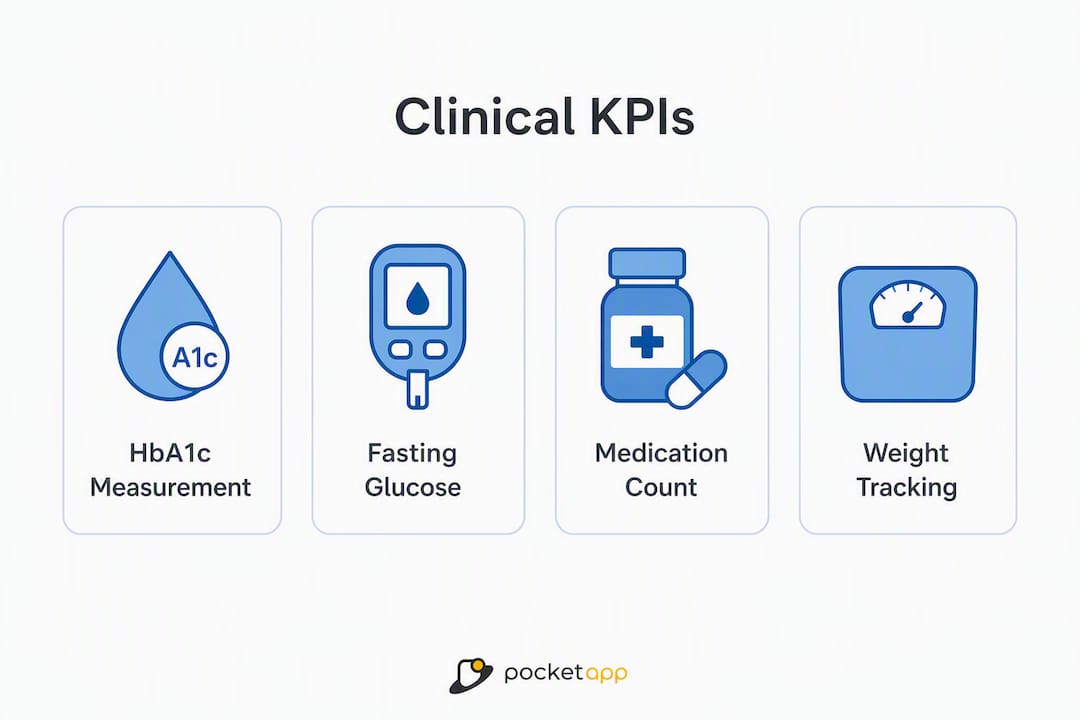
Clinically, reversal is measured against endpoints such as HbA1c reduction below 7.0, fasting glucose normalisation, weight loss, blood pressure improvement, and reduction in prescribed medication count. Programmes following a phased root-cause protocol — Remove, Replace, Reinoculate, Repair, Rebalance — avoid burnout and yo-yo failure cycles by sequencing interventions rather than overwhelming patients at once.
For your product scope, this means continuous monitoring rather than periodic check-ins, clinician workflows that support medication step-downs safely, and relapse-prevention features that activate when biomarkers drift. A health restoration app without these is a wellness tracker, not a reversal programme.
Pro Tip: During vendor evaluation, ask specifically how the app builds 'lifestyle literacy' — interactive education, clinician feedback loops, and progress reflection — rather than simply delivering video content. The difference between the two is the difference between short-term results and durable remission.
What features does an MVP need, and how do you prioritise for scale?
MVP modules
- Secure onboarding, identity verification, and clinical assessment
- CGM integration (Dexcom, Libre) and manual biomarker logging
- Asynchronous clinician review queue and teleconsultation scheduling
- Personalised care plans with medication step-down workflow and audit trail
- Behaviour-change modules: habit stacking, micro-commitments, NEAT nudges
- Emotional support: guided meditation, cohort group messaging, crisis escalation
- Clinician and patient analytics dashboard
Multidisciplinary programmes that combine human coaching, nutrition guidance, and real-time monitoring consistently outperform content-only apps on clinical outcomes. Build the platform as a clinical care pathway first.
Feature priority for pilot scope
| Feature | Clinical impact | Build complexity | Pilot priority |
|---|---|---|---|
| CGM integration | High | High | Phase 1 |
| Clinician review workflow | High | Medium | Phase 1 |
| Medication step-down audit trail | High | Medium | Phase 1 |
| Behaviour-change modules | High | Low | Phase 1 |
| Teleconsultation | Medium | Medium | Phase 1 |
| Cohort group features | High | Low | Phase 2 |
| EHR/FHIR integration | Medium | High | Phase 2 |
| AI triage and advanced analytics | Medium | High | Phase 3 |
| Employer ROI reporting | Medium | Medium | Phase 3 |
Pro Tip: Require clinician-supervised medication adjustment capability and a full audit trail from day one. Retrofitting these into a live system is expensive and creates regulatory exposure.
What clinical evidence and KPIs must procurement demand?
Clinical validation is not optional. Structured programmes report that a large proportion of patients can achieve HbA1c below 7.0 within a few months under intensive support, with full remission typically taking several months. Use that as your pilot benchmark, not your marketing claim.
| Endpoint | Measurement method | Cadence | Business impact |
|---|---|---|---|
| HbA1c | Lab blood test | Baseline, 12 weeks, 6 months, 12 months | Medication cost reduction |
| Fasting glucose | CGM / lab | Weekly in active phase | Safety monitoring |
| Time-in-range | CGM continuous | Daily | Clinician triage trigger |
| Body weight | Self-reported / connected scale | Weekly | Adherence proxy |
| Blood pressure | Connected cuff / manual | Monthly | Complication risk reduction |
| Medication count | Clinician record | 12 weeks, 6 months | Direct cost saving |
Programmes that combine human coaching, nutrition, and continuous monitoring achieve better clinical outcomes than content-only apps. Clinical evidence consistently points to multidisciplinary teams and real-time data review as the mechanism behind safe medication step-downs.
Community cohort programmes report clinical compliance above 90% when cohorts and multidisciplinary teams support patients, compared with standalone tracking tools. That gap in adherence is the commercial case for investing in the full feature set.
Procurement should require vendors to supply peer-reviewed evidence, named clinical oversight, and validated device integrations — not marketing case studies.
UK regulatory and privacy checklist for a reversal app
Every reversal app deployed in the UK must satisfy the following before go-live:
GDPR and ICO:
- Data processing agreements with all sub-processors
- Lawful basis documented for each data category (health data requires explicit consent or Schedule 1 condition)
- Data subject rights workflows: access, erasure, portability
- Retention policy and deletion schedule for health records
MHRA device classification:
- Determine whether the app meets the definition of a Software as a Medical Device (SaMD) under MHRA guidance
- If classified as a medical device, UKCA marking and a clinical evidence file are required before commercial deployment
- Apps that only log data without clinical decision support are typically lower risk; apps that recommend medication changes are not
NHS integration and security:
- FHIR R4 API compatibility for NHS system integration
- NHS login support for patient identity
- ISO 27001 certification or equivalent for the development partner
- Penetration testing prior to launch and annually thereafter
- Incident response plan and 72-hour breach notification procedure per ICO requirements
Pro Tip: Request attestations and evidence documents, not yes/no answers. Ask for the ISO 27001 certificate, the penetration test report summary, and the MHRA classification rationale in writing before contracts are signed.
How do you design UX that makes health reversal stick?
Behaviour change fails when the product creates friction at the moments patients most need support. Wellbeing-centred UX design prioritises frictionless data capture, timely nudges, and habit stacking over feature density.
Emotional regulation is a physiological lever, not a nice-to-have. High cortisol undermines nutrition and exercise plans directly, so digital reversal programmes must include stress-management and emotional-support modules as core features.
Core UX principles:
- Frictionless logging: one-tap meal confirmation, auto-sync from CGM and wearables
- Timely nudges: post-meal activity prompts and NEAT reminders every 30–60 minutes to support insulin sensitivity
- Habit stacking: attach new behaviours to existing routines within the app flow
- Micro-commitments: daily check-ins that take under 60 seconds
Emotional support features:
- Guided meditation and breathing exercises
- Cohort group messaging with peer accountability
- Asynchronous clinician messaging for low-urgency queries
- Crisis escalation path to clinical team or emergency services
Example user journey:
- Onboarding: clinical assessment, baseline bloods, CGM pairing, care plan generation
- Active intervention (weeks 1–12): daily nudges, weekly clinician review, behaviour modules
- Clinician adjustment: medication step-down triggered by sustained time-in-range improvement
- Sustain phase: reduced check-in frequency, cohort group, relapse-prevention alerts
Pro Tip: Build NEAT nudges and post-meal activity prompts into the core engagement model, not as optional add-ons. These are low-cost, high-impact features for insulin sensitivity and long-term adherence.
What integrations and ROI reporting will stakeholders require?
Integration checklist:
- CGM vendors: Dexcom G7, Abbott Libre 3 APIs
- Wearables: Apple HealthKit, Google Health Connect, Garmin Connect
- EHR systems: EMIS Web, TPP SystmOne via FHIR R4
- Pathology and lab results: NHS Pathology Messaging, third-party lab APIs
- Pharmacy and prescription records: NHS Spine integration
- Employer payroll and benefit systems for ROI calculation
| ROI metric | Data source | Reporting frequency |
|---|---|---|
| Medication cost reduction | Prescription records | 6-monthly |
| Clinician visit reduction | EHR appointment data | 6-monthly |
| Complication risk reduction | HbA1c and blood pressure trends | 12-monthly |
| Employee productivity gain | Employer HR/payroll data | Annual |
| Programme adherence rate | App engagement logs | Monthly |
Virtual care models combining human coaches and remote biomarker tracking report measurable reductions in prescriptions and healthcare costs. Build the ROI dashboard to export these metrics in formats your employer clients and commissioners can use directly.
Pro Tip: During discovery, ask your development partner to produce a dashboard mockup showing cohort outcomes, medication usage trends, and cost-savings projections. If they cannot prototype this before build, they will not deliver it on time.
How do you scope, budget, and timetable a UK build?
| Phase | Duration | Key deliverables | Sign-off required |
|---|---|---|---|
| Discovery | 2–6 weeks | Clinical brief, feature map, integration spec, regulatory classification | Clinical lead, legal, procurement |
| MVP / pilot build | 3–6 months | Working app, CGM integration, clinician workflow, pilot cohort | Clinical lead, information governance |
| Clinical validation | 3–12 months | Outcome data, endpoint reports, safety review | Clinical sponsor, MHRA if SaMD |
| Wider roll-out | 2–4 months | Full integration suite, employer reporting, scale infrastructure | Board / commissioner |
| Sustain | Ongoing | Feature updates, security patches, outcome monitoring | Product owner |
Budget concentration areas:
- Clinical validation and clinician time: typically the largest ongoing cost
- CGM and EHR integrations: high build complexity, licence fees apply
- Security: penetration testing, ISO 27001 audit, hosting
- Regulatory: MHRA classification advice, UKCA evidence file if required
Procurement checklist for vendor selection:
- Demonstrated healthcare app portfolio with clinical integration evidence
- Named clinical co-design capability or established clinical partner network
- ISO 27001 certification and penetration test reports available on request
- MHRA SaMD classification experience
- Pilot success criteria agreed in writing before build commences
- SLA covering uptime, incident response, and data breach notification
Pro Tip: Set pilot success criteria in the contract, not after launch. Define the minimum HbA1c improvement, adherence rate, and medication step-down target that must be met before wider roll-out funding is released.
How Pocketapp builds clinically focused health apps
Pocketapp brings over 300 completed projects and deep UK healthcare app experience to every health commission. Our process for reversal programmes runs from clinical co-design workshops through iterative prototyping, secure build, and pilot support — with clinical stakeholders involved at every gate.
The most effective reversal apps are designed as clinical care pathways first and mobile products second. The app must enable medication step-downs and generate complete audit trails, not simply collect data.
Our portfolio spans healthcare, charity, retail, and enterprise clients including WWF and Dechra, demonstrating the cross-sector integration and compliance experience that health commissioners require. We work with your clinical partner from discovery, not as a handover at the end.
What to request from Pocketapp in your RFP:
- Healthcare case studies with named clinical integration evidence
- ISO 27001 certificate and most recent penetration test summary
- MHRA SaMD classification approach for your specific use case
- Pilot proposal with defined success criteria and milestone sign-offs
- Post-launch support SLA covering security, updates, and outcome monitoring
Pro Tip: Ask us to run a clinical discovery workshop before you commit to a full build. A structured 2–4 week discovery will surface integration risks, regulatory requirements, and clinical workflow gaps that would otherwise cost significantly more to resolve mid-build.
Key takeaways
A clinically validated reverse health program app requires measurable endpoints, clinician workflows, GDPR-compliant architecture, and phased delivery from discovery through pilot to scale.
| Point | Details |
|---|---|
| Clinical endpoints are non-negotiable | Require HbA1c, weight, medication count, and time-in-range measurement at baseline, 12 weeks, 6 months, and 12 months. |
| Clinician workflows must be built in from day one | Medication step-down audit trails and asynchronous review queues cannot be retrofitted without significant cost and risk. |
| Regulatory classification shapes the entire build | Determine MHRA SaMD status in discovery; UKCA marking and a clinical evidence file are required if the app supports clinical decisions. |
| Pilot success criteria belong in the contract | Define minimum HbA1c improvement, adherence rate, and medication reduction targets before build commences. |
| Pocketapp delivers end-to-end | From clinical co-design workshops to secure build and post-launch support, Pocketapp covers the full commissioning lifecycle for UK health apps. |
What we have learned building health apps that actually change outcomes
The most common mistake we see in health app briefs is treating clinical validation as a phase that comes after launch. By the time a product is live, the architecture either supports clinician-supervised medication adjustments and generates auditable records, or it does not. Retrofitting those capabilities is expensive, slow, and sometimes impossible without a rebuild.
What actually works is designing the clinical care pathway on paper first, with a clinician in the room, before a single line of code is written. The app is then built to serve that pathway. Iterative pilots with real patients surface the UX friction points that no amount of internal testing will find. And emotional-support features — the ones that feel optional in a feature list — turn out to be the ones that determine whether a patient is still using the app at month six.
The commercial case for doing this properly is straightforward. A programme that reduces medication dependence, cuts clinician visits, and keeps patients adherent for twelve months delivers measurable cost savings to employers and commissioners. That is the ROI story your stakeholders need, and it only exists if the clinical rigour is built in from the start.
Pocketapp's clinical app development service
Pocketapp is the UK development partner for businesses that need a custom health app built to clinical standards, not just consumer standards. We run structured discovery workshops, co-design clinical workflows with your named clinician, and deliver secure, GDPR-compliant builds with full integration support for CGM vendors, EHR systems, and NHS pathology APIs.
Our enterprise mobile app capability means we can support the scale, security, and SLA requirements that health commissioners and employers demand. With over 300 projects delivered and a portfolio that spans healthcare, charity, and enterprise, we bring the cross-sector experience your brief requires. To commission a clinical discovery workshop and receive a pilot proposal tailored to your reversal programme, contact Pocketapp today.
Useful sources for procurement and clinical reviewers
- PMC: Lifestyle medicine and reversal misconceptions — peer-reviewed framing of reversal as sustained metabolic management; essential reading for clinical brief writers.
- Public Health Toxicology: Prevention and reversal of chronic diseases protocol — five-step clinical protocol with biomarker methodology; useful for validation phase design.
- Health Morn: Disease reversal pathways — practitioner framework covering root-cause identification and phased intervention sequencing.
- Virta Health reversal report — virtual care model outcomes including prescription reduction and cost data; useful for ROI modelling.
- Gini Health: Can type 2 diabetes be reversed? — programme-level outcome data including HbA1c benchmarks for pilot target-setting.
Prioritise sources that publish measured outcomes with defined methodologies and sample sizes. Marketing claims without clinical data should not inform your procurement decisions.
FAQ
What is a reverse health programme in a digital product context?
A reverse health programme app is a clinically supervised digital service designed to deliver measurable metabolic improvement — such as HbA1c reduction, weight loss, and medication step-down — through continuous monitoring, behaviour-change modules, and clinician workflows, rather than simply tracking symptoms.
How long does it take to build and validate a reversal app in the UK?
Discovery typically takes 2–6 weeks, MVP build 3–6 months, and clinical validation 3–12 months; plan for a minimum of 12 months from brief to validated launch.
Does a health reversal app need MHRA approval?
If the app supports clinical decisions — such as recommending medication adjustments — it is likely classified as a Software as a Medical Device under MHRA guidance and requires UKCA marking and a clinical evidence file before deployment.
What clinical KPIs should procurement require from day one?
Require measurement of HbA1c, fasting glucose, time-in-range, body weight, blood pressure, and medication count at baseline, 12 weeks, 6 months, and 12 months, with a defined minimum improvement threshold agreed before build commences.
Can Pocketapp build a clinically compliant reversal app?
Pocketapp has delivered over 300 projects including healthcare applications with clinical integration, GDPR-compliant architecture, and NHS-compatible APIs; contact us to request a clinical discovery workshop and pilot proposal.