
TL;DR:
- Mobile consumer engagement leverages personalized and context-aware interactions through smartphones and apps, becoming the primary channel for brand attention and loyalty. It involves integrated channels, behavioral triggers, and AI-driven personalization to influence purchase frequency and customer retention. Emerging AI agents will shift engagement toward autonomous, task-based interactions, requiring brands to restructure app workflows.
Mobile consumer engagement is defined as the use of smartphones, apps, and connected mobile platforms to create personalised, context-aware interactions that influence purchasing decisions and brand loyalty. Mobile devices now account for over 64% of total website traffic, with average daily use exceeding five hours per user. That figure alone tells you where your customers are spending their attention. Platforms like Airship, Braze, and CleverTap have built entire product suites around this reality, recognising that the role of mobile technology in consumer engagement is no longer peripheral. It is the primary channel through which brands compete for attention, trust, and repeat business.
How does mobile technology change consumer behaviour?
Mobile devices have fundamentally altered the psychology of purchasing. Consumers no longer plan shopping trips or sit at desks to research products. They act in micro-moments: a spare two minutes on the train, a quick search between meetings, a push notification that lands at exactly the right time.
The behavioural shift is measurable. Retail customers receiving mobile-first in-app experiences purchase 140% more frequently than those without them. That statistic, drawn from 1.7 billion device sessions, is not a marginal improvement. It represents a structural change in how purchase frequency is generated.
Mobile also compresses the discovery-to-decision cycle. A consumer can discover a brand through a social ad, read reviews, compare prices, and complete a purchase within a single session on one device. Traditional web journeys required multiple touchpoints across days. Mobile collapses that timeline into minutes.
Key behavioural characteristics that distinguish mobile consumers from desktop users include:
- Short, task-focused sessions where users expect immediate results with minimal friction
- Location and context sensitivity, meaning the same user behaves differently at home versus in-store
- Higher emotional responsiveness to personalised messaging, particularly push notifications tied to recent behaviour
- Lower tolerance for poor UX, with users abandoning apps after a single frustrating experience
Pro Tip: Map your customer journey specifically for mobile sessions under three minutes. Most mobile conversions happen in short bursts, not extended browsing sessions. Design your critical conversion paths to complete within that window.
Understanding consumer behaviour and mobile technology together means accepting that attention is fragmented and that your engagement strategy must meet users where they are, not where it is convenient for your brand to reach them.
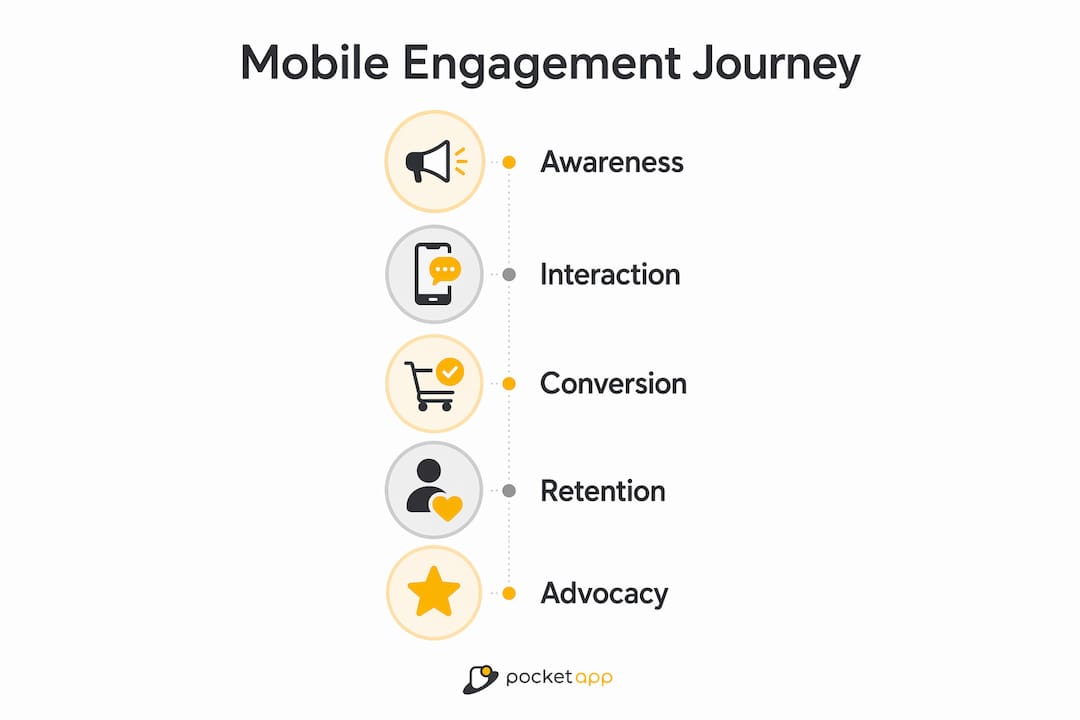
What are the key mobile engagement strategies?
The most effective mobile engagement strategies treat the channel as an integrated ecosystem rather than a collection of separate tactics. Customers experience fragmented interruptions without channel integration across push, SMS, email, in-app messaging, and mobile wallets. Brands that manage these channels in silos create noise. Brands that unify them create loyalty.
The technological infrastructure underpinning this is the mobile martech stack. The mobile martech ecosystem connects acquisition, engagement, retention, and revenue, increasingly powered by AI for personalised experiences. The core components include attribution tools, deep linking, and AI decisioning engines that determine which message to send, to whom, and at what moment.
A structured approach to building your mobile engagement strategy covers four layers:
- Channel integration: Unify push notifications, in-app messaging, SMS, and email under a single orchestration layer. Tools like Airship and Braze provide this natively.
- Behavioural triggering: Replace scheduled broadcast campaigns with messages triggered by specific in-app actions. A user who views a product three times without purchasing is a different audience than one who just installed the app.
- Deep linking: Connect every message to a specific screen or workflow inside the app, not just the home screen. Behavioural-triggered messaging linked to deep-linking workflows drives superior user engagement by guiding users to the exact function they need.
- AI decisioning: Use machine learning to determine optimal send times, message formats, and content variants at the individual user level.
Combining push notifications and in-app messaging with advanced segmentation yields engagement scores 31% higher than average. The implication is clear: the combination of channels, not the volume of messages, is what drives results.
Pro Tip: Audit your current notification strategy by calculating the ratio of behavioural-triggered messages to scheduled broadcasts. If broadcasts dominate, you are optimising for convenience rather than relevance. Flip that ratio.

For teams looking to sharpen their analytical approach, mobile app analytics strategies provide the measurement framework needed to validate these decisions with real user data.
How does mobile engagement differ across retail, education, and services?
The impact of mobile devices on engagement varies significantly by sector. The underlying mechanics are the same, but the objectives, constraints, and performance benchmarks differ considerably.
| Sector | Primary Mobile Engagement Goal | Key Performance Evidence |
|---|---|---|
| Retail | Purchase frequency and loyalty | 78% of global e-commerce traffic from smartphones; 68% of online orders placed via mobile |
| Education | Learning facilitation and focus management | 1 percentage point increase in focused learning improves performance; distraction reduces it by 0.13 points |
| Healthcare | Patient communication and appointment adherence | Mobile UX reduces friction in booking, reminders, and follow-up care |
| Nonprofits | Donor engagement and campaign participation | Apps like WWF's use mobile to deepen cause connection and recurring giving |
| Banking | Self-service and real-time financial management | Mobile-first interfaces reduce branch dependency and increase daily active use |
Retail is the most data-rich sector. Mobile apps drive the majority of e-commerce traffic and orders, which means a poorly designed retail app is not just a UX problem. It is a direct revenue problem. Brands like Crocus and Dechra, both clients of Pocketapp, demonstrate how sector-specific app design translates into measurable engagement outcomes.
Education presents a more nuanced picture. Mobile learning apps facilitate real-time interaction and collaborative learning when managed properly, but the same device that supports learning also enables distraction. The difference lies in how the app is designed and how its use is structured within the learning environment.
Service sectors including healthcare, banking, and nonprofits benefit most from mobile UX that reduces friction in high-stakes interactions. A patient who can reschedule an appointment in two taps is more likely to attend. A donor who receives a timely, personalised update on campaign impact is more likely to give again.
What emerging mobile technologies will shape engagement next?
The next phase of mobile consumer interaction is being shaped by AI agents operating at the operating system level. These are not chatbots embedded in apps. They are autonomous agents that can see the screen, interpret context, and take actions across multiple apps on behalf of the user.
Projects like OPPO's OmniClaw demonstrate what this looks like in practice. Edge-native AI agents perform tasks autonomously across apps without relying on cloud processing, handling tasks such as product searches, content creation, and workflow management entirely on-device. This shifts the engagement model from brand-to-consumer to agent-mediated interaction.
The implications for marketing professionals are significant:
- App discoverability changes: If an AI agent is completing tasks on a user's behalf, your app's workflows must be structured so the agent can find and execute them. Apps that are not agent-accessible will be bypassed.
- UX must accommodate non-human navigation: Screens designed purely for human visual scanning may not translate well to AI agent interaction. Brands must expose app workflows to AI agents to remain relevant in user interactions.
- Engagement metrics will shift: Session duration and screen views become less meaningful when an agent completes a task in the background. Outcome-based metrics such as task completion and conversion will matter more.
- Retention becomes the primary objective: Marketing is shifting from a download-first to an engagement-retention model powered by mobile martech and AI. Getting the install is no longer the hard part. Keeping users engaged over months is.
For teams planning ahead, understanding AI integration in mobile apps is the most practical starting point for preparing your product for this shift.
Key takeaways
The role of mobile technology in consumer engagement is defined by integrated ecosystems, behavioural intelligence, and AI-driven personalisation that together determine whether a brand retains or loses its audience.
| Point | Details |
|---|---|
| Mobile dominates attention | Users spend over five hours daily on mobile devices, making it the primary engagement channel for every sector. |
| Integrated channels outperform silos | Combining push, in-app messaging, and SMS with advanced segmentation delivers 31% higher engagement scores. |
| Behavioural triggers beat broadcast | Context-aware, action-triggered messages consistently outperform scheduled volume-based notification campaigns. |
| Sector application varies significantly | Retail, education, healthcare, and nonprofits each require distinct mobile engagement approaches tied to specific user goals. |
| AI agents will redefine interaction | Edge-native AI agents performing tasks autonomously will require brands to restructure app workflows for agent discoverability. |
What i have learned about mobile engagement after 300+ projects
The most common mistake I see from marketing teams is treating mobile as a delivery mechanism rather than a relationship infrastructure. They build an app, set up a few push notifications, and wonder why retention drops off after week two.
The brands that get this right, and I have seen it across sectors from retail to healthcare, share one characteristic: they think about the mobile experience as a continuous conversation, not a series of campaigns. Every interaction is either building or eroding trust. A notification sent at the wrong moment, or for the wrong reason, costs more than the engagement it was meant to generate.
The second thing I have learned is that data without interpretation is noise. Most teams have access to more mobile user behaviour data than they can act on. The discipline is in choosing which signals matter and building your engagement logic around those specific triggers.
The AI agent shift is the development I am watching most closely right now. The brands preparing for it are not just updating their apps. They are rethinking what it means for a consumer to "use" their product when an agent might be doing the using. That is a genuinely new design problem, and the teams who solve it first will have a structural advantage that is very difficult to replicate.
— Paul
How Pocketapp builds engagement into every app
The insights in this article only create value when they are built into the product itself. Pocketapp has delivered over 300 mobile projects for brands including WWF, Dechra, and Crocus, integrating martech capabilities, behavioural triggers, and AI-ready architectures from the ground up. Every engagement strategy discussed here requires a technically sound foundation to execute. If you are planning a new app or reassessing an existing one, explore Pocketapp's mobile app development services to understand how professional development translates strategy into measurable consumer engagement outcomes.
FAQ
What is mobile consumer engagement?
Mobile consumer engagement is the practice of building personalised, context-aware interactions between a brand and its customers through smartphones, apps, and connected mobile platforms. It encompasses push notifications, in-app messaging, mobile loyalty programmes, and AI-driven personalisation.
How does mobile technology increase purchase frequency?
Retail customers receiving integrated mobile-first in-app experiences purchase 140% more frequently than those without them. The combination of contextual messaging, frictionless UX, and behavioural triggers drives this uplift.
Which mobile engagement channels deliver the best results?
Using push notifications and in-app messaging together with advanced segmentation yields engagement scores 31% higher than average. Channel integration consistently outperforms any single-channel approach.
How will AI agents affect mobile engagement strategies?
Edge-native AI agents will perform tasks autonomously across apps on behalf of users, shifting the engagement model from direct brand-to-consumer interaction to agent-mediated experiences. Brands must structure app workflows to be accessible and executable by these agents.
What is the difference between mobile engagement and traditional web engagement?
Mobile engagement is characterised by short, task-focused sessions, location sensitivity, and higher responsiveness to personalised messaging. Traditional web engagement typically involves longer sessions, planned visits, and lower tolerance for real-time interruption.