
Most mobile apps take between one month and a year to build, depending on scope. A simple MVP ships quickly, a standard app with custom design and integrations takes several months, and a complex or enterprise-grade build can run for much longer. The three biggest swing factors are feature scope, third-party integrations, and how quickly stakeholders sign off on decisions. This guide breaks the full app development timeline into phases, calendar weeks, and the tactics that shorten it without cutting corners.
TL;DR:
- Most app development projects fall between 20 and 40 weeks from concept to launch, with MVPs shipping in as little as one to three months.
- A thorough discovery phase of two to four weeks is crucial to define scope and prevent costly mid-build changes, especially for complex apps.
- Integrating third-party services like payments or maps typically adds one to three weeks per feature, with API stability influencing delays.
- Stakeholder availability and decision-making speed are the primary causes of timeline overruns, far more than actual coding or technical challenges.
- Planning and scoping well in advance, including using fixed-scope sprints and parallel work streams, can significantly shorten time to market without sacrificing quality.
Table of Contents
- App development timeline by complexity: the quick-reference snapshot
- What happens in each phase of the app development process
- What actually changes your app's timeline
- Building the right team for your timeline
- App store review times and launch-week realities
- How to shorten your time to market without cutting quality
- Why Pocket App's experience matters when you need reliable timelines
- The honest truth about app timelines nobody wants to hear
- Get a realistic timeline for your own app idea
- Sources
- FAQ
App development timeline by complexity: the quick-reference snapshot
Before booking stakeholder meetings or setting a budget, work out which row of the table below your project actually sits in. Most founders overestimate their app's complexity at the pitch stage and underestimate it once integrations and edge cases surface, so treat this as a starting point rather than a fixed promise.
These ranges echo what independent research on mobile app project timelines finds: most projects fall somewhere between 20 and 40 weeks once you count planning through to launch, and MVPs can ship in as little as one to three months while complex apps often stretch to nine to twelve months or more.
To pick the right row for your own project, ask yourself:
- Does the app need a backend that stores and syncs user data, or is it mostly static content?
- How many third-party services (payments, maps, authentication) does it depend on?
- Will design need multiple stakeholder sign-off rounds, or does one product owner have final say?
- Is this a first version you plan to iterate on, or a fully-specified enterprise system with fixed requirements?
Use this snapshot when you book internal planning meetings. A common mistake is scheduling a marketing launch date before development has even started scoping, which locks in a deadline nobody involved in the build has actually agreed to. Set the calendar range first, then work backwards to a realistic launch window.
What happens in each phase of the app development process
Every mobile app development schedule, regardless of complexity, moves through the same six phases. What changes between a simple app and a complex one isn't the sequence, it's how long each phase takes and how many people are involved. The core phases of app development are discovery and planning, design, development, testing and QA, deployment, and post-launch support.
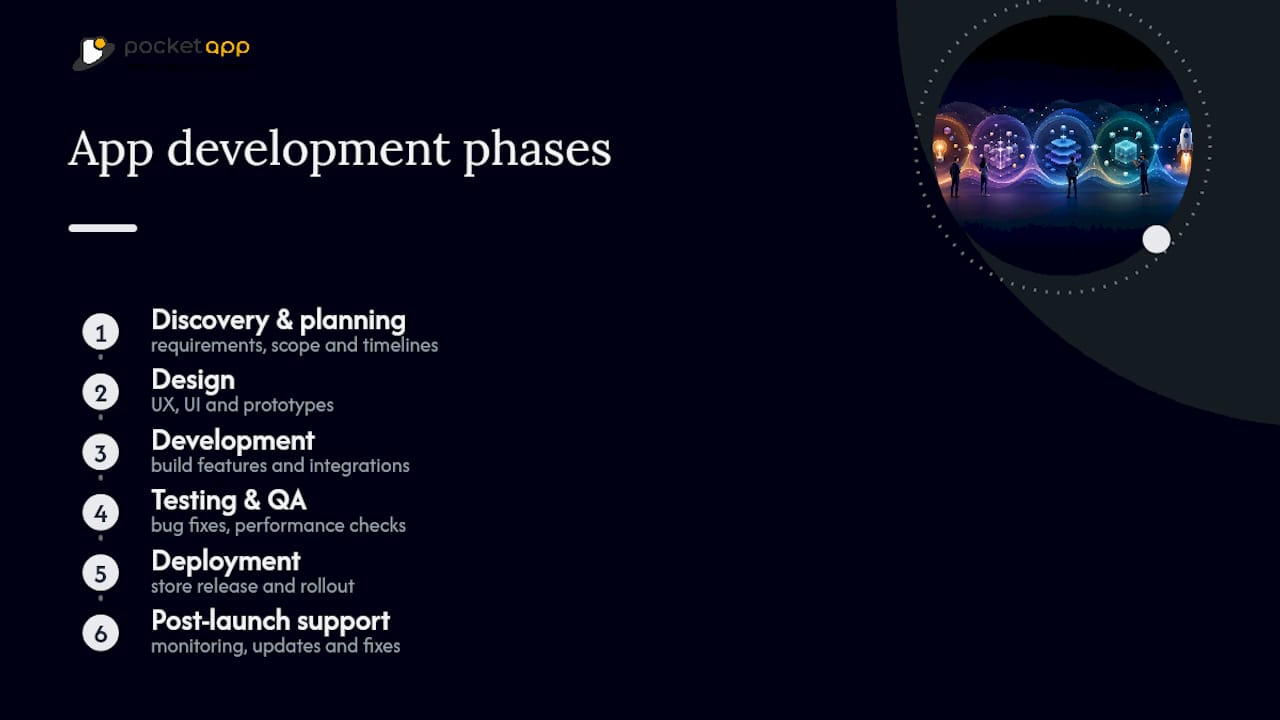
Discovery and planning (typically 2 to 4 weeks)
This is where scope gets defined, and it's also where most timeline overruns actually begin, not in development as many assume. During discovery, the team works through:
- Market and competitor research to confirm the app solves a real problem and isn't duplicating an existing solution.
- User stories and acceptance criteria, written in plain language so everyone agrees what "done" looks like for each feature.
- Technical scoping, including which platforms to target, what backend architecture is needed, and which integrations are mandatory versus nice-to-have.
- A prioritised feature list, split into must-have, should-have, and could-have, so scope can flex later without derailing the whole schedule.
A rushed discovery phase feels like it saves time, but it almost always costs more later because requirements get rewritten mid-build. Two to four weeks is the realistic window for a project of any real complexity; anything shorter usually means decisions are being deferred rather than made.
Design (typically 2 to 6 weeks)
Design translates the agreed user stories into something a developer can actually build from. It usually runs in three stages: low-fidelity wireframes to test navigation and flow, high-fidelity UI screens with the actual visual language, and an interactive prototype that stakeholders can click through before a single line of production code is written.
The prototype stage matters more than most non-technical clients expect. Catching a confusing checkout flow or an awkward onboarding sequence in a clickable prototype costs a design revision. Catching the same problem after development starts costs a rebuild. Teams that invest properly in wireframing and prototyping upfront tend to see fewer costly changes once build begins.
Design handover, the point where finalised screens, assets, and a style guide pass to developers, marks the end of this phase. For a standard app, expect four to six weeks; for a simple MVP with a lighter interface, two to three weeks is achievable.
Development (typically 2 to 6+ months)
This is the longest phase and the one most affected by scope creep. Development splits into frontend (what users see and interact with), backend (databases, servers, business logic), and the API layer that connects the two, plus any third-party integrations.
Most teams work in two-week sprints, a cadence that gives stakeholders regular visibility without demanding daily involvement. A realistic sprint structure for a standard app might look like this:
- Sprints 1 to 2: core architecture, authentication, and navigation shell.
- Sprints 3 to 6: primary feature build, working through the prioritised list from discovery.
- Sprints 7 to 8: integrations (payments, push notifications, analytics) and edge-case handling.
- Sprint 9 onward: polish, performance tuning, and preparation for handover to QA.
An MVP with three to five core features can often complete this entire phase in six to eight weeks. A complex platform with real-time syncing, multiple user roles, and several integrations can easily run sixteen to twenty-four weeks, sometimes longer if backend architecture needs rework mid-build. The full development process, phase by phase, tends to follow this same rhythm regardless of industry.
Testing and QA (typically 2 to 4 weeks, or 20 to 25% of development time)
Testing isn't a single event at the end, it runs continuously through development via automated unit tests, but a dedicated QA phase before launch catches what automation misses. This includes manual testing across device types and operating system versions, user acceptance testing (UAT) with real stakeholders or a pilot user group, and regression testing to confirm new fixes haven't broken existing features.
A widely cited rule of thumb is to budget 20 to 25% of total development time for testing and bug fixing. For a four-month build, that's roughly three to four weeks of dedicated QA. Skipping this step to hit a launch date is the single most common cause of a rocky first week post-launch, and it's almost always more expensive to fix in production than to catch beforehand.
Deployment (typically 1 to 2 weeks)
Deployment covers final builds, app store submission, and setting up monitoring so the team knows immediately if something breaks post-launch. This phase needs to account for platform review windows, which vary and aren't fully within your control (more on that below). CI/CD pipelines, which automate build and release steps, shrink the manual work here considerably and reduce the chance of a last-minute deployment error.
Post-launch (first 2 to 4 weeks are the highest priority)
The first month after launch determines whether early users stick around. Priorities include monitoring crash reports and performance metrics, responding fast to hotfix-worthy bugs, and building a feedback loop from app store reviews and in-app analytics into the next development sprint. Treating post-launch as an afterthought, rather than a planned phase with its own resourcing, is one of the more avoidable reasons apps lose early momentum.
What actually changes your app's timeline
Feature scope is the single biggest driver of calendar time, more than team size, more than platform choice. A simple scoring method helps here: rate each feature as low, medium, or high complexity based on whether it needs custom backend logic, third-party data, or real-time updates. An app with ten low-complexity features often builds faster than one with three high-complexity ones.
Integrations are the second major variable, and they're routinely underestimated at the quoting stage. Common ones and their typical time impact:
- Payment processing (Stripe, PayPal, Apple Pay): 1 to 2 weeks, longer if you need PCI compliance work.
- Maps and location services: 1 to 2 weeks, depending on how much custom map behaviour is needed.
- Authentication (social login, single sign-on, biometric): 1 to 3 weeks, especially if multiple providers are required.
- Push notifications and analytics SDKs: usually under a week each, but they add up when stacked together.
Third-party integrations commonly add one to three weeks each to a project, and API stability matters as much as the integration itself. A well-documented, mature API adds far less friction than one with sparse documentation or frequent breaking changes.
Backend complexity is the quieter risk. Real-time features (live chat, live location tracking), multi-tenant architecture (where one codebase serves multiple client organisations), and secure handling of sensitive data (health records, financial details) all add lead time that isn't visible in a feature list. These requirements often need specialist backend engineering and more rigorous security testing before launch.

The hidden delay that catches almost everyone out, though, is stakeholder availability. A development team can only move as fast as decisions get made. Content that isn't ready (copy, imagery, legal text), approval chains that require sign-off from people who are hard to schedule, and regulatory checks that surface late (particularly in healthcare or financial apps) routinely add weeks that never show up in the original project plan.
Pro Tip: Nominate one decision-maker with authority to approve design and scope changes before development starts. Committees that need to "circle back" on every screen are the single most common reason a four-month build becomes a seven-month one.
Building the right team for your timeline
Resourcing shapes your schedule almost as much as scope does. A minimum viable team for an MVP typically consists of one product manager or lead, one designer, one to two developers, and a QA resource shared part-time. A standard or complex app usually needs a fuller team: a dedicated backend developer, a frontend or mobile developer per platform, a designer, a QA specialist, and a project lead coordinating sprints.
Two-week sprint cycles, combined with CI/CD pipelines that automate testing and deployment, meaningfully compress the gap between a design handover and a working build in a tester's hands. Teams that release manually, with a person triggering each build and submission step, routinely lose days per release that automation would have saved.
The in-house versus freelance versus agency decision affects calendar time as much as cost. In-house teams offer control but take time to hire and onboard if you're starting from scratch. Freelancers can be fast for narrow, well-defined tasks but coordination overhead grows quickly once a project needs more than two or three specialists working in parallel. An established agency typically has the full team already assembled and working together, which removes the ramp-up period entirely.
One counterintuitive point worth remembering: adding more people to a delayed project usually slows it down further, not up. New team members need onboarding time, and communication overhead grows faster than output once a team passes six or seven people on one codebase. If a project is behind schedule, better sprint discipline and clearer priorities almost always beat throwing more headcount at it.
App store review times and launch-week realities
App store submission is the part of the timeline least within your control, and it's where avoidable delays cluster if preparation is rushed. Apple's review process commonly takes one to three days, but a rejection resets that clock and can add a week or more if the same issue recurs. Common Apple rejection triggers include incomplete metadata, crashes on specific devices, and privacy disclosures that don't match what the app actually does.
Google Play's review process differs in a useful way: it supports staged rollouts, releasing an update to a small percentage of users first before expanding to everyone. This catches crash-inducing bugs before they hit your full user base, at the cost of a slightly longer full rollout window.
Practical steps that prevent last-mile delays:
- Prepare app store metadata, screenshots, and privacy policy text at least a week before your planned submission date, not the day of.
- Test on the actual minimum supported OS version, not just the newest one, since older-device crashes are a frequent rejection cause.
- Set up crash monitoring and analytics before launch day, not after the first bug report arrives.
- Consider a soft launch in a smaller market or user segment first, giving you a live signal before the full release.
Given that app store download volumes remain enormous and growing globally, a rocky launch week is a real cost, not just an inconvenience, since early reviews and ratings shape long-term discoverability. A well-prepared launch checklist run through a week before submission catches most of these issues before they become emergencies.
How to shorten your time to market without cutting quality
- Define your MVP ruthlessly. Pick three to five features that solve the core problem, write acceptance criteria for each, and resist adding "just one more thing" before launch. This single decision does more to compress an MVP timeline than any process change.
- Use Backend-as-a-Service (BaaS) platforms and ready-made SDKs where they fit. Authentication, push notifications, and basic data storage rarely need custom-built infrastructure for a first version, and using an established SDK instead can save weeks of backend engineering.
- Choose your platform strategy deliberately. Cross-platform frameworks like React Native and Flutter remain strong, actively maintained options for sharing a single codebase across iOS and Android, and both are still widely used in production apps. Native development is still the better call when an app depends heavily on platform-specific hardware features or needs maximum performance, but for most standard apps, cross-platform cuts build time without a meaningful compromise on user experience.
- Run design and backend work in parallel. There's no reason backend architecture has to wait for final UI approval. Starting API and data model work as soon as user stories are locked, rather than after design sign-off, can shave two to three weeks off a standard build.
- Automate testing from sprint one. Manual-only QA doesn't scale as feature count grows, and it's the phase most likely to eat into your buffer if left until the end.
Pro Tip: If your team is documentation-heavy, tools built for speeding up client work and technical briefs can cut hours off the discovery and scoping phase, freeing that time for actual build work instead.
Why Pocket App's experience matters when you need reliable timelines
Timeline estimates are only as good as the experience behind them. Pocket App has delivered more than 300 mobile app projects across sectors including charity, retail, and healthcare, with case examples spanning organisations like WWF, Dechra, and Crocus. That range matters for timeline planning specifically: a team that has scoped enterprise-grade backend work alongside fast MVP builds has a much more grounded sense of where a given project will actually land within these ranges.
Structured discovery workshops before any development starts convert vague requirements into a fixed-scope plan with agreed acceptance criteria, which is precisely the step that prevents the mid-build scope changes that derail most schedules. Fixed-scope sprints then give clients weekly visibility into progress against that original plan, rather than a black box that only opens at the end.
For readers wanting deeper detail on any single phase, Pocket App's guide to the app development process from concept to reality and its phase-by-phase breakdown of app development stages both go further into the checklists and templates behind these numbers.
The honest truth about app timelines nobody wants to hear
The uncomfortable reality is that most timeline overruns aren't caused by development being slow, they're caused by decisions being slow. Every range in this guide assumes stakeholders show up to reviews on time, content is ready when design needs it, and scope doesn't shift after sprint three. Strip out those assumptions and even a well-run four-month build can stretch to seven.
Conventional advice tends to focus entirely on development speed: which framework, which team size, which methodology. That's the wrong lever for most delays. The teams that hit their dates aren't necessarily the fastest coders, they're the ones with one empowered decision-maker and a locked scope before sprint one starts.
If you take one thing from this guide, prioritise discovery over development speed. A properly scoped four-week discovery phase, with acceptance criteria written down and one person accountable for sign-off, will save you more calendar time than any framework choice or team size increase ever could.
— Paul
Get a realistic timeline for your own app idea
Generic ranges are useful for planning, but your actual project has its own scope, integrations, and constraints that no table can capture. Pocket App is the practical alternative to guessing at your launch date from a blog post: a short discovery consultation turns your idea into a phase-by-phase schedule with real calendar weeks attached, based on the same scoping process used across 300-plus delivered projects.
A typical engagement starts with a discovery workshop, usually completed within one to two weeks, that produces a prioritised feature list, a fixed-scope plan, and an honest estimate of where your project sits across the MVP, standard, or complex ranges covered above. From there, fixed-scope sprints keep you updated weekly rather than leaving you waiting for a big reveal at the end. Whether you're weighing up native versus cross-platform development or need a full custom mobile app build, the next step is the same: request a timeline review and get a schedule built around your actual scope, not an industry average.
Sources
FAQ
What are the 7 stages of app development?
Most guides describe six or seven stages depending on how they split the work: discovery and planning, design, development, testing and QA, deployment, post-launch support, and sometimes market research as a separate first step before discovery begins.
How long will it take to develop an app?
A simple MVP typically takes 1 to 3 months, a standard app takes 3 to 6 months, and a complex or enterprise-grade app can take 6 to 12 months or longer, depending mainly on feature scope and integrations.
Is Flutter still relevant in 2026?
Yes. Flutter remains actively developed and widely used for cross-platform mobile development, alongside React Native, and both are sound choices when a shared codebase across iOS and Android matters more than squeezing out platform-specific performance.
What are the 5 phases of the app development process?
A common five-phase version condenses the process into discovery and planning, design, development, testing, and deployment, with post-launch maintenance treated as an ongoing sixth stage rather than a one-off phase.
How can I shorten my app's development timeline?
Define a tight MVP scope, use Backend-as-a-Service platforms for standard features like authentication, run design and backend work in parallel, and work with a team like Pocket App that runs fixed-scope discovery workshops to lock requirements before development starts.