
A mobile app MVP (minimum viable product) is a live, measurable product that solves one core user problem with the fewest possible features — you ship it fast, measure real behaviour, and use that data to decide what to build next. According to NN/g's definition, an MVP is primarily a learning tool, not a polished release; its success is measured by the quality of the data it generates, not by how complete it feels.
Start here:
- Define one measurable hypothesis. State who the user is, what problem they have, what value your app delivers, and which metric will confirm it within 60–120 days.
- Map the core user flow. Identify the single journey from app open to the moment the user gets value. Every screen outside that journey is a v2 candidate.
- Choose a fast build approach and instrument analytics from day one. Whether you use no-code, cross-platform, or native, set up mobile app analytics before you launch — not after.
Key takeaways
A mobile app MVP succeeds when it is scoped to a single falsifiable hypothesis, instrumented with analytics from day one, and measured over a defined 60–120 day learning window.
| Point | Details |
|---|---|
| Define one hypothesis first | State who, what, why, and which metric confirms it before scoping any features. |
| UK cost bands | Basic no-code MVPs start around £10k–£25k; cross-platform builds typically run £30k–£80k; complex or regulated MVPs exceed £80k. |
| Core flow only | Cut every feature that does not sit on the single user journey from app open to value moment. |
| Analytics before launch | Instrument event tracking and cohort tagging in sprint one, not as an afterthought. |
| Pocketapp's approach | Fixed-price discovery sprint produces a validated scope and prototype before any production build begins. |
Table of Contents
- What is the difference between an MVP, a prototype, and a PoC?
- Why should you build an MVP rather than a full product?
- How to build a mobile app MVP: a step-by-step playbook
- How do you strip your app to the essential core flow?
- Which technology should you choose for your mobile MVP?
- Who should build your MVP: agency, in-house, or freelancers?
- What does a mobile MVP cost in the UK, and how long does it take?
- What should you test before launch, and which metrics matter after?
- Minimum feature checklists by app type
- How Pocketapp scopes and delivers a UK MVP
- Legal and compliance considerations for UK mobile apps
- How to prepare your MVP for scaling and post-MVP planning
- The founder mistakes that cost the most — and how to fix them
- Pocketapp builds UK-ready mobile MVPs, from discovery to launch
- Sources
- FAQ
What is the difference between an MVP, a prototype, and a PoC?
Founders frequently conflate three distinct formats, and choosing the wrong one wastes weeks. Each answers a different question.
A prototype validates design and usability. It is typically a clickable mock-up built in Figma or a similar tool, with no real logic behind it. It answers "does this interface make sense to users?" and produces qualitative feedback from observed sessions. Cost and time are low; the data you get is attitudinal, not behavioural.
A proof of concept (PoC) validates technical feasibility. It is a narrow code spike that proves a specific technology can do what you need — for example, that a computer-vision model can classify images at the required speed on a mobile device. It is internal-facing, rarely shown to real users, and produces an engineering verdict rather than market signal.
A minimum viable product is a live, deployed application that real users interact with under real conditions. NN/g confirms that live-code MVPs let teams measure engagement, retention, and conversion in ways no prototype can replicate. The data is behavioural, not self-reported.
| Format | Primary purpose | Fidelity | Data gathered | Typical timeline | Typical cost |
|---|---|---|---|---|---|
| Prototype | Design validation | Low–medium | Qualitative usability | 1–3 weeks | £1k–£8k |
| Proof of concept | Technical feasibility | Low | Engineering verdict | 2–4 weeks | £5k–£20k |
| MVP | Behavioural market test | High (live code) | Retention, conversion, engagement | 8–20 weeks | £10k–£80k+ |
When to progress through each stage:
- Move from prototype to PoC when the core interface is understood but a specific technical risk (AI, hardware, real-time sync) needs de-risking before you commit to a full build.
- Move from PoC to MVP when both the design concept and the technical approach are validated and you need real user behaviour to confirm market value.
- Skip the PoC entirely when the technology is well-understood (standard CRUD app, booking flow, marketplace) and the risk is product-market fit, not engineering.
Why should you build an MVP rather than a full product?
The primary reason is speed of learning. Shipping a full product before validating demand is one of the most common and costly mistakes in mobile app development. An MVP compresses the feedback loop: you get real user data in weeks rather than months, and you spend a fraction of the budget before you know whether the core hypothesis holds.
The practical benefits are concrete:
- Validated learning. You replace assumptions with measured behaviour — activation rates, drop-off points, and retention curves tell you what users actually do, not what they say they will do.
- Faster time to market. A scoped MVP typically reaches the app stores in 8–16 weeks; a full product can take 12–24 months.
- Lower upfront cost. Deferring non-core features means you spend £15k–£40k proving the concept before committing to a £150k+ full build.
- Investor traction evidence. A live product with measurable retention data is substantially more persuasive to early-stage investors than a deck or a prototype.
An MVP is not a beta version of your final product. It is a scientific experiment. If you are not prepared to be wrong — to discover that your core assumption does not hold — you are not building an MVP. You are building a product with a small budget, which is a very different thing.
Realistic limits matter too. An MVP with poor usability will generate noise, not signal; users may churn because the experience is rough, not because the value proposition is wrong. In regulated sectors — financial services, healthcare, certain categories of children's apps — an MVP may require compliance work (FCA registration, clinical safety assessments, GDPR data protection impact assessments) that adds cost and time before any user can touch it. Plan for this early.
Common misunderstandings to avoid: treating the MVP launch as a product release (it is the start of a feedback loop, not the end of a build); adding features because stakeholders ask for them rather than because the hypothesis requires them; and launching without analytics instrumentation, which makes the experiment unmeasurable.
How to build a mobile app MVP: a step-by-step playbook
A structured build–measure–learn cycle is the validated workflow for mobile MVPs. The sequence below maps each stage to the decisions founders actually make.
-
Discovery and hypothesis definition. Run a structured discovery workshop (2–5 days). Define one falsifiable hypothesis: "We believe [user type] will [take action] because [value], and we will know this is true when [metric] reaches [threshold] within [timeframe]." Involve a product manager, a designer, and at least one engineer. Artefact: a one-page hypothesis document.
-
User journey mapping. Draw the single most important user journey from app open to value moment. Use a whiteboard or a tool like Miro. Identify every screen, input, and decision point. Artefact: a validated user flow diagram.
-
Feature prioritisation. Apply MoSCoW (Must/Should/Could/Won't) to every feature on the list. Anything that does not sit on the core user flow is a "Won't" for v1. Artefact: a prioritised backlog.
-
Prototype. Build a clickable prototype in Figma. Run at least five usability sessions with target users, using NN/g's standard moderated testing protocol. Artefact: a tested, iterated prototype with documented findings.
-
Live-code MVP build. Choose your tech stack (see Section 6), set up your analytics instrumentation before writing a single screen, and build in two-week agile sprints. Artefact: a deployed app on the App Store and/or Google Play.
-
QA and launch. Run functional, device-matrix, performance, accessibility, and security smoke tests. Submit to app stores with compliant privacy policies and data handling documentation. Artefact: a QA sign-off checklist and live app.
-
Measure and iterate. Track your hypothesis metric daily for 60–120 days. Hold a weekly data review. Use findings to decide: persevere, pivot, or stop. Artefact: a weekly metrics dashboard and a documented decision log.
Pro Tip: Tag every user cohort at registration with the acquisition channel and date. This lets you compare retention curves across cohorts rather than averaging across all users — a critical distinction when you are trying to understand whether a product change improved retention or whether a better cohort simply arrived.
Set your learning window at launch: 60 days for a consumer app with high daily-use potential, 90–120 days for a B2B or low-frequency utility app. Commit to reviewing the hypothesis metric at the end of that window before making any major scope decisions.
How do you strip your app to the essential core flow?
Scope creep is the single biggest cause of MVP overruns. The discipline of feature prioritisation is not about cutting corners; it is about focusing the experiment.
Practical prioritisation methods:
- MoSCoW: Assign every feature to Must, Should, Could, or Won't for v1. Only Must features ship.
- RICE scoring: Score each feature on Reach, Impact, Confidence, and Effort. Features with a low RICE score relative to their effort are v2 candidates.
- Story mapping: Map features against a single user journey. Anything that does not appear on that journey's critical path is deferred.
How to document the core user flow:
- State the user's goal in one sentence.
- List every screen required to achieve that goal, in order.
- For each screen, note the one key input and the one success event you will instrument.
- Remove any screen that is not strictly required for the user to reach the value moment.
A booking app's core flow, for example, is: open app → browse availability → select slot → confirm booking → receive confirmation. Everything else — reviews, social sharing, loyalty points, push notification preferences — is v2.
Pro Tip: For mobile specifically, design the core flow for a 3G connection and a four-year-old mid-range Android device. If it works there, it works everywhere. Designing for flagship hardware first is a common trap that inflates scope and hides performance problems until late in QA.
Prioritisation rules for mobile constraints:
- Offline states must be handled gracefully for any feature on the core flow.
- Battery-intensive operations (GPS, camera, Bluetooth) should be deferred unless they are the core value proposition.
- Latency-sensitive features (real-time chat, live maps) add backend complexity; defer them unless the hypothesis specifically requires them.
- UX decisions at this stage directly affect retention — a confusing core flow will produce churn data that looks like a product-market fit problem.
Which technology should you choose for your mobile MVP?
The right technology for a mobile MVP depends on three variables: how fast you need to ship, how much you can spend, and how complex the product will become after v1. No-code platforms such as Bubble can produce a working application foundation rapidly, which lowers time-to-first-release while preserving visual editability — a genuine advantage when the design is still evolving.
| Approach | Typical cost | Time to build | Best for | Scalability | Required skills |
|---|---|---|---|---|---|
| No-code / low-code (e.g. Bubble) | £5k–£25k | 4–8 weeks | Web-first MVPs, non-technical founders, rapid concept tests | Moderate; may hit limits at scale | Product thinking, no engineering required |
| Cross-platform (React Native, Flutter) | £20k–£60k | 10–18 weeks | iOS + Android from one codebase, cost-conscious builds | High; production-ready at scale | JavaScript / Dart engineers, mobile UX |
| Native iOS + Android | £40k–£120k+ | 8–16 weeks | Performance-critical apps, hardware-dependent features | Highest | Two separate engineering teams |
| Backend-as-a-service (Firebase, Supabase + cross-platform front end) | £15k–£40k | 8–14 weeks | MVPs needing real-time data, auth, storage without custom backend | Good; replace BaaS layer later | Front-end engineers with BaaS configuration skills |
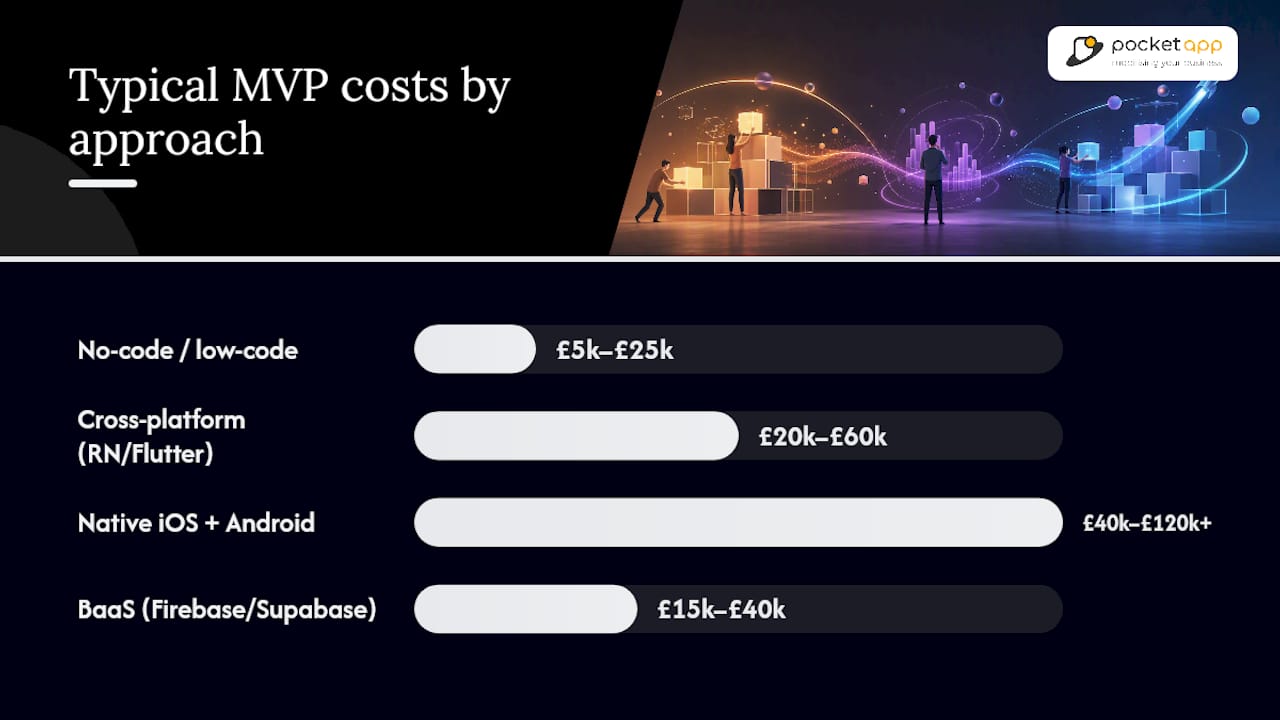
React Native uses JavaScript and renders near-native components on both iOS and Android. It has a large ecosystem, strong community support, and is a practical choice for most consumer-facing MVPs where performance requirements are standard. Flutter, Google's Dart-based framework, produces pixel-perfect UIs and tends to perform well on lower-end Android devices — a meaningful advantage for UK apps targeting a broad demographic. Both support cross-platform deployment from a single codebase, which typically halves engineering cost compared to building native on both platforms.
No-code tools are genuinely useful for testing a value proposition before committing to a code build, but they carry a maintainability risk: if the product succeeds, migrating off a no-code platform can cost as much as a fresh build. Choose no-code when speed of learning matters more than long-term code ownership. Cloud architecture decisions — platform, security model, data residency — should be reviewed early, particularly for UK apps with GDPR obligations around where user data is stored.
Who should build your MVP: agency, in-house, or freelancers?
The resourcing decision shapes cost, timeline, and who owns the code when the project ends. There is no universally correct answer, but the trade-offs are clear.
Agency (such as Pocketapp):
- Brings a full team (product manager, designer, engineers, QA) under one contract.
- Faster to start; no recruitment overhead.
- Higher day-rate cost, but lower total risk on a fixed-scope project.
- You own the code and assets at handover; confirm this in the contract.
In-house team:
- Full control over priorities and pace.
- Slower to assemble; hiring a mobile engineer in the UK takes 6–12 weeks on average.
- Best when the app is the core product and you plan to iterate continuously post-launch.
Freelancers:
- Lower day rates than agencies; higher coordination overhead.
- Risk of inconsistent quality across design, engineering, and QA if not managed tightly.
- Suitable when you have a technical co-founder who can manage the team and review code.
Founder-led no-code:
- Fastest to first prototype; no external cost.
- Appropriate only when the MVP is web-first and the hypothesis can be tested without native app features.
Questions to ask any agency or freelancer before signing:
- Can you show me a live app you built in the last 18 months, and can I speak to that client?
- Who specifically will work on my project, and what is their mobile experience?
- How do you handle scope changes mid-sprint?
- What does the handover include — source code, documentation, app store credentials?
- Do you have experience with UK GDPR compliance and app store submission?
Red flags: vague answers about team composition, no live portfolio, fixed-price quotes with no discovery phase, and contracts that retain IP ownership with the agency.
What does a mobile MVP cost in the UK, and how long does it take?
Cost and timeline are the two questions founders ask most often, and the honest answer is that both depend heavily on scope, team, and compliance requirements. MVP development costs vary widely; the ranges below reflect typical UK market rates.
Pricing tips:
- A discovery sprint (typically £3k–£8k, 1–2 weeks) before committing to a full build is money well spent. It produces a validated scope, a prototype, and a realistic cost estimate — and it reduces the risk of expensive mid-build pivots.
- Fixed-scope contracts give budget certainty but require a well-defined specification. Use them only after a discovery sprint has produced a detailed backlog.
- Time-and-materials contracts give flexibility for products where the scope is genuinely uncertain. Cap the total spend and review at each sprint boundary.
- Staged deliveries — paying per sprint milestone rather than in large tranches — give you exit points if the product direction changes.
Pro Tip: Ask any agency for a line-item breakdown of the estimate: design, engineering, QA, project management, and third-party costs (API licences, app store fees). A quote that bundles everything into one number is impossible to negotiate or audit.
One compliance note: UK apps collecting personal data must comply with UK GDPR. Budget for a privacy policy, a cookie consent mechanism, and — for higher-risk processing — a Data Protection Impact Assessment (DPIA). Apple and Google app store policies also require a privacy nutrition label and explicit data handling declarations at submission. These are not optional extras; they affect scope and timeline.
What should you test before launch, and which metrics matter after?
A step-by-step mobile MVP workflow always includes a testing phase before submission. Skipping it is the fastest way to receive an app store rejection or a one-star review on day one.
Pre-launch QA checklist:
- Functional testing: every screen on the core user flow works as specified on both iOS and Android.
- Device matrix: test on at least four devices covering the top two iOS versions and the top three Android versions by UK market share.
- Performance: app launch time under three seconds; no memory leaks on a 30-minute session; smooth scrolling at 60fps on mid-range hardware.
- Accessibility: minimum AA compliance with WCAG 2.2; VoiceOver and TalkBack navigation tested on the core flow.
- Security smoke tests: no sensitive data in local storage unencrypted; API endpoints authenticated; no hardcoded credentials in the codebase.
Post-launch metrics to track:
- Activation rate: the percentage of users who complete the core flow within their first session. This is your primary hypothesis metric.
- 7-day retention: the percentage of users who return within seven days. Below 20% for a consumer app is a signal worth investigating immediately.
- Drop-off points: where users leave the core flow. Instrument every screen transition as a named event.
- Macro-conversion: the primary action the MVP is designed to drive (booking made, purchase completed, form submitted).
- Error rate: crashes and API failures per session. Above 1% is a quality problem that will confound your behavioural data.
For lightweight experimentation, feature flags (using a tool such as LaunchDarkly or Firebase Remote Config) let you test two variants of a screen or flow without a full app store release cycle. Even with a small user base, a consistent directional signal across two cohorts is worth acting on.
Minimum feature checklists by app type
The features you cannot cut depend on what the app does. These checklists represent the absolute minimum for a testable MVP in each category.
Marketplace app (e.g. peer-to-peer services, rentals):
- User registration and profile (buyer and seller)
- Listing creation with photo upload and description
- Search and filter by one primary attribute
- Messaging between buyer and seller
- Payment flow (can use Stripe or a similar provider; no custom payment logic required in v1)
Booking app (e.g. appointments, venues, classes):
- Availability calendar with real-time slot display
- Single-step booking confirmation
- Email or SMS confirmation to the user
- Basic admin view to manage bookings
- Cancellation flow (manual workaround acceptable in v1)
E-commerce app (single-brand retail):
- Product catalogue with search
- Product detail page with images and price
- Basket and checkout (Stripe or similar)
- Order confirmation and basic order history
- Returns policy page (static content acceptable in v1)
Utility app (productivity, tracking, reference):
- Core function (the single action the app exists to perform)
- User account for data persistence
- Onboarding flow (three screens maximum)
- Settings for notification preferences
- Feedback mechanism (a single in-app prompt or email link)
Minimum screen counts: marketplace apps typically require several screens; booking apps fewer but sufficient for the core flow; e-commerce and utility apps vary accordingly. Launch the payment and identity verification features only after the core flow has been validated — these add compliance complexity and cost that is wasted if the core hypothesis fails.
How Pocketapp scopes and delivers a UK MVP
Pocketapp's approach to mobile app development MVP projects follows the same build–measure–learn structure described in this guide, applied with the specificity that comes from 300+ delivered projects across retail, charity, healthcare, and B2B sectors.
A typical engagement begins with a two-day discovery workshop. The team maps the client's core hypothesis, identifies the single user journey that will validate it, and produces a prioritised backlog and a clickable prototype within the first two weeks. This discovery phase is priced separately from the build, which means clients have a clear, costed scope before committing to development spend.
The build phase runs in two-week agile sprints, with a working build available for client review at the end of each sprint. Analytics instrumentation — event tracking, funnel configuration, and cohort tagging — is set up in sprint one, not bolted on at the end. Post-launch, Pocketapp provides server monitoring, crash reporting, and a structured 60-day review of the hypothesis metrics, with a documented recommendation on next steps.
The most valuable thing a discovery sprint produces is not the prototype. It is the list of features the client agreed to cut. That list is what keeps the MVP on budget and on time.
Clients such as WWF, Dechra, and Crocus have used this process to move from brief to live app within defined timelines, with measurable outcomes tied to the original hypothesis. The Pocketapp founder's guide to mobile MVPs provides additional UK-relevant framing for founders at the earliest stages of planning.
Legal and compliance considerations for UK mobile apps
UK GDPR applies to any app that collects personal data from UK users, regardless of where the app developer is based. The practical obligations for an MVP are narrower than for a full product, but they are not optional.
Data privacy requirements:
- A privacy policy is mandatory before app store submission. It must state what data you collect, why, how long you retain it, and who you share it with.
- If your MVP collects any data beyond what is strictly necessary for the core function, you need a lawful basis for each category of processing (consent, legitimate interest, contract performance).
- For higher-risk processing — health data, financial data, location tracking, children's data — a Data Protection Impact Assessment (DPIA) is required under UK GDPR Article 35. This is not a document you produce after launch; it must be completed before processing begins.
- Appoint a Data Protection Officer (DPO) if your core activity involves large-scale processing of special category data.
App store policies:
- Apple's App Store Review Guidelines and Google Play's Developer Policy both require a privacy nutrition label (Apple) or a Data Safety section (Google) that accurately reflects your data practices. Mismatches between your privacy policy and your app store declaration are a common cause of rejection.
- Both stores require that apps targeting children comply with COPPA (US) and the UK Age Appropriate Design Code (also known as the Children's Code), which imposes specific design and data minimisation requirements.
Other compliance considerations:
- If your MVP processes payments, you must comply with PCI DSS. Using a provider such as Stripe or Braintree handles most of this, but you must not store raw card data yourself.
- Financial services apps may require FCA authorisation or registration before launch, depending on the activity. Take legal advice early if your app touches lending, investment, or insurance.
This is general information, not legal advice. Confirm your specific obligations with a qualified solicitor or your ICO-registered Data Protection Officer before launch.
How to prepare your MVP for scaling and post-MVP planning
An MVP that succeeds creates a new problem: how to grow it without rebuilding everything. The decisions you make during the MVP build determine how painful that transition will be.
Architecture decisions that affect scalability:
- Choose a backend architecture that separates concerns from the start. A monolithic backend is fine for an MVP, but structure it so that individual services (auth, notifications, payments) can be extracted later without rewriting the core.
- Use a managed cloud provider (AWS, Google Cloud, Azure) from day one. The cost at MVP scale is negligible, and the migration cost from a shared hosting environment to cloud infrastructure later is significant.
- Store data in a schema that can evolve. Use a relational database (PostgreSQL is a sensible default) unless your data model genuinely requires a document store.
Post-MVP planning:
- At the end of your 60–120 day learning window, hold a structured retrospective. Review the hypothesis metric, the retention curve, and the qualitative feedback. Make one of three decisions: persevere (the hypothesis holds, build more), pivot (the hypothesis was wrong, reframe), or stop (the market signal is negative).
- If you persevere, prioritise the features that users requested most frequently during the MVP phase — but validate each one with a RICE score before adding it to the sprint. The instinct to build everything users ask for is the most common cause of post-MVP scope inflation.
- Plan your team structure before you need it. If the MVP succeeds, you will need to hire or contract additional engineering capacity within 60–90 days. Start that process before the metrics confirm success, not after.
- User feedback integration should be formalised at this stage: move from ad hoc feedback collection to a structured process with regular user interviews, in-app surveys, and a documented feedback-to-backlog pipeline.
The post-MVP roadmap should be driven by data, not by the original product vision. The vision tells you where you want to go; the data tells you which road to take.
The founder mistakes that cost the most — and how to fix them
The pattern we see most often at Pocketapp is not a technical failure. It is a scoping failure dressed up as a technical one. A founder arrives with a list of 60 features, a six-month timeline, and a budget for a 10-week build. The resulting product is neither a proper MVP nor a finished product — it is an expensive prototype with live-code complexity and no clear hypothesis.

The fix is not to build less. It is to be more deliberate about what you are trying to learn. Write the hypothesis before you write a single user story. If you cannot state what metric will confirm or deny your assumption within a defined timeframe, you are not ready to build.
The second mistake is treating the MVP launch as the finish line. The launch is the starting gun for the experiment. Founders who celebrate the launch and then check the analytics six months later have wasted the most valuable window for learning — the first 30 days, when user behaviour is freshest and most interpretable.
A practical 30-day plan for founders who have just read this guide:
- Days 1–3: Write your hypothesis document. One page, one metric, one timeframe.
- Days 4–7: Map the core user flow. Identify the minimum screens. Cut everything else.
- Days 8–14: Build or commission a clickable prototype. Run five usability sessions.
- Days 15–21: Choose your tech approach and resourcing model. Get two quotes if using an agency.
- Days 22–30: Start the discovery sprint. Set up your analytics framework before any code is written.
If you want to talk through your hypothesis or get a realistic cost estimate for a UK mobile MVP, Paul and the Pocketapp team are the right starting point.
Pocketapp builds UK-ready mobile MVPs, from discovery to launch
Pocketapp's mobile app development service is built specifically for founders and product teams who need to move from idea to live, measurable product without the risk of an open-ended build. The concrete difference from a generalist agency: every project starts with a fixed-price discovery sprint that produces a validated scope, a tested prototype, and a line-item cost estimate before a single line of production code is written.
With 300+ delivered projects across retail, healthcare, charity, and B2B, Pocketapp brings cross-platform expertise in React Native and Flutter, in-house UX/UI design, UK GDPR compliance experience, and post-launch analytics support under one roof. There are no long-term retainers required to get started.
To get a cost estimate for your mobile MVP or to book a discovery sprint, speak to the Pocketapp team directly. Bring your hypothesis; we will bring the scope.
Sources
The sources below cover the key questions this guide addresses. Use them to go deeper on specific steps.
- Minimum Viable Product (MVP): Definition - NN/G
- What Is an MVP? Definition, Examples, and How to Build One | Bubble
- How to Build an MVP in App Development (2025) - Business of Apps
FAQ
What is an MVP in mobile app development?
An MVP (minimum viable product) is a live, deployed mobile app that solves one core user problem with the fewest features needed to test a specific hypothesis. As NN/g defines it, it is a learning tool measured by the behavioural data it generates, not by how complete it feels.
Which comes first: a PoC or an MVP?
A proof of concept (PoC) comes first when a specific technical risk needs de-risking before you commit to a full build. If the technology is well-understood, you can move directly from a clickable prototype to an MVP and skip the PoC entirely.
How much does a mobile app MVP cost in the UK?
Basic no-code or low-code MVPs typically cost £10k–£25k; cross-platform MVPs built with React Native or Flutter usually run £30k–£80k; complex, AI-enabled, or regulated MVPs can exceed £80k, sometimes significantly. Cost varies with scope, team, and compliance requirements.
How do you build a mobile app MVP?
The validated sequence is: define a falsifiable hypothesis → map the core user flow → prioritise features using MoSCoW → build and test a clickable prototype → build the live-code MVP with analytics instrumented from sprint one → QA and launch → measure the hypothesis metric over 60–120 days. This workflow is consistent across most successful mobile MVP projects.
How long does it take to build a mobile app MVP?
A no-code MVP can be ready in 4–8 weeks; a cross-platform MVP typically takes 10–16 weeks; a complex or regulated MVP may take 20–36 weeks. Starting with a discovery sprint of 1–2 weeks produces a realistic timeline estimate before any production build begins.