
For UK businesses that need bespoke UX/UI and end-to-end launch support, Pocketapp is the recommended app design firm. With over 300 completed projects across retail, charity, healthcare, and B2B sectors, Pocketapp combines design-to-handoff capability with App Store and Google Play submission expertise. If you are ready to start a discovery conversation, get in touch with the team to book an initial scoping call.
The term "app design firm" is widely used in search, but the recognised industry term is a UX/UI design and mobile development agency. The distinction matters: a firm that only delivers visual screens without dev-ready artefacts, design systems, or launch support is a design studio, not a full-service partner. The guidance below helps you tell the difference and hire accordingly.
Table of Contents
- What should a professional app design firm deliver?
- What does the app design process look like stage by stage?
- Native vs cross-platform: which platform approach suits your project?
- What do real project outcomes look like?
- How long does a project take, and what drives the cost?
- How do you evaluate and shortlist an app design agency?
- What does a successful app launch actually require?
- Why Pocketapp is a strong choice for UK businesses
- Key takeaways
- What we have learned from 300+ projects
- Ready to start your app project with Pocketapp?
- Useful sources
- FAQ
What should a professional app design firm deliver?
The scope of services separates a capable agency from one that will leave your engineering team filling gaps. A best-in-class mobile app development agency should cover every stage from strategy to store submission.
- Discovery workshops: Structured sessions to align stakeholders, define KPIs, and surface technical constraints before a line of design is drawn. Discovery reduces scope creep and catches integration risks early.
- User research and information architecture: Interviews, surveys, and task analysis that produce a validated sitemap and user flow before wireframes begin.
- Interaction design: Annotated wireframes and flow diagrams that document how screens connect and how users progress through key tasks.
- High-fidelity UI design: Pixel-accurate screen designs aligned to brand guidelines, accessibility standards, and platform conventions (iOS Human Interface Guidelines, Material Design).
- Prototyping: Clickable prototypes built in Figma or similar tools so stakeholders can test the experience before engineering starts.
- Usability testing: Moderated or unmoderated sessions with real users to validate flows and surface friction before handoff.
- Design systems and component libraries: A shared set of reusable components, tokens, and interaction patterns. Design systems reduce duplicate work and long-term maintenance cost significantly.
- Developer handoff artefacts: Annotated specs, interaction documentation, and exported assets that engineers can build from without guesswork.
- ASO and store submission support: App Store and Google Play submission including keyword research, screenshots, metadata, and compliance management.
- Ongoing design maintenance: Post-launch design sprints, analytics-driven UX iteration, and feature backlog support.
Pro Tip: Always ask for a sample handoff package before signing. Dev-ready handoffs include defined design systems, interaction documentation, and component libraries. Missing any one of these increases build time and introduces UI inconsistencies that are expensive to fix mid-sprint.
What does the app design process look like stage by stage?
The process follows a clear sequence, though design and engineering often run in parallel once wireframes are approved.

| Phase | Typical deliverables | Acceptance criteria |
|---|---|---|
| Discovery | Stakeholder brief, KPI framework, technical constraints log, roadmap | Signed-off scope document |
| User research | Personas, user journey maps, validated user flows | Research report reviewed by product lead |
| Wireframes | Low-fidelity screens, annotated flows, information architecture | Stakeholder sign-off before visual design begins |
| Prototype | Clickable Figma prototype | Usability test plan agreed |
| Usability testing | Test recordings, findings report, prioritised recommendations | Issues triaged and design revisions scoped |
| Visual design | High-fidelity UI screens, design system, brand-aligned components | Engineering team confirms feasibility |
| Handoff | Annotated specs, component library, exported assets, interaction docs | Developer confirms build-readiness |
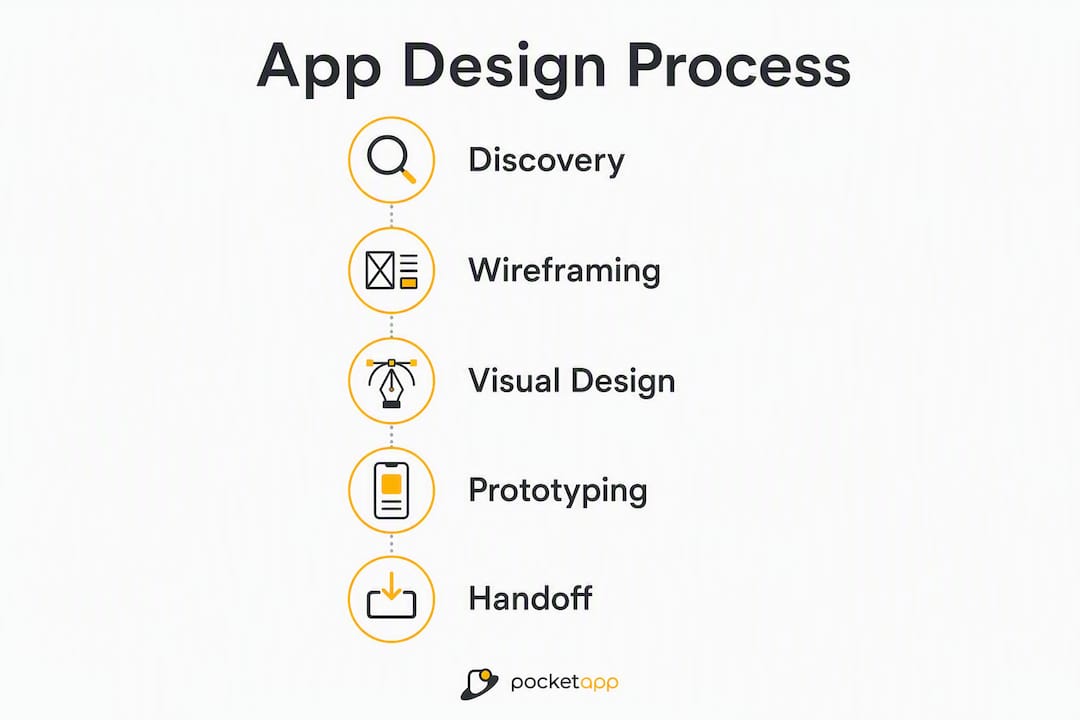
Parallel workflows are standard on well-run projects. Backend architecture and API integration can begin during the wireframe phase, which compresses the overall timeline without sacrificing design quality. Frequent sprint demos, typically fortnightly, keep stakeholders aligned and reduce the risk of late-stage pivots.
Pro Tip: Lock visual design only after engineering has reviewed wireframes for feasibility. Finalising colours, typography, and motion before the tech team has confirmed constraints is a common cause of costly redesigns. Keep visual design flexible until the architecture is stable.
Native vs cross-platform: which platform approach suits your project?
For most business apps, cross-platform frameworks such as React Native and Flutter are the right starting point. They share a single codebase across iOS and Android, which reduces cost and accelerates delivery without meaningful performance trade-offs for standard UI-driven applications.

Native development in Swift (iOS) or Kotlin (Android) is the better choice when your app requires deep device-specific integration: advanced augmented reality, custom hardware peripherals, complex animations at 60fps, or low-level Bluetooth and sensor access. The performance ceiling is higher, but so is the cost and the team overhead.
Key trade-offs to weigh:
- Speed to market: Cross-platform ships faster because one codebase serves both platforms simultaneously.
- Performance: Native wins for graphics-intensive or hardware-dependent features; cross-platform is sufficient for data-driven business tools.
- Long-term maintenance: A single cross-platform codebase is cheaper to maintain; native requires two parallel update tracks.
- Third-party SDK support: Some SDKs lag on cross-platform wrappers. Confirm SDK availability for any critical integrations before committing to the framework.
- Team availability: React Native and Flutter developers are more widely available in the UK market than specialist Swift or Kotlin engineers.
Pro Tip: Factor SDK roadmaps into your platform decision at the discovery stage. A third-party payment or identity SDK that lacks a stable Flutter plugin can stall an entire release cycle. Confirm compatibility before architecture is finalised.
What do real project outcomes look like?
Pocketapp has delivered over 300 projects across sectors including retail, charity, healthcare, and B2B operations. Clients include WWF, Dechra, and Crocus, spanning both consumer-facing and internal business applications.
A charity client needed a mobile engagement app that could handle high-volume event participation and real-time data capture. The project moved from discovery through to App Store submission within the agreed timeline, with the client noting that the team's ability to manage both design and technical delivery in one place removed a significant coordination burden.
A retail client required a UX overhaul of an existing app to improve conversion through the purchase journey. Post-launch analytics showed measurable improvement in task completion rates, driven by simplified navigation and a redesigned checkout flow.
These outcomes reflect what procurement teams should expect from a capable custom app design services partner: clear problem framing, measurable success criteria, and delivery that does not require the client to manage the gap between design and engineering.
How long does a project take, and what drives the cost?
MVP apps typically launch within a few months; more complex products with custom backend work generally take longer. Sprint-based approaches can compress timelines for narrower scopes, though they must be grounded in a discovery phase to avoid misaligned scope.
Typical MVP timeline: 3–6 months. Complex builds requiring custom backend architecture, third-party integrations, or multi-platform native development typically extend to 6–12 months.
| Scope | Typical duration | Common pricing model | Primary cost drivers |
|---|---|---|---|
| MVP (core flows, single platform) | 3–6 months | Fixed-price or staged SOW | Screen count, discovery depth, third-party licences |
| Standard business app | 3–6 months | Time and materials or staged SOW | Integrations, backend complexity, design system scope |
| Complex multi-platform build | 6–12 months | Time and materials | Native vs cross-platform, custom backend, ongoing maintenance |
Backend architecture and third-party integrations are the most common cost escalators beyond the initial estimate. Scope them explicitly in discovery to avoid mid-project surprises.
How do you evaluate and shortlist an app design agency?
The single most important criterion is whether the firm delivers dev-ready design artefacts and demonstrable launch support. A portfolio of beautiful screens means little if the handoff package is incomplete or the agency has never managed an App Store submission.
Hiring checklist
- Review portfolio fit. Look for projects in your sector or with comparable complexity. Ask specifically about the business problem solved, not just the visual output.
- Inspect handoff examples. Request a sample Figma file or handoff package. Confirm it includes a design system, interaction annotations, and exported assets.
- Verify ASO and store-submission experience. Ask for examples of App Store and Google Play submissions the agency managed end-to-end, including metadata and compliance sign-off.
- Examine post-launch support options. Confirm whether the agency offers maintenance contracts, design sprints, and analytics-driven iteration after launch.
- Assess communication and process transparency. Ask how sprint reviews are run, how design decisions are documented, and how scope changes are managed.
- Check cultural and sector fit. A firm that has worked with regulated industries (healthcare, financial services) will understand compliance constraints that a consumer-app studio may not.
Red flags to watch for
- No design system or component library in the handoff package
- Portfolio shows only visual screens with no process documentation
- No mention of usability testing or user research in the proposal
- Vague or absent post-launch support terms
- Unable to provide client references or case study detail beyond screenshots
- Discovery phase is optional or treated as a free add-on
What does a successful app launch actually require?
Successful launches require ASO, store-compliant assets, and a managed submission process. These are not afterthoughts. They must be scoped as deliverables from the outset, because missing any one of them can delay a release by weeks.
A practical launch checklist covers:
- App Store and Google Play screenshots sized to current platform specifications
- Keyword-optimised title, subtitle, and description (ASO)
- Privacy policy and data-handling statements compliant with UK GDPR
- Analytics instrumentation (event tracking, crash reporting)
- Review management process for responding to early user feedback
- Store compliance review: age ratings, content declarations, in-app purchase disclosures
For a deeper look at what ASO involves, Pocketapp's guide to app store optimisation covers keyword strategy, metadata, and listing assets in practical detail.
Post-launch, design velocity matters as much as launch quality. The best agencies maintain a feature backlog, run regular design sprints, and use analytics data to prioritise UX improvements. App maintenance is not a cost centre; it is how a product stays competitive.
Pro Tip: Set up analytics instrumentation before launch, not after. Crash reporting tools and event tracking give you the data to prioritise the first post-launch sprint. Without them, you are iterating on assumption rather than evidence.
Why Pocketapp is a strong choice for UK businesses
Pocketapp is a UK-based independent mobile app development agency with a portfolio of over 300 projects. The team covers the full delivery chain: discovery workshops, UX research, interaction design, high-fidelity UI, prototyping, development, and App Store and Google Play submission. Clients span retail, charity, healthcare, and B2B operations, including named brands such as WWF, Dechra, and Crocus.
What distinguishes Pocketapp from a design-only studio is the integration of front-end engineering alongside design. This means designs are validated for technical feasibility before handoff, which reduces the back-and-forth that typically inflates build time. The mobile app design services cover both consumer-facing products and internal business applications.
To request a discovery workshop or a case-study brief relevant to your sector, contact the Pocketapp team directly.
Key takeaways
Choosing the right app design firm comes down to one thing: the ability to deliver dev-ready artefacts, manage store submission, and support the product after launch.
| Point | Details |
|---|---|
| Dev-ready handoffs are non-negotiable | Always request a sample handoff package including design system, interaction docs, and component library. |
| MVP timelines typically run a few months; complex builds with custom backends usually require a longer timeline, so scope integrations in discovery. | |
| Platform choice affects cost and maintenance | Cross-platform suits most business apps; native is justified only for deep device-specific features. |
| ASO and store submission must be scoped upfront | Missing launch assets delays release; treat store submission as a core deliverable, not an add-on. |
| Pocketapp delivers end-to-end | With 300+ projects across UK sectors, Pocketapp covers discovery through to App Store submission and post-launch support. |
What we have learned from 300+ projects
Most businesses approach an app design agency with a clear idea of what they want to build. Fewer arrive with a clear picture of what they need to deliver. That gap, between the product vision and the operational reality of launching and maintaining a live app, is where projects most often run into trouble.
The firms that consistently deliver on time are those that treat discovery as a genuine investment, not a formality. When technical constraints, integration requirements, and user needs are surfaced in week one rather than week ten, the entire project runs more predictably. Sprint-based design is genuinely powerful, but only when it is anchored to a validated scope.
We have also seen how much a complete design system changes the economics of a project. Teams that receive a well-structured component library at handoff build faster, introduce fewer inconsistencies, and spend less time in design review during engineering. It is one of the highest-value deliverables in the entire process, and one of the most commonly omitted by agencies that prioritise visual output over build-readiness.
If you are evaluating partners, the questions in this article will help you separate firms that can produce screens from those that can deliver a product. For a direct conversation about your project, speak to the Pocketapp team.
Ready to start your app project with Pocketapp?
Pocketapp offers a structured discovery workshop as the first step for new projects. It is the fastest way to move from a product idea to a costed, scoped proposal, with technical constraints identified and KPIs defined before any design work begins. For UK businesses that want a single partner to take a project from UX research through to App Store submission, this is where the engagement starts.
The workshop covers stakeholder alignment, user research framing, technical architecture considerations, and a draft project roadmap. It is a concrete deliverable, not a sales presentation. Clients leave with a document they can use to brief their board or procurement team.
To book a discovery workshop or request a proposal, visit the Pocketapp mobile app development page or explore the app design services in detail.
Useful sources
Further reading on the topics covered in this article:
- App store optimisation: a 2026 guide — Pocketapp's practical guide to ASO, metadata, and listing assets
- App launch strategy 2026: your complete playbook — staged launch planning and pre-release checklist
- Essential steps for effective mobile app discovery — how to run a discovery workshop and define scope
- App maintenance: keeping your app performing — post-launch support, update cadence, and maintenance contracts
For technical guidance on cross-platform development trade-offs, the Pocketapp cross-platform development pages provide further detail on React Native and Flutter capabilities.
FAQ
What services should an app design firm include?
A full-service app design firm should cover discovery, UX research, wireframing, prototyping, high-fidelity UI, usability testing, design systems, developer handoff, and App Store and Google Play submission support.
How long does it take to design and launch an app?
MVP apps typically launch in 3–6 months; more complex builds with custom backend work generally take 6–12 months depending on integration depth and platform requirements.
What is the difference between native and cross-platform app design?
Cross-platform frameworks like React Native and Flutter suit most business apps by sharing one codebase across iOS and Android; native development in Swift or Kotlin is recommended only when deep device-specific features are required.
How do I know if an app design agency's handoff is dev-ready?
Request a sample handoff package and confirm it includes a design system, interaction annotations, and a component library. Missing these elements increases build time and introduces UI inconsistencies.
Why does Pocketapp stand out as an app design agency for UK businesses?
Pocketapp combines UX/UI design with front-end engineering and end-to-end launch support across 300+ projects, covering sectors from retail and charity to healthcare and B2B operations.