
TL;DR:
- App store optimisation improves an app’s visibility, ranking, and conversion rate across app stores through targeted metadata, visual assets, and engagement signals. Many developers underestimate the effort required, leaving substantial growth potential untapped. Regular measurement, testing, and updates are essential for sustained success in a competitive environment.
App store optimisation (ASO) is the practice of improving an app's discoverability and conversion rate on platforms like the Apple App Store and Google Play. Where web SEO relies on backlinks and domain authority, ASO is driven by download velocity, engagement signals, and metadata relevance. The Apple App Store attracts over 850 million weekly visitors, which means the competition for visibility is fierce and the reward for getting it right is substantial. Yet over 70% of app developers spend less than two hours monthly on ASO. That gap between effort and opportunity is exactly where well-informed teams win.
What is app store optimisation and why does it matter?
App store optimisation is defined as the process of improving an app's ranking, visibility, and install conversion rate within app store search results and browse sections. It operates across two parallel axes: search optimisation, which determines whether users find your app, and conversion rate optimisation, which determines whether they install it once they do. Both axes work symbiotically but require entirely different tactics. Treating them as one task is one of the most common mistakes developers make.

The importance of app store optimisation becomes clear when you look at acquisition economics. Organic installs from ASO are often the largest acquisition channel for consumer apps, and the results compound over time. Unlike paid campaigns that stop delivering the moment you cut spend, a well-optimised listing continues to attract downloads for months. For business owners and marketers weighing up where to invest, that compounding return makes ASO one of the highest-leverage activities available.
ASO also differs from traditional web SEO in a fundamental way. Store algorithms prioritise download velocity, engagement, and retention rather than backlinks or domain authority. A new app with strong early engagement can outrank an established competitor. That dynamic makes ASO genuinely accessible to teams without large marketing budgets, provided they understand what the algorithm actually rewards.
What are the core components of ASO?
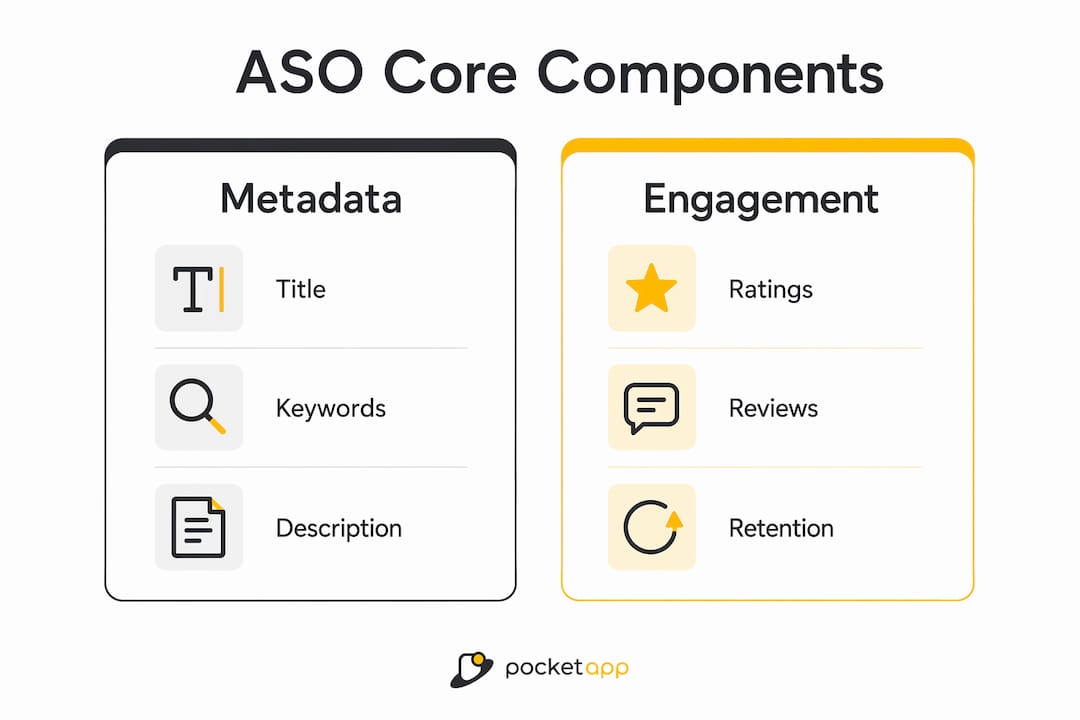
ASO breaks down into two categories: metadata optimisation and visual asset optimisation. Each category contains specific elements that influence either ranking or conversion, and sometimes both.
Metadata optimisation covers the textual signals that store algorithms read:
- App title: The single most weighted ranking field. Include your primary keyword naturally.
- Keyword field (Apple) or description (Google): Apple provides a dedicated 100-character keyword field. Google indexes the title and description directly.
- Short description and long description: Google reads these for keyword relevance. Apple's long description does not affect ranking but does influence conversion.
- Developer name and category: Both contribute to discoverability, particularly for browse traffic.
Visual asset optimisation covers the elements users see before they decide to install:
- App icon: The first visual signal. A strong icon increases tap-through rate from search results.
- Screenshots: Conversion layer optimisation accounts for 60–80% of the user install decision. Screenshots carry most of that weight.
- Preview video: Effective for demonstrating utility in apps where function is hard to convey in static images.
User engagement signals form the third pillar. Ratings, reviews, retention rates, and session frequency all feed into store algorithms. A high rating does not just reassure users; it directly influences ranking position.
Pro Tip: Do not treat your app icon as a branding exercise alone. Test it as a conversion asset. A single icon change has been known to shift install rates by double digits.
How do ASO strategies differ between apple and google play?
The Apple App Store and Google Play share the same goal but use different mechanisms to rank apps. Copying metadata directly between stores is a reliable way to underperform on both.
| Factor | Apple App Store | Google Play |
|---|---|---|
| Keyword indexing | Dedicated 100-character keyword field | Title plus first 120 characters of description |
| Description ranking | Long description does not affect ranking | Full description is indexed for keywords |
| Behavioural signals | Ratings, retention, engagement | Crash rates, uninstall rates, engagement |
| Advanced features | In-App Events, Custom Product Pages | Promotional content, store listing experiments |
| A/B testing | Custom Product Pages for variant testing | Store listing experiments built into console |
Apple's 100-character keyword field means every character counts. You should not repeat words already in your title, and you should avoid spaces between keywords since commas serve as separators. Google, by contrast, rewards a description written for humans that naturally incorporates target terms. Keyword stuffing in a Google Play description actively harms both ranking and conversion.
Google Play also incorporates app stability metrics such as crash rates and uninstall rates into its ranking algorithm. Apple does not weight these signals in the same way. This means a technically unstable app will lose ground on Google Play regardless of how well its metadata is optimised. For developers, this makes code quality a direct ASO concern on Android, not just a user experience issue.
Apple introduced In-App Events and Custom Product Pages as tools for advanced segmentation. Custom Product Pages let you create up to 35 distinct versions of your store listing, each targeting a different user segment or acquisition channel. This is particularly powerful when running Apple Search Ads, where top search results convert at over 60% and a matched landing page amplifies that rate further.
Pro Tip: On Google Play, write your first 120 characters of the description as if they are a standalone pitch. That is the section the algorithm indexes most heavily, and it is also what users read before tapping "read more."
What practical techniques can developers and marketers use?
Effective ASO is built on measurement before action. Establishing baseline metrics before running any test is the discipline that separates teams who improve consistently from those who guess. Use App Store Connect and Google Play Console as your primary data sources before reaching for third-party tools.
A structured approach to implementation looks like this:
- Audit your current listing. Record your existing keyword rankings, impression-to-install conversion rate, and average rating. This is your baseline.
- Conduct keyword research. Identify terms with high relevance and achievable competition levels. Tools like AppTweak, Sensor Tower, and MobileAction each provide keyword volume and difficulty scores for both stores.
- Rewrite metadata. Update your title, keyword field (Apple), and description (Google) based on research findings. Prioritise terms that match user intent rather than broad category terms.
- Test visual assets. Use Google Play's store listing experiments or Apple's Custom Product Pages to A/B test icons and screenshots. Run tests for at least two weeks to reach statistical significance.
- Monitor and iterate. Check keyword rankings weekly. Review conversion data after each change. ASO is a continuous process that adapts to algorithm changes and competitor moves.
Common pitfalls to avoid:
- Changing multiple elements simultaneously, which makes it impossible to attribute results
- Ignoring review responses, which affect both user perception and algorithmic signals
- Treating the app description as a legal document rather than a conversion tool
- Neglecting to update metadata after major feature releases
For deeper guidance on improving app discoverability, Pocketapp's 2025 strategy guide covers the latest ranking shifts in detail.
Pro Tip: High impression volume with low conversion does not just waste traffic. Poor keyword conversion signals to the algorithm that your keyword is a poor match, which actively drops your ranking for that term.
How do in-app events and promotional content enhance ASO?
In-App Events on Apple and promotional content on Google Play represent the most underused tier of ASO. Advanced marketers use these features to create fresh entry points into their app listing, bypassing the static limitations of a standard product page.
Apple allows up to 5 concurrent In-App Events which appear in search results, the Today tab, and editorial placements. Each event has its own card with a title, short description, and visual. This means a well-timed event can surface your app to users who were not actively searching for it. Google Play's promotional content serves a similar function, supporting discounts, seasonal campaigns, and feature announcements.
Best practices for using these features effectively:
- Match event messaging to user segment. A re-engagement event for lapsed users should use different language than an acquisition event for new users.
- Use deep linking. In-App Events require deep links to route users directly into the relevant in-app experience from the event card. Without this, users land on the home screen and drop off.
- Time events around genuine activity. Seasonal campaigns, product launches, and content updates all provide legitimate hooks. Fabricated urgency performs poorly and damages trust.
- Track event-specific conversion. Measure installs and re-opens attributed to each event separately from organic baseline traffic.
The algorithmic benefit is real. Events generate fresh impressions and engagement signals, both of which feed positively into ranking. An app that runs three or four well-executed events per year will accumulate engagement data that a static listing simply cannot generate. For a broader view of how ASO has evolved as a discipline, the historical context helps explain why these features now matter so much.
Key takeaways
App store optimisation succeeds when metadata, visual assets, and engagement signals are treated as one connected system, not three separate tasks.
| Point | Details |
|---|---|
| ASO has two axes | Search optimisation drives visibility; conversion optimisation drives installs. Both require distinct tactics. |
| Stores use different signals | Apple indexes a keyword field; Google indexes the description. Copy-pasting metadata between stores reduces performance on both. |
| Visuals drive install decisions | Screenshots and icons account for 60–80% of the install decision. Test them as conversion assets, not design choices. |
| Measure before you change | Establish baseline metrics in App Store Connect or Google Play Console before running any A/B test. |
| ASO is ongoing | Algorithm changes, competitor updates, and seasonal shifts mean ASO requires regular review and iteration, not a one-time setup. |
Why most apps are leaving downloads on the table
From my experience working across hundreds of app projects, the single most common ASO mistake is treating it as a launch activity. Teams spend weeks perfecting their listing before release, then leave it untouched for six months while the algorithm moves on and competitors iterate. The listing that ranked well in January often struggles by June, not because anything broke, but because the competitive context shifted and nobody noticed.
The second thing I see consistently underestimated is the screenshot set. Developers tend to treat screenshots as documentation, showing features in sequence. Users treat them as a pitch. They scan left to right in under three seconds and decide whether the app solves their problem. I have seen apps double their conversion rate purely from a screenshot redesign, with no metadata changes at all. That is the kind of result that paid acquisition cannot replicate at the same cost.
There is also a tendency to conflate app quality with ASO performance. A genuinely excellent app with poor metadata will underperform a mediocre app with sharp optimisation, at least in the short term. The goal is to align both. Good app usability testing feeds directly into ASO by surfacing the language real users use to describe the app, which is often different from what the development team assumes. That user language belongs in your metadata.
ASO is not a shortcut. It is a discipline. The teams who treat it as a continuous measurement cycle, rather than a checklist, are the ones who build lasting organic growth.
— Paul
How Pocketapp can help you build an app that ranks
Building an app that performs well in the store starts long before the listing goes live. Pocketapp has delivered over 300 mobile projects for brands including WWF, Dechra, and Crocus, and that experience shapes how we approach every stage of development with store performance in mind.
From mobile app development grounded in technical stability to app design services that treat your icon and screenshots as conversion assets from day one, Pocketapp builds apps that are ready to rank. If you are planning a new app or looking to improve the store performance of an existing one, speak to the Pocketapp team about how development and design decisions made early can compound into significant ASO gains later.
FAQ
What is the difference between ASO and app store SEO?
App store SEO refers specifically to keyword ranking within store search results. ASO is broader, covering both search visibility and conversion rate optimisation through visual assets, ratings, and engagement signals.
How long does ASO take to show results?
Metadata changes typically affect keyword rankings within one to two weeks. Visual asset changes can influence conversion rates within days of an A/B test going live, though statistically significant results usually require two to four weeks of data.
Does ASO work the same way on apple and google play?
No. Apple uses a dedicated keyword field that does not appear publicly, while Google indexes the full description. Google also factors in crash rates and uninstall rates, which Apple does not weight in the same way.
How often should i update my app store listing?
ASO is a continuous optimisation process. Review keyword rankings monthly, update metadata after major feature releases, and run visual asset tests at least quarterly to stay competitive.
Can in-app events improve my app's ranking?
Yes. In-App Events on Apple generate fresh impressions and engagement signals that feed into the ranking algorithm. Running regular, well-targeted events creates algorithmic momentum that a static listing cannot produce on its own.