
TL;DR:
- A successful app launch in 2026 relies on a structured 90-day process, disciplined release gates, and intense marketing efforts. Continuous post-launch optimization and careful ASO are essential for sustained visibility and growth beyond the initial boost window. Prioritizing key assets like screenshots and maintaining quality control during every phase significantly improve chances of long-term success.
A successful app launch strategy in 2026 is defined by three non-negotiable pillars: structured preparation across a 90-day timeline, concentrated marketing intensity at the moment of release, and continuous post-launch optimisation. The mobile app market rewards founders who treat launch not as a single event but as a disciplined campaign. This guide covers every phase, from App Store Optimisation (ASO) and release gating to beta testing and launch week tactics, giving you a clear framework to maximise visibility and user acquisition from day one.
What are the key phases of an app launch strategy 2026?
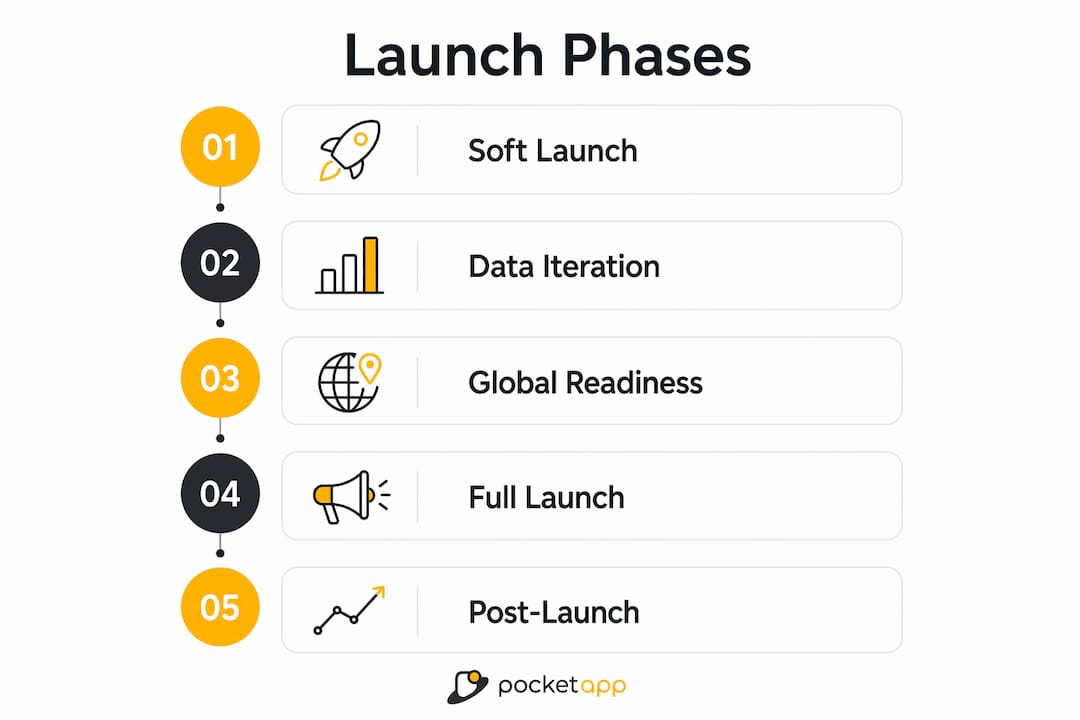
A professional 2026 mobile app launch spans at least 90 days, structured across four distinct phases: soft launch and foundation building, data-driven iteration, global readiness, and the launch event itself. This is not a suggestion. Teams that compress this timeline consistently produce weaker first impressions, lower ratings, and slower growth curves.
The 90-day launch playbook breaks down as follows:
- Days 90–61 (soft launch and foundation): Release to a limited audience. Collect crash reports, retention data, and early user feedback. Set your baseline metrics before any marketing spend.
- Days 60–31 (data-driven iteration): Use what you learned in the soft launch to fix friction points, refine onboarding, and test your core value proposition with real users.
- Days 30–1 (global readiness): Finalise ASO assets, localise metadata and screenshots for target markets, brief press contacts, and schedule paid campaigns.
- Day 0 (launch event): Execute your concentrated marketing push across all channels simultaneously.
Each phase ends with a release gate: a predefined set of criteria that must be met before you progress. If your day 60 retention rate is below your target, you do not move to global prep. You iterate. This discipline is what separates launches that build momentum from those that stall in the first fortnight.
Pro Tip: Set your release gate criteria in writing before the soft launch begins. Agreeing on success metrics after you have seen the data introduces bias and leads to premature progression.
How to design and optimise your app store presence for maximum conversion
ASO is the practice of improving your app's visibility and conversion rate within the App Store and Google Play. It is the closest analogue to SEO in the mobile world, and it deserves the same level of rigour.

Start with keyword research. Identify the terms your audience actually searches for, not the terms you wish they used. Tools like AppFollow, Sensor Tower, and AppTweak each approach keyword discovery differently, but all three surface search volume and difficulty data you need before writing a single word of metadata.
Your metadata structure should follow this priority order:
- Title: Include your primary keyword. The title carries the highest algorithmic weight of any metadata field.
- Subtitle (App Store) or short description (Google Play): Your secondary keyword opportunity. Keep it benefit-led and under 30 characters.
- Keyword field (App Store only): No spaces after commas, no repetition of words already in your title or subtitle.
- Long description: Written for humans first, algorithms second. Lead with your strongest benefit in the first two lines, since most users never tap "more."
The first two screenshots carry the majority of conversion weight in any store listing. High-contrast text and benefit-led headers on those first two frames decide whether a user explores your listing or leaves. Many founders spend weeks on their icon and minutes on their screenshots. That is the wrong ratio.
| ASO element | Priority | Common mistake |
|---|---|---|
| Title | Critical | Omitting the primary keyword |
| First two screenshots | Critical | Feature-led rather than benefit-led copy |
| Subtitle / short description | High | Generic tagline with no keyword value |
| Promo video | Medium | Too long; users drop off after 15 seconds |
| Long description | Medium | Burying the core benefit below the fold |
Pro Tip: Run A/B tests on your screenshots before launch using tools like Storemaven or SplitMetrics. A 10% improvement in conversion rate compounds significantly over the life of the app.
What operational best practices ensure a smooth technical launch?
Technical readiness is not a checklist item you tick the night before release. It is a process that runs in parallel with your marketing preparation throughout the 90-day timeline.
Release gates act as decision points with observable success metrics, preventing premature progression between build, beta, and submission phases. They stop competing launch goals from pulling your team in different directions at the worst possible moment. Define your gates early and enforce them without exception.
Your QA process must go well beyond the "happy path." Testing edge cases such as permission denial, connectivity loss, and invalid inputs is critical. Failure in these scenarios produces negative early reviews, and negative early reviews kill organic momentum before the algorithm has a chance to work in your favour.
Key technical practices to embed before launch:
- CI/CD pipeline: Automate your build and test process so that every code change is validated before it reaches a human reviewer.
- Feature flags: Use tools like LaunchDarkly or Firebase Remote Config to toggle features on and off without a new app submission.
- Phased rollout: Both the App Store and Google Play allow you to release to a percentage of users first. Use this to catch production issues before they affect your entire user base.
- Incident response plan: Know who is on call on launch day, what your escalation path is, and how quickly you can push a hotfix.
Beta testing with representative users catches device-specific bugs and improves early reviews. Even a small closed beta group of 20–50 users provides feedback that internal QA consistently misses, because real users behave in ways your team never anticipates.
Pro Tip: Use TestFlight for iOS and Google Play's internal testing track for Android. Recruit beta testers from your target market, not from your own team. Internal testers are too familiar with the product to find the friction points that matter.
For a deeper look at release management, the app deployment process guide from Pocketapp covers phased rollout and CI/CD readiness in detail.
How can concentrated marketing during launch week maximise visibility?
The new app algorithmic boost lasts 7–30 days post-launch, elevating your app in "New Apps" and editorial sections. This boost occurs once and cannot be re-triggered by updates. That fact alone should shape your entire marketing strategy. You get one window. Use it fully.
The principle here is density over duration. Concentrated marketing within a 48-hour window creates a sharp spike in downloads that signals quality to store algorithms. A slow rollout spread over two weeks produces a fraction of the algorithmic impact, even if the total download count is identical.
Execute your launch week in this sequence:
- 48 hours before launch: Brief your press contacts with an embargo. Send review copies to relevant journalists and bloggers. Post a teaser to your community channels.
- Launch day, 08:00: Publish your Product Hunt listing. Post across LinkedIn, X, and any relevant Reddit communities simultaneously. Activate your paid campaigns.
- Launch day, midday: Send your email list announcement. This is your warmest audience and the most likely source of immediate five-star reviews.
- Launch day, 18:00: Engage every comment, reply, and review. Algorithmic signals include engagement rate, not just download volume.
- Day 2: Follow up with any press contacts who have not yet covered the launch. Share early traction numbers if they are strong.
Visual consistency across your store listing and marketing channels matters more than most teams realise. Your Product Hunt thumbnail, your social graphics, and your first two screenshots should feel like the same campaign. Inconsistency creates doubt.
Pro Tip: Schedule your launch for a Tuesday or Wednesday. App store editorial teams review new submissions at the start of the week, and mid-week launches avoid the noise of Monday announcements and the low-engagement Friday drop-off.
What post-launch optimisation steps drive sustained app growth?
The launch event is not the finish line. The new app boost window gives you elevated visibility for up to 30 days. What you do with that traffic determines whether your app builds a sustainable growth engine or fades after the first month.
Continuous post-launch optimisation including A/B testing of screenshots, keyword tracking, and localisation drives sustained growth. Small, data-driven changes compound over time and maintain competitive ranking long after the initial boost expires.
Your post-launch routine should cover:
- Keyword tracking: Monitor your rankings weekly using AppFollow or Sensor Tower. Identify keywords where you rank in positions 6–15 and target those for metadata refinement, since they offer the highest return on effort.
- Conversion funnel analysis: Track the drop-off between store page views and installs. If your conversion rate falls below your category benchmark, your screenshots or description need updating.
- Review engagement: Respond to every one-star and two-star review within 48 hours. A thoughtful response to a negative review is visible to every future user who reads it.
- Creative refresh: Update your screenshots for major app updates and seasonal campaigns. Stale assets signal an abandoned product to both users and algorithms.
- Localisation: Translating metadata and screenshots into additional languages opens entirely new markets without requiring a single line of new code.
For practical guidance on keeping users engaged after acquisition, the Pocketapp article on increasing app engagement covers retention mechanics and in-app behaviour in depth.
Key takeaways
A successful app launch in 2026 requires a 90-day structured timeline, disciplined release gating, concentrated marketing intensity, and relentless post-launch optimisation to sustain the visibility gained at launch.
| Point | Details |
|---|---|
| Use a 90-day timeline | Structure your launch across four phases: soft launch, iteration, global prep, and launch event. |
| Prioritise your first two screenshots | These carry the greatest conversion weight in any store listing; treat them as your primary marketing asset. |
| Enforce release gates | Define measurable criteria for each phase transition and do not progress until they are met. |
| Concentrate your marketing | A 48-hour burst of coordinated activity outperforms a slow rollout in triggering algorithmic visibility. |
| Optimise continuously post-launch | Track keywords, refresh creatives, and respond to reviews weekly to sustain growth beyond the initial boost window. |
What I have learned from watching launches succeed and fail
The single most common mistake I see from businesses entering the mobile market is treating the launch date as the goal. It is not. The launch date is the moment your preparation either pays off or exposes its gaps.
The teams that execute well share one habit: they make decisions based on data from their soft launch, not on instinct or internal opinion. When the retention numbers from days 1, 7, and 30 tell you something is broken, you fix it before you spend a pound on paid acquisition. Spending marketing budget to drive users into a leaky funnel is one of the most expensive mistakes in mobile.
The release gate discipline is harder to maintain than it sounds. There is always pressure to ship. A board wants to see the product live. A competitor appears to be moving faster. In my experience, the teams that hold the gate and fix the problem first consistently outperform those that launch early and patch later. The app development tips that matter most are rarely about technology. They are about process.
The post-launch phase is where I see the most value left on the table. Founders celebrate the launch, then move on to the next feature. Meanwhile, their keyword rankings drift, their screenshots go stale, and their review response rate drops to zero. The algorithmic boost is a gift. Squander it and you will spend months trying to recover ground that was yours for free.
Choose your development and launch team carefully. The technical quality of your app and the quality of your ASO assets are not separable concerns. Both require expertise, and both determine your outcome.
— Paul
How Pocketapp supports your 2026 app launch
Planning a mobile app launch is one thing. Executing it with the technical quality and ASO precision that 2026 demands is another. Pocketapp has delivered over 300 mobile projects for clients including WWF, Dechra, and Crocus, covering every phase from discovery and design through to deployment and post-launch optimisation.
Whether you need a development partner to build your app to the standard your launch strategy requires, or expert guidance on ASO and release planning, Pocketapp brings the experience to get it right the first time. Explore Pocketapp's mobile app development services to see how the team can support your 2026 release from concept to store listing.
FAQ
What is an app launch strategy?
An app launch strategy is a structured plan covering pre-launch preparation, store optimisation, marketing execution, and post-launch iteration to maximise visibility and user acquisition. A professional 2026 strategy spans at least 90 days.
How long should an app launch timeline be in 2026?
The recommended app launch timeline is 90 days, divided into soft launch, data-driven iteration, global readiness, and the launch event. Compressing this timeline increases the risk of poor early ratings and weak algorithmic performance.
What is ASO and why does it matter for launch?
ASO (App Store Optimisation) is the process of improving your app's metadata, screenshots, and ratings to increase visibility and conversion in the App Store and Google Play. Strong ASO from day one is critical because the new app algorithmic boost cannot be re-triggered after launch.
How do release gates improve a mobile app launch?
Release gates are predefined success criteria that must be met before progressing from one launch phase to the next. They prevent teams from shipping prematurely and protect the quality of the first user experience.
When is the best time to concentrate marketing for an app launch?
Concentrate your marketing and PR efforts within a 48-hour window on launch day. This creates a spike in downloads that signals quality to store algorithms, producing stronger ranking outcomes than a slow rollout over several weeks.