
TL;DR:
- Most business leaders recognize mobile's importance but few treat it as the core driver of their strategy. Google’s mobile-first indexing in 2024 makes mobile experience the key factor in search rankings, affecting visibility and revenue. Continuous measurement, user-centric design, and alignment with business outcomes are essential for leveraging mobile as a strategic business system.
Most business leaders know mobile matters. Far fewer treat it as the commercial engine it actually is. Understanding why mobile strategy is important goes well beyond responsive design or a mobile-friendly website. It touches your search visibility, your revenue per visitor, your internal operations, and whether customers trust you enough to complete a transaction. The gap between leaders who grasp this and those who still treat mobile as a scaled-down desktop experience is, increasingly, a gap in market share.
Table of Contents
- Understanding why mobile strategy is important for search visibility
- The financial imperative: how mobile performance affects revenue and customer retention
- Mobile strategy's role in operational effectiveness and real-time decision-making
- How mobile optimisation drives customer trust, engagement, and conversion beyond the first interaction
- Measuring and iterating your mobile strategy for sustainable business impact
- Rethinking mobile strategy: beyond design to strategic business system
- How Pocket App supports your mobile strategy journey
- Frequently asked questions
Key Takeaways
| Point | Details |
|---|---|
| Mobile-first indexing matters | Google ranks your site primarily on its mobile version, so mobile optimisation affects overall search visibility. |
| Page speed drives revenue | Faster mobile sites reduce abandonment and increase conversions, directly impacting your bottom line. |
| Mobile BI speeds decisions | Accessing analytics on mobile helps leaders react quickly and improve operational efficiency. |
| Mobile UX builds trust | A well-designed mobile experience increases engagement and supports customer retention across sessions. |
| Measure and iterate | Combining analytics and user feedback enables continuous improvements in your mobile strategy. |
Understanding why mobile strategy is important for search visibility
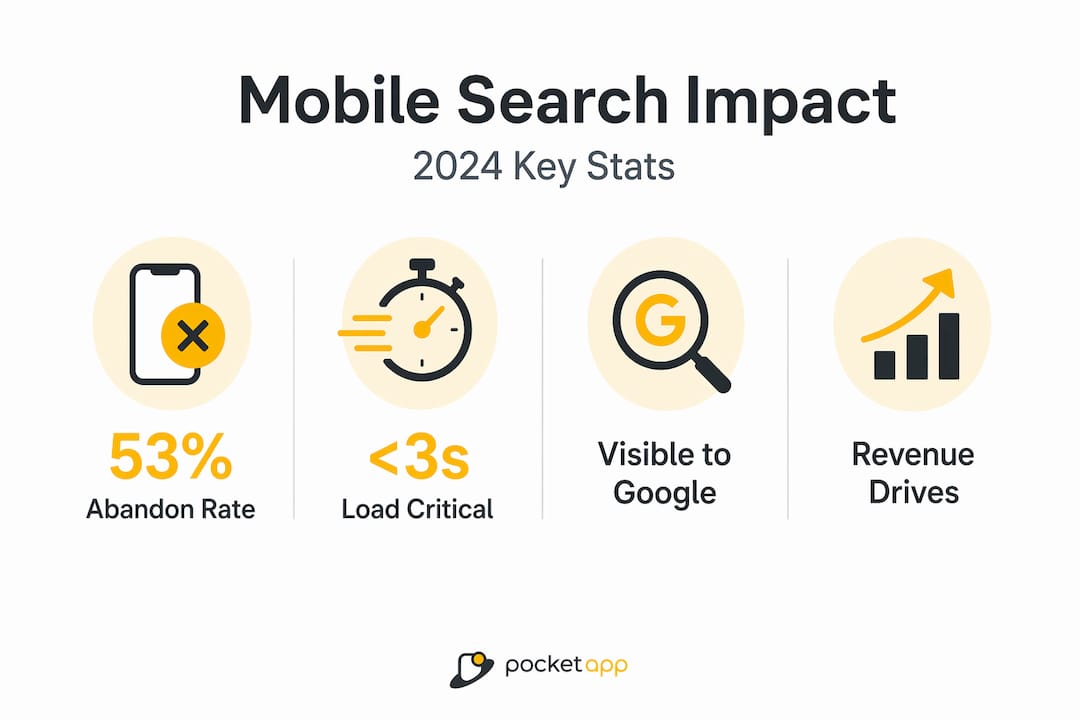
Google completed its mobile-first indexing rollout in 2024, which means it primarily evaluates the mobile version of your pages when determining search rankings. Not your desktop site. Not a blended view. Your mobile experience is now your SEO presence, full stop.
This has profound implications for how you think about content, structure, and performance. If your mobile pages strip out structured data, collapse key content, or load slowly, you are being ranked on a degraded version of your own work. Businesses that still maintain separate mobile and desktop experiences often suffer from content parity gaps — where the desktop carries richer text, schema markup, and media that simply does not appear on mobile.
Key actions to align your SEO with mobile-first evaluation:
- Match content exactly across mobile and desktop versions, including headings, body copy, and metadata
- Implement structured data on mobile pages, not just desktop
- Prioritise mobile search optimisation by auditing page speed with tools like Google Search Console's Core Web Vitals report
- Test mobile usability regularly using Google's mobile usability report to catch layout and tap-target issues before they affect rankings
- Ensure mobile SEO and accessibility work together, as accessible design often correlates directly with better crawlability
The shift also reflects actual user behaviour. When Google indexes mobile-first, it is mirroring how your audience actually arrives at your content. Ignoring this is not just a technical oversight — it is a misread of your market.
Pro Tip: Run a side-by-side audit comparing your mobile and desktop pages using a tool like Screaming Frog. Any content appearing on desktop but absent from mobile is invisible to Google's ranking systems.
The financial imperative: how mobile performance affects revenue and customer retention
Beyond search rankings, mobile strategy directly influences your bottom line through its effect on speed, abandonment, and customer loyalty. This is where the importance of mobile strategy becomes impossible to ignore from a finance perspective.
53% of mobile visitors abandon sites that take longer than three seconds to load. For a business turning over £2 million in online revenue, even a modest 10% abandonment improvement from faster load times can represent hundreds of thousands of pounds in recovered sales annually. Speed is not a technical metric — it is a revenue lever.
| Mobile load time | Estimated abandonment rate | Revenue impact (illustrative) |
|---|---|---|
| Under 2 seconds | ~15% | Minimal loss |
| 2 to 3 seconds | ~30% | Moderate loss |
| 3 to 5 seconds | ~53%+ | Significant loss |
| Over 5 seconds | ~70%+ | Severe loss |
Mobile users increasingly expect app-level responsiveness from mobile websites. If your site hesitates, they do not wait — they leave. And they rarely come back. Research confirms this pattern holds across retail, financial services, and healthcare, making mobile performance a cross-sector priority for any business leader.
Key mobile performance priorities for revenue protection:
- Compress images aggressively and use next-generation formats such as WebP
- Reduce render-blocking JavaScript to improve time-to-interactive scores
- Use a content delivery network (CDN) to serve assets from locations close to the user
- Test on real devices, not just emulators, to expose genuine performance issues
Addressing mobile UX optimisation at the performance level pays dividends beyond conversion rates. It reduces bounce rates, increases session depth, and signals quality to Google's ranking algorithms simultaneously.
Pro Tip: Use Google's PageSpeed Insights to identify your Largest Contentful Paint (LCP) score. This single metric has the strongest correlation with conversion rates and is where most mobile performance gains are found.
Mobile strategy's role in operational effectiveness and real-time decision-making
Having covered financial and search benefits, let us explore how mobile strategy enhances internal operations and decision-making speed. This dimension is where many business leaders find the most immediate return.
Mobile business intelligence (mobile BI) extends analytics beyond central office teams and static dashboards. Mobile BI delivers analytics to decision-makers anytime and anywhere, accelerating decision cycles in ways that static reporting simply cannot match. For a regional sales director travelling between client sites, or a warehouse manager on the floor, waiting until Monday's report is not good enough.
The operational benefits of embedding mobile analytics and decision-making into your workflows include:
- Faster identification of performance gaps — field teams can spot stock issues, sales shortfalls, or service failures before they escalate
- Reduced decision latency — leaders approve, adjust, or redirect resources without being desk-bound
- Improved accountability — real-time dashboards on mobile devices keep distributed teams aligned to shared goals
- Embedded analytics in workflows — operational data surfaces inside the tools people already use, rather than requiring separate logins to BI platforms
The caveat here is user-friendly design. Mobile BI tools with cluttered interfaces or difficult navigation get abandoned, regardless of the quality of the underlying data. The mobile-first approach significance is not just about consumer-facing products — it applies equally to internal tools your teams use every day.
Pro Tip: When deploying internal mobile analytics, start with one or two high-value dashboards your field teams actually ask for, rather than replicating every desktop report. Adoption drives ROI, not completeness.
How mobile optimisation drives customer trust, engagement, and conversion beyond the first interaction
Besides internal benefits, mobile optimisation profoundly shapes customer trust and engagement through superior UX design. And trust, once lost on mobile, is rarely recovered.

Improving mobile UX increases lead completion, sales efficiency, and retention beyond the first session. The mechanism is straightforward. When users can tap accurately, read without zooming, and complete forms without frustration, they associate that ease with the credibility of your brand. When they struggle, they associate the friction with your reliability as a business.
Practical elements that build trust and reduce friction:
- Tap targets sized to at least 44x44 pixels to eliminate accidental taps and user error
- Short, single-column forms that feel native to mobile rather than compressed from desktop
- Visible security indicators such as HTTPS and trust badges, particularly on checkout and login pages
- Fast-loading images and readable font sizes that do not require pinching to read
The customer journey on mobile is rarely linear. A user might first encounter your brand through a social ad on their phone, research on desktop, then convert back on mobile. Optimising online trust and mobile UX at each touchpoint ensures these assisted conversions do not fall apart at the mobile stage.
"A well-designed mobile experience is not just about aesthetics — it is about reducing the cognitive and physical effort a user must expend to achieve their goal."
Steps to build trust through the full mobile journey:
- Audit your current mobile experience from a first-time visitor's perspective, on an actual device
- Identify the three highest-friction moments — forms, checkout steps, navigation
- Fix tap targets and form field sizing before tackling visual design
- Add trust signals through mobile UX such as client testimonials and accreditations at decision points
- Monitor support ticket volumes for mobile-specific complaints as a qualitative friction indicator
When mobile UX works well, the operational benefit is equally valuable. Fewer users abandoning checkout means fewer abandoned cart recovery emails. Fewer form errors mean fewer support queries. The savings compound.
Measuring and iterating your mobile strategy for sustainable business impact
To realise mobile strategy benefits fully, it is crucial to implement ongoing measurement and iterative refinement. Most businesses track downloads or page views. That is not enough.
Combining app analytics with qualitative signals uncovers friction points that dashboards alone miss entirely. A high session count is meaningless if users are repeatedly hitting a broken form. A strong retention rate in week one can mask a sharp cliff in week four. The metrics that matter are those tied to commercial and operational outcomes, not surface-level traffic numbers.
A practical measurement framework for mobile strategy:
- Track active users and session length, not just downloads or unique visitors
- Measure funnel conversion at each step, not just final conversion rates
- Monitor retention curves at 7, 14, and 30 days to identify where engagement drops
- Collect qualitative data through in-app surveys, exit intent prompts, and support ticket analysis
- Review iterative mobile design feedback in structured sprint cycles, not ad hoc reviews
The iterative mindset is what separates businesses that extract lasting value from their mobile investment and those that launch and leave. Mobile strategy best practices all converge on the same principle: the first release is a hypothesis, and measurement is how you test it.
Pro Tip: Set up a monthly mobile review that includes both quantitative data from your analytics platform and five to ten verbatim user comments from support or review channels. The combination surfaces problems no single source can reveal alone.
Rethinking mobile strategy: beyond design to strategic business system
Here is the uncomfortable truth about how most organisations approach mobile. They treat it as a project with a finish line. Design the app or mobile site, launch it, move on. The mobile strategy benefits they report are often shallow — download counts, session numbers, perhaps a Net Promoter Score. The deeper commercial impact remains unmeasured and therefore unrealised.
In our experience working across more than 300 mobile projects, the clients who extract the most value from mobile are the ones who refuse to separate it from their commercial goals. They do not ask "how does the app look?" — they ask "how does the app affect our cost per acquisition, our churn rate, and our sales cycle length?"
This mindset shift has specific practical consequences. It means tracking assisted conversions, not just last-click sales. It means measuring how a mobile workflow improvement reduced manual data entry hours across a distributed team. It means calculating the support cost reduction from a better onboarding flow. These are real numbers that justify investment and guide iteration.
The mobile engagement optimisation insights that drive sustainable ROI are almost always found at the intersection of qualitative feedback and commercial data. Yet most businesses invest in one or the other, not both. They have dashboards but no user conversations, or they have intuition but no measurement rigour. The gap between the two is where improvement dies.
How to develop mobile strategy as a commercial system means asking a different set of questions from day one. Not "what features should we build?" but "what business outcomes must this product move?" Every design decision, every performance investment, and every measurement choice should trace back to that question.
How Pocket App supports your mobile strategy journey
If you are ready to put these principles into action, we can help you build, refine, and measure a mobile strategy that actually moves commercial needles.
At Pocket App, our mobile app development services are built around business outcomes, not just deliverables. Our expert mobile app design teams create experiences that reduce friction, build trust, and convert across every stage of the customer journey. And our approach to mobile analytics solutions ensures you have the measurement infrastructure to keep improving long after launch. With over 300 projects delivered across retail, healthcare, charity, and B2B sectors, we understand what it takes to turn mobile into a genuine competitive advantage.
Frequently asked questions
What is mobile-first indexing and why is it important?
Mobile-first indexing means Google primarily uses the mobile version of your site to determine search rankings, so ensuring your mobile content is complete and well-structured is essential for visibility.
How does mobile page speed affect user behaviour?
Slow mobile pages lead to higher abandonment rates, with 53% of visitors leaving sites that take longer than three seconds to load, which has a direct and measurable impact on revenue.
What benefits does mobile business intelligence provide?
Mobile BI extends analytics to decision-makers regardless of location, enabling faster, data-informed choices that improve operational responsiveness and reduce decision latency across distributed teams.
How can mobile user experience impact customer trust?
Good mobile UX reduces user errors and cognitive effort, building brand credibility; improving mobile UX demonstrably increases lead completion, conversion rates, and long-term retention.
Why is continuous measurement important in mobile strategy?
Combining analytics with qualitative signals such as user surveys and support data uncovers friction points that quantitative dashboards alone cannot surface, enabling focused improvements with genuine commercial impact.