
TL;DR:
- Digital product discovery is an ongoing, evidence-based process that verifies value, usability, feasibility, and viability before development. Teams that integrate cross-functional collaboration and AI tools within discovery sprints reduce wasted effort and improve product success. Moving from opinion-based to evidence-driven decisions optimizes innovation and minimizes project failure.
Digital product discovery is defined as the continuous, evidence-based process of validating what to build before committing engineering resources. The industry term is simply "product discovery," and it sits at the heart of any sound digital product strategy. The process targets four key risks: value, usability, feasibility, and business viability. Teams that skip it ship unused features, wasting costly engineering effort. For business leaders and product managers, mastering what is digital product discovery is the single most effective way to reduce project failure and improve user engagement from the outset.
What is digital product discovery and why does it matter?
Product discovery is the structured practice of answering one question before development starts: are we building the right thing? It is not a one-time gate. Discovery runs alongside delivery continuously, helping teams learn and adapt in dynamic digital markets.
The four risk categories define the scope of every discovery activity:
- Value risk: Will users actually want this?
- Usability risk: Can users figure out how to use it?
- Feasibility risk: Can the team build it with current technology and resources?
- Viability risk: Does it make business sense to build it at all?
Each risk category demands a different type of evidence. Value risk calls for user interviews and demand testing. Usability risk requires prototype walkthroughs and app usability testing. Feasibility risk needs engineers in the room from day one, not after a handover. Viability risk demands market research and financial modelling.
The practical implication is significant. A team that validates all four risks cheaply, before writing a line of production code, avoids the most common and expensive failure mode in product development: building something nobody uses.

What are the core elements of the product discovery process?
The product discovery process is built around activities that generate evidence quickly and cheaply. Three methods do the most work: user interviews, prototyping, and market research. Each targets a different risk category and produces a different type of insight.
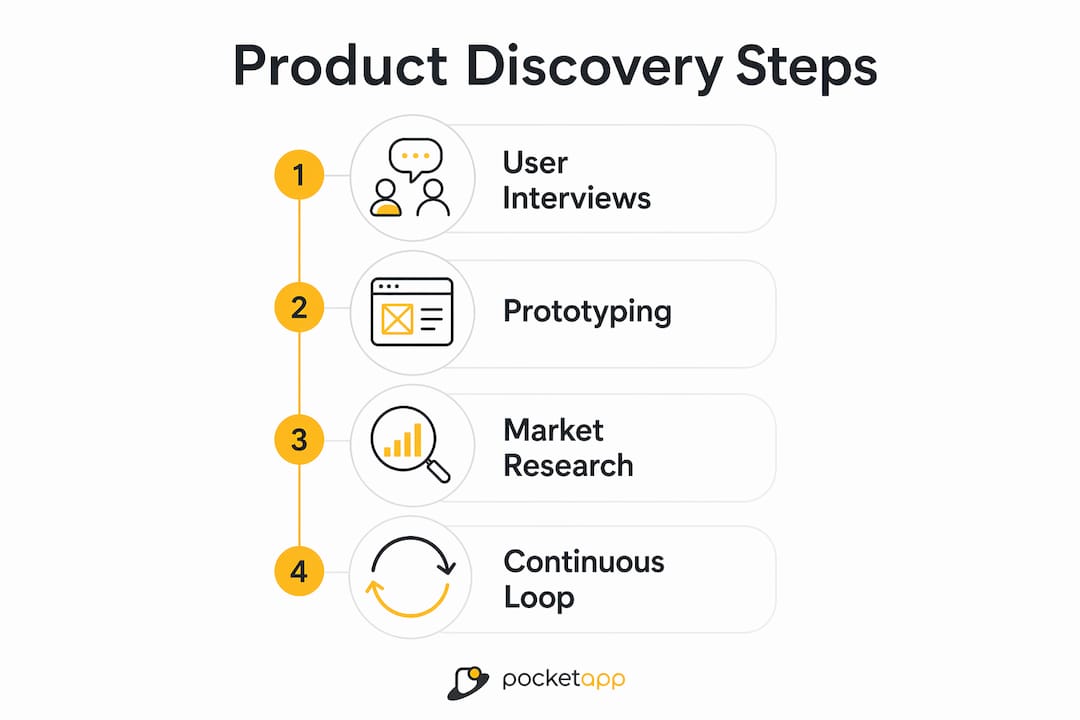
User interviews surface the real problems users face, not the ones teams assume they face. A 30-minute conversation with five representative users routinely overturns months of internal assumptions. The goal is not to ask users what they want. The goal is to understand the context, constraints, and frustrations that shape their behaviour.
Prototyping tests usability and feasibility before any production code exists. A clickable prototype built in a day can answer questions that would otherwise take a sprint to resolve. Low-fidelity prototypes work best early; higher-fidelity versions are appropriate once the core concept is validated.
Market research addresses viability. Desk research, competitor analysis, and pricing studies tell you whether a validated user problem is also a viable business opportunity. Skipping this step produces products that users love, but that cannot sustain themselves commercially.
Pro Tip: Run user interviews and prototype tests in parallel, not in sequence. Waiting for research to finish before prototyping adds weeks to your timeline without adding proportional insight.
The most effective discovery teams treat these activities as a continuous loop, not a linear checklist. Evidence from one activity reshapes the questions asked in the next.
How do discovery sprints accelerate product validation?
A structured discovery sprint can validate a product idea within two weeks. That compression, from months to weeks, changes the economics of product development entirely. AI tools now accelerate the research, synthesis, and prototyping phases further, making two-week validation cycles achievable for most teams.
A well-run discovery sprint follows four phases in sequence:
- Framing. Define the problem space, the user segment, and the success criteria. This phase cannot be skipped or shortened. Skipping framing means building the wrong solution faster, which costs more than building nothing at all.
- Gathering. Conduct user interviews, review existing data, and map the competitive context. AI tools can synthesise large volumes of qualitative data in hours, a task that previously took days.
- Synthesising. Identify patterns, define the core user problem, and agree on the riskiest assumptions to test. This is where cross-functional teams earn their value: engineers spot feasibility constraints that designers miss, and designers spot usability gaps that engineers overlook.
- Prototyping. Build the lowest-fidelity version that can answer the riskiest question. Test it with real users. Record what you observe, not what users say they think.
Pro Tip: AI tools are genuinely useful in the gathering and synthesising phases. They are not useful in the framing phase. Human judgement about which problem is worth solving cannot be delegated to a language model.
Speed without correct problem framing is expensive chaos. The sprint framework is only as good as the framing that precedes it.
Why is cross-functional collaboration essential in product discovery?
Cross-functional collaboration with product managers, designers, and engineers working in parallel is the industry standard for effective discovery. Siloed workflows, where designers research, then hand off to product managers, who then brief engineers, introduce delays and lose critical information at every handover.
Parallel working solves three specific problems:
- Engineers identify technical constraints early, before designs are finalised around assumptions that cannot be built.
- Designers surface usability issues before engineers commit to an architecture that makes changes expensive.
- Product managers align business priorities with user evidence in real time, rather than retrospectively.
The eight foundational steps of a structured discovery process begin with team assembly and end with continuous integration into delivery. Every step between those two points benefits from simultaneous input across disciplines. A product manager who waits for a designer to finish research before involving an engineer will always produce slower, lower-quality outcomes than a team that works together from the first day.
The practical lesson for business leaders is direct: discovery is not a design activity or a product management activity. It is a team sport, and the team must include engineering from the start.
What are the best practices and common pitfalls in product discovery?
The most common pitfall in digital product exploration is treating discovery as a one-time phase that precedes development. Discovery is not a phase. It runs continuously alongside delivery, feeding validated insights into the backlog on an ongoing basis.
The second most common pitfall is prioritising features based on internal opinions or sales pressure rather than user evidence. Effective discovery prioritises validated real user problems over internal assumptions. The discipline required to say "we don't have enough evidence yet" is harder than it sounds in organisations where stakeholders have strong opinions.
A useful framework for avoiding both pitfalls is the distinction between two discovery modes:
| Mode | Purpose | Risk if overused |
|---|---|---|
| Exploring (divergent) | Broad discovery of new problems and opportunities | Missing focused validation; spreading effort too thin |
| Exploiting (convergent) | Narrow validation of a specific solution | Missing new market opportunities; fixating on known solutions |
Maintaining an "always-on" practice that alternates between these two modes drives both innovation and rigorous validation. Teams that only exploit known solutions miss untapped opportunities. Teams that only explore never ship anything validated.
Discovery should also end with a clear decision. Research stops when the cost of further research exceeds the risk it would reduce. The output is a firm decision: build, change, narrow, or stop. Continuing past that point wastes resources without improving outcomes.
Pro Tip: Track the cost of each discovery activity against the risk it reduces. When the ratio inverts, stop researching and decide. Indecision dressed up as thoroughness is still indecision.
Key takeaways
Digital product discovery is the continuous, evidence-based process of validating value, usability, feasibility, and viability before committing engineering resources, and teams that practise it consistently ship products with significantly higher adoption rates.
| Point | Details |
|---|---|
| Four core risk categories | Validate value, usability, feasibility, and viability before writing production code. |
| Discovery is continuous | Run discovery alongside delivery, not as a one-time phase before development begins. |
| Framing cannot be skipped | Define the problem correctly before gathering evidence; speed without framing produces the wrong solution faster. |
| Cross-functional from day one | Include engineers in discovery from the start to catch feasibility constraints before they become expensive. |
| Stop when the ratio inverts | End research when its cost exceeds the risk it reduces, then make a firm decision to build, change, narrow, or stop. |
Discovery in 2026: what I have learnt from watching teams get it wrong
The most persistent mistake I see is organisations treating discovery as a box to tick rather than a capability to build. They run one round of user interviews, produce a report, and consider the job done. Six months later, they are rebuilding features that real users never wanted.
The paradigm shift that actually matters is moving from opinion-based to evidence-based decision-making. That shift is cultural, not methodological. You can teach a team the discovery sprint framework in a day. Teaching them to say "we don't know yet, let's find out" instead of "I think users want this" takes much longer.
AI tools have genuinely changed what is possible in the gathering and synthesis phases. Teams can now process qualitative research at a scale that was impractical two years ago. What AI cannot do is tell you which problem is worth solving. That judgement requires empathy, context, and experience. The leaders who understand this distinction will use AI to go faster in the right direction. Those who do not will use it to go faster in the wrong one.
My advice to business leaders is direct: invest in discovery capability as you would invest in any other core competency. The return is not just better products. It is fewer wasted sprints, fewer failed launches, and teams that make decisions based on evidence rather than whoever spoke loudest in the last meeting.
— Paul
How Pocketapp integrates discovery into every project
Pocketapp builds mobile apps across retail, healthcare, charity, and B2B sectors, and discovery is embedded in every project from the first conversation. With over 300 projects delivered for clients including WWF, Dechra, and Crocus, the team knows that the quality of the discovery phase determines the quality of the final product.
Pocketapp's approach combines cross-functional collaboration, AI-enhanced research synthesis, and structured sprint methods to validate ideas before development begins. Product managers, designers, and engineers work in parallel from day one, exactly as the evidence demands. If you are planning a mobile app development project and want to build on validated user insight rather than assumptions, Pocketapp has the experience to guide you through it.
FAQ
What is digital product discovery in simple terms?
Digital product discovery is the process of validating what to build before development starts. It uses user interviews, prototyping, and market research to confirm that a product idea solves a real problem and makes business sense.
How long does a product discovery process take?
A structured discovery sprint can validate a product idea in two weeks. Larger or more complex products may require longer discovery periods, but the sprint framework compresses validation significantly compared to traditional approaches.
What are the four risks that product discovery addresses?
Product discovery targets value risk, usability risk, feasibility risk, and business viability risk. Each risk category requires different evidence-gathering activities to validate before engineering resources are committed.
Why do teams skip product discovery?
Teams skip discovery because it feels slower than starting development immediately. Skipping it results in unused features and wasted engineering effort, making it far more costly in the long run than the time discovery requires.
What is the difference between exploring and exploiting in discovery?
Exploring is broad, divergent discovery that searches for new problems and opportunities. Exploiting is narrow, convergent validation of a specific solution. Effective teams alternate between both modes to drive both innovation and rigorous validation.