
TL;DR:
- Agile development is an iterative approach that emphasizes delivering working software in short cycles and responding to feedback. It is driven by four core values from the Agile Manifesto, focusing on people, working software, customer collaboration, and adaptability. Various frameworks like Scrum, Kanban, and XP implement these principles based on team size and project needs.
Agile development is defined as an iterative, incremental approach to building software, grounded in the 2001 Agile Manifesto's four core values and twelve guiding principles. Rather than locking down every requirement before writing a single line of code, agile teams deliver working software in short cycles, gather feedback, and adjust course. The methodology centres on people over processes, working software over exhaustive documentation, and responding to change over following a fixed plan. For software developers, project managers, and business decision-makers, understanding agile development methodology is the difference between shipping products users actually want and spending months building the wrong thing.
What is agile development and what does the Agile Manifesto say?
The Agile Manifesto established four core values that still define the methodology today. They are not abstract philosophy. They are practical trade-offs that change how teams make decisions every day.
- Individuals and interactions over processes and tools. People solve problems; tools support them.
- Working software over comprehensive documentation. A functioning product proves more than a perfect specification.
- Customer collaboration over contract negotiation. Continuous dialogue beats a signed-off requirements document.
- Responding to change over following a plan. Markets shift, user needs evolve, and agile teams adapt.
These values are supported by twelve guiding principles, which include delivering working software frequently, welcoming changing requirements even late in development, and maintaining a sustainable pace for the team. The principles shift the focus from rigid, sequential planning to cycles of continuous improvement. That shift is what separates agile from traditional Waterfall development, where each phase must complete before the next begins. Agile treats planning as an ongoing activity, not a one-time event at the project's start.
Which frameworks are commonly used in agile development?
Agile is an umbrella term. Several distinct frameworks sit beneath it, each offering a different structure for applying agile principles in practice.
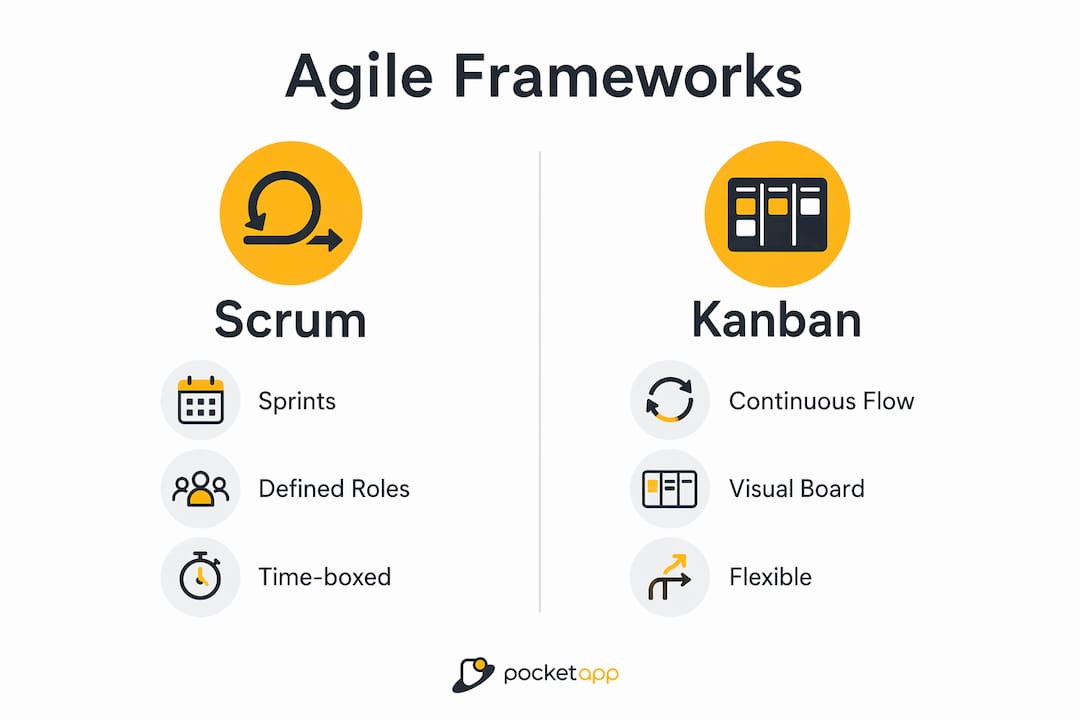
Scrum is the most widely adopted agile framework. It organises work into fixed-length iterations called sprints, typically lasting one to four weeks. Three core roles define a Scrum team: the Product Owner, who manages the backlog and priorities; the Scrum Master, who removes obstacles and coaches the team; and the Development Team, who build the product. Scrum uses four key events: sprint planning, daily stand-ups, sprint reviews, and retrospectives.

Kanban takes a different approach. Rather than fixed sprints, Kanban uses a visual board to manage a continuous flow of work. Teams set work-in-progress limits to prevent bottlenecks and pull new tasks only when capacity exists. Kanban suits teams handling ongoing maintenance or support work where priorities shift frequently.
Extreme Programming (XP) focuses on technical practices. It promotes pair programming, test-driven development, and continuous integration to maintain code quality at high delivery speeds. Scaled Agile Framework (SAFe) addresses the challenge of applying agile across large organisations with multiple teams, adding coordination layers above the individual team level.
All four frameworks share the same agile principles. The choice between them depends on team size, project type, and organisational culture. A small product team building a consumer app often thrives with Scrum. An enterprise running dozens of parallel workstreams may need SAFe's coordination structure.
How do agile teams manage work through sprints and backlogs?
The sprint is the engine of agile delivery. Sprints last one to four weeks and end with a potentially shippable product increment. That cadence forces teams to break large features into small, deliverable chunks and gives stakeholders something real to review at regular intervals.
The product backlog is the ordered list of everything the team might build. Items are written as user stories, typically in the format: "As a [user], I want [feature] so that [benefit]." This format keeps the focus on user value rather than technical tasks. Backlog grooming is a critical ongoing activity. Neglecting it leads to loss of focus and project delays, as priorities drift and scope expands without discipline.
- Sprint planning. The team selects backlog items they can complete in the sprint and breaks them into tasks.
- Daily stand-up. A 15-minute meeting where each team member answers three questions: what did I do yesterday, what will I do today, and what is blocking me?
- Sprint review. The team demonstrates completed work to stakeholders and collects feedback.
- Sprint retrospective. The team reflects on their process and agrees on one or two improvements for the next sprint.
A stable team might complete 40 story points per two-week sprint, creating a predictable delivery cadence that replaces the long, uncertain planning cycles of Waterfall. That predictability lets project managers give business stakeholders reliable forecasts without pretending the future is certain.
Pro Tip: Track velocity over three to five sprints before committing to a delivery date. One sprint's output is noise; a trend is signal.
What are the practical benefits and challenges of agile development?
Agile is the recommended methodology for mobile app projects in complex, fast-changing environments. The benefits are concrete and well-documented.
- Faster response to change. When user feedback or market conditions shift, agile teams adjust the backlog and redirect effort within days, not months.
- Higher product quality. Cross-functional teams that integrate design, development, and QA within the same sprint cycle catch defects earlier and reduce the communication silos that cause quality issues in traditional project flows.
- Better stakeholder alignment. Sprint reviews give business decision-makers visibility into progress every two weeks, reducing the risk of a six-month build that misses the mark.
- Continuous delivery. CI/CD pipelines automate builds, tests, and deployments, sustaining high-velocity delivery without manual bottlenecks. Without automation, frequent releases create more errors, not fewer.
The challenges are equally real. The most common misconception is that agile means no planning. Agile teams plan continuously. They rely on rigorous backlog grooming and sprint planning to stay aligned with business goals. The difference is that planning happens in short cycles rather than one big upfront exercise.
Cultural change is the harder challenge. Agile requires trust between team members, genuine self-organisation, and a willingness to surface problems openly in retrospectives. Organisations that adopt agile ceremonies without changing their culture end up with the overhead of agile and none of its benefits. Managers who demand detailed long-term plans while running two-week sprints create contradictions that undermine team confidence.
Technical excellence is non-negotiable. Agile's speed depends on clean code, automated testing, and working app project workflows. Teams that skip these foundations accumulate technical debt that slows every future sprint.
Pro Tip: Run a blameless retrospective after every sprint. Teams that feel safe raising problems fix them. Teams that feel judged hide them until they become crises.
For business decision-makers evaluating enterprise mobile adoption, the cultural dimension of agile is often underestimated. The process is learnable in weeks. The mindset takes months to embed.
Key takeaways
Agile development succeeds when teams treat it as a continuous discipline of planning, delivery, feedback, and improvement, not a set of ceremonies to perform.
| Point | Details |
|---|---|
| Agile Manifesto foundation | Four core values and twelve principles replace rigid, sequential planning with continuous improvement cycles. |
| Sprint-driven delivery | Fixed sprints of one to four weeks produce shippable increments and give stakeholders regular, concrete feedback. |
| Backlog discipline | Continuous backlog grooming prevents scope creep and keeps the team focused on the highest-value work. |
| Cross-functional teams | Integrating design, development, and QA in one sprint reduces silos and improves both speed and quality. |
| Culture over ceremony | Agile fails when teams follow rituals without the underlying trust, self-organisation, and openness to change. |
Agile is a mindset, and most teams only get halfway there
I have worked with enough development teams to know that the gap between "we do agile" and "we are agile" is enormous. Most teams adopt the ceremonies quickly. Stand-ups, sprint planning, retrospectives. They tick the boxes and wonder why delivery is still slow and morale is still low.
The problem is almost always cultural. Agile is a mindset, not a process. The ceremonies are just the visible surface. What drives real performance is the trust underneath: trust that the team can self-organise, trust that raising a problem in a retrospective will not get someone blamed, trust that the Product Owner's priorities reflect genuine business value rather than internal politics.
I have seen teams transform when they stop treating retrospectives as a formality and start using them as genuine problem-solving sessions. The ones that improve fastest are the ones where the Scrum Master has the authority to remove obstacles, not just document them. Integrating user feedback into each sprint is another practice that separates high-performing teams from those going through the motions.
My honest advice: before you worry about which framework to use, ask whether your organisation is willing to give teams real autonomy. If the answer is no, no framework will save you.
— Paul
How Pocketapp delivers agile-driven mobile apps
Pocketapp brings agile development methodology to every mobile project it takes on, from initial discovery through to deployment.
With a portfolio of over 300 projects for clients including WWF, Dechra, and Crocus, Pocketapp has refined an agile process that keeps stakeholders informed at every sprint and adapts to changing requirements without derailing timelines. Whether you need a consumer-facing app or a B2B tool, the team combines UX/UI design, development, and QA within the same sprint cycle. For teams ready to build with confidence, Pocketapp's mobile app development service delivers working software on a cadence that business decision-makers can plan around. You can also explore bespoke app development options tailored to your specific sector and requirements.
FAQ
What is agile development in simple terms?
Agile development is an iterative approach to building software where teams deliver working features in short cycles, gather feedback, and adjust priorities continuously rather than following a fixed, upfront plan.
How long is an agile sprint?
Sprints typically last one to four weeks. Most teams settle on two-week sprints, which balance the need for regular stakeholder feedback with enough time to complete meaningful work.
Is agile suitable for mobile app development?
Agile is the recommended methodology for mobile app projects because it handles evolving user expectations and platform constraints better than linear methods such as Waterfall.
What is the difference between Scrum and Kanban?
Scrum uses fixed-length sprints and defined roles to deliver increments on a regular cadence. Kanban uses a continuous flow board with work-in-progress limits, making it better suited to ongoing support or maintenance work.
Does agile mean there is no planning?
Agile requires continuous planning through backlog grooming and sprint planning sessions. The difference from Waterfall is that planning happens in short, regular cycles rather than one large upfront exercise.