
Many businesses assume app development is just writing code, but this misconception leads to budget overruns and missed deadlines. The reality involves seven distinct stages from initial concept through ongoing maintenance. Understanding this complete process helps you plan effectively, control costs, and deliver apps that genuinely serve your users. This guide walks you through each critical phase, explores methodologies like agile and waterfall, addresses common challenges, and examines how emerging technologies are reshaping development timelines and budgets.
Table of Contents
- Key Takeaways
- The core stages of end-to-end app development
- Development methodologies: agile vs waterfall and hybrids
- Common challenges and solutions in app development projects
- Costs, timelines, and emerging trends including AI in app development
- How Pocket App can support your end-to-end app development
- Frequently asked questions
Key Takeaways
| Point | Details |
|---|---|
| Seven development stages | There are seven distinct phases from ideation to maintenance that guide planning and budgeting. |
| Agile preferred method | Agile is favoured for flexibility and faster delivery. |
| Time and cost vary | Estimates change with app complexity and scope. |
| Common development challenges | Platform fragmentation and security concerns commonly slow progress. |
| AI speeds development | Emerging AI tools help accelerate tasks and reduce costs. |
The core stages of end-to-end app development
Successful app development follows a structured path through seven essential phases. Each stage builds on the previous one, creating a solid foundation for your mobile solution.
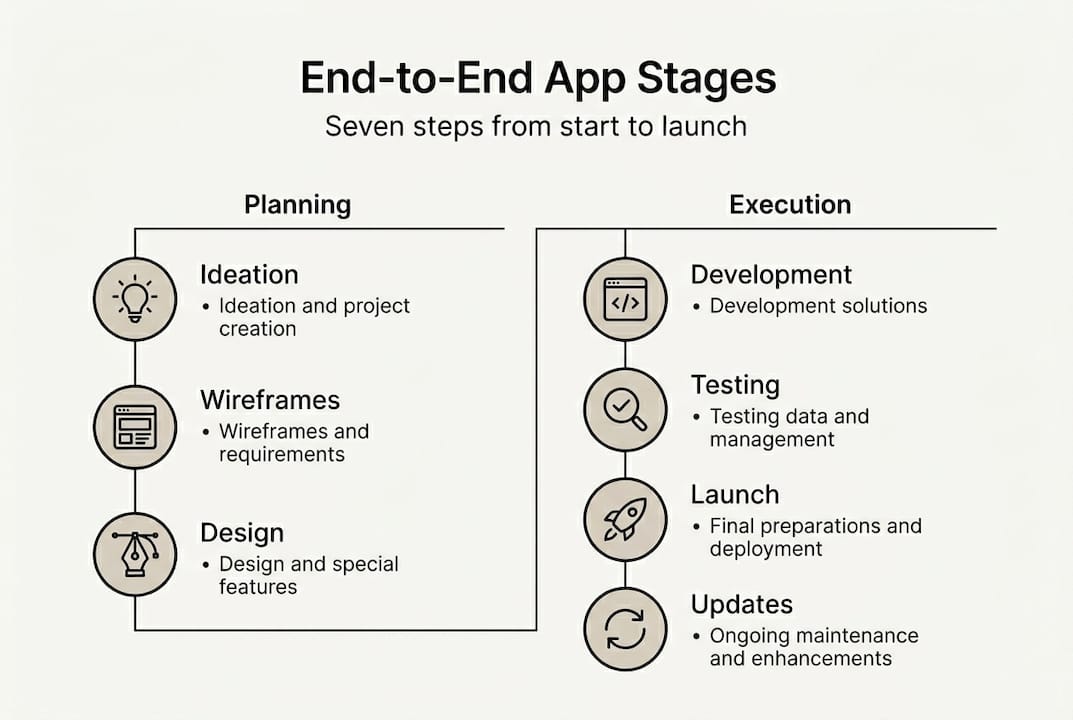
First comes ideation and research, where you validate your concept against market needs and competitor offerings. You'll define your target audience, identify pain points, and establish core features that differentiate your app. This phase typically takes 2-4 weeks and involves stakeholder workshops, user interviews, and market analysis.
Planning and wireframing translates your concept into concrete specifications. Your development team creates technical architecture documents, defines data models, and produces low-fidelity wireframes showing screen layouts and user flows. This stage establishes the project roadmap, technology stack, and resource allocation. Budget 3-6 weeks for thorough planning that prevents costly changes later.
UI/UX design and prototyping brings your app to life visually. Designers craft high-fidelity mockups, establish brand guidelines, and build interactive prototypes for user testing. This phase ensures your app looks professional and feels intuitive before any code gets written. Expect 4-8 weeks depending on complexity and revision cycles.
Development splits into frontend and backend work happening simultaneously. Frontend developers build the user interface and client-side logic using Swift, Kotlin, or cross-platform frameworks. Backend teams create server infrastructure, databases, APIs, and business logic. This longest phase typically consumes 40-60% of total project time.
Testing and quality assurance validates every function, screen, and interaction. QA teams perform functional testing, usability testing, performance testing, security audits, and device compatibility checks. Industry best practice recommends allocating 15-20% of budget specifically for rigorous testing to catch issues before launch.
Deployment and launch involves submitting to app stores, configuring analytics, setting up crash reporting, and preparing marketing materials. Apple's App Store and Google Play each have specific requirements and review processes that can take 1-3 weeks. Your team monitors initial user feedback and stands ready to address any immediate issues.
Maintenance and updates keeps your app relevant and functional. You'll release bug fixes, add features based on user feedback, update for new OS versions, and maintain server infrastructure. Plan for ongoing costs representing 15-25% of initial development annually.
Here's how timelines vary by project complexity:
| Project type | Timeline | Key characteristics |
|---|---|---|
| Simple MVP | 2-4 months | Single platform, basic features, minimal backend |
| Mid-level app | 6-8 months | Cross-platform, moderate features, API integration |
| Enterprise solution | 12+ months | Complex architecture, custom backend, advanced security |
Pro tip: Invest extra time in planning and prototyping stages. Discovering usability issues or technical constraints during design costs far less than rebuilding features mid-development. A comprehensive step-by-step approach prevents expensive rework.
Development methodologies: agile vs waterfall and hybrids
Your chosen methodology fundamentally shapes how your development team works, communicates, and delivers results. The two dominant approaches offer starkly different philosophies.
Agile breaks projects into short sprints, typically 2-4 weeks each. Teams deliver working features incrementally, gathering feedback and adjusting priorities between sprints. This iterative approach embraces change, allowing you to refine requirements as you learn what users actually need. Agile promotes close collaboration between developers and business stakeholders through daily standups, sprint planning, and retrospectives.
Waterfall follows a linear sequence where each phase completes before the next begins. You finalise all requirements upfront, then move through design, development, testing, and deployment in strict order. Changes during development are discouraged because they disrupt the planned sequence and timeline. This methodology works well when requirements are crystal clear and unlikely to change.
Hybrid approaches combine elements of both, often using waterfall for high-level planning whilst employing agile for actual development sprints. You might fix the overall scope and budget upfront but allow flexibility in how individual features get implemented within those constraints.
Here's how these methodologies compare in practice:
| Aspect | Agile | Waterfall | Hybrid |
|---|---|---|---|
| Flexibility | High, welcomes changing requirements | Low, changes are costly | Medium, defined scope with flexible execution |
| Speed to market | 40% faster for MVP delivery | Slower, no usable product until end | Moderate, phased releases possible |
| Budget predictability | Variable, scope adjusts to budget | Fixed, detailed upfront estimates | Medium, capped budget with priority-based scope |
| Best for | Innovative products, unclear requirements | Regulated industries, fixed specifications | Large organisations needing budget certainty |
| Stakeholder involvement | Continuous throughout project | Mainly at beginning and end | Regular checkpoints at phase transitions |
When selecting your methodology, consider these factors:
- Project size and complexity: smaller projects benefit from agile's speed, whilst massive enterprise systems may need waterfall's structure
- Requirement certainty: choose agile if you're exploring user needs, waterfall if specifications are locked
- Team experience: agile requires mature teams comfortable with autonomy and collaboration
- Organisational culture: traditional hierarchies often struggle with agile's flat team structure
- Budget constraints: waterfall provides fixed quotes, agile offers better value through continuous prioritisation
Current data shows agile used by 71% of organisations for mobile development, reflecting its proven advantages for most business scenarios. The methodology you choose directly impacts team productivity and project success.
Pro tip: Involve business stakeholders in sprint reviews every 2-3 weeks rather than waiting for major milestones. Early, frequent feedback prevents building features nobody wants and keeps development aligned with business goals.
Common challenges and solutions in app development projects
Even well-planned projects encounter obstacles that test your team's expertise and adaptability. Understanding these challenges helps you prepare effective responses.
Platform fragmentation tops the list of technical headaches. Android runs on thousands of device models with varying screen sizes, OS versions, and hardware capabilities. iOS offers better consistency but still requires supporting multiple iPhone and iPad configurations. Testing across this device matrix consumes significant time and resources.

Cross-platform frameworks like Flutter and React Native mitigate fragmentation by letting you write code once and deploy to both iOS and Android. These tools have matured considerably, now delivering near-native performance for most use cases. You sacrifice some platform-specific optimisation but gain massive efficiency in development and maintenance.
Performance optimisation challenges emerge as apps grow more complex. Users expect instant responsiveness, smooth animations, and minimal battery drain. Achieving this requires careful attention to image compression, efficient data caching, background task management, and memory usage. Poor performance leads to 25% higher negative reviews and increased uninstall rates.
Testing and quality assurance present logistical challenges beyond just finding bugs. You need to validate functionality across devices, test edge cases, verify accessibility compliance, and ensure graceful handling of network interruptions. Industry standards recommend budgeting 15-20% of total project costs specifically for comprehensive QA processes.
Security and privacy concerns have intensified with stricter regulations like GDPR and increasing user awareness. Your app must implement:
- End-to-end encryption for sensitive data transmission
- Secure authentication with multi-factor options
- Regular security audits and penetration testing
- Transparent privacy policies and user consent mechanisms
- Compliance with industry-specific regulations (healthcare, finance, etc.)
Scope creep silently destroys budgets and timelines. Stakeholders request "just one more feature" repeatedly, each addition seeming small but collectively derailing the project. Without disciplined scope management, projects balloon to 150-200% of original estimates.
App store rejections waste weeks of effort when apps fail Apple or Google's review processes. Common rejection reasons include incomplete functionality, confusing user interfaces, privacy policy violations, or inappropriate content. Studying platform guidelines thoroughly before submission prevents these delays.
Addressing security considerations requires specialised expertise, particularly for apps handling payment information or personal health data. Many businesses benefit from security audits by third-party specialists before launching their secure mobile app.
Pro tip: Establish a formal change control process from day one. Require written justification for any scope additions, including impact analysis on timeline and budget. This discipline doesn't prevent necessary changes but ensures informed decisions rather than casual feature creep.
Costs, timelines, and emerging trends including AI in app development
Realistic budgeting separates successful projects from those that stall mid-development when funds run out. Costs vary dramatically based on complexity, features, and team expertise.
Here's what typical projects cost in 2026:
| App complexity | Development cost | Timeline | Annual maintenance |
|---|---|---|---|
| Simple app | £10K-£50K | 3-6 months | 15-20% of development |
| Medium app | £50K-£150K | 6-10 months | 18-22% of development |
| Enterprise app | £150K-£300K+ | 12+ months | 20-25% of development |
Maintenance costs persist long after launch, typically consuming 15-25% of initial development costs annually. This covers server hosting, OS compatibility updates, security patches, bug fixes, and minor feature enhancements. Apps that neglect maintenance quickly accumulate technical debt and user complaints.
Artificial intelligence is fundamentally reshaping development economics and timelines. AI-powered tools now assist with:
- Code generation from natural language descriptions, accelerating routine development tasks
- Automated testing that identifies bugs faster than manual QA processes
- UI/UX design suggestions based on proven patterns and user behaviour analysis
- Performance optimisation recommendations highlighting inefficient code sections
- Predictive analytics for project planning and resource allocation
Early case studies suggest AI tools can reduce development costs 75-90% for certain project types, particularly those with well-defined requirements and standard functionality. However, these tools still require experienced oversight to ensure quality, security, and alignment with business objectives.
"AI accelerates code generation and testing, potentially cutting costs by 75-90%, but human expertise remains essential for architecture decisions, user experience design, and quality oversight."
Critical caveats temper the AI enthusiasm:
- AI excels at generating boilerplate code but struggles with novel business logic
- Security vulnerabilities can hide in AI-generated code without expert review
- User experience design still requires human empathy and creativity
- Complex integrations and custom requirements need experienced developer judgement
Smart businesses view AI as augmenting rather than replacing development teams. The technology handles repetitive tasks whilst developers focus on strategic decisions, creative problem-solving, and ensuring robust architecture.
When budgeting your project, factor in contingency reserves of 15-25% beyond base estimates. Unexpected challenges always emerge, and having financial buffer prevents compromising on quality or abandoning features mid-development. Companies harnessing AI capabilities gain competitive advantages through faster iteration and lower costs.
How Pocket App can support your end-to-end app development
Understanding the complete development process empowers you to make informed decisions, but executing successfully requires partnering with experts who've navigated these challenges hundreds of times.
Pocket App brings over 300 projects worth of experience across retail, healthcare, charity, and consumer sectors. We handle every stage from initial concept validation through ongoing maintenance, using agile methodologies that keep you involved and informed throughout development. Our team excels at cross-platform development using modern frameworks, reducing your time to market whilst maintaining native-quality performance.
We've integrated AI-enhanced development tools where they add genuine value, accelerating routine tasks whilst our experienced developers focus on strategic architecture and user experience. This combination delivers the cost efficiency of automation with the quality assurance of human expertise. Whether you need comprehensive mobile app development or specialised business application solutions, our proven process transforms your concept into a polished, market-ready product.
Let's address some remaining questions about the development process.
Frequently asked questions
What exactly does end-to-end app development include?
End-to-end app development encompasses every phase from initial concept through ongoing maintenance. It includes market research and ideation, strategic planning, UI/UX design, frontend and backend development, comprehensive testing, app store deployment, and continuous updates. This holistic approach ensures all aspects work together seamlessly rather than treating development as isolated coding tasks.
Why do most companies prefer agile over waterfall methodology?
Agile delivers working features incrementally, allowing businesses to validate assumptions and adjust priorities based on real user feedback. This flexibility proves invaluable when requirements evolve or market conditions shift. Waterfall's rigid structure works well for projects with fixed specifications but struggles when innovation or user discovery drives development.
How long does typical app development actually take?
Timelines vary significantly by complexity. A simple MVP with basic features takes 2-4 months, mid-level apps with moderate functionality require 6-8 months, and enterprise solutions with complex architecture need 12+ months. These estimates assume experienced teams working without major scope changes or resource constraints.
What impact is AI having on development costs and speed?
AI tools accelerate code generation, automated testing, and routine development tasks, potentially reducing costs by 75-90% for standard functionality. However, complex business logic, custom integrations, and user experience design still require experienced human developers. AI augments teams rather than replacing them, delivering efficiency gains whilst maintaining quality standards.
What are the biggest challenges in mobile app projects?
Platform fragmentation across thousands of device configurations complicates testing and optimisation. Security and privacy compliance require specialised expertise, particularly for regulated industries. Scope creep silently inflates budgets when stakeholders continuously add features. Performance optimisation demands careful attention to ensure smooth, responsive experiences that users expect from professional apps.