
TL;DR:
- Poor requirements are the primary cause of project overruns, scope creep, and failures in app development.
- Effective gathering involves thorough preparation, stakeholder mapping, layered elicitation techniques, and continuous validation.
Poor requirements are the single biggest reason app projects overrun, get descoped, or fail entirely. If you are a project manager or business analyst who has ever sat in a post-mortem wondering how a project drifted so far from the original brief, you already know this. Learning how to gather app requirements properly, before a single line of code is written, is what separates projects that deliver from those that drain budgets and goodwill. This guide walks through the full process: from preparation and stakeholder alignment, through proven elicitation techniques, to verification and prioritisation.
Table of Contents
- Key takeaways
- How to gather app requirements: starting with preparation
- Techniques for collecting app specifications
- Common mistakes in the requirements gathering process
- Verifying, validating, and prioritising requirements
- What working on hundreds of projects has taught me
- How Pocketapp supports your requirements process
- FAQ
Key takeaways
| Point | Details |
|---|---|
| Prepare before you elicit | Define scope and identify all stakeholders before conducting any interviews or workshops. |
| Use layered techniques | Combine interviews, workshops, surveys, and prototyping to surface both explicit and hidden requirements. |
| Document with user journeys | Mapping detailed user journeys, including edge cases, significantly reduces scope churn during development. |
| Validate early and often | Confirm that real users have the problem your app solves before committing to a full specification. |
| Build a living PRD | Treat your Product Requirements Document as a contract, updated iteratively throughout the project. |
How to gather app requirements: starting with preparation
Before you speak to a single stakeholder, you need to do your homework. Skipping preparation is the equivalent of conducting a job interview without reading the candidate's CV. You will ask vague questions and get vague answers.
The first task is defining your project scope and objectives with precision. Not a broad mission statement, but a clear articulation of what the app must do, what it explicitly will not do, and how success will be measured. Without this boundary, every stakeholder conversation risks pulling the project in a different direction.
Stakeholder identification is equally critical and frequently underestimated. Your stakeholder map should go beyond the obvious sponsors and product owners. Consider:
- Primary users who will interact with the app daily
- Secondary users such as administrators or managers who consume outputs
- Technical teams including developers, QA engineers, and security leads
- Compliance or legal representatives where regulated industries are involved
- Third-party integrators whose systems the app must connect with
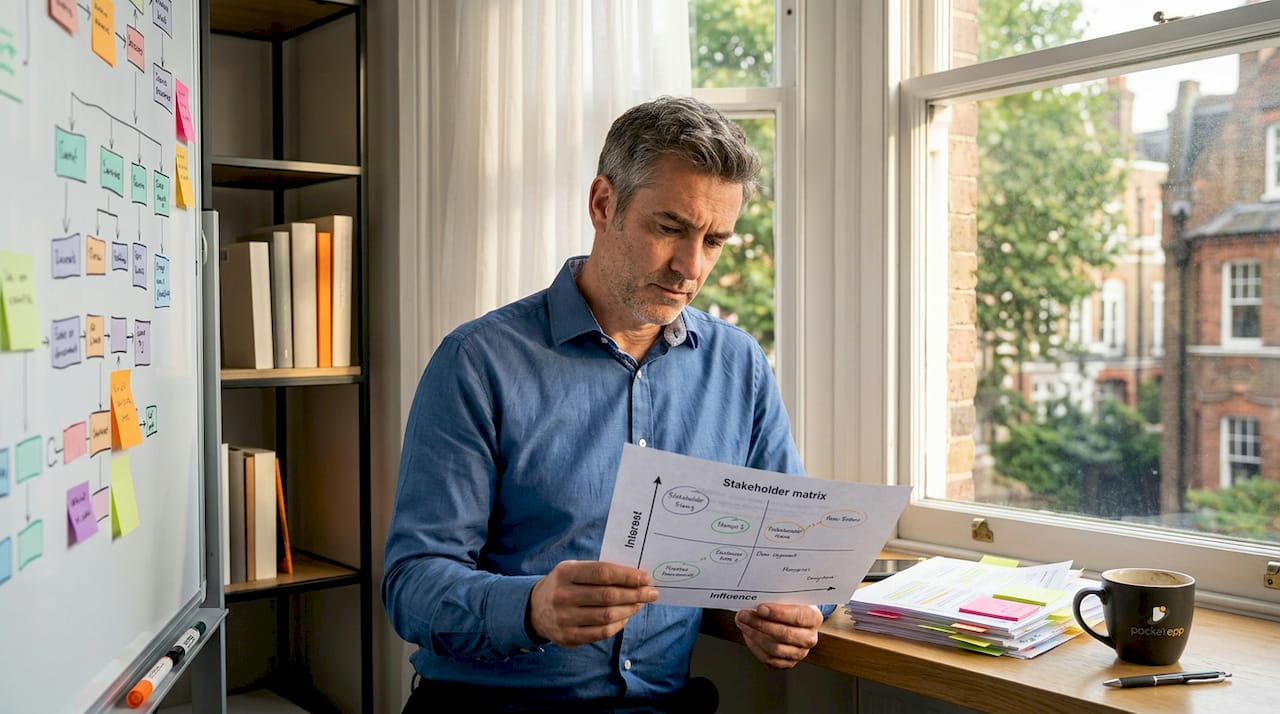
Once you have identified everyone, analyse their influence and interest. A stakeholder who holds budget authority but rarely uses the product has very different priorities from a frontline user who will rely on the app to do their job. Misreading this dynamic early is how conflicting requirements end up baked into the specification.
Pro Tip: Use a simple two-by-two matrix to categorise stakeholders by influence and interest before your first meeting. It will tell you who needs deep involvement, who needs regular updates, and who simply needs to be kept informed.
Mind-mapping tools and documentation templates at this stage are genuinely useful. A one-page scope brief shared with all stakeholders before any workshops begin gives everyone a common reference point and dramatically reduces the time spent relitigating fundamentals later.
Techniques for collecting app specifications
With preparation complete, you move into the elicitation phase itself. The most effective approaches combine several complementary techniques rather than relying on any single method. Here is a structured sequence that works well in practice:
-
Stakeholder interviews. Start here. One-to-one conversations allow you to probe deeply without group dynamics suppressing candid feedback. Good structured requirements interviews go well beyond "what do you need?" They explore workflows, exceptions, failure scenarios, priorities, and what success actually looks like for that individual. Ask follow-up questions relentlessly.
-
Collaborative workshops. Once you have gathered individual perspectives, bring stakeholders together. Workshops are particularly effective for surfacing contradictions between departments and resolving conflicts about priorities in real time. A skilled facilitator can turn what would otherwise be weeks of email chains into a single productive session.
-
Surveys and questionnaires. For larger user bases or geographically dispersed teams, surveys and questionnaires give you quantitative data to complement qualitative interview findings. Use them to validate assumptions, not to replace human conversation.
-
Observation. Watching users perform their actual tasks in their real environment reveals requirements that no interview will uncover. People often cannot articulate what they do intuitively. Seeing a warehouse manager navigate three separate systems to check stock levels tells you more than asking them what they need from an app.
-
Prototyping. Even a rough wireframe or clickable mockup unlocks a different quality of feedback. Stakeholders who struggle to describe an abstract requirement will immediately tell you what is wrong when they interact with something tangible. Use low-fidelity prototypes early and often.
-
AI-assisted interviews. AI chatbot interview tools now offer a genuinely useful addition to this toolkit. They conduct asynchronous, adaptive conversations that guide stakeholders through structured questions with automatic follow-ups, removing the scheduling friction that often delays human-led sessions. Particularly useful when your stakeholders span multiple time zones or are difficult to schedule.
Pro Tip: After each round of interviews, map the inputs against your scope document before the next session. You will spot contradictions and gaps far earlier, and your subsequent interviews will be sharper for it.
Once you have gathered responses across these techniques, the documentation challenge begins. The standard formats to use are:
- User stories ("As a [user type], I want to [action] so that [outcome]") for capturing functional requirements from the user's perspective
- Use cases for documenting specific interactions between users and the system, including alternative flows
- Acceptance criteria that define, precisely, what "done" looks like for each requirement
The discipline of writing acceptance criteria forces vague requirements into the open. "The app should be fast" is not a requirement. "The app should load the home screen in under two seconds on a 4G connection" is.
Validation through real user research before development begins dramatically improves the likelihood that what you are building solves a problem people actually have and are willing to engage with. Many apps fail not because they were built poorly, but because the problem they solved was never validated with real users before the specification was locked.
Common mistakes in the requirements gathering process
Even experienced teams fall into predictable traps during requirements gathering. Recognising them early saves significant rework.
The most common is accepting vague requirements without challenge. When a stakeholder says "the app needs to be user-friendly" or "we need good reporting," those phrases need to be unpacked immediately. What does user-friendly mean to that person? Which metrics need to appear in reports, and who will read them? Letting vague language pass into your documentation is how scope disputes begin.
- Stakeholder conflict left unresolved. When two departments have competing priorities, the temptation is to document both and defer the decision. Do not. Unresolved conflicts surface as change requests mid-development, at the worst possible time.
- Underestimating budget and contingency. Treating your budget as tradeoffs rather than a fixed number is a more mature approach. Build in flexibility from the outset.
- Assuming requirements are stable. In any project of meaningful length, requirements will evolve. Your process needs to accommodate change without allowing it to become uncontrolled.
- Losing stakeholder engagement mid-process. People disengage when they feel their input has not been heard. Regular short updates showing how their contributions are shaping the specification keep people invested.
"Incomplete requirements are not a documentation problem. They are a communication problem. The fix is not better templates — it is better conversations."
Continuous feedback loops are your best defence against requirements drift. Rather than a single sign-off event at the end of the gathering phase, build in short validation checkpoints. Share evolving documentation with key stakeholders in digestible sections and invite specific, structured feedback rather than open-ended review. This approach also surfaces misaligned expectations before they become costly.
A particular area where teams underinvest is avoiding common app development mistakes around requirements validation. Catching these early, rather than at the point of build, is where the real efficiency gains lie.
Verifying, validating, and prioritising requirements
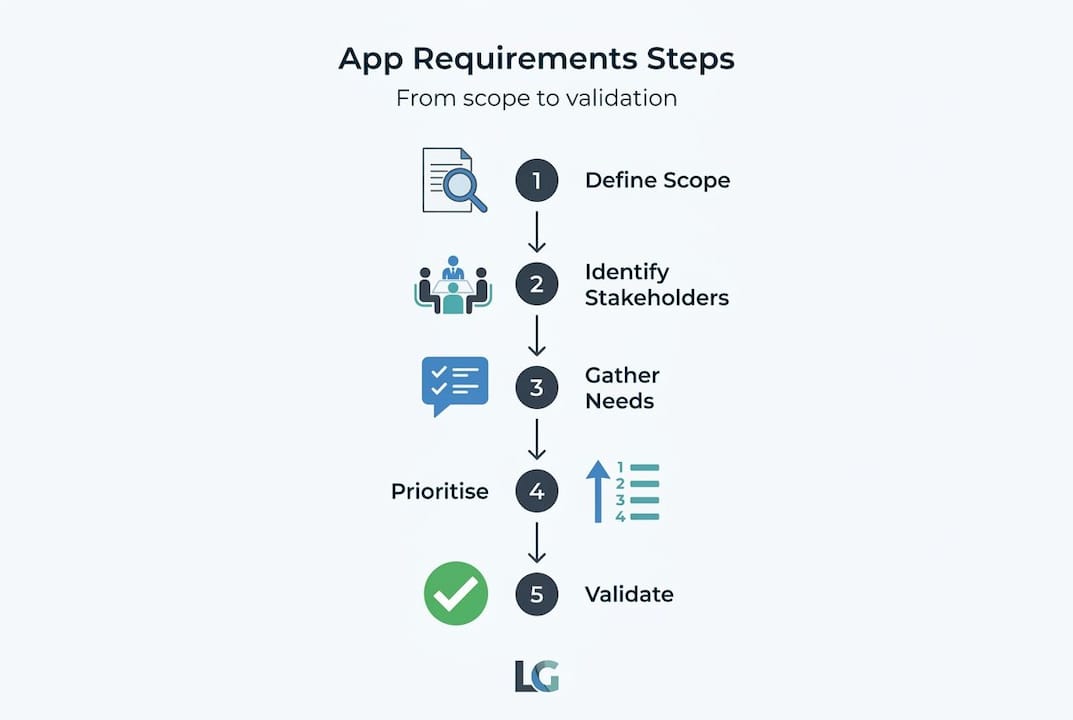
Gathering requirements and verifying them are two distinct activities that many teams conflate. Verification asks: "Did we capture the requirement correctly?" Validation asks: "Is this the right requirement to build?"
A structured prioritisation method gives you a principled way to answer both questions under real-world constraints. The MoSCoW framework (Must have, Should have, Could have, Won't have this time) is widely used because it forces honest conversations about what is genuinely critical versus what is a wishlist item wearing the costume of a requirement.
| Method | Best used when | Limitation |
|---|---|---|
| MoSCoW | Clarifying must-haves vs. nice-to-haves with business stakeholders | Can be gamed if stakeholders classify everything as "Must have" |
| Weighted scoring | Comparing requirements across multiple criteria (value, risk, effort) | Requires upfront agreement on scoring criteria |
| Kano model | Identifying delight features versus baseline expectations | More complex to explain to non-technical stakeholders |
Prioritising requirements effectively creates a realistic roadmap that aligns development effort with the features that deliver the most value within your actual time and resource constraints. Without prioritisation, teams often build extensive low-value features while core user needs remain unaddressed.
Your Product Requirements Document should function as a contract between vision and execution: a living document that covers user journeys including edge cases, feature specifications with acceptance criteria, and non-functional requirements such as performance, security, and accessibility. Documenting detailed user journeys, including edge cases, reduces scope churn significantly and gives your development team a clear picture of what they are building and why.
Pro Tip: Build a 20 to 30 percent contingency into your PRD budget section from the start. Unknown technical challenges are not exceptional events in app development. They are the norm. Teams that budget for them avoid the painful scope cuts that happen when they inevitably arise.
The step-by-step app development process that follows a well-formed PRD is significantly smoother. Developers spend less time seeking clarification, QA teams have clear acceptance criteria to test against, and stakeholders have a document they can refer back to when memory of original decisions inevitably fades.
Iterative validation matters too. Each sprint or development cycle is an opportunity to confirm that what is being built still aligns with what was specified and that the specification still reflects what the business needs. Requirements that were accurate three months ago may need revisiting as market conditions, user feedback, or organisational priorities shift.
What working on hundreds of projects has taught me
Having been involved in the requirements phases of well over a hundred digital products across retail, healthcare, charity, and B2B sectors, the pattern I keep seeing is the same one. Teams that invest seriously in the preparation and elicitation phase consistently outperform those that treat requirements as a formality to pass through on the way to building.
I have seen AI-assisted elicitation tools make a genuine difference, particularly on projects where stakeholders are spread across time zones or genuinely too busy to schedule multiple workshops. They are useful. But I have never seen them replace the value of a skilled analyst who can read the room, notice when a stakeholder is hedging, or recognise that the real requirement is different from the stated one.
The human element in effective requirements gathering is not about sentiment. It is about political intelligence. Who in the room actually has authority? Whose objection will derail the project at sign-off? These things do not appear in a chatbot transcript.
My honest advice: spend more time on preparation than feels comfortable, validate your assumptions with real users before locking the specification, and treat your PRD as a living document rather than a milestone to be checked off. The projects that get this right are the ones people are proud of at the end.
— Paul
How Pocketapp supports your requirements process
Getting requirements right is genuinely difficult, and the stakes are high. At Pocketapp, we work with clients from the very first conversation to define scope, map stakeholders, and build a specification that development teams can actually work from. Our discovery process includes structured stakeholder workshops, collaborative prototyping sessions, and technical documentation that bridges business intent and engineering reality.
Whether you are bringing us an early idea or a partially formed brief, our mobile app development team will help you get from concept to clear requirements without the rework that comes from skipping the foundations. We also offer dedicated app design services grounded in user research, so your specification and your UX decisions are aligned from the start. With over 300 projects delivered, we know what good requirements look like and we know how to get there efficiently.
FAQ
What is the first step in gathering app requirements?
Define your project scope and identify all relevant stakeholders before conducting any interviews or workshops. Starting elicitation without this preparation leads to unfocused conversations and contradictory outputs.
How do I define app requirements that are actually useful?
Write every requirement with a clear acceptance criterion attached. Vague statements like "the app should be intuitive" need to be replaced with measurable, testable conditions that developers and QA teams can work from directly.
How many techniques should I use for collecting app specifications?
Use at least three complementary techniques, typically interviews, workshops, and observation or prototyping. Each technique uncovers different requirement types, and relying on one alone will leave significant gaps in your specification.
How do I handle stakeholders who keep changing their requirements?
Implement structured change control from the outset. Any new requirement after sign-off should be assessed against scope, timeline, and cost before acceptance. Regular short validation checkpoints during the process also reduce late-stage surprises.
Should I include a budget contingency in my requirements document?
Yes. Industry practice recommends building a contingency of 20 to 30 percent into the PRD to cover technical unknowns, scope adjustments, and post-launch costs. Projects that omit this routinely face forced descoping under pressure.