
TL;DR:
- Mobile innovation transforms business operations and enhances customer engagement by integrating mobile as a central strategic hub.
- Focusing on UX design, offline functionality, and data integration ensures mobile tools are adopted effectively and produce measurable impact.
Mobile innovation is frequently treated as shorthand for building a customer-facing app. That framing misses the point entirely. The role of mobile innovation in business is far broader: it reshapes how frontline teams operate, how organisations talk to customers, and how companies create competitive distance from rivals who are still thinking about mobile as a marketing channel. This article unpacks both dimensions with evidence, practical frameworks, and the kind of specificity that turns strategy into something you can actually act on.
Table of Contents
- Key takeaways
- The role of mobile innovation in business operations
- Mobile innovation and customer engagement
- Integrating mobile into your wider technology strategy
- Practical steps for business growth through mobile
- My perspective: where most organisations go wrong
- How Pocketapp helps you act on mobile opportunity
- FAQ
Key takeaways
| Point | Details |
|---|---|
| Mobile transforms operations | Field and retail teams using mobile apps process work faster and with fewer errors than those relying on fixed systems. |
| App as anchor channel | Treating your mobile app as the central hub of customer experience improves data quality and conversion rates across all channels. |
| UX investment drives adoption | Doubling UI budget from 1% to 2% has been shown to lift adoption from 60% to 85% in enterprise deployments. |
| Agile delivery accelerates value | Mobile AI workflows built in around 12 weeks outperform lengthy development cycles by focusing directly on automating expertise. |
| Measurement must evolve | Success metrics should shift from cost savings to experience transformation and revenue impact to reflect mobile's true business contribution. |
The role of mobile innovation in business operations
The clearest proof of mobile's operational value sits in retail and field service. Retail teams using mobile apps for inventory management and customer data experience measurably fewer errors and faster service than those tethered to fixed workstations. This is not marginal. When an associate can check stock, process a return, and upsell from a single handheld device, the entire customer interaction changes in speed and quality.
Connectivity is the hidden weak link in most operational mobile deployments. Peak trading days bring unpredictable network load, and a system that fails at 3pm on Black Friday is worse than no system at all. Offline-first mobile design solves this by allowing associates to accept payments and create orders without any connectivity at all, maintaining full service velocity regardless of Wi-Fi availability. Organisations that treat offline capability as optional rather than foundational tend to learn that lesson the hard way.
Artificial intelligence is compressing timelines that used to be measured in weeks into decisions made in minutes. Rakuten Symphony is a telling case. By deploying generative AI across mobile field operations, they achieved an 85% reduction in inspection time and more than $2.4 million in first-year savings. The workflows were production-ready in approximately 12 weeks. That speed is not accidental. It came from avoiding lengthy research cycles and building directly on existing domain expertise rather than starting from theory.
Here is what operational mobile innovation actually changes in practice:
- Scheduling flexibility for frontline staff, with shift management and task allocation handled entirely through mobile interfaces
- Real-time data capture in the field, eliminating manual transcription errors that compound over time
- Automated exception alerts that surface problems to managers before they become customer-facing failures
- Lower training overhead because well-designed mobile apps guide users through complex processes step by step
Pro Tip: When scoping a mobile operational tool, prioritise offline functionality and error-state handling before adding features. A lean app that works reliably in all conditions delivers more business value than a feature-rich one that fails at critical moments.
Mobile innovation and customer engagement
Most organisations think they have a customer engagement strategy. What they often have is a collection of disconnected tools: an email platform, a push notification service, a CRM, and an app that does not talk to any of them properly. The mobile app as anchor channel idea challenges that directly. It positions the app not as one channel among many but as the central point around which every other interaction is orchestrated.
Why does that matter? Because unified customer journeys across app, push, email, and web reduce the contradictory personalisation that erodes trust. If a customer dismisses a push notification about a product they already bought, and then receives an email promoting the same product an hour later, you have not just wasted spend. You have signalled that your systems do not communicate. That signal damages brand credibility in a way that takes time to repair.
Consider what measurable improvement actually looks like when the mobile-first approach is executed properly:
- Ooredoo Qatar implemented a mobile engagement platform and saw app engagement reach 86%, with conversion rates rising by 10 percentage points. Those are not vanity metrics. They represent real shifts in customer behaviour at scale.
- AI-driven automation allows teams to move away from manually managing individual campaigns. Platforms processing 80 billion messages monthly demonstrate that engagement at genuine scale requires machine intelligence, not larger marketing teams.
- Automation also frees human teams to focus on strategy and creative decisions rather than scheduling and segmentation. That is a meaningful shift in how marketing departments spend their capacity.
"The mobile app is the owned channel with the highest engagement potential — yet most brands treat it as an afterthought rather than the foundation of their customer relationship strategy." Source: Mobile-first customer experience playbook
One consideration that organisations frequently underestimate: zero-party data. As third-party cookies disappear and privacy regulation tightens, the data customers choose to share directly through your app becomes more valuable than anything you can infer or buy. Building that relationship requires earning it through genuine utility, not just notification frequency. The importance of mobile apps in business extends into data strategy in ways that many leaders have not fully reckoned with yet.
Integrating mobile into your wider technology strategy
Mobile innovation does not succeed in isolation. The organisations that get the most from it treat their mobile capability as part of a broader technology ecosystem rather than a standalone project. That requires making deliberate choices about how platforms connect, how data flows, and who owns what.

| Approach | Risk profile | Time to value | Adoption rate |
|---|---|---|---|
| Siloed mobile app (no integration) | High data fragmentation | Fast build, slow ROI | Often low |
| Integrated mobile with existing CRM and data | Medium complexity | Moderate | High if UX is prioritised |
| Full mobile-first ecosystem redesign | High upfront investment | Slower initially, compounding returns | Depends on governance |
The UX investment question deserves more attention than it gets in strategy conversations. When Pernod Ricard increased their UI budget allocation from 1% to 2%, adoption of their enterprise mobile tool rose from 60% to 85%. That is a 25-point lift from a single decision about where to spend effort. Most organisations treat UI as decoration. The data suggests it should be treated as adoption infrastructure.
Governance is the unglamorous piece that determines whether mobile innovation scales or stalls. Speed matters. But so does reliability, data security, and clear ownership of who can ship what. Without those structures, fast pilots become technical debt and inconsistent user experiences that undermine the business case for further investment.
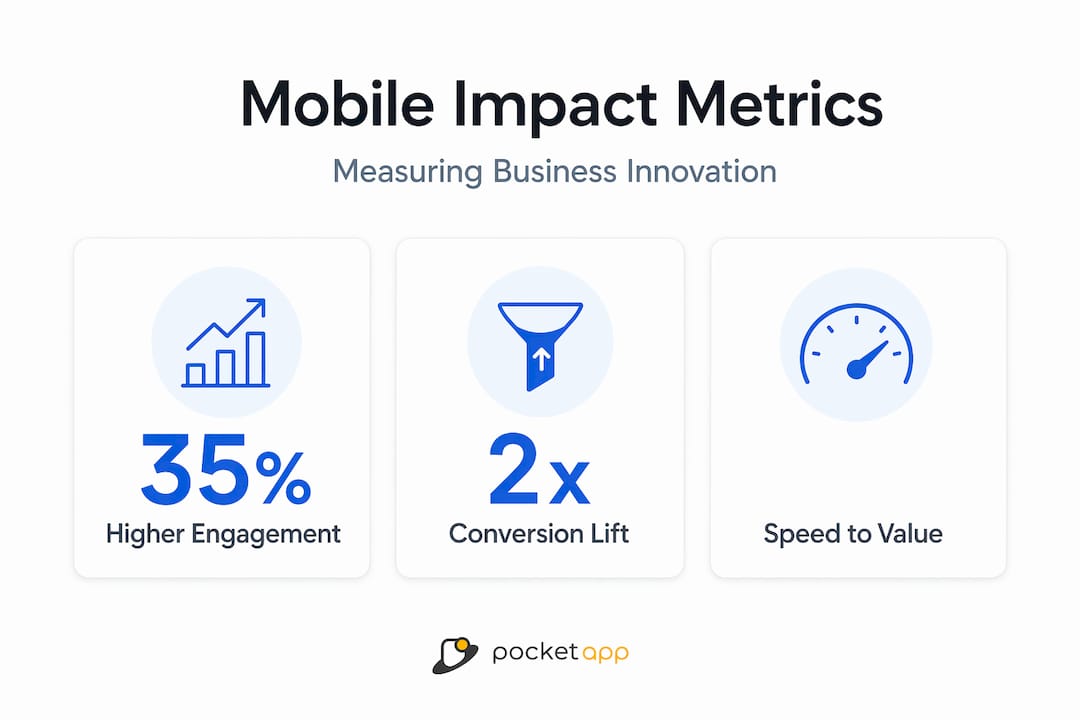
Measurement frameworks also need updating. Asking whether a mobile project saved cost is the wrong question if the goal was to transform customer experience and grow revenue. T-Mobile's AI programme now handles more than half of customer calls at enterprise scale. That is measured in experience quality and service capacity, not just pounds saved.
Pro Tip: Establish a cross-functional mobile steering group that includes product, IT, marketing, and operations from day one. Mobile innovation that lives in one department rarely scales into the rest of the business.
Practical steps for business growth through mobile
If you are looking to move from understanding the opportunity to building a credible plan, the following structure gives you a workable starting point. Each step builds on the last, so resist the temptation to skip to the technology before the groundwork is in place.
- Audit your current workflows to identify where mobile could automate manual steps, reduce handoffs, or put real-time data in the hands of people who need it. Field operations, customer service, and retail environments are typically the highest-value starting points.
- Define your app-as-anchor strategy before building anything. Decide which channel owns the customer relationship, how data will be unified across touchpoints, and what the single source of truth will be for customer identity and behaviour.
- Invest in UX before features. A product backlog full of functionality is worthless if users do not adopt it. The role of mobile apps in digital transformation is only realised when people actually use them, and that depends on how the experience feels.
- Use AI tools for personalisation at scale, particularly for customer communications where manual segmentation cannot keep pace with the volume and specificity that modern customers expect.
- Set outcome-based KPIs from the start: engagement rates, conversion lifts, error reduction percentages, and time-to-task metrics. Avoid measuring activity (push notifications sent) and measure behaviour change instead.
For startups specifically, a mobile strategy built on these principles can be a genuine differentiator before you have the brand recognition or budget of larger competitors. Getting early customers through AI-powered mobile engagement tools is a real and underused approach in early-stage growth.
My perspective: where most organisations go wrong
I have watched organisations spend six-figure budgets on mobile projects that delivered almost nothing, and I have seen modestly funded teams build tools that transformed how their businesses operate. The difference is rarely about technology. It is almost always about the decisions made before a line of code is written.
The biggest barrier I see repeatedly is underinvestment in UX. Leaders approve the budget for a mobile app and then treat design as a cost to minimise. What they end up with is a technically functional product that nobody wants to use. Adoption never reaches the threshold where the business case can be proven, so the project is quietly shelved and the lesson drawn is that "mobile didn't work for us." The lesson should have been that design is not optional.
The second mistake is treating mobile as an IT or marketing project rather than a business transformation programme. When mobile sits inside a single department, it gets optimised for that department's goals. Integration suffers. Other teams do not buy in. The cross-channel orchestration that makes mobile genuinely powerful never happens because nobody owns it at the right level.
What I have found actually works is starting with a clear business problem, not a technology. Then building a minimum viable product fast, getting it in front of real users, and iterating based on what the data tells you. The organisations that treat mobile as a strategic capability rather than a project tend to compound returns over time. The ones who treat it as a one-off build tend to repeat the same mistakes.
— Paul
How Pocketapp helps you act on mobile opportunity
If you have read this far and recognise your business in these patterns, you are already ahead of most. The next question is how to translate that recognition into something built and shipped.
Pocketapp has delivered over 300 mobile projects across retail, healthcare, charity, and consumer sectors, for clients including WWF, Dechra, and Crocus. The team brings together mobile app development expertise with strategic discovery that starts from your business outcomes rather than a feature list. Whether you need a customer-facing product that anchors your engagement strategy, an internal tool that transforms how your field teams work, or cross-platform app development that future-proofs your investment across iOS and Android, Pocketapp builds to a standard that holds up under real-world conditions. If design and adoption are your priority, the app design service treats UX as the foundation rather than the finish. Reach out to talk through your requirements with a team that has done this before.
FAQ
What is the role of mobile innovation in business?
Mobile innovation drives both operational efficiency and customer engagement. It enables frontline teams to work faster with fewer errors, and allows organisations to deliver personalised, connected experiences across every customer touchpoint.
How does mobile innovation improve operational efficiency?
Mobile tools remove reliance on fixed systems, allow offline working during connectivity issues, and use AI to accelerate decision-making in field operations. Rakuten Symphony reduced inspection time by 85% using AI-powered mobile workflows.
Why is UX investment critical to mobile innovation success?
Poor UX is the most common reason mobile projects fail to scale. Evidence from Pernod Ricard shows that increasing UI allocation from 1% to 2% of budget raised enterprise app adoption from 60% to 85%.
How should business leaders measure mobile innovation outcomes?
Shift measurement away from cost savings and towards experience transformation metrics: engagement rates, conversion lifts, customer retention, and revenue impact. Activity metrics like messages sent do not reflect real business value.
What is the app-as-anchor approach to customer engagement?
It means treating your mobile app as the central hub of your customer relationship strategy, with all other channels (email, push, SMS, web) orchestrated around it. This approach reduces contradictory personalisation and improves data quality across the customer journey.